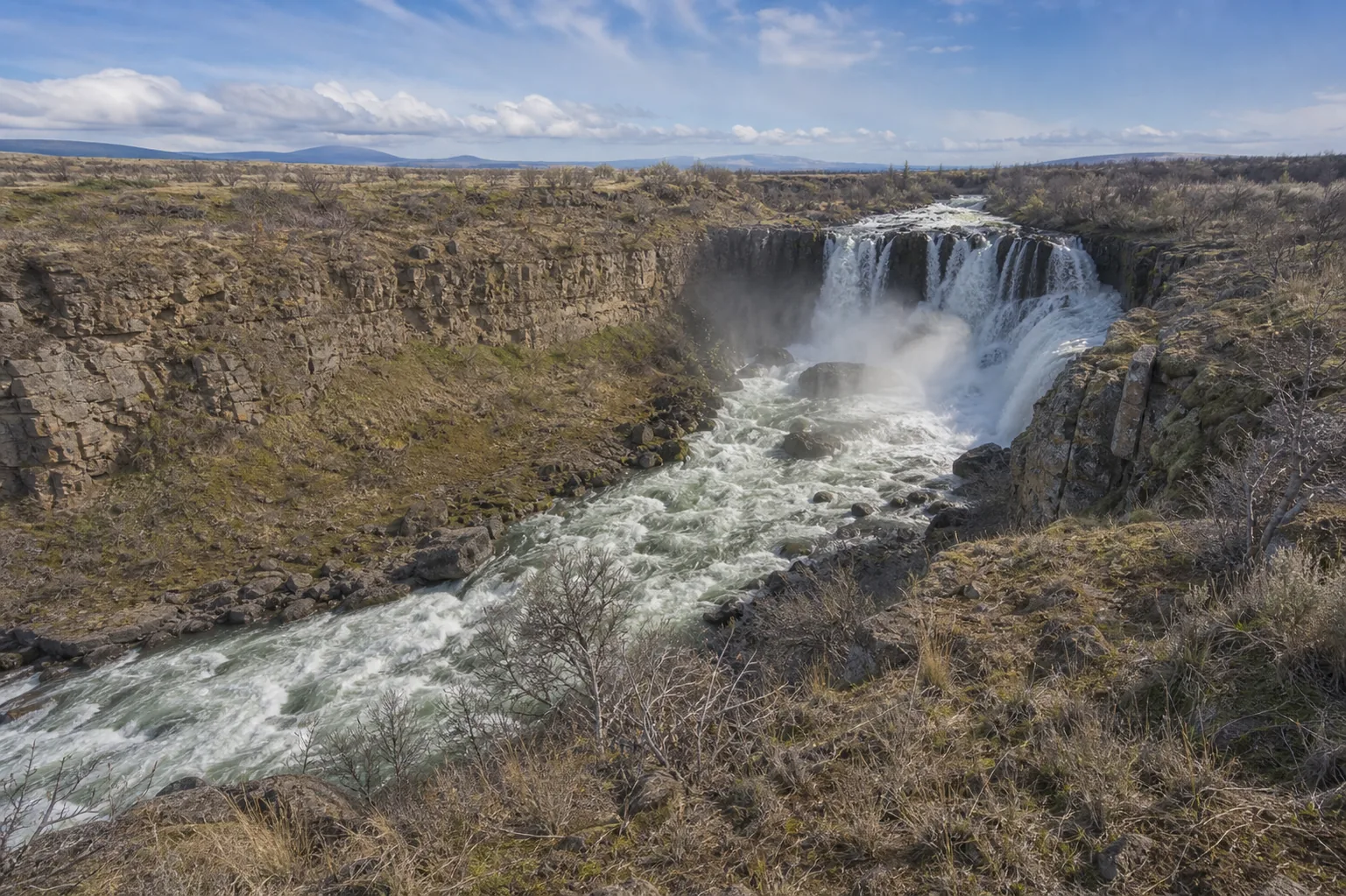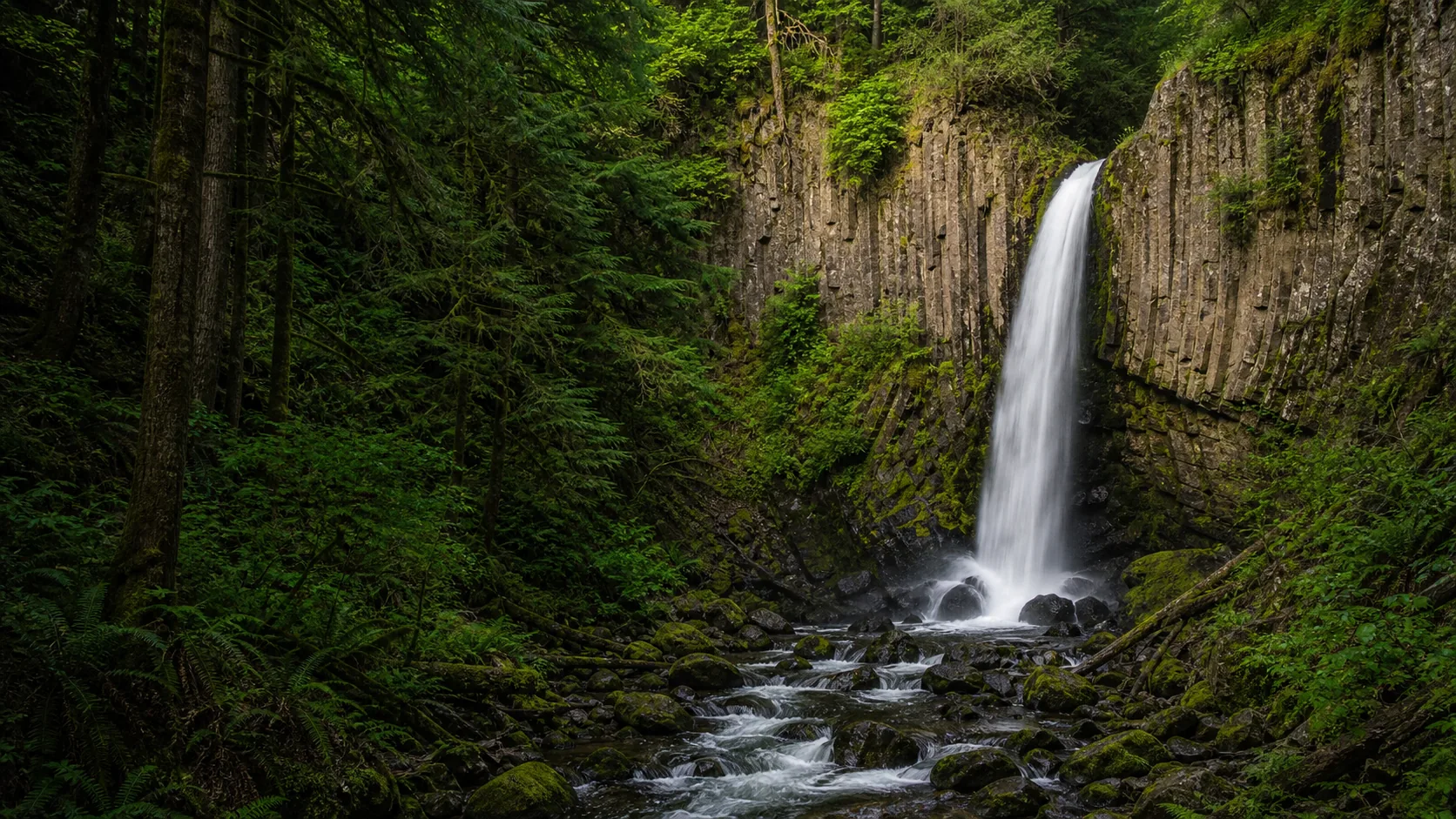
White River Falls plunges 90 feet over a basalt ledge with the 1910 powerhouse ruins visible at the base
Tygh Valley, OR

White River Falls

White River Falls is a 90-foot single-tier plunge over a Columbia River Basalt ledge in Wasco County, Oregon, east of Mount Hood. The river that feeds it is glacial meltwater from Mt Hood, which is why the water runs visibly pale in summer, and the 1910 Tygh Valley Hydroelectric Plant still stands in masonry ruins at the base. The park is free, day-use only, and the entry gate closes from roughly mid-October through late April.

Last verified May 12, 2026 Visited Desk-verified May 2026 8 sources checked
Trail 0.9 mi 1.6 mi extended
Time 20-90 min Easy at the top viewpoint, moderate to the powerhouse
Best season Late April through October when the gate is open; June for peak glacial-melt flow Late May through June (Mt Hood glacial melt)
Parking Free day-use lot at the rim. Gravel access road, no fee, no pass; gate closes seasonally from approximately mid-October through late April. White River Falls State Park
Quick answer

Is White River Falls worth visiting?

Yes, with one timing constraint: the entry road gate is closed from roughly mid-October through late April, so plan a visit between late April and mid-October. June is peak flow as Mount Hood's glaciers melt and the water runs whitest with suspended ash. The park is free, no Oregon State Parks pass needed, and the gravel road is passable in a standard car.

  • Free park, no pass required
  • Gate open late April through mid-October
  • Peak flow late May through June (Mt Hood glacial melt)
  • Paved 100-yard walk to the upper overlook
  • 0.7-mile steep spur to the 1910 powerhouse ruins
  • Pair with Maupin or The Dalles for food and lodging
Last verified May 12, 2026 Visited Desk-verified May 2026 8 sources checked
Distance 0.9 mi 1.6 mi extended
Round trip 20-90 min Paved 100-yard walk to the upper overlook; steep, rocky 0.7-mile spur drops about 250 ft to the 1910 powerhouse ruins
Difficulty Easy at the top viewpoint, moderate to the powerhouse Paved 100-yard walk to the upper overlook; steep, rocky 0.7-mile spur drops about 250 ft to the 1910 powerhouse ruins
Location Tygh Valley, OR White River Falls State Park
Parking Free day-use lot at the rim. Gravel access road, no fee, no pass; gate closes seasonally from approximately mid-October through late April. Oregon State Parks
Transit No fixed-route transit Drive only; nearest service is The Dalles or Maupin · 0 ft
Drive 35 mi 50 min from downtown
Best season Late April through October when the gate is open; June for peak glacial-melt flow Late May through June (Mt Hood glacial melt)
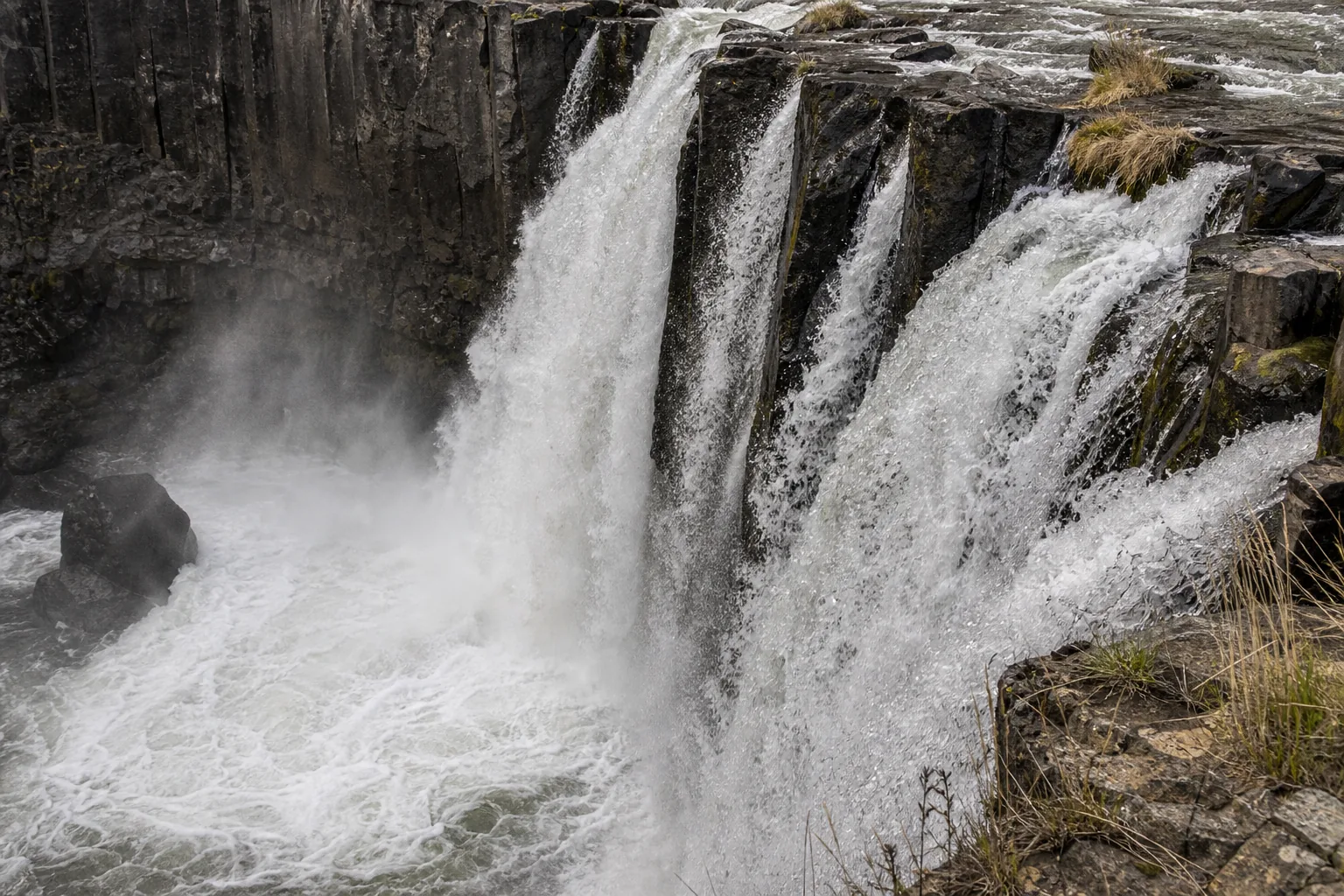
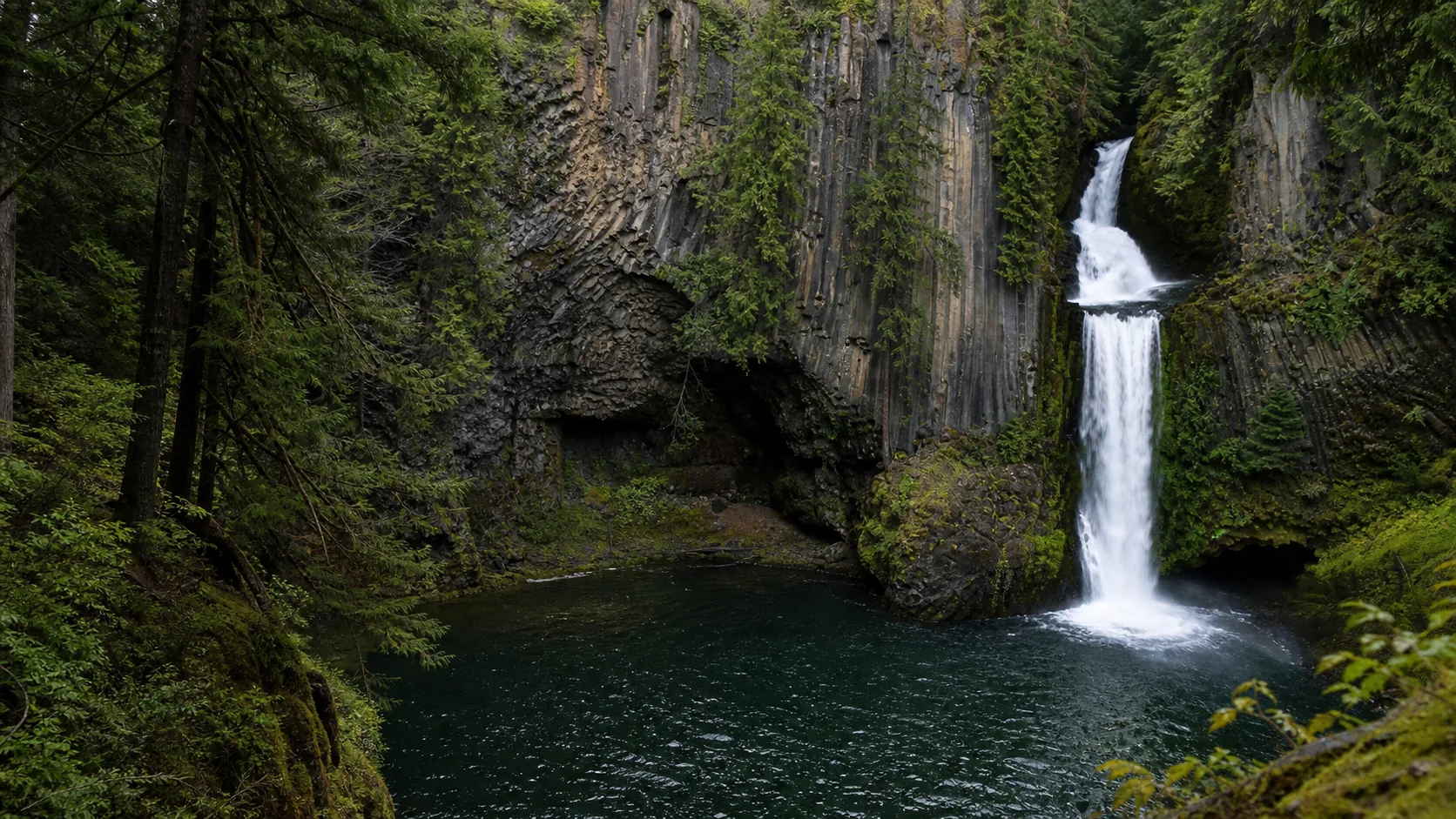
White River Falls base of the falls with mt hood glacial water hitting the basalt apron
Photo guide

Three angles of a 90-foot basalt plunge.

Three working viewpoints: the upper rim overlook (paved, step-free), the 1910 powerhouse base (reached by a 0.7-mile rocky spur), and the side traverse toward Celestial Falls. Use the captions to pick angles before committing to the descent.

White River Falls plunges 90 feet over a basalt ledge with the 1910 powerhouse ruins visible at the base
White River Falls, hero composition
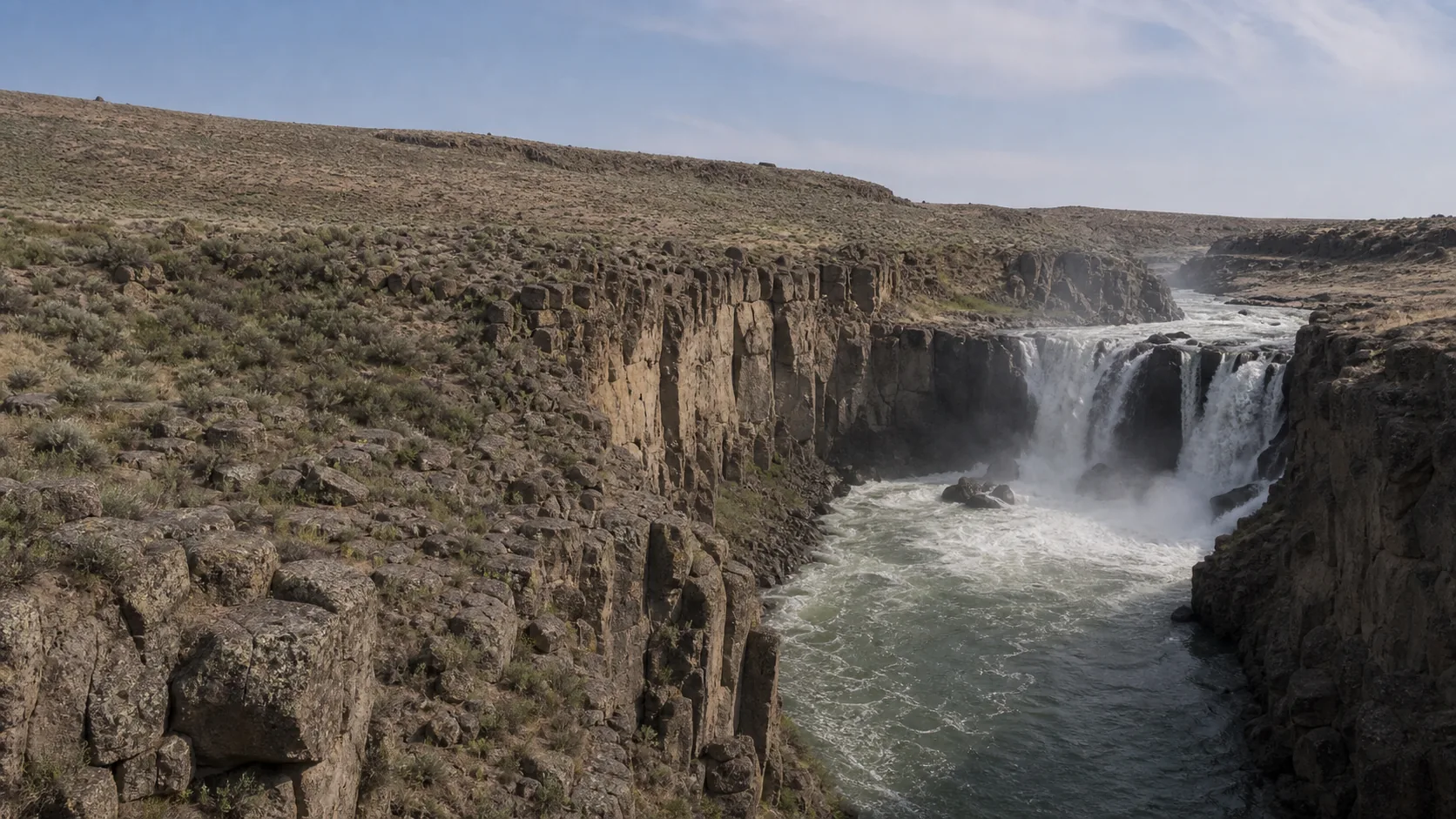
White River Falls canyon with Columbia River Basalt walls and the powerhouse ruins downstream
Wide canyon view with basalt walls framing the 90-foot plunge
White River Falls base showing milky glacial-flour water on dark basalt with the 1910 powerhouse foreground
Base of the falls with Mt Hood glacial water hitting the basalt apron
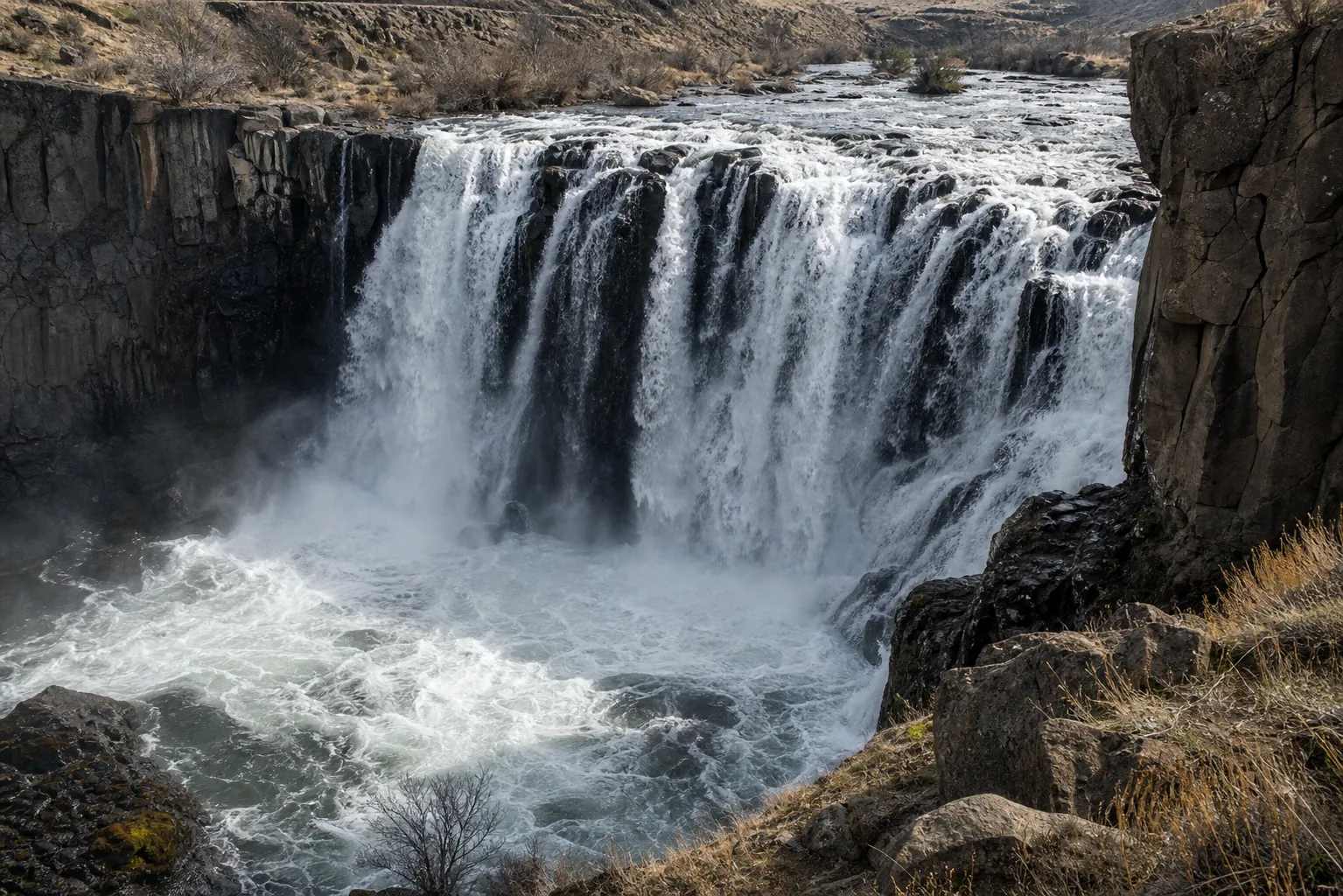
Detail of White River Falls showing pale glacial-flour water sliding across dark Columbia River Basalt columns
Glacial-flour water on Columbia River Basalt close-up
01Is White River Falls flowing right now?

Live data: USGS gauge 14101500 (White River below Tygh Valley) ↗, period of record 1996 to present. The 30-year daily-discharge median is 236 cfs, the 75th percentile is 469 cfs, the 90th percentile is 678 cfs, and the highest recorded reading is 3,490 cfs. Peak flow runs late May through June as the Mount Hood glaciers melt; late summer often drops below 150 cfs.

02How long is the walk?

The upper overlook is a 100-yard paved walk from the gravel lot with no stairs. The powerhouse descent is 0.7 miles one-way, steep and rocky, dropping about 250 feet. The longer Lower White River extension is 1.6 miles round trip and passes Celestial Falls on the way to the lower river.

03How do you get there?

From The Dalles: I-84 east, US-197 south for about 30 miles, then OR-216 east for 4 miles. From Portland: I-84 to The Dalles (about 85 mi), then US-197 / OR-216. From Bend: US-97 north, OR-216 west. Park entrance road turns north off OR-216 about 4.5 miles east of Tygh Valley.

04Is there free parking?

Free gravel lot at the rim, no Oregon State Parks day-use pass needed. The lot is small (about 20 cars); arrive early on summer weekends. The entry gate closes from approximately mid-October through late April and reopens with seasonal park reservations.

05Does it cost money?

Free. No entry fee, no day-use pass, no parking fee. Special-use permits (weddings, drones, commercial filming) cost extra through Oregon State Parks.

06Trail variants

Upper overlook 0.1 mi paved, 10 min, step-free view of the 90-foot plunge from the rim.
Powerhouse descent 0.7 mi one-way, 45-75 min round trip, rocky, no shade, steep return climb; 1910 hydroelectric ruins at the base.
Lower White River extension 1.6 mi round trip, 90 min, continues past the powerhouse to Celestial Falls and the lower river.
Winter gate visit 0.5 mi roadwalk from the gate, 30-45 min, when the entry road is closed (typically Oct to Apr), walk in from the OR-216 gate at your own risk.

Detailed maps and recent reviews: Falls route on AllTrails · Creek route on AllTrails

07Can you swim?

No. Swimming and wading at White River Falls and Celestial Falls are not allowed and have killed multiple people. The whirlpool at the base of Celestial Falls is the documented hazard; the basalt rim above both falls is also unfenced and slick.

08Are dogs allowed?

Yes, on leash, throughout the park. Keep dogs back from the unfenced basalt rim above the falls and off the powerhouse spur if footing is wet.

09Is it accessible?

The upper overlook is reachable by a short paved path from the gravel lot and is the only step-free view of the falls. The powerhouse descent is steep, rocky, and not accessible. Pit toilets at the lot.

Field notes

White River Falls at a glance.

90-foot plunge over a Columbia River Basalt ledge, fed by Mount Hood glacial meltwater, gauged by USGS 14101500, managed by Oregon State Parks, free to enter, day-use only, gate closed mid-October to late April.

Height 90 ft USGS 3DEP
Type Plunge (single tier) USGS
Rock Columbia River Basalt Group DOGAMI / USGS: Columbia River Basalt Group
County Wasco Tygh Valley, OR
Managed by Oregon Parks and Recreation Department Oregon State Parks
Water source White River (Mount Hood glacial meltwater) USGS
Elevation 1040 ft USGS NED
Park area 248 acres Oregon State Parks
Hours Day-use only, typically 7am to dusk; entry gate closed approximately mid-October through late April Oregon State Parks
When to visit

One open season, one peak flow window, one closed gate.

Late April through mid-October the gate is open. Late May through June is peak glacial-melt flow. October light is the cleanest if you catch the last week before the seasonal closure. The live USGS reading next to this section tells you what today actually looks like.

PEAK FLOW

Peak flowLate May through June (Mt Hood glacial melt)
Ice / low flowRare full freeze; rim ice common Dec-Feb
Most crowdedWeekends and midday
Best photosSunrise or weekdays

Live water context

Discharge data -- Live reading from White River below Tygh Valley, OR (USGS 14101500) refreshes on the next build. Open the gauge link below for the current cubic-feet-per-second reading.

USGS 14101500 · White River below Tygh Valley, OR

Why is it called White River Falls?

The river takes its name from the color of its water. Mount Hood's glaciers grind volcanic rock into a fine suspended powder (glacial flour) that turns the river visibly pale gray-white in summer when melt is highest. The falls inherited the river's descriptive name in late-nineteenth-century survey records. There are at least a dozen other White Rivers and White River Falls in the United States; for searches and directions, pair the name with Oregon or Wasco County to avoid the Indiana, Arkansas, Washington, and Vermont waterfalls of the same name.

What else to do at White River Falls State Park

White River Falls State Park is a 248-acre day-use park north of OR-216, about 4.5 miles east of Tygh Valley and 35 road miles south of The Dalles. It is free, no Oregon State Parks day-use pass required, and the main feature is the single-tier 90-foot plunge over a Columbia River Basalt ledge with the masonry ruins of the 1910 Tygh Valley Hydroelectric Plant visible at the base. Maupin (11 miles southwest, Deschutes River) and The Dalles (35 miles north on US-197 and I-84) are the practical base towns for food, gas, and lodging.

  • Upper overlook. Paved 100-yard walk from the gravel lot to a basalt-rim view of the full 90-foot plunge. The only step-free option in the park.
  • 1910 Tygh Valley Hydroelectric Plant ruins. Masonry powerhouse at the base of the falls, operated by Pacific Power and Light from 1910 until 1960 when The Dalles Dam made it redundant. Walls, generator floor, and penstock anchors are still visible.
  • Powerhouse descent trail. A 0.7-mile rocky spur drops about 250 feet from the rim to the powerhouse and the lower river. No shade, steep return climb; bring water in summer.
  • Celestial Falls. A second drop just below the main falls, narrower and more violent. Whirlpool at the base; off-limits to swimming.
  • Picnic area. Tables and pit toilets near the rim lot, no potable water on site.
  • Wild and Scenic White River. All but the 0.6 mile through the falls itself is federally designated Wild and Scenic, managed by the Forest Service and BLM upstream.

Why it looks this way

White River Falls drops over a hard ledge of the Columbia River Basalt Group, the same flood-basalt sequence that built most of the Columbia Plateau between roughly 17 and 6 million years ago. The lip is a single resistant flow; the cliffs below are stacked columnar basalt with the classic horizontal jointing the group is known for. The river cutting the canyon is glacial meltwater from Mount Hood's White River and Sandy glaciers, which carry fine volcanic ash and rock flour downstream and give the water its pale, milky cast in summer. That ash and flour is also why the basalt lip is visibly scoured rather than polished.
Field guide deep dive

What the brochure does not tell you about White River Falls.

How the basalt ledge formed, why the water reads white, what happened to the 1910 powerhouse, and when the gate is actually open. Skim the headers, read what you need.

How White River Falls formed

White River Falls drops over a single resistant ledge of the Columbia River Basalt Group, the flood-basalt sequence that paved most of eastern Oregon and Washington between roughly 17 and 6 million years ago. The flows that built the ledge here are part of the Grande Ronde and Wanapum basalts in DOGAMI's mapping: stacked lava sheets, each tens of feet thick, with columnar jointing visible in the canyon walls below the lip.

The river cuts through the stack because the basalt is hard but the flow-top breccia between sheets is not. The White River exploits the contact between a hard lower flow and a softer top, and the result is the textbook ledge-and-amphitheater profile you see at the rim. The same process produced Celestial Falls a few hundred feet downstream, which is essentially a younger second step in the same retreating cut. Upstream of the falls the river is federally designated Wild and Scenic; the 0.6 mile through the falls itself is the only segment that is not, because the 1910 powerhouse and its diversion structure pre-date the designation.

Why the river is actually white

The river is not white because of foam or aeration. It is white because Mount Hood is grinding itself into powder upstream. The White River and Sandy glaciers on Mount Hood's east and south flanks scrape against volcanic bedrock at the head of the watershed and produce a fine suspended sediment called glacial flour. The river carries that flour and additional volcanic ash downstream year-round, and the result is a pale, milky cast that gets stronger as summer melt peaks.

The visual transition: in April the river runs comparatively clear because the snowpack is still locked in. By late May and through June the glaciers are melting fastest, the gauge climbs above the 75th percentile of 469 cfs, and the water reads opaque pale gray-white. By September glacial melt has slowed, the gauge often drops below 150 cfs, and the water clears to a more conventional waterfall blue-green. October visits get cleaner photography, June visits get the loudest most cinematic version of the falls; both are correct.

The 1910 Tygh Valley Hydroelectric Plant

The masonry ruins at the base of the falls are what is left of the Tygh Valley Hydroelectric Plant, built in 1910 by The Dalles Light and Power Company and later operated by Pacific Power and Light. A wooden penstock diverted water from the lip of the upper falls down a steep canyon wall to twin generators inside the powerhouse, producing electricity for The Dalles and the surrounding wheat country. It ran for about 50 years.

The plant was decommissioned in 1960, made redundant by The Dalles Dam on the Columbia River. The penstock and most of the wood structure are long gone, but the concrete-and-masonry powerhouse walls, the generator floor, and the iron anchor pins are still on the canyon floor at the base of the 0.7-mile descent trail. Treat the ruins as a historic site, not a playground: the masonry is unstable, the floor has open shafts, and Oregon State Parks asks visitors to stay off the structure.

Live flow at USGS 14101500

The USGS gauges the White River about a quarter mile downstream of the falls at monitoring location 14101500 (White River below Tygh Valley). The record runs from 1996 to present, daily values. The 30-year daily-discharge median is 236 cfs, the 25th percentile is 116 cfs, the 75th percentile is 469 cfs, the 90th percentile is 678 cfs, and the highest reading on record is 3,490 cfs.

Reading the gauge the day of your visit is the single most useful thing you can do for planning. Below about 125 cfs the lip splits into several braids and the falls looks like a bridal-veil set rather than a single curtain. From roughly 150 to 475 cfs the falls is the full-width curtain in most brochure photos. Above 675 cfs the spray climbs to the upper overlook and the canyon air gets cold and wet even on a hot day. Peak readings happen late May through June when Mount Hood's glaciers melt fastest; the biggest reading on record is usually a rain-on-snow event in late spring.

The seasonal gate closure

White River Falls State Park is day-use only, and the entry road gate closes from approximately mid-October through late April. Exact dates shift year to year with weather and Oregon State Parks staffing; check the official park page within a week of your trip. When the gate is closed the falls itself keeps running (gauge data is continuous year-round), but you cannot drive in. Some visitors park near the gate on OR-216 and walk the closed road; this is not officially encouraged, the canyon rim is unfenced, and the powerhouse descent is dangerous in ice.

The practical planning window for a normal road-accessible visit is therefore late April through mid-October. June is the loudest, October is the cleanest, August can be busiest on summer weekends despite the heat. The east-of-Cascades climate means the canyon is much hotter and drier than the Hood River side; summer afternoons routinely hit the high 90s F with no shade on the rim or the descent trail.

Photography practical: south-facing rim, three working positions

The falls faces roughly south and the canyon is open above, which means midday light is hard. The cleanest light is the first hour after sunrise and the last hour before sunset; both keep detail in the pale glacial water and the dark basalt columns. Overcast days work all day and are the easiest setup for white-balance.

Three working positions are worth your time. The upper overlook is the brochure shot, paved access, and the only step-free angle; it captures the full 90-foot drop in one frame. The powerhouse base, at the bottom of the 0.7-mile descent, is the dramatic foreground frame: 1910 masonry walls against the falling water, with the basalt columns rising on both sides of the canyon. The side traverse along the rim toward Celestial Falls gives the canyon-context wide shot with both drops in one composition. Bring a polarizer to handle the glare off the pale water and a 24-70 equivalent for the descent.

If you have a planning afternoon for Oregon waterfalls beyond White River, the closest published guides in this collection are Toketee Falls and Watson Falls on the North Umpqua, the Gorge classic at Latourell Falls, and the bridge-overlook at Drift Creek Falls. Volcanic-plateau pairings include Benham Falls on the Deschutes and Plaikni Falls in Crater Lake National Park.

Map and route

35 miles south of The Dalles, 11 miles northeast of Maupin.

From The Dalles: I-84 east, US-197 south for about 30 miles, then OR-216 east for 4 miles. From Portland: I-84 to The Dalles (about 85 mi), then US-197 / OR-216. From Bend: US-97 north, OR-216 west. Park entrance road turns north off OR-216 about 4.5 miles east of Tygh Valley.

Photography and weddings

South-facing basalt rim, three working positions, the 1910 powerhouse foreground.

There are three working positions at White River Falls. The upper rim overlook is the brochure shot and the only step-free angle. The powerhouse base, reached by the 0.7-mile spur, is the dramatic foreground frame with the 1910 masonry walls against the falling water. The side traverse along the rim toward Celestial Falls gives the canyon-context wide shot with both drops in one frame.

The falls faces roughly south, which means midday is harsh and the lip blows out by mid-morning in summer. The cleanest light is the first hour after sunrise and the last hour before sunset; both keep detail in the pale glacial water against the dark basalt. Overcast days work all day. Fall and early-spring low sun angles light the powerhouse foreground without flattening the basalt columns.

Casual personal photography is fine from public viewpoints. Tripods at the upper overlook are okay; drone flights, commercial shoots, and any wedding session require Oregon State Parks permission in advance.

Permits

Weddings and engagements

Small ceremonies happen occasionally at the upper overlook in shoulder season. The setting is dramatic, but the park is exposed, gravel-floored, and has no on-site shelter, so plan for sun, wind, and ash dust.

Special-use permits go through Oregon Parks and Recreation Department; rates and lead time vary, and the seasonal gate closure (mid-October through late April) rules out most winter dates.

Stage the shot at the upper overlook rather than the powerhouse descent; the rocky spur is not safe for formal attire, and there is no railing at the rim above the falls.

Nearby waterfalls

Three Oregon waterfalls east of the Cascade crest.

White River Falls pairs naturally with the Deschutes River corridor at Maupin and with the Columbia River Gorge drives north of The Dalles. The east-of-Cascades climate means semi-arid sun, basalt geology, and fewer crowds than the Multnomah Falls corridor.

Related questions

More questions visitors ask about White River Falls.

Free park, gate dates, hike length, height, why the water is white, dogs, powerhouse, and whether it is worth the drive. The full set is indexed in the FAQ schema for AI answer engines.

01Is White River Falls free to visit?

Yes. White River Falls State Park is free, day-use only, and does not require an Oregon State Parks day-use pass. Parking at the rim lot is also free.

02Is White River Falls open in winter?

The waterfall itself runs year-round, but the entry road gate is closed from approximately mid-October through late April. During the closure you cannot drive in. Some visitors park near the gate on OR-216 and walk the closed road, but the unfenced rim and icy descent trail make winter visits hazardous.

03How tall is White River Falls?

White River Falls is a single-tier plunge of approximately 90 feet over a Columbia River Basalt ledge. Celestial Falls, a separate narrower drop just downstream, adds roughly another 40 to 50 feet for a combined canyon descent of about 130 to 140 feet.

04Why is the White River white?

The river is fed by glacial meltwater from Mount Hood. The White River and Sandy glaciers grind volcanic rock into a fine suspended powder called glacial flour, which gives the river its pale, milky cast. Color is strongest from late May through August when glacial melt peaks; by October the water clears.

05Is there a powerhouse at White River Falls?

Yes. The masonry ruins of the 1910 Tygh Valley Hydroelectric Plant sit at the base of the falls. It was built by The Dalles Light and Power Company, later operated by Pacific Power and Light, and ran until 1960 when The Dalles Dam on the Columbia made it redundant. Walls, generator floor, and anchor pins are still visible.

06Is White River Falls worth visiting?

Yes, between late April and mid-October when the gate is open. It is one of the most powerful waterfalls east of the Cascade crest, the 90-foot plunge over Columbia River Basalt is genuinely cinematic, and the 1910 powerhouse ruins at the base are unusual among Oregon waterfalls. June is peak flow; October is the cleanest light.

Sources and data

Where the White River Falls guide gets its facts.

Live discharge from USGS NWIS gauge 14101500. Park rules and hours from Oregon State Parks. Basalt geology from DOGAMI and the USGS Columbia River Basalt Group record. Hydroelectric plant dates from Wikipedia and the Tygh Valley historical record. Wild and Scenic status from rivers.gov.

USGS Streamflow: 14101500 White River below Tygh Valley, OR waterdata.usgs.gov
Oregon State Parks: White River Falls State Park stateparks.oregon.gov
Access, parking, and permit rules: stateparks.oregon.gov
DOGAMI / USGS: Columbia River Basalt Group: Tygh Valley bedrock oregongeology.org
NOAA / NWS Pendleton forecast grid PDT 53,94 noaa.gov
USGS National Elevation Dataset 3DEP
Wikidata: Q7995015 (White River Falls) wikidata.org
Google Maps: embedded map and directions maps.google.com
Google Places: nearby restaurants and hotels places API
Oregon State Parks: White River Falls State Park stateparks.oregon.gov
USGS National Water Information System: Gauge 14101500 (White River below Tygh Valley) waterdata.usgs.gov
National Wild and Scenic Rivers System: White River rivers.gov
Wikipedia: White River Falls State Park en.wikipedia.org
Travel Oregon: White River Falls traveloregon.com
Oregon Hikers: White River Falls Hike field guide oregonhikers.org
AllTrails: White River Falls (current trail conditions) alltrails.com
Wikimedia Commons: White River Falls image category commons.wikimedia.org
Fact checks
Height audit: 90-foot single-tier figure cross-checked against the Oregon State Parks profile, Travel Oregon, and the World Waterfall Database entry; Celestial Falls below is documented separately at roughly 40 to 50 feet.
Gate closure audit: seasonal closure (approximately mid-October through late April) confirmed against the Oregon State Parks profile and current Oregon Hikers reports; exact dates shift yearly and the guide tells readers to verify within a week of the trip.
Powerhouse history audit: 1910 construction and 1960 decommissioning sourced to the Wikipedia entry, the Register-Guard 2018 article on the park, and the National Register / Oregon historic-power record; The Dalles Dam date confirmed against the Army Corps of Engineers project record.
Flow stats audit: 30-year daily-discharge values (median 236 cfs, p75 469 cfs, p90 678 cfs, max 3,490 cfs) were computed directly from USGS NWIS gauge 14101500 daily values for water years 1996 onward.
Free-access audit: free entry and no day-use pass requirement confirmed against the Oregon State Parks profile for park ID 28.
Corrections: [email protected]