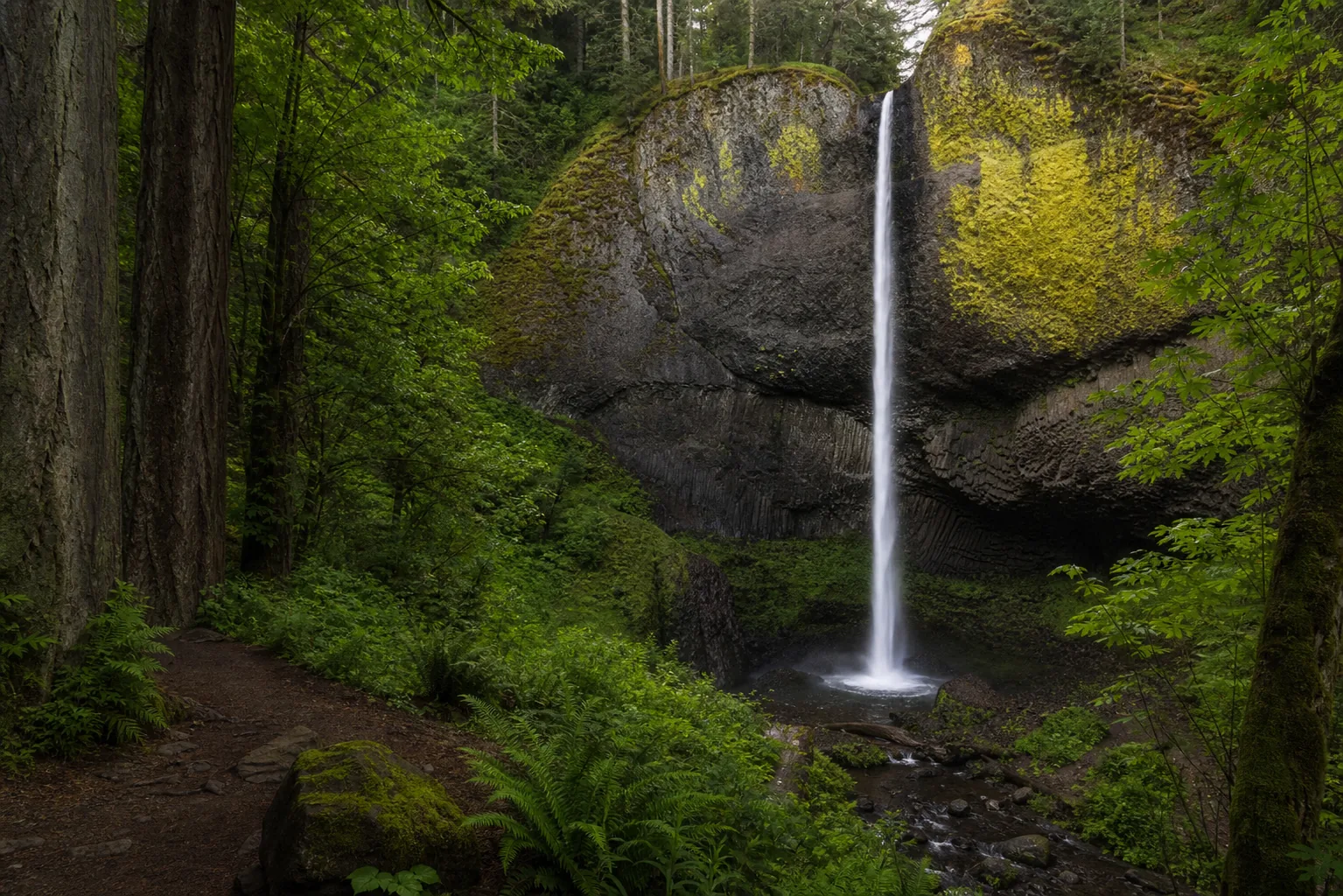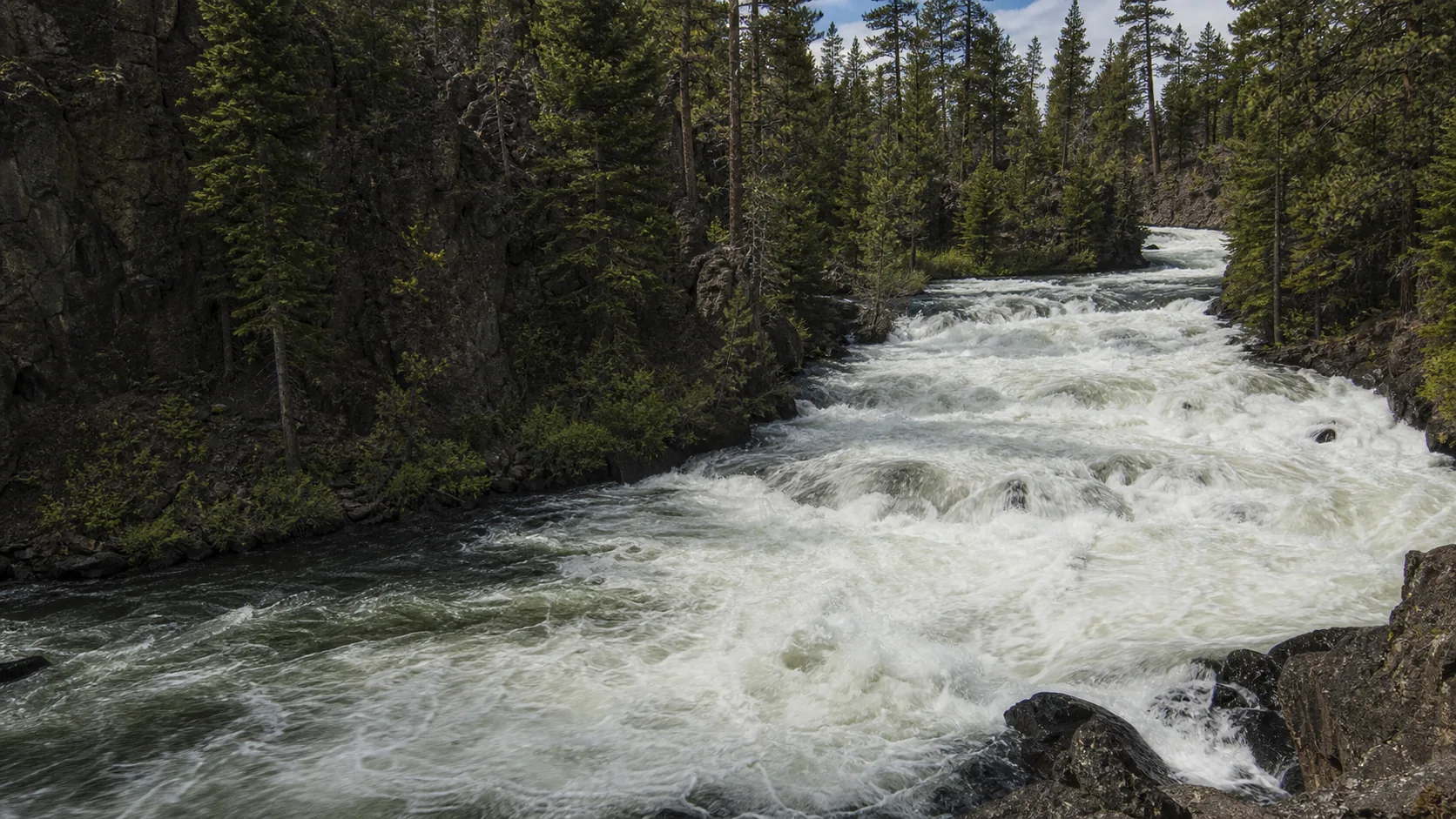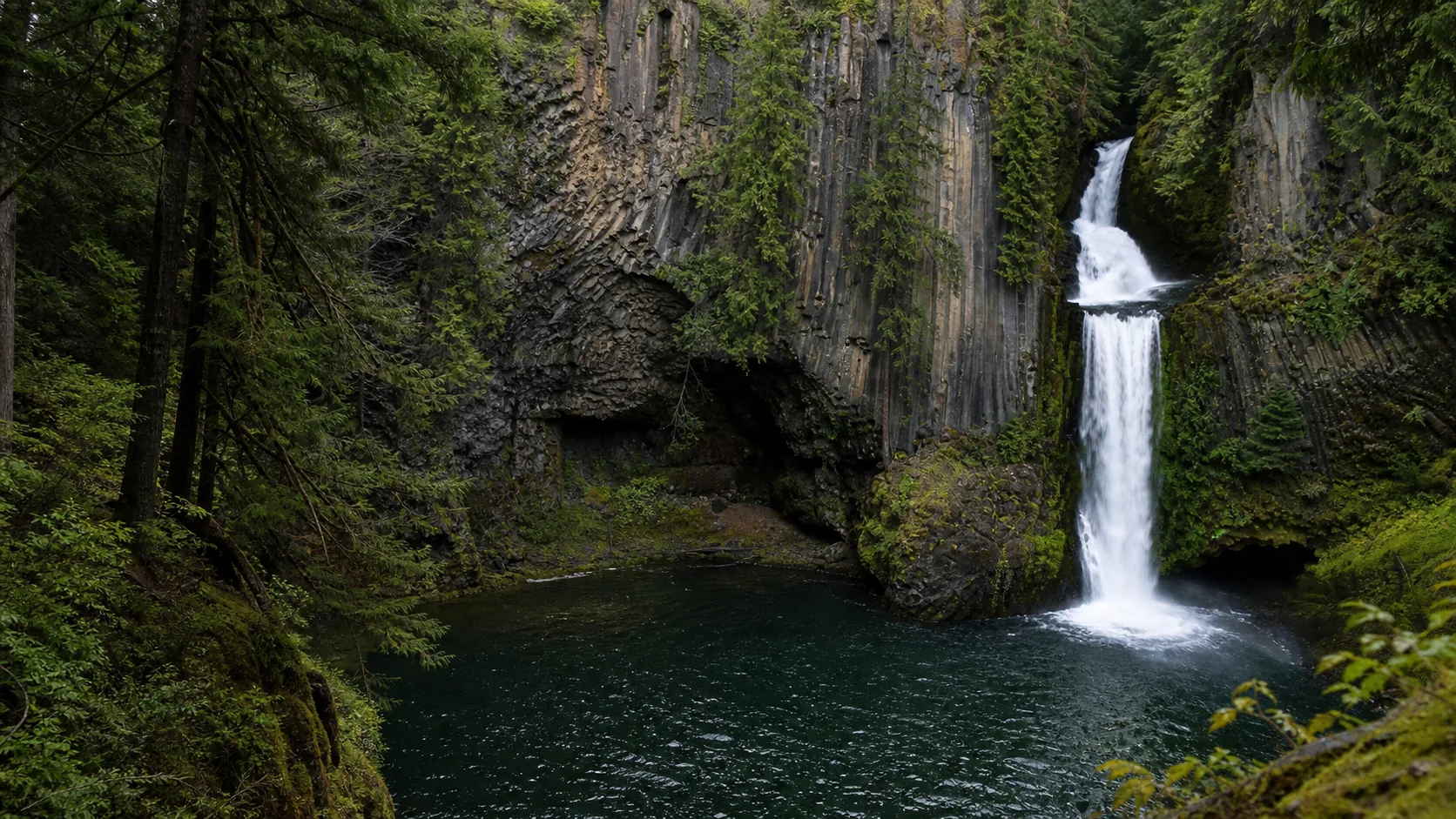
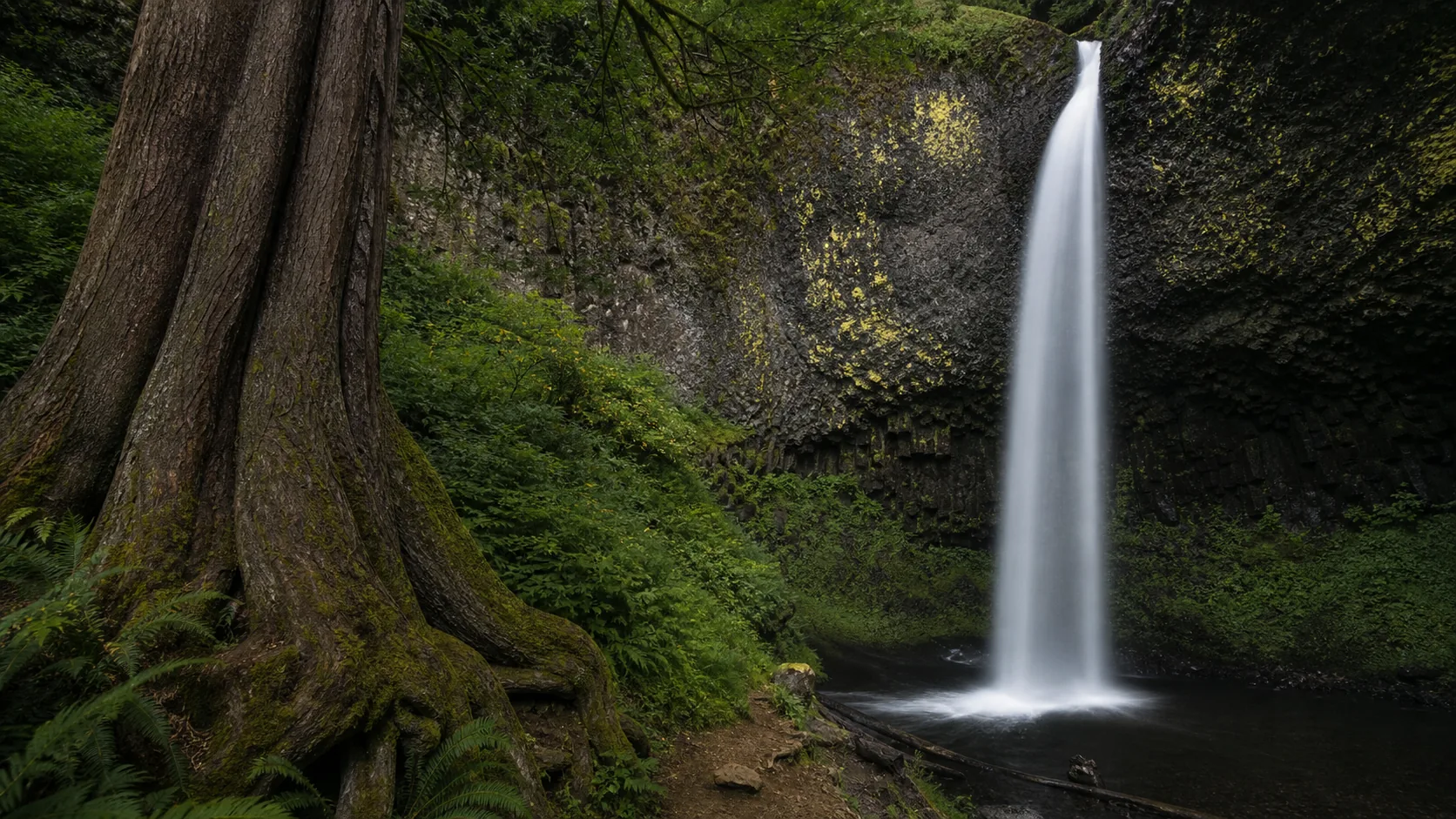
Latourell Falls waterfall and surrounding setting
Multnomah County, OR

Latourell Falls

Latourell Falls is a 249-foot single-drop plunge in the western Columbia River Gorge, falling straight off an undercut wall of columnar basalt streaked with chartreuse-yellow lichen. The viewpoint sits about 0.5 mile from the trailhead in Guy W. Talbot State Park, roughly 30 minutes east of Portland on the Historic Columbia River Highway. It is one of the only Gorge waterfalls that drops the whole way without breaking; a 2.4-mile loop continues upstream to two-tiered Upper Latourell Falls.

Last verified May 4, 2026 Visited Desk-verified May 2026 5 sources checked
Trail 2.4 mi Round-trip route varies
Time 60-120 min Easy to moderate
Best season Late October through early June for full flow against cool wet weather; overcast days year-round for the cleanest photos After rain or snowmelt
Parking Trailhead lot, Oregon day-use pass required Guy W. Talbot State Park
Quick answer

Is Latourell Falls worth the stop?

The strongest visit windows are late October through early June, when cool Gorge weather and steady rain keep Latourell Creek at full volume against its yellow-lichen basalt wall. Mid-summer flow thins to a misty curtain but the alders and bigleaf maples leaf in fully, which softens the amphitheater. The trail is paved to the lower viewpoint and is open year-round during the 6 a.m. to 10 p.m. day-use window; only the 60-step stair from the lot and the longer 2.4-mile loop need real footing.

  • 249-foot single plunge over columnar basalt, the marquee Lower Latourell Falls
  • 2.4-mile loop with 625 ft gain to two-tiered Upper Latourell Falls
  • $10 Oregon resident / $12 non-resident day-use permit, or annual State Parks pass
  • Open 6 a.m. to 10 p.m. for day use, year-round
  • Leashed dogs welcome; trail is family-friendly but rocky in places
  • About 30 minutes east of Portland on the Historic Columbia River Highway
Last verified May 4, 2026 Visited Desk-verified May 2026 5 sources checked
Distance 2.4 mi Loop distance varies
Round trip 60-120 min 2.4-mile loop with 625 feet of elevation gain, four small wooden bridges, and rocky tread along Latourell Creek; the lower viewpoint requires a 60-step staircase from the parking area
Difficulty Easy to moderate 2.4-mile loop with 625 feet of elevation gain, four small wooden bridges, and rocky tread along Latourell Creek; the lower viewpoint requires a 60-step staircase from the parking area
Location Multnomah County, OR Guy W. Talbot State Park
Parking Trailhead lot, Oregon day-use pass required Oregon State Parks
Transit No fixed-route transit verified Drive and verify the current trailhead or access point · 0 ft
Drive Verify route Downtown route varies
Best season Late October through early June for full flow against cool wet weather; overcast days year-round for the cleanest photos After rain or snowmelt
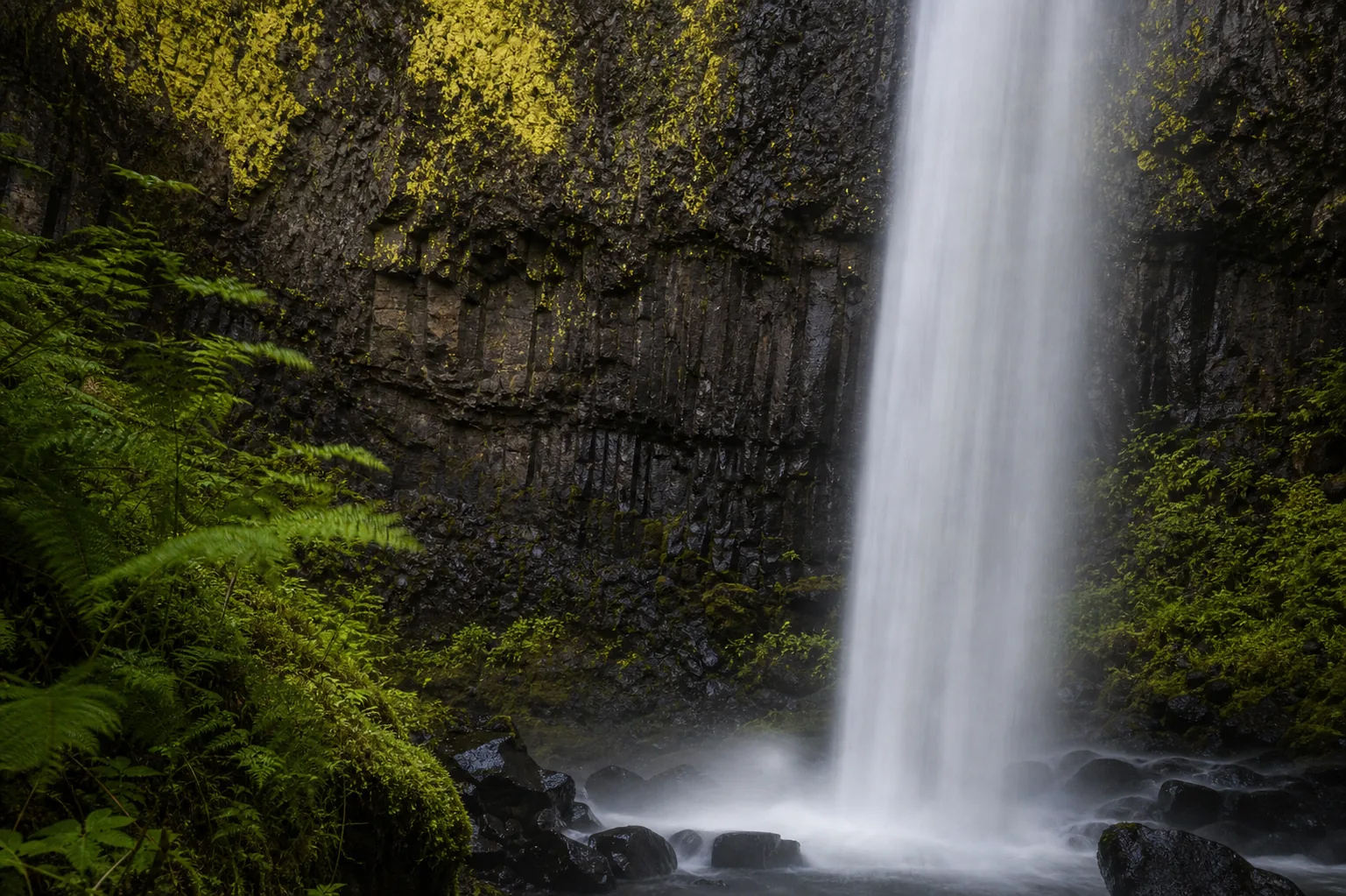
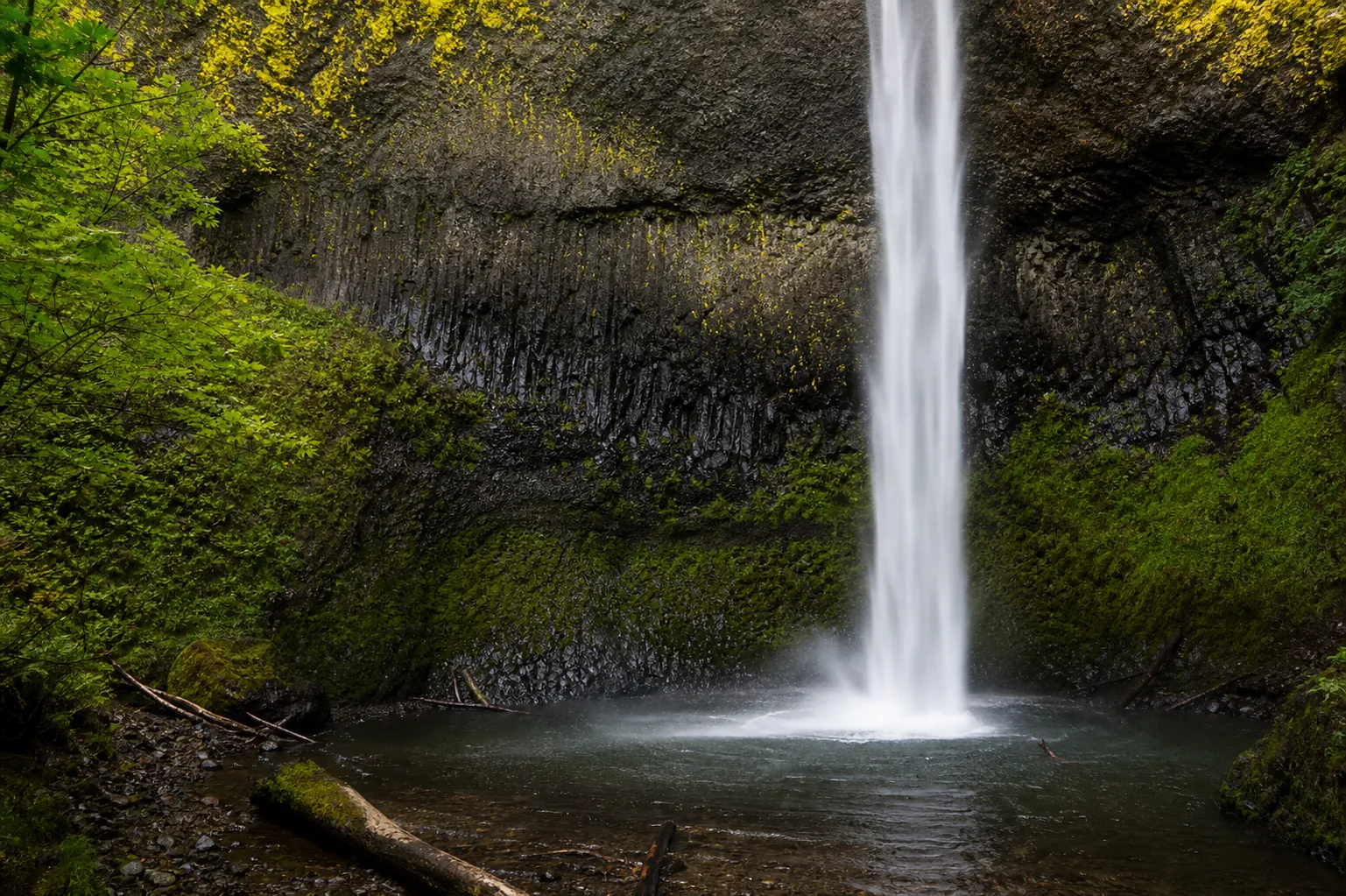
Latourell Falls splash pool and full 249-foot curtain framed against the lichen-streaked back wall
Photo guide

Four frames on a 249-foot columnar basalt plunge.

The signature shot is the curtain against the yellow-lichen basalt wall. Supporting frames are the splash pool from the bridge, the cross-glen view from the upper loop, and the autumn maple framing in late October.

Latourell Falls waterfall and surrounding setting
Latourell Falls, hero composition
Latourell Falls in autumn with yellow maple foliage framing the columnar basalt cliff
Wide canyon view in fall: bigleaf maple yellow against the dark basalt amphitheater
Latourell Falls splash pool and full 249-foot single-drop plunge against the columnar basalt amphitheater
Splash pool and full 249-foot curtain framed against the lichen-streaked back wall
Close detail of yellow golden cobblestone lichen on the columnar basalt back wall of Latourell Falls
Yellow-lichen-streaked basalt wall behind the plunge: chartreuse Pleopsidium flavum on Grande Ronde columnar basalt
01Is Latourell Falls flowing right now?

There is no live USGS gauge on Latourell Creek. Use the NOAA/NWS forecast for the Bridal Veil / west Gorge area as a rainfall proxy, and check Oregon State Parks alerts for closures during winter storms.

Latourell Creek runs year-round, fed by springs and runoff from the Columbia Gorge rim. Flow peaks during winter rain and spring snowmelt; by August the lower falls thin to near-misty conditions. In hard winter cold, spray freezes across the trail and viewpoints, a real slip hazard.

02How long is the walk?

The full Latourell Falls Loop is 2.4 miles with about 625 feet of elevation gain; allow 1 to 2 hours. The lower viewpoint alone is 60 steps from the parking lot, and the base of the falls via the picnic area adds about 0.4 miles round trip with stairs.

03How do you get there?

From Portland, take I-84 east to Exit 28 (Bridal Veil), turn right and follow signs onto the Historic Columbia River Highway westbound about 2.8 miles to the Latourell Falls Trailhead lot on the right. The lot is on the south side of the highway in Latourell, OR 97019, roughly 30 minutes from downtown Portland.

04Is there free parking?

Park at the Latourell Falls Trailhead on the Historic Columbia River Highway. The lot is small and fills early on summer and fall weekends; arrive before 9 a.m. or visit on a weekday. There is no overflow lot; do not block driveways in the residential area.

05Does it cost money?

$10 per vehicle per day for Oregon residents, $12 for non-residents, or use an annual Oregon State Parks day-use pass. One-day permits are sold on site. The America the Beautiful federal pass is not accepted.

06Trail variants

Lower viewpoint only Under 0.1 mi, 10-15 min, 60 steps up from the parking lot to a head-on view of the 249-foot plunge.
Base of Lower Falls via picnic area About 0.4 mi round trip, 20-30 min, Cross the highway, descend through Guy W. Talbot picnic area, walk under the 1914 bridge to the splash pool.
Latourell Falls Loop 2.4 mi loop, 1-2 hr, Full loop past two-tiered Upper Latourell Falls and back along the opposite bank of Henderson/Latourell Creek.
Upper Latourell Falls out-and-back About 1.6 mi round trip, 1 hr, Turn around at the metal footbridge below Upper Latourell Falls if the loop's western descent is muddy.

Detailed maps and recent reviews: Falls route on AllTrails · Creek route on AllTrails

07Can you swim?

Swimming is not a developed activity here. The splash pool below the 249-foot plunge is shallow, cold, and covered with broken basalt columns. For a legal river swim, drive about 5 minutes east to Rooster Rock State Park on the Columbia.

08Are dogs allowed?

Leashed dogs are welcome on the loop trail and in the picnic area. Use a 6-foot leash, pack out waste, and watch footing on the rocky upper-trail sections and the wet steps near the lower viewpoint.

09Is it accessible?

The 60-step staircase to the lower viewpoint and the stairs down to the picnic area make the standard route not wheelchair accessible. Visitors with mobility needs can sometimes glimpse the lower falls from the Historic Columbia River Highway pullouts; contact the park at 503-695-2261 for current accessibility details.

Field notes

Latourell at a glance.

249 feet, single-tier plunge over Grande Ronde Basalt of the Columbia River Basalt Group, Guy W. Talbot State Park, free, year-round access. Sourced from Oregon State Parks and the DOGAMI CRBG mapping.

Height 249 ft USGS 3DEP
Type Plunge (single tier) USGS
County Multnomah Multnomah County, OR
Managed by Oregon Parks and Recreation Department Oregon State Parks
Water source Latourell Creek (Henderson Creek above the upper falls) USGS
Elevation 377 ft USGS NED
Park area 125 acres Oregon State Parks
Hours Day-use only, 6 a.m. to 10 p.m. year-round Oregon State Parks
When to visit

November to April for full curtain, May to October for forest color.

The Columbia Gorge is a winter waterfall destination. Latourell runs hardest from November through April, when the basalt wall is wet and the lichen glows. May through October is lighter flow but full leaf cover.

PEAK FLOW

Peak flowAfter rain or snowmelt
Ice / low flowWinter varies
Most crowdedWeekends and midday
Best photosSunrise or weekdays

Live water context

Discharge data -- There is no live USGS gauge on Latourell Creek. Use the NOAA/NWS forecast for the Bridal Veil / west Gorge area as a rainfall proxy, and check Oregon State Parks alerts for closures during winter storms.

Why is it called Latourell Falls?

The falls is named for Joseph Latourell (born 1825 in Quebec, died 1907), an early Columbia Gorge settler who arrived in Oregon Territory in the 1850s and homesteaded near the mouth of what was then called Henderson Creek. The creek above the upper falls still carries the Henderson name on USGS maps; the lower reach and the falls themselves picked up the Latourell name through repeated local use, and the Oregon Geographic Names Board eventually adopted it. The tiny residential community of Latourell along the Historic Columbia River Highway and the post office Joseph ran in the 1880s carry the same surname. The state park itself is named for Guy Webster Talbot, the Pacific Power and Light Company president who donated 125 acres of family summer estate to Oregon in 1929.

What else to do at Guy W. Talbot State Park

Guy W. Talbot State Park sits along the Historic Columbia River Highway in Multnomah County, about 30 minutes east of Portland and 7 miles east of Troutdale. The 125-acre park is the western anchor of a four-falls cluster you can drive in a single day: Latourell, Shepperd's Dell, Bridal Veil, and Wahkeena, all reached from the same scenic byway built in 1913 to 1916. The trailhead is across the highway from a grassy picnic hill and a reservable shelter; the tiny residential community of Latourell borders the park on the north side, so the state asks visitors to stay on park property and respect the homes.

  • Latourell Falls Trailhead. Small paid lot on the Historic Columbia River Highway with a 60-step staircase to the lower viewpoint and the start of the 2.4-mile loop.
  • 1914 Latourell Creek Bridge. Historic concrete arch bridge, a contributing structure on the Historic Columbia River Highway National Historic Landmark; trail passes underneath to reach the base.
  • Guy W. Talbot picnic area. Grassy hill with Port Orford cedars and Douglas-firs, picnic tables, seasonal restrooms, and a reservable covered shelter (book up to 6 months ahead at 800-452-5687).
  • Upper Latourell Falls. Two-tiered drop inside the adjacent George W. Joseph State Natural Area, reached at the halfway point of the loop via a metal footbridge.
  • Cable-protected viewpoint. About two-thirds of the way around the loop, with views of Young Creek bottomland, Rooster Rock, Cape Horn, Hamilton Mountain, and Table Mountain across the Columbia.

Why it looks this way

Latourell Falls drops off a wall of Grande Ronde basalt, the oldest flows of the Columbia River Basalt Group, erupted from feeder dikes in eastern Washington and Oregon between roughly 16.7 and 15.6 million years ago. As that lava cooled in place it contracted vertically into the hexagonal columns now exposed across the back of the amphitheater; the slow Pleistocene-era undercutting of softer interflow zones is what left the lip overhanging the splash pool. Upper Latourell Falls, half a mile upstream, falls over a younger Priest Rapids Member flow, with a Frenchman Springs flow exposed in the creek between them. The chartreuse-yellow film on the dark basalt is golden cobblestone lichen (Pleopsidium flavum, often filed under the broader rock-tripe genus Rhizocarpon); it grows on the order of millimeters per century, so the lichen mosaic you photograph in October is older than the city of Portland.
Field guide deep dive

What the highway-pullout listing leaves out.

Columbia River Basalt Group geology, the yellow-lichen wall, the lower-viewpoint vs full-loop choice, the four-falls Gorge day. Skim the headers, read what you need.

How Latourell Falls formed

Latourell Falls is a textbook plunge-type waterfall dropping off a stack of Columbia River Basalt flows. The basalt erupted in eastern Washington and eastern Oregon between roughly 16.7 and 6 million years ago, with the oldest Grande Ronde flows (the ones forming the back wall here) filling this stretch of the ancestral Columbia valley around 16.5 million years ago. Latourell Creek itself is much younger; it became a hanging tributary when the Columbia carved its modern gorge through the basalt during the Pleistocene.

The Missoula Floods, a series of 40 to 100 cataclysmic glacial-lake outburst floods between roughly 18,000 and 13,000 years ago, scoured the main Columbia channel down to its present level and left tributaries like Latourell Creek stranded several hundred feet above the river. That hanging configuration is why Latourell can drop 249 feet in a single uninterrupted plunge. The undercut amphitheater behind the curtain reflects slow erosion of the softer interflow zones between basalt layers, where weaker rubble and baked-soil horizons retreat faster than the columnar interior of the flow above.

Why the back wall is yellow

The chartreuse splash on the dark basalt is golden cobblestone lichen (Pleopsidium flavum), a crustose rock-tripe relative whose pigment includes rhizocarpic acid. It is the same family of slow-growing saxicolous lichens that mountaineers use as a dating proxy on glacial moraines, where Rhizocarpon growth rates of 0.5 to 1.5 millimeters per century are well documented. Pleopsidium grows slightly faster than its alpine cousins but is still in the millimeters-per-century range.

That means the visible lichen mosaic on the back wall is centuries to millennia old; the larger patches predate the Latourell post office, the Historic Columbia River Highway, and arguably the entire post-contact history of the Lower Columbia. The lichen needs three things to thrive here: persistent mist from the plunge pool, north-facing low-direct-sun exposure, and stable basalt that does not spall off in big sheets. The amphitheater geometry hands it all three. Photographers chasing the yellow want overcast light; in direct sun the yellow blows out and the dark basalt goes muddy.

Lower viewpoint in 10 minutes vs the full 2.4-mile loop

Two visit shapes, two very different experiences. The paved lower viewpoint is roughly 0.1 mile from the trailhead with a brief stair climb, and it gives you a clean head-on of the full 249-foot plunge framed against the columnar basalt. Most visitors stop here. For a base perspective, cross the highway and descend through the Guy W. Talbot picnic area to walk under the 1914 concrete-arch bridge to the splash pool; this adds about 0.4 miles round trip with more stairs.

The full Latourell Falls Loop is 2.4 miles with about 625 feet of elevation gain, four small wooden bridges, and a metal footbridge below two-tiered Upper Latourell Falls at the halfway point. The loop's western descent back to the highway is steep and can run slick after rain; the eastern climb up Latourell (Henderson) Creek is the more forgiving direction. About two-thirds of the way around there is a cable-protected viewpoint with a long Columbia panorama: Rooster Rock immediately east, Cape Horn across the river in Washington, and Hamilton Mountain and Table Mountain further upriver. Plan 60 to 120 minutes for the full loop, 15 to 30 minutes for the lower viewpoint alone.

The Historic Columbia River Highway, 1916 to today

The Historic Columbia River Highway opened in 1916, the first paved scenic highway in the United States and one of the earliest examples of a road designed to frame a landscape rather than just punch through it. Samuel C. Lancaster engineered the route with bridges, overlooks, and curves chosen to expose specific waterfalls and viewpoints; the 1914 concrete-arch Latourell Creek Bridge at the base of Lower Latourell Falls is one of the route's earliest contributing structures.

The highway lost its through-route status when I-84 opened along the river bottom in the 1950s, but Oregon kept the older alignment for scenic use. Today the Historic Columbia River Highway is a National Historic Landmark, a National Scenic Byway, and an All-American Road; you reach Latourell on the segment between Crown Point and Bridal Veil. The road is narrow, slow, and shoulder-less in places; this is the right time to drop your speed and let your passenger watch.

A Columbia Gorge four-falls day trip

The Historic Columbia River Highway clusters four major waterfalls within roughly 6 driving miles, and you can see all four in a single day with time for lunch. Start at Latourell Falls for the iconic 249-foot single plunge and yellow-lichen wall; allow 30 to 90 minutes depending on whether you do just the lower viewpoint or the full loop. Drive 2 to 3 minutes east to Shepperd's Dell, a 60-foot two-tiered drop visible from a stone-arch bridge pullout with a very short trail to a railed viewpoint.

Continue 2 to 3 minutes east to Bridal Veil Falls State Scenic Viewpoint for a 0.7-mile round trip to a two-tiered 120-foot falls in a mossy alcove. Finish at Wahkeena Falls for a 0.4-mile climb to a tiered 242-foot falls, or push another 5 minutes east to Multnomah Falls for the iconic 620-foot tiered drop with Benson Bridge. Total drive time on the historic highway is under 30 minutes; total visit time can easily fill 4 to 6 hours.

Photography practical: north-facing wall, golden hour, mist control

The amphitheater faces roughly north-northwest, so direct sun never lands squarely on the plunge. The cleanest light is heavy overcast or the bright-shade hour before sunset, when warm sky light reflects into the canyon without hitting the basalt directly. Mornings in winter and shoulder-season can put the whole canyon in deep shade for hours; that is great for long-exposure curtain shots, bad for handheld.

The lower viewpoint 60 steps above the parking lot is the head-on frame; carry a small chamois cloth because mist drifts back onto the railing in any wind. From under the 1914 bridge at the base, shoot upward to compress the columns and curtain into a vertical composition; a polarizer cuts wet-rock glare. In October and November, frame bigleaf maples and vine maples in the foreground for fall color against the dark wall. Drones require park-specific approval (call 503-695-2261) and are subject to Columbia River Gorge National Scenic Area rules; tripods are fine for personal use, commercial shoots require an Oregon State Parks Special Use Permit.

Map and route

Mile 10 of the Historic Columbia River Highway.

From Portland, take I-84 east to Exit 28 (Bridal Veil), turn right and follow signs onto the Historic Columbia River Highway westbound about 2.8 miles to the Latourell Falls Trailhead lot on the right. The lot is on the south side of the highway in Latourell, OR 97019, roughly 30 minutes from downtown Portland.

Photography and weddings

North-facing wall, golden hour through the trees, no permit needed for personal photography.

The cleanest head-on shot is from the lower viewpoint 60 steps above the parking lot, where the full 249-foot plunge frames against the columnar basalt amphitheater. For a base perspective, walk under the 1914 highway bridge from the picnic area and shoot up at the splash pool.

Overcast days are the strongest light here; the dark basalt and bright water blow out under direct sun. Early morning shade in the canyon and late afternoon work too. Spring brings the highest flow; summer flow drops to misty conditions.

Personal photography is fine. A handheld tripod at the lower viewpoint is workable on quiet weekdays. Drones require park-specific approval (call 503-695-2261), and any commercial shoot or special event needs an Oregon State Parks Special Use Permit.

Permits

Weddings and engagements

Engagement portraits work well at the lower viewpoint and at the base under the 1914 bridge on a weekday morning, but the trail is narrow and shared with day hikers. The Guy W. Talbot picnic shelter is reservable for small ceremonies.

Oregon State Parks issues the Special Use Permit; call 503-695-2261 for application instructions. The picnic shelter can also be booked through reservereports at 800-452-5687.

Plan around the 6 a.m. to 10 p.m. day-use window, expect winter spray-ice on the trail, and have a rain plan. The Gorge sees frequent storms and the basalt amphitheater funnels mist back onto the viewpoint.

Related questions

More questions visitors ask before driving to Latourell.

Height reconciliation (224 vs 249 feet), accessibility, dog policy, winter access, and the fee question. All entries also index in the FAQ schema for AI answer engines.

01How tall is Latourell Falls?

Lower Latourell Falls is a 249-foot single-drop plunge over Grande Ronde basalt, making it one of the tallest single-tier waterfalls in the Columbia River Gorge. Upper Latourell Falls, half a mile upstream, is a roughly 100-foot two-tiered drop.

02What is the best time to visit Latourell Falls?

Late October through early June is the strongest window. Fall rain and winter Gorge storms keep Latourell Creek at full volume against the yellow-lichen wall, and overcast skies are the right light for the dark basalt and bright water. Midsummer flow thins to a misty curtain; hard January cold snaps glaze the trail and lower amphitheater in spray ice.

03Is Latourell Falls open in winter?

Yes. Guy W. Talbot State Park is open year-round for day use, 6 a.m. to 10 p.m. The lower viewpoint stays accessible in most winter conditions, though the 60-step staircase ices up; the full 2.4-mile loop can close informally during snow or after windstorms drop limbs across the trail. Check Oregon State Parks alerts before driving.

Sources and data

Where the Latourell guide gets its facts.

Park rules and trail map from Oregon State Parks Guy W. Talbot. Geology from the Oregon Department of Geology and Mineral Industries on the Columbia River Basalt Group. Yellow-lichen identification from Oregon State University field guides on Pleopsidium and Rhizocarpon.

Oregon State Parks: Guy W. Talbot State Park stateparks.oregon.gov
Access, parking, and permit rules: stateparks.oregon.gov
Oregon Department of Geology and Mineral Industries (DOGAMI): Columbia River Basalt Group overview: Multnomah County bedrock oregongeology.org
NOAA / NWS Portland forecast grid PQR 128,101 noaa.gov
USGS National Elevation Dataset 3DEP
Google Maps: embedded map and directions maps.google.com
Google Places: nearby restaurants and hotels places API
Oregon State Parks: Latourell Falls Trailhead stateparks.oregon.gov
Oregon Hikers Field Guide: Latourell Falls Loop Hike oregonhikers.org
Travel Oregon: Latourell Falls traveloregon.com
Friends of the Columbia Gorge gorgefriends.org
Wikipedia: Latourell Falls en.wikipedia.org
Wikimedia Commons: Latourell Falls commons.wikimedia.org
AllTrails: Latourell Falls Loop Trail alltrails.com
USGS Mineral Resources Online Spatial Data: Columbia River Basalt Group usgs.gov
Fact checks
Height: 249 feet for the lower single-drop plunge, cross-referenced with the Oregon State Parks Latourell Falls Trailhead page and Wikipedia's Latourell Falls article; older Forest Service signage cites 224 feet, which appears to measure only the visible curtain from the standard viewpoint.
Paved trail audit: the trail from the Latourell Falls Trailhead lot to the lower viewpoint is paved through the 60-step staircase per Oregon State Parks; the full 2.4-mile loop transitions to dirt with rocky tread and four small wooden bridges and is not paved.
Dog policy audit: leashed dogs welcome on all park trails and the picnic area per Oregon State Parks rules; 6-foot leash is the statewide standard.
Fee status audit: $10 Oregon resident / $12 non-resident day-use permit verified against Oregon State Parks 2026 fee schedule; the federal America the Beautiful pass is not accepted at Oregon State Parks.
Corrections: [email protected]