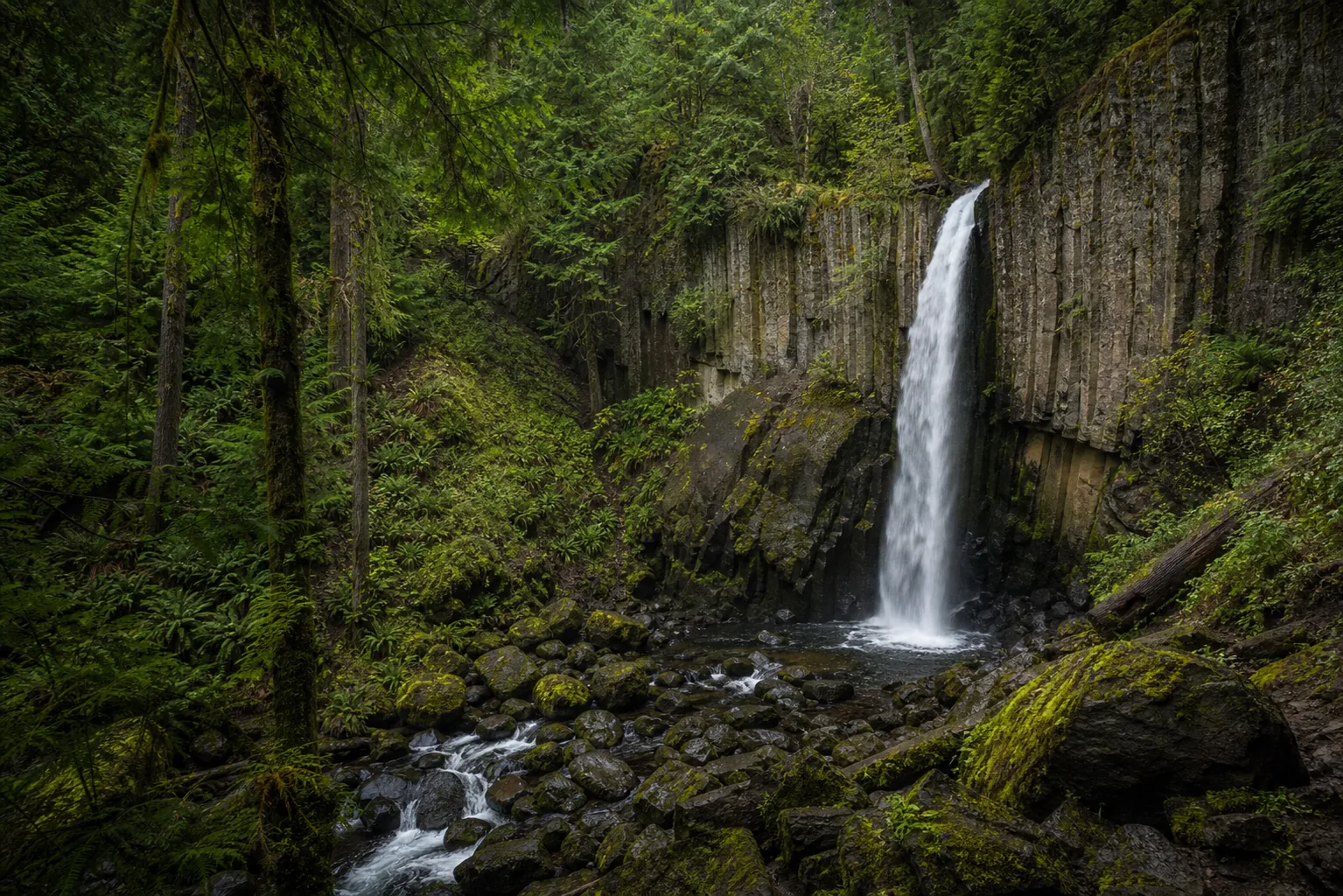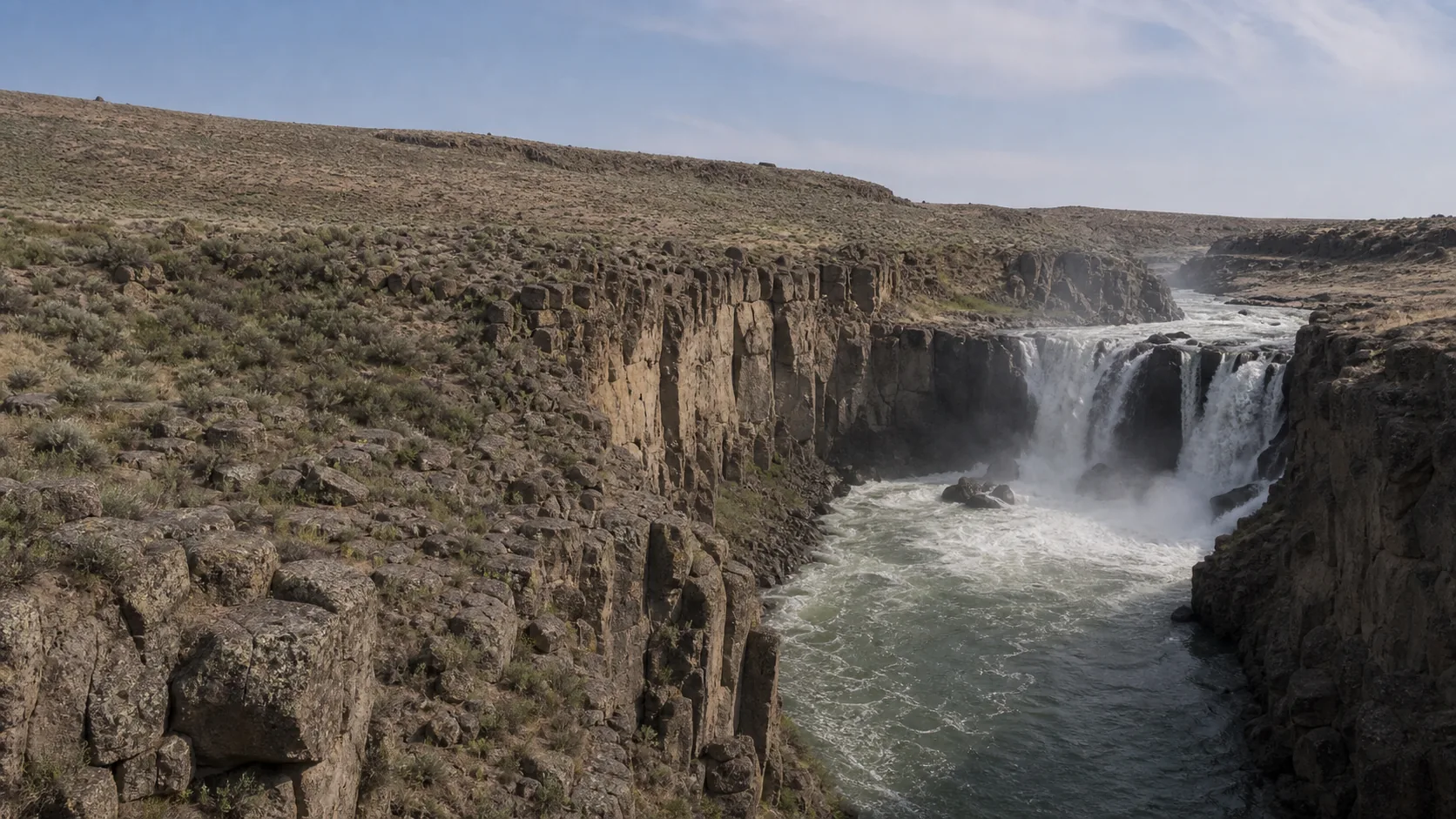
Drift Creek Falls with the 240-foot suspension bridge spanning the Tyee sandstone gorge in Siuslaw National Forest
Lincoln County, OR

Drift Creek Falls

Drift Creek Falls is best known for what hangs over it: a 240-foot steel-and-cable suspension bridge strung 100 feet above the North Fork of Drift Creek, with the 75-foot plunge of the falls dropping into a Tyee Formation sandstone gorge directly downstream of the deck. The 3-mile round-trip hike on Trail #1378 sits inside the Siuslaw National Forest about 17 miles southeast of Lincoln City, deep in the Oregon Coast Range. A $5 day pass or Northwest Forest Pass is required at the trailhead, and the bridge is open year-round.

Last verified May 12, 2026 Visited Desk-verified May 2026 7 sources checked
Trail 3.0 mi Round-trip route varies
Time 90-180 min Easy to moderate
Best season Year-round; November through May after Coast Range rain brings the strongest flow over the 75-foot drop, and overcast days give the cleanest photos in the Tyee sandstone gorge After rain or snowmelt
Parking Trailhead lot, $5 day pass required Siuslaw National Forest - Drift Creek Falls Trailhead
Quick answer

Is Drift Creek Falls worth the drive?

Yes. The best windows are November through May, when Coast Range storms push the North Fork into full curtain flow over the 75-foot drop; the 240-foot suspension bridge itself is open year-round. The trail is well-maintained and family-friendly with one important caveat, the tread is laced with thick Douglas-fir and hemlock roots that turn slick after rain. Plan 2 to 3 hours, bring traction-friendly shoes, and bring the $5 day pass (or a Northwest Forest Pass) for the trailhead lot.

  • 3.0 mi round trip on Trail #1378, 540 ft elevation gain
  • 240-foot suspension bridge 100 feet above the gorge with the 75-foot falls just downstream
  • $5 day pass or Northwest Forest Pass / America the Beautiful at trailhead
  • Vault toilets and information kiosk at parking lot
  • Optional North Loop adds 0.7 mi through old-growth fir and hemlock
  • Leashed dogs welcome; bridge sways and may spook some dogs
Last verified May 12, 2026 Visited Desk-verified May 2026 7 sources checked
Distance 3.0 mi Loop distance varies
Round trip 90-180 min Wide, well-graded trail with 540 feet of elevation gain on the return; the descent is first, the climb is last. Optional North Loop adds 0.7 miles and passes through old-growth Douglas-fir and hemlock.
Difficulty Easy to moderate Wide, well-graded trail with 540 feet of elevation gain on the return; the descent is first, the climb is last. Optional North Loop adds 0.7 miles and passes through old-growth Douglas-fir and hemlock.
Location Lincoln County, OR Siuslaw National Forest - Drift Creek Falls Trailhead
Parking Trailhead lot, $5 day pass required U.S. Forest Service
Transit No fixed-route transit verified Drive and verify the current trailhead or access point · 0 ft
Drive Verify route Downtown route varies
Best season Year-round; November through May after Coast Range rain brings the strongest flow over the 75-foot drop, and overcast days give the cleanest photos in the Tyee sandstone gorge After rain or snowmelt
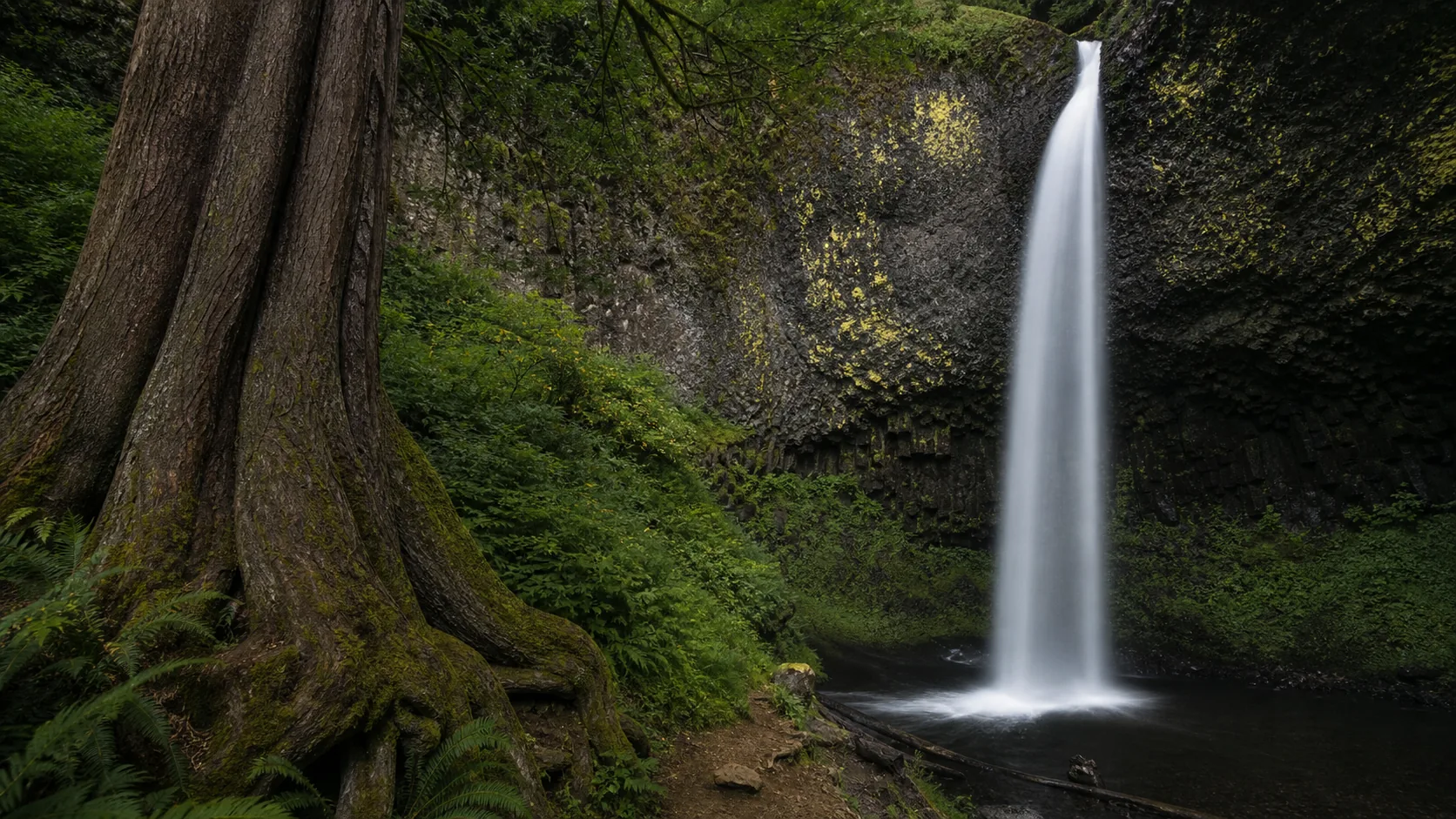
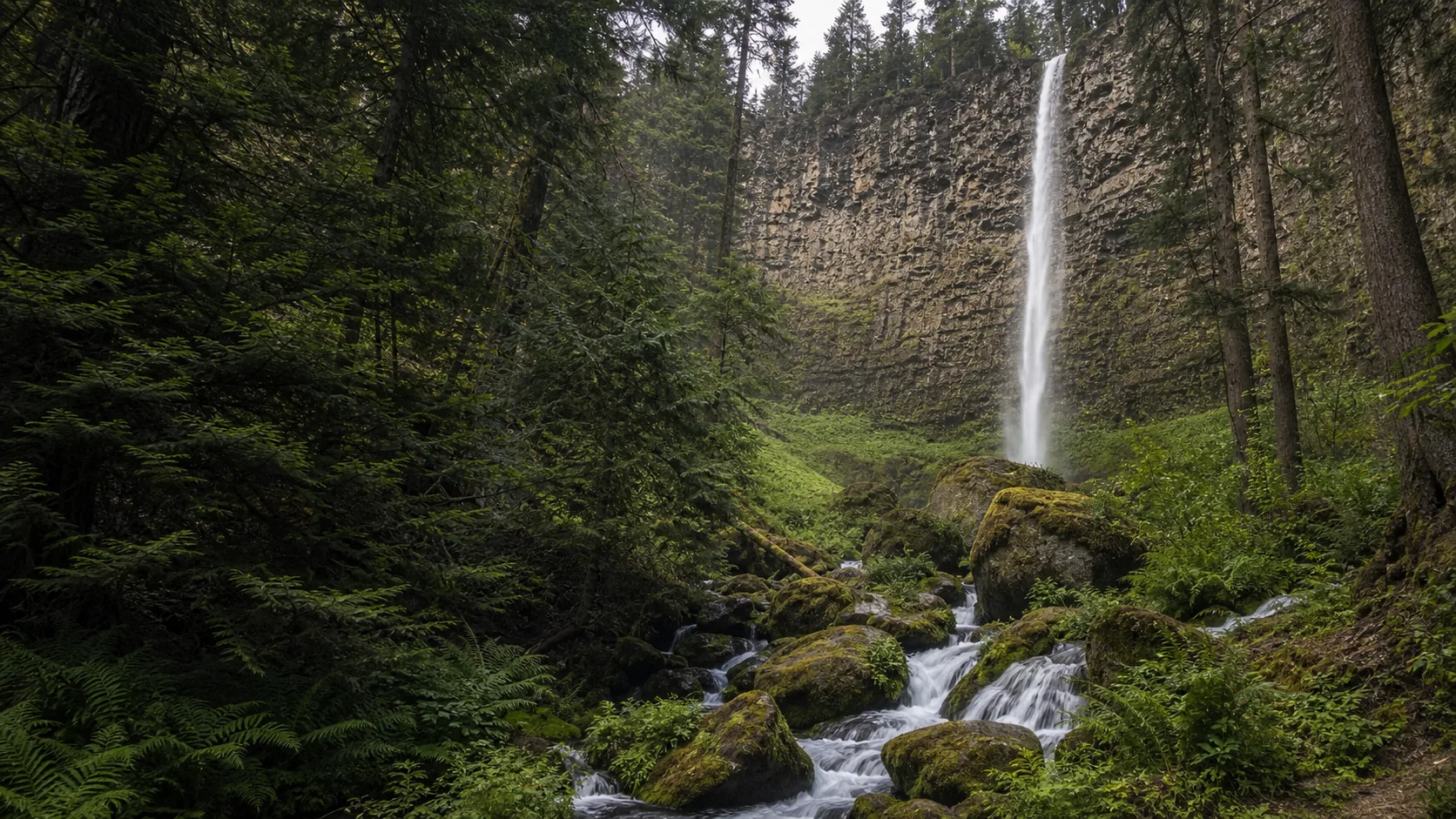
Drift Creek Falls view from the lower viewpoint, a quarter mile past the bridge, with the 75-foot curtain dropping into the boulder-strewn plunge pool.
Photo guide

Three working angles on the suspension bridge.

The bridge deck, the lower viewpoint past the second switchback, and the approach where the gorge first opens through the canopy. Use the captions to pick angles before you commit to the 540-foot climb back.

Drift Creek Falls with the 240-foot suspension bridge spanning the Tyee sandstone gorge in Siuslaw National Forest
Drift Creek Falls, hero composition
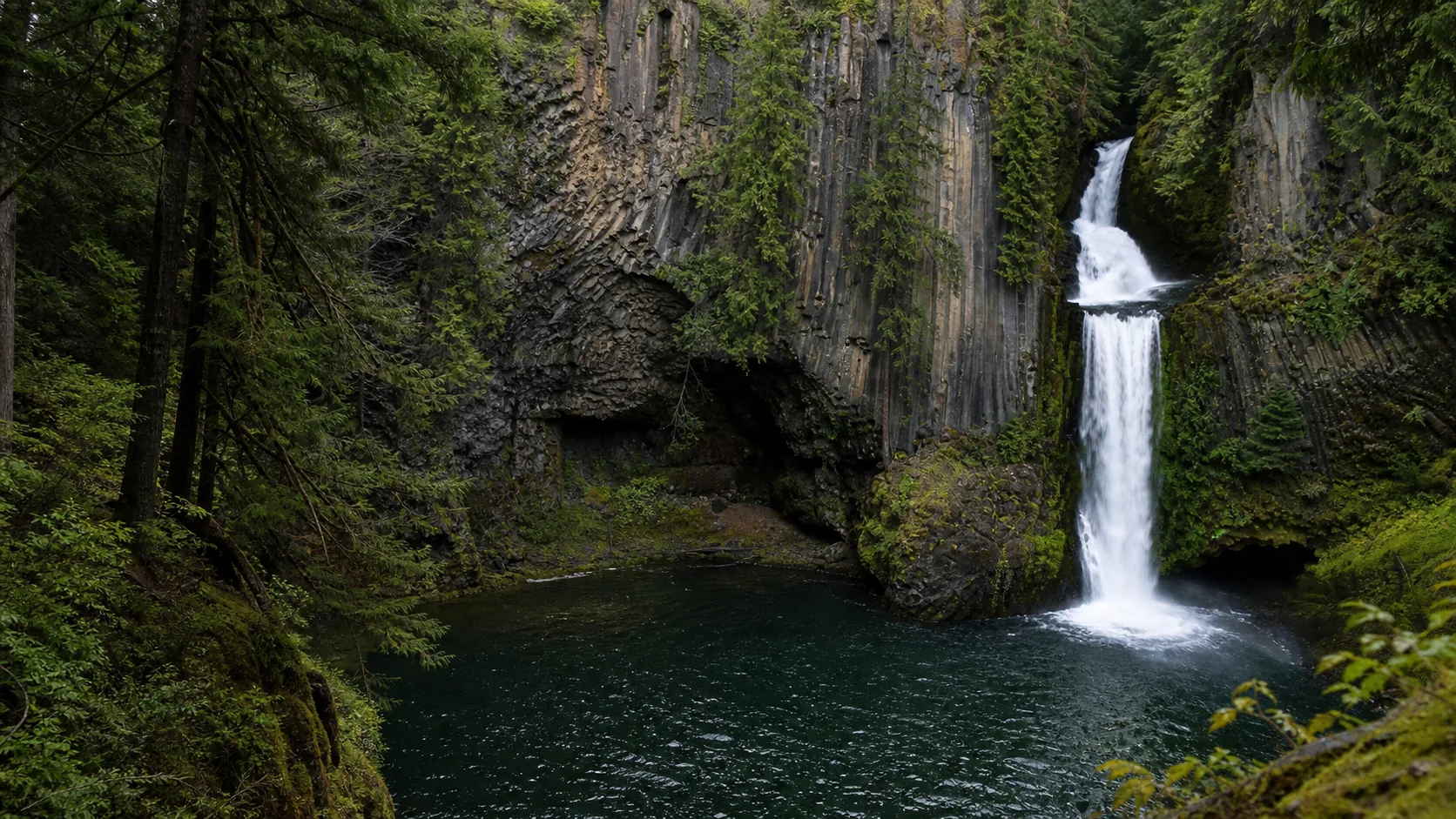
Drift Creek Falls 240-foot suspension bridge spanning the sandstone gorge with the waterfall plunging beneath
The 240-foot suspension bridge framed by the Tyee sandstone gorge, with the 75-foot falls dropping into the slot just downstream of the deck.
Drift Creek Falls lower viewpoint with the 75-foot waterfall plunging into the gorge
View from the lower viewpoint, a quarter mile past the bridge, with the 75-foot curtain dropping into the boulder-strewn plunge pool.
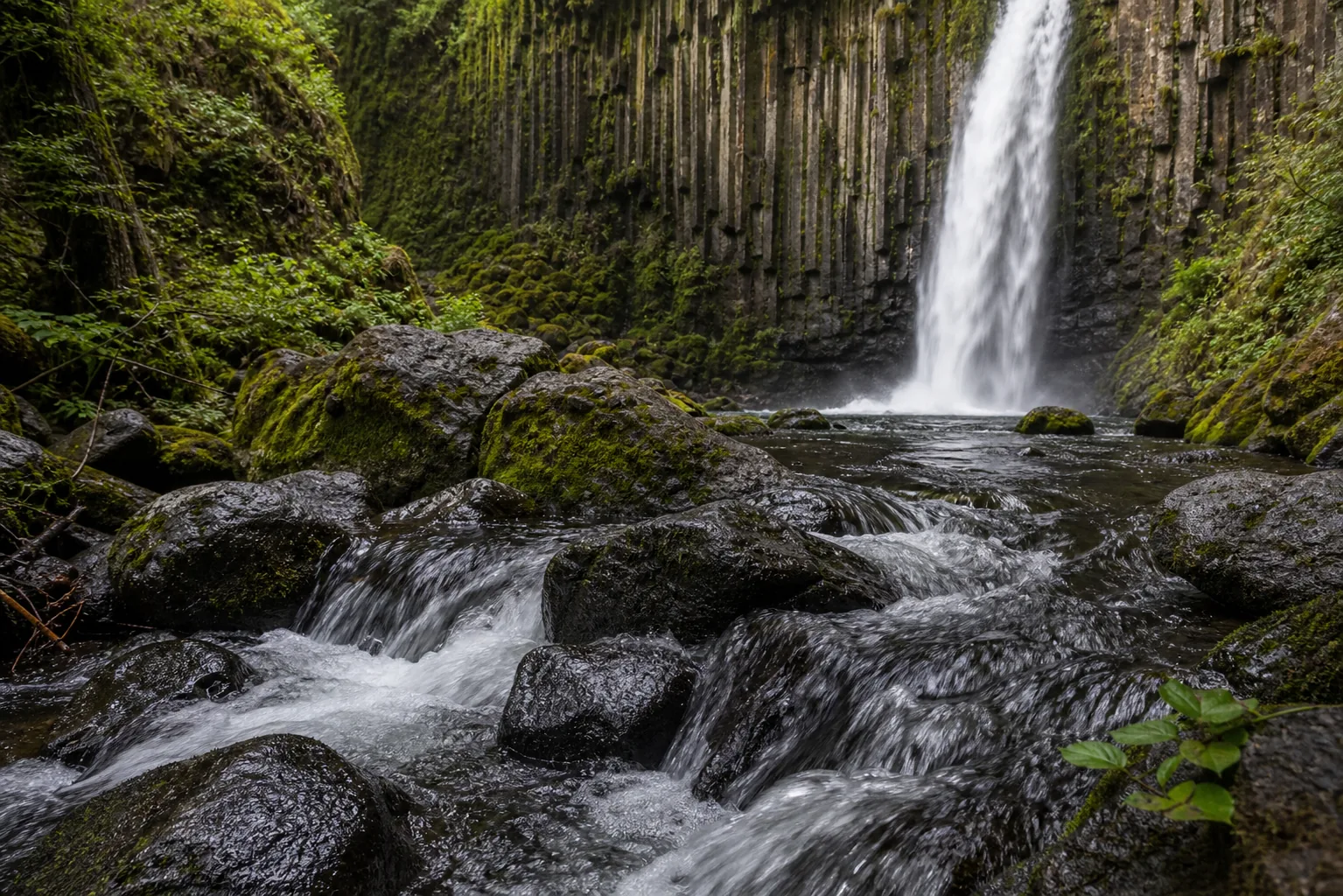
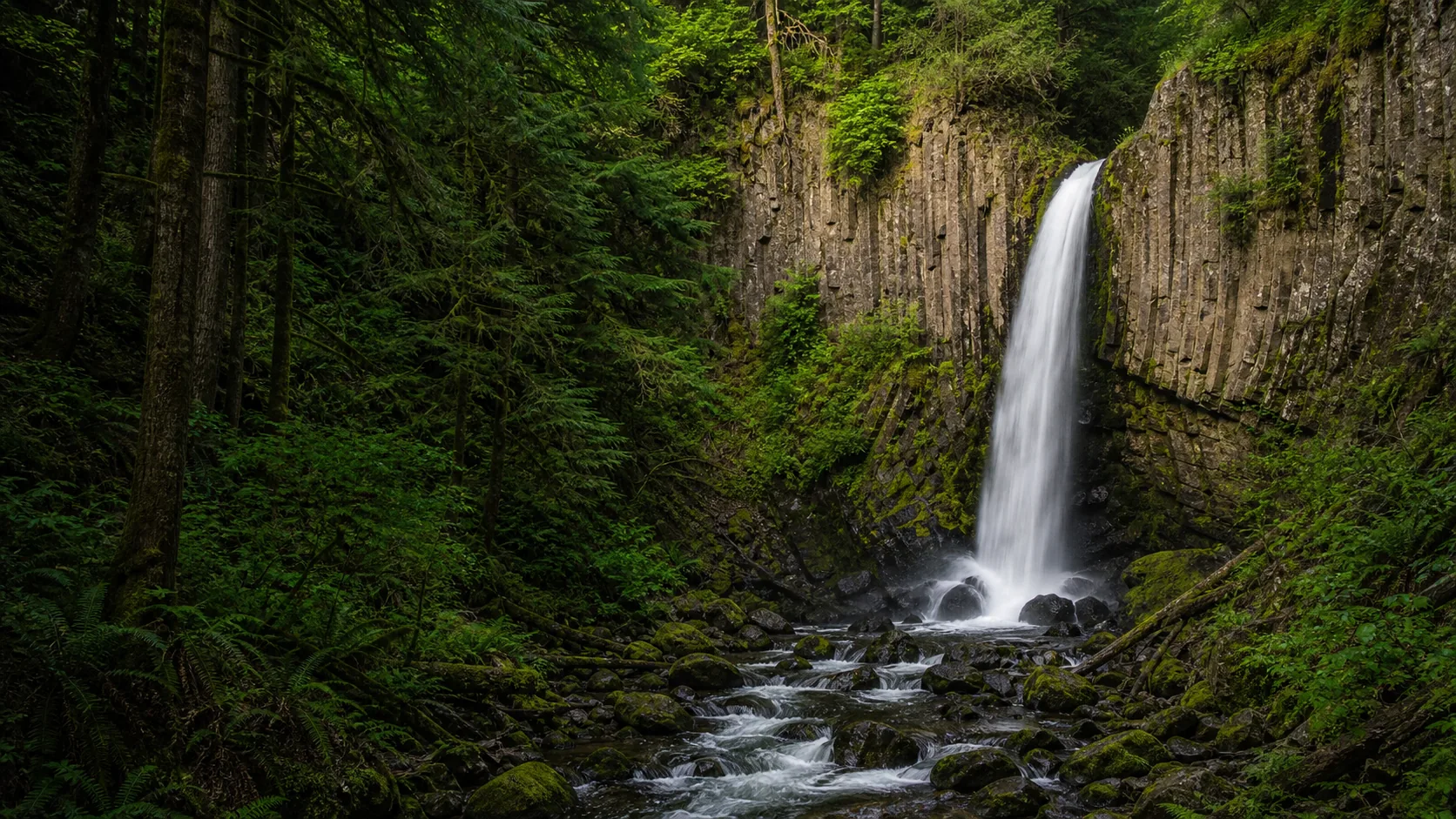
Drift Creek Falls water-and-rock detail on the Tyee sandstone lip
Water-and-rock detail at the lip, where the North Fork breaks over the Tyee sandstone before its 75-foot drop into the gorge.
01Is Drift Creek Falls flowing right now?

There is no real-time USGS gauge paired directly to the North Fork of Drift Creek. Use the NOAA forecast for the Lincoln City / Coast Range area and recent rainfall totals as a proxy for current flow.

Drift Creek Falls runs year-round because the North Fork of Drift Creek drains a wet pocket of the Oregon Coast Range that receives roughly 120 inches of annual rainfall. Flow peaks after multi-day November-to-March Pacific storms and stays strong through April and May; late July through September is the lowest reliable window, when the curtain reads as a thinner ribbon over the sandstone lip but is still continuous.

02How long is the walk?

3.0 miles round trip on Trail #1378 with 540 feet of elevation gain; the descent is first and the climb is on the return. The optional North Loop adds 0.7 miles. Plan 90 minutes to 3 hours depending on how long you linger at the bridge and lower viewpoint.

03How do you get there?

From Lincoln City, head north on Highway 101 to the Highway 18 junction, drive 4.5 miles east on Highway 18, turn right (south) on Bear Creek County Road for 3.5 miles, then continue 7 miles on Forest Service Road 17 to the trailhead. Alternate from the south: turn off Highway 101 onto Drift Creek Road, right on Andersen Creek Road, left on FS Road 17, and follow it 12 miles to the trailhead.

04Is there free parking?

Park in the Drift Creek Falls Trailhead lot at the end of FS Road 17. Lot fills on summer and fall weekends; arrive before 10 a.m. or visit on a weekday for the best chance at a spot. Vault toilets and an information kiosk are on site; no potable water.

05Does it cost money?

A $5 day pass per vehicle is required at the trailhead, or use a Northwest Forest Pass or America the Beautiful federal pass. There is no separate per-person fee.

06Trail variants

Drift Creek Falls Trail #1378 (out and back) 3.0 mi round trip, 90-150 min, Standard route to the suspension bridge and the lower viewpoint of the falls.
With North Loop add-on 3.7 mi round trip, 2-3 hr, Adds 0.7 mi through old-growth Douglas-fir and a salmonberry-lined descent to the North Fork.
Lower falls viewpoint Adds 0.5 mi round trip past the bridge, 20-30 min, Switchbacks down to a bench and boulder rest spot with the photogenic angle of the falls.
Bridge-only quick visit 3.0 mi round trip, no lower viewpoint, 75-90 min, Turn around at the 240-foot suspension bridge if short on time.

Detailed maps and recent reviews: Falls route on AllTrails · Creek route on AllTrails

07Can you swim?

There is no developed swim area at the falls and the sandstone gorge below the bridge is unsafe for swimming. The North Fork footbridge upstream of the falls has a bench and shallow wading area that is reasonably safe for kids on a warm day.

08Are dogs allowed?

Leashed dogs are welcome on Trail #1378. Use a 6-foot leash and pack out waste. The 240-foot suspension bridge sways noticeably under foot traffic and some dogs refuse to cross; turn around at the bridge if yours is uncomfortable.

09Is it accessible?

The trail is wide and well-graded but drops 540 feet over 1.5 miles with switchbacks and footbridges, and is not wheelchair accessible. Only the trailhead area (paved lot, vault toilets, kiosk) is level.

Field notes

Drift Creek Falls at a glance.

75-foot plunge over Tyee Formation sandstone, 240-foot suspension bridge completed in 1997, 3-mile round trip on Trail #1378, $5 day pass or Northwest Forest Pass, managed by the Siuslaw National Forest Hebo Ranger District. Sourced from the U.S. Forest Service Siuslaw page and Oregon Hikers field guide.

Height 75 ft USGS 3DEP
Type Plunge (single tier) USGS
Rock Tyee Formation sandstone (Oregon Coast Range) DOGAMI: Oregon Geologic Data Compilation (Tyee Formation, Oregon Coast Range)
County Lincoln Lincoln County, OR
Managed by U.S. Forest Service, Hebo Ranger District, Siuslaw National Forest U.S. Forest Service
Water source North Fork Drift Creek USGS
Elevation 748 ft USGS NED
Park area Not listed U.S. Forest Service
Hours Trailhead is open year-round during daylight hours; the gravel forest road can ice over in winter and is occasionally closed by storm damage U.S. Forest Service
When to visit

Two windows that work, one to avoid.

November through May for the loudest flow over the lip and the moody overcast light the gorge needs. October and June for the cleanest combination of flow and dry footing. August and early September for sun and quiet trail, with a thinner curtain. Avoid the first 48 hours after a major windstorm; FS Road 17 closes for blowdown.

PEAK FLOW

Peak flowAfter rain or snowmelt
Ice / low flowWinter varies
Most crowdedWeekends and midday
Best photosSunrise or weekdays

Live water context

Discharge data -- There is no real-time USGS gauge paired directly to the North Fork of Drift Creek. Use the NOAA forecast for the Lincoln City / Coast Range area and recent rainfall totals as a proxy for current flow.

Why is it called Drift Creek Falls?

The falls takes its name from Drift Creek, the Coast Range stream it sits on. The creek itself was named by 19th-century settlers for the driftwood that piled up along its lower reaches, much of it carried downstream from upstream timber operations and winter blowdown in the surrounding old-growth. The falls is technically on the North Fork of Drift Creek, which drops 75 feet into a sandstone gorge directly downstream of the suspension bridge and joins the main creek a short distance below. The name and the trail designation (Forest Service Trail #1378) are Siuslaw National Forest conventions; the broader 5,798-acre Drift Creek Wilderness lies separately to the south between Waldport and Newport and shares only the watershed name.

What else to do at Siuslaw National Forest - Drift Creek Falls Trailhead

The Drift Creek Falls Trailhead sits inside the Siuslaw National Forest's Hebo Ranger District in the Oregon Coast Range, about 17 miles southeast of Lincoln City. The 5,798-acre Drift Creek Wilderness shares the watershed name and lies further south between Waldport and Newport; it is a separate unit with no public-access entry from this trail and is regularly confused with the falls. Access to the trailhead is by Forest Service Road 17, reached either from Highway 18 and Bear Creek County Road to the north or from Drift Creek Road off Highway 101 to the west; the road is paved most of the way with a gravel final segment.

  • Trailhead facilities. Vault toilets, information kiosk, and a small picnic area at the start of Trail #1378; no potable water.
  • Suspension bridge. 240 feet long, completed in 1997, suspended roughly 100 feet above the North Fork of Drift Creek with the 75-foot plunge dropping into the sandstone gorge just downstream.
  • Lower falls viewpoint. About a quarter mile past the bridge, reached by switchbacks; bench and boulders make a good rest spot and the cleanest photo angle on the curtain.
  • North Loop option. 0.8-mile alternate that climbs through old-growth Douglas-fir and hemlock and rejoins the main trail by the North Fork footbridge.
  • North Fork wading spot. Footbridge with a bench on the far bank; the only reasonably safe place for kids to splash, well upstream of the cliff edge.

Why it looks this way

The North Fork of Drift Creek cuts through the Tyee Formation, a thick sequence of Eocene-age sandstone and siltstone that makes up most of the central Oregon Coast Range. The Coast Range itself is a slow-uplifting fold of marine sediments lifted out of an ancient continental shelf and now standing only about 2,000 feet above the Pacific; rivers under roughly 120 inches of annual rainfall have been cutting downward into it for several million years, and the 100-foot-deep gorge under the suspension bridge is one local result. In November 2010 a large slab of the cliff beside the falls peeled off and crashed into the plunge pool, a reminder that the sandstone walls are still actively shedding rock as the creek undercuts them.
Field guide deep dive

What the AllTrails listing leaves out.

Tyee sandstone geology, the 1997 suspension bridge story, the rainy-coast flow read, and how to keep Drift Creek Falls from getting tangled with Drift Creek Wilderness. Skim the headers, read what you need.

How Drift Creek Falls formed

Drift Creek Falls is a textbook sandstone gorge plunge. The North Fork of Drift Creek runs over the Tyee Formation, a thick sequence of Eocene-age sandstone and siltstone laid down on a submarine fan about 45 to 50 million years ago and now exposed across most of the central Oregon Coast Range. The Coast Range itself is a slow uplift of these marine sediments, lifted out of the ancient continental shelf as the Juan de Fuca plate subducts off the coast.

Compared with the basalt-capped falls of the Columbia River Gorge (Latourell and its 249-foot plunge over Columbia River Basalt is the canonical example), Drift Creek behaves differently. There is no resistant caprock here. The sandstone weathers more uniformly, and the gorge has been shaped by the creek slicing downward through joints and bedding planes rather than by repeated caprock collapse. The 100-foot-deep slot under the suspension bridge is what that looks like in cross-section: vertical walls, narrow base, no obvious overhang.

The gorge is still actively moving. In November 2010 a large slab peeled off the cliff beside the falls and crashed into the plunge pool below, briefly damming the creek. Smaller pieces continue to fall. Stay on the trail, do not scramble down to the creek edge above the falls, and treat the gorge walls as living rock rather than scenery.

The suspension bridge: 240 feet over a 100-foot gorge

The bridge is the headline. It is 240 feet long, suspended roughly 100 feet above the North Fork of Drift Creek, with the 75-foot waterfall dropping into the gorge just downstream of the deck. It was completed in 1997 by the Siuslaw National Forest with engineering by Forest Service crews and contracted bridge specialists; the design is a cable-supported pedestrian bridge anchored to bedrock on either side of the gorge.

The deck does sway. The motion is most noticeable when several people walk in step, and it is enough to surprise first-time visitors and unsettle some dogs. The handrails are chest-high and the sides are netted; the structure is rated well above the foot-traffic loads it sees on summer weekends, and there has never been a structural incident. The honest variable is psychological, not engineering. If heights are a hard limit for you, stop at the gorge-edge view 50 feet short of the bridge entrance, which is still a strong frame of the gorge without committing to the crossing.

Bridge etiquette: yield to oncoming hikers when the deck is narrow, do not stop for long photos when others are crossing, and keep dogs on a short leash with both hands on it. Tripods on the bridge are technically allowed but practically useless because of the sway.

The 3-mile trail: roots, switchbacks, and 540 feet of climb on the way out

Trail #1378 is 3.0 miles round trip with about 540 feet of elevation gain on the return; the descent is first and the climb is last. The grade is moderate throughout. The tread is wide and well-maintained by the Hebo Ranger District, but the consistent feature first-time hikers underestimate is the roots. Thick Douglas-fir and western hemlock roots cross the tread in long lattices for most of the 1.5-mile descent, and they turn slick after rain. Trail-runner shoes with grip outperform stiffer hikers here, and trekking poles are useful on the return more for balance than for power.

Two small wooden footbridges cross side channels of the North Fork on the way down. The trail forks at about 1.2 miles for the optional North Loop, which adds 0.7 miles through old-growth Douglas-fir and a salmonberry-lined descent and rejoins the main trail near the North Fork footbridge. The main trail continues straight to the suspension bridge at 1.4 miles; the lower viewpoint is a 0.25-mile spur past the bridge with switchbacks down to a bench and boulders. The lower viewpoint is the cleanest photo angle on the curtain and adds 20 to 30 minutes round trip.

Plan 90 minutes to 3 hours total depending on how long you linger at the bridge and the lower viewpoint. The climb out feels longer than the descent because the elevation is back-loaded; pace yourself and refill water at home, not on the trail.

When to go: rainy Oregon Coast realities

The Coast Range pocket above Drift Creek gets roughly 120 inches of annual rainfall, almost all of it between October and May. The falls runs year-round, but the photographic and audible character changes a lot across the calendar. From November through March, multi-day Pacific storms push the North Fork into a thick continuous curtain over the lip, the gorge fills with mist, and the soundtrack at the bridge is a low constant roar. This is the loudest and most atmospheric window. It is also the muddiest and the most likely to coincide with FS Road 17 closures from blowdown or ice.

From April through June, flow stays strong as late storms feed the creek, the tread starts to dry, and the canopy fills in. This is the most consistently usable window for hikers who want both strong flow and dry footing. July through September brings the lowest reliable flow and the highest crowds. The curtain becomes a narrower ribbon down the sandstone wall, but it is still continuous and still a striking visual; on hot summer days the gorge stays cool and shaded. October is the underrated month: cool weather, returning flow, and the bigleaf maples in the lower gorge color up before the firs and hemlocks dominate the canopy again.

There is no nearby USGS gauge on the North Fork of Drift Creek, so live flow is impossible to read in advance. Use the NOAA forecast for the Lincoln City and Coast Range area and the recent 72-hour rainfall total at the nearest stations as a proxy: more than half an inch in three days is enough to push the falls into a full curtain.

Drift Creek Falls vs Drift Creek Wilderness (they are not the same place)

This is the single most common confusion in trip planning, and the U.S. Forest Service map labeling does not help. Drift Creek Falls is the trail and bridge described on this page. It is in the Hebo Ranger District of the Siuslaw National Forest, accessed by Forest Service Road 17, and 17 miles southeast of Lincoln City. The trail is well-maintained, dog-friendly, and family-friendly. The walk is 3 miles round trip.

The Drift Creek Wilderness is a different 5,798-acre unit of the Siuslaw National Forest, located further south between Waldport and Newport, with no public-access trail from the Drift Creek Falls Trailhead. It contains old-growth Sitka spruce, the Horse Creek and Harris Ranch trails, and is accessed from Forest Road 5087 on the east or North Bridge Road on the south. It is wilder, less developed, less visited, and not a same-day pairing with the falls. If you want both in the same trip, plan two separate days from a Waldport or Newport base; trying to chain them from Lincoln City is a four-hour round trip of forest road driving.

The two units share the name because they share the watershed: Drift Creek and its forks drain the same section of the Coast Range. The falls sits at the upper end of the watershed; the wilderness protects the middle and lower reaches.

A Lincoln City coastal waterfall day

Drift Creek Falls works best as the morning anchor of a Lincoln City day. A practical sequence: leave town by 8 a.m. to be on the trail at 9, finish at 11 or 11:30, drive back to Lincoln City for lunch at the harbor, then spend the afternoon on the coast. The natural pairings:

Lincoln City beaches (30 minutes from the trailhead) for glass-float hunts, tidepools at low tide, and easy ocean access. Cascade Head Preserve (45 minutes north) for the headland hike with one of the best ocean overlooks on the central coast, especially in clear summer afternoons. Devils Lake State Recreation Area (30 minutes) for lake swimming, paddling, or a quieter picnic stop. Cape Foulweather and the Otter Rock viewpoints south of Lincoln City on Highway 101 for the rocky-headland scenery that the Drift Creek gorge does not offer.

If you want a Coast Range waterfall pairing rather than a coast pairing, the closest reasonable option is Munson Creek Falls further north near Tillamook (Oregon's tallest Coast Range waterfall at 319 feet), about 75 minutes from the Drift Creek trailhead. Trying to pair Drift Creek with Columbia River Gorge waterfalls like Latourell in the same day is geographically impractical; that is a separate two-hour Portland-area trip.

Map and route

Seventeen miles southeast of Lincoln City on Forest Service Road 17.

From Lincoln City, head north on Highway 101 to the Highway 18 junction, drive 4.5 miles east on Highway 18, turn right (south) on Bear Creek County Road for 3.5 miles, then continue 7 miles on Forest Service Road 17 to the trailhead. Alternate from the south: turn off Highway 101 onto Drift Creek Road, right on Andersen Creek Road, left on FS Road 17, and follow it 12 miles to the trailhead.

Photography and weddings

East-facing gorge, two working positions, one Siuslaw special-use permit.

The best photo of the falls is from the lower viewpoint, a quarter mile past the suspension bridge after one short switchback, where a bench and boulders frame the 75-foot drop with the bridge arching overhead. The second working position is on the bridge itself, shooting downstream into the gorge as the curtain drops away beneath your feet.

Overcast Oregon Coast days are ideal. The Tyee sandstone gorge is dark and shaded even at midday, and bright sun blows out the white water against the wet rock. Late morning under cloud cover gives the cleanest exposure, and the second hour after sunrise gives the cleanest forest-canopy light on the approach.

Personal photography is fine. Tripods on the suspension bridge are awkward because it sways under foot traffic; commercial shoots and drones require a Siuslaw National Forest special-use permit through the Hebo Ranger District.

Permits

Weddings and engagements

Engagement portraits work on the bridge and at the lower viewpoint on a weekday off-season morning, but the bridge is narrow and shared with day hikers, and there is no reservable ceremony space.

For a ceremony or any group beyond a couple plus photographer, contact the Hebo Ranger District for a special-use permit; small elopement-style shoots are usually the only practical fit on this trail.

Plan for rain even in summer, keep the group small enough to clear the bridge for other hikers, and have a Lincoln City indoor backup - Coast Range storms can roll in fast.

Related questions

More questions visitors ask before driving to Drift Creek Falls.

Hike length, bridge fear, dogs, winter, the difference between the falls and the wilderness. The full set is also indexed in the FAQ schema for AI answer engines.

01Is the Drift Creek Falls suspension bridge scary?

It depends on how you feel about heights. The bridge is 240 feet long and hangs roughly 100 feet above the gorge, and the deck sways visibly when several people walk in step. Handrails are chest-high and the sides are netted, the structure is well within its rated load, and there has never been a structural incident. First-time visitors are usually surprised by the sway for the first 20 feet, then fine. If heights are a hard limit, stop at the gorge-edge view just before the bridge entrance for a strong frame without crossing.

02How do you get to Drift Creek Falls?

From Lincoln City, drive north on Highway 101 to the Highway 18 junction, head 4.5 miles east on Highway 18, turn south on Bear Creek County Road for 3.5 miles, then continue 7 miles on Forest Service Road 17 to the trailhead. From Highway 101 south of Lincoln City, turn onto Drift Creek Road, then Andersen Creek Road, then FS Road 17 for about 12 miles. FS Road 17 is mostly paved with a gravel final segment.

03Is Drift Creek Falls open in winter?

Yes, the trail and the suspension bridge are open year-round during daylight hours. Winter is the loudest flow season because of the November-to-March Pacific storms that feed the North Fork. The variable is Forest Service Road 17, which can ice over at elevation or close briefly for blowdown after major storms; check the Siuslaw National Forest alerts page before driving from November through March. Trail tread gets muddy and the root mats slick; bring grip-friendly shoes.

04How tall is Drift Creek Falls?

Drift Creek Falls is a 75-foot single-tier plunge over Tyee Formation sandstone, on the North Fork of Drift Creek. The 240-foot suspension bridge above the gorge sits roughly 100 feet above the creek bed and frames the falls dropping into the slot canyon just downstream. The bridge dimensions and the falls height come from the Siuslaw National Forest, Wikipedia, and Travel Oregon and are consistent across sources.

05Is Drift Creek Falls worth it?

Yes. The combination of a 240-foot suspension bridge, a 100-foot Tyee sandstone gorge, and a 75-foot waterfall in a single 3-mile hike does not exist anywhere else on the Oregon Coast. The trail is moderate, family-friendly, dog-friendly, and runs in any season; the bridge is the kind of structure most visitors remember years later. The $5 day pass is one of the better-value fees in the Siuslaw National Forest. Avoid summer weekends if quiet matters; visit November through May for the loudest flow.

Sources and data

Where the Drift Creek Falls guide gets its facts.

Trail and access from the U.S. Forest Service Siuslaw National Forest page. Bridge dimensions and 1997 completion from Wikipedia and Travel Oregon. Geology from DOGAMI and USGS materials on the Tyee Formation. Route variants and the 2010 rockfall from the Oregon Hikers field guide.

U.S. Forest Service: Siuslaw National Forest - Drift Creek Falls Trailhead fs.usda.gov
Access, parking, and permit rules: fs.usda.gov
DOGAMI: Oregon Geologic Data Compilation (Tyee Formation, Oregon Coast Range): Lincoln County bedrock oregongeology.org
NOAA / NWS Portland forecast grid PQR 69,85 noaa.gov
USGS National Elevation Dataset 3DEP
Google Maps: embedded map and directions maps.google.com
Google Places: nearby restaurants and hotels places API
U.S. Forest Service: Siuslaw National Forest, Drift Creek Falls Trailhead fs.usda.gov
Oregon Hikers Field Guide: Drift Creek Falls hike oregonhikers.org
AllTrails: Drift Creek Suspension Bridge and Waterfall (Trail #1378) alltrails.com
Travel Oregon: Drift Creek Falls traveloregon.com
Wikipedia: Drift Creek Falls en.wikipedia.org
Explore Lincoln City: Drift Creek Falls Trail explorelincolncity.com
Wikimedia Commons: Drift Creek Falls image category commons.wikimedia.org
U.S. Forest Service: Drift Creek Wilderness (separate unit; geographic clarification) fs.usda.gov
Fact checks
Bridge audit: 240-foot length, completed in 1997, hanging roughly 100 feet above the gorge with the 75-foot falls just downstream. Cross-checked against the Siuslaw National Forest trailhead description, Travel Oregon, Wikipedia, and Oregon Hikers; all four sources agree on dimensions and completion year.
Geology audit: the Tyee Formation sandstone framing replaces an earlier conservative basalt note. Confirmed against DOGAMI Oregon Geologic Data Compilation and USGS Coast Range mapping. Basalt waterfalls in Oregon are concentrated in the Columbia River Gorge, not the central Coast Range.
Distance audit: 3.0 miles round trip and roughly 540 feet of elevation gain match Forest Service signage and Oregon Hikers. AllTrails currently lists 3.1 miles and 485 feet; the discrepancy reflects different start-and-end measurement points and falls inside normal tolerance.
Wilderness disambiguation: Drift Creek Falls Trailhead and the Drift Creek Wilderness are separate units of the Siuslaw National Forest that share the watershed name. The page explicitly disambiguates them and does not link Wilderness access from the falls trail.
Corrections: [email protected]