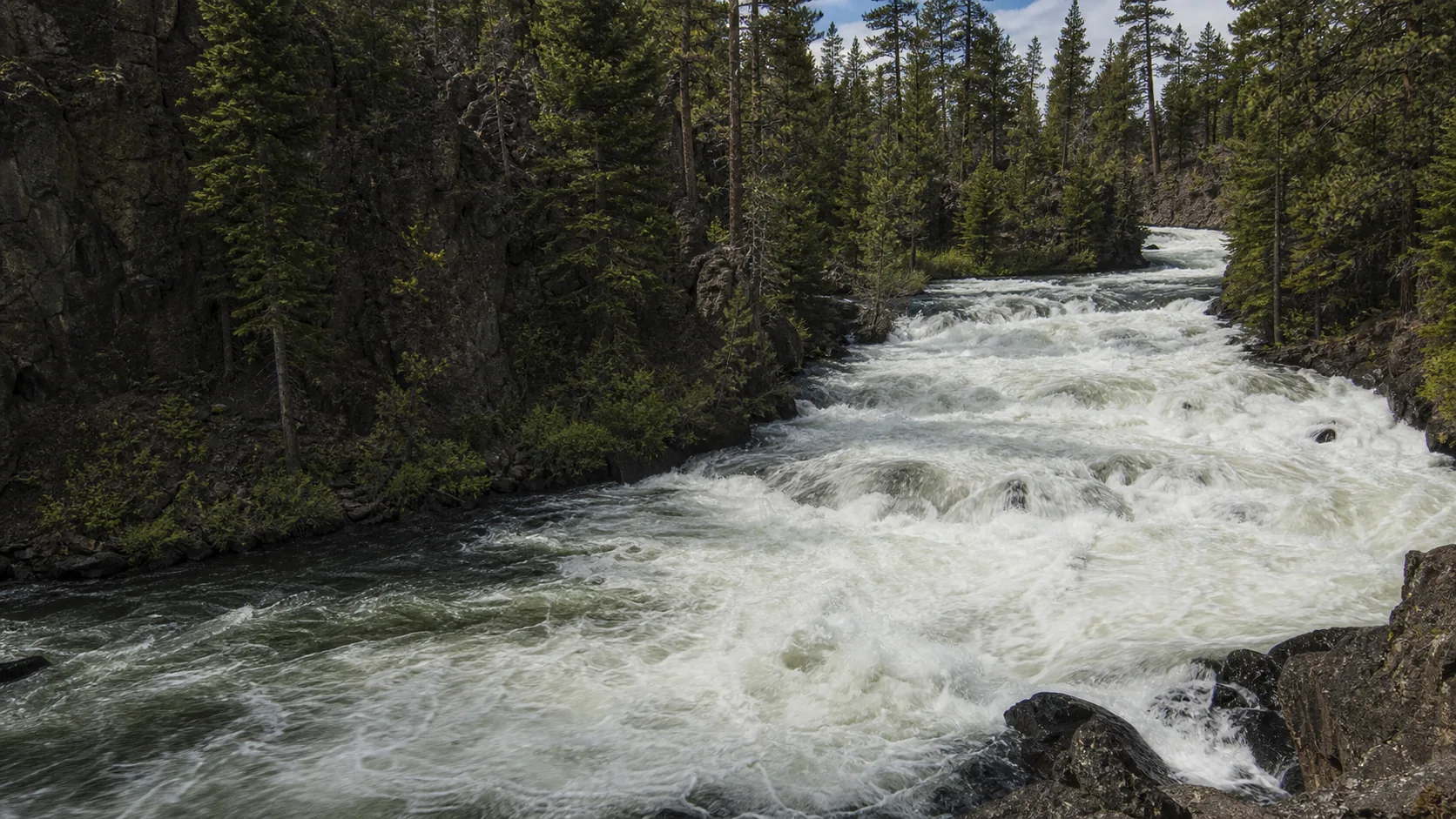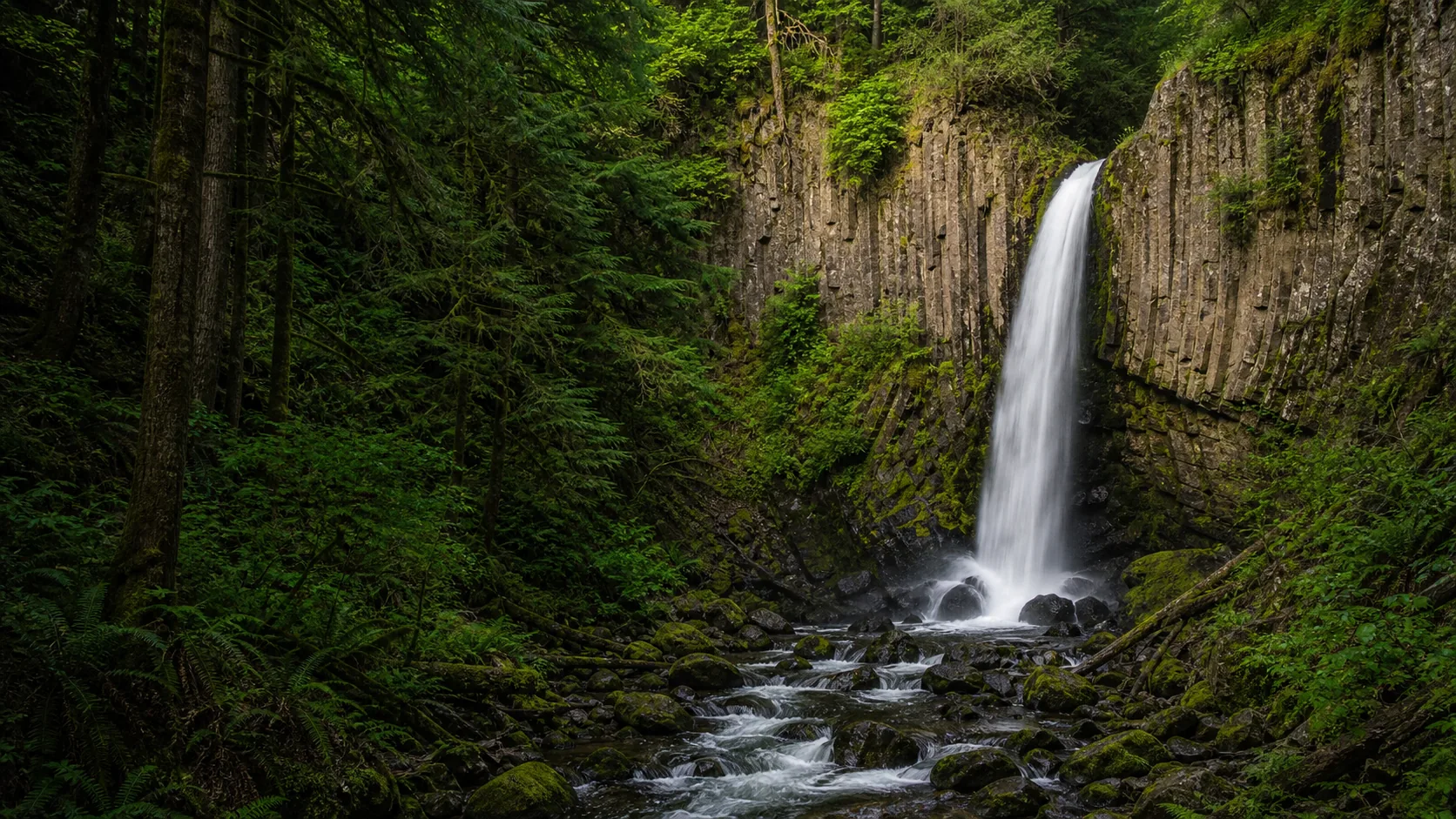
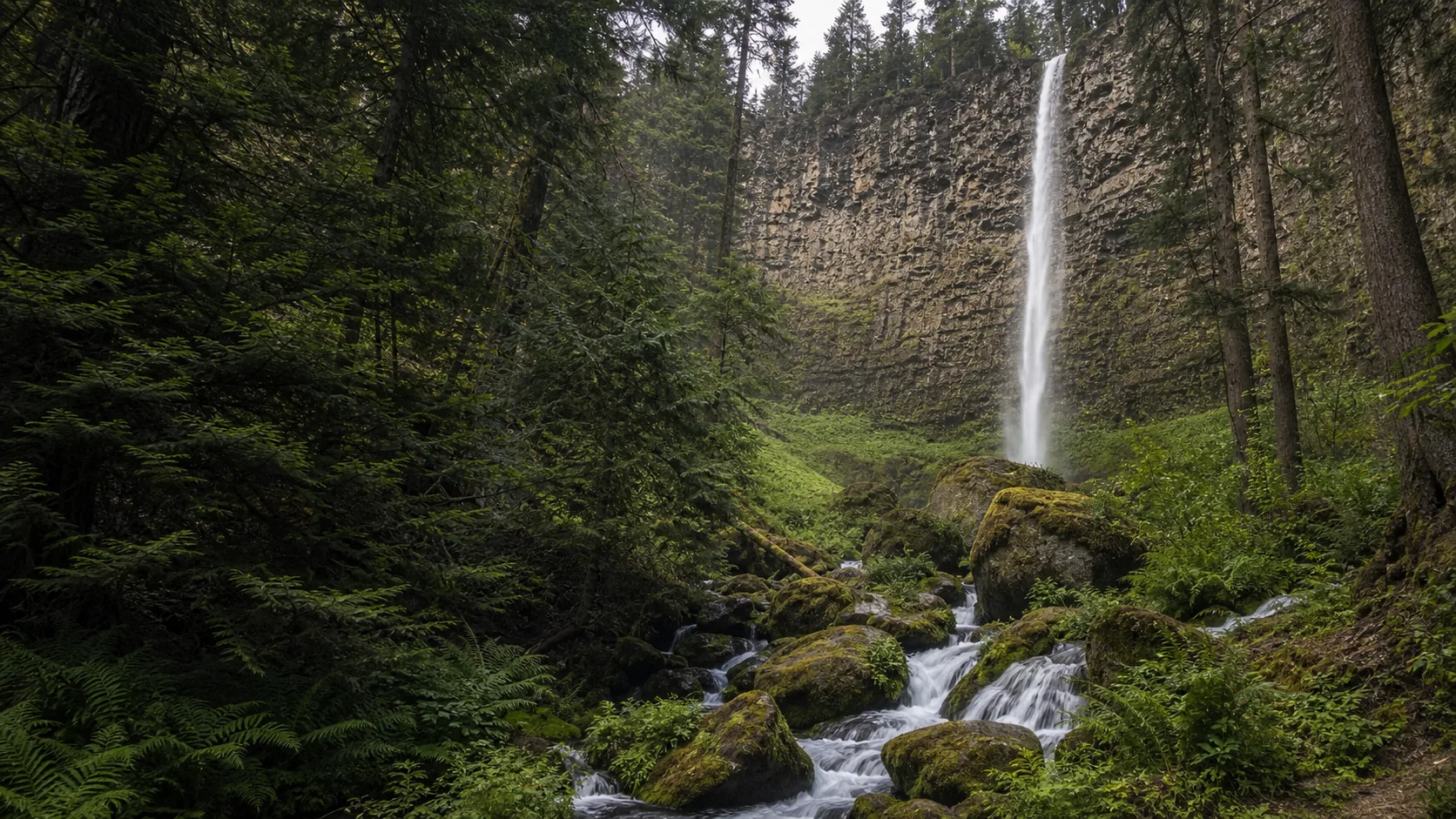
Watson Falls 272-foot single-tier plunge on Watson Creek in the Umpqua National Forest, Oregon
Douglas County, OR

Watson Falls

Watson Falls is a 272-foot single-tier plunge on Watson Creek, a tributary of the Clearwater River in the Umpqua National Forest of Douglas County, Oregon. It is commonly listed as the third-tallest waterfall in Oregon (a ranking the Northwest Waterfall Survey disputes; either way, it is unambiguously the tallest in the southwest part of the state). A 0.6-mile out-and-back trail climbs to the lower viewpoint, with a wooden footbridge crossing the lower stream just below the spray line.

Last verified May 12, 2026 Visited Desk-verified May 2026 8 sources checked
Trail 0.6 mi 1.6 mi extended
Time 25-75 min Easy to moderate
Best season May-June for runoff, October for fall color May - early June (snowmelt)
Parking Free lot at the Watson Falls picnic area; a NW Forest Pass, an Interagency annual pass, or a $5 day pass is required to park Umpqua National Forest
Quick answer

Is Watson Falls worth visiting?

Yes, and the two windows that justify a deliberate trip are May through early June for snowmelt runoff and the first half of October for vine-maple and big-leaf-maple color in the gorge. The trail is short (0.6 mi round trip, about 300 feet of climb), the trailhead requires a NW Forest Pass or an America the Beautiful interagency pass, and the lower viewpoint deck sits in the mist plume from May onward.

  • 272-foot single-tier plunge
  • 0.6-mile trail to the lower viewpoint
  • NW Forest Pass or America the Beautiful required
  • Wooden footbridge crossing the lower stream
  • Pairs with Toketee, Whitehorse, and Clearwater falls
  • Peak flow: May - early June
Last verified May 12, 2026 Visited Desk-verified May 2026 8 sources checked
Distance 0.6 mi 1.6 mi extended
Round trip 25-75 min About 300 feet of climb in roughly a third of a mile to the lower viewpoint
Difficulty Easy to moderate About 300 feet of climb in roughly a third of a mile to the lower viewpoint
Location Douglas County, OR Umpqua National Forest
Parking Free lot at the Watson Falls picnic area; a NW Forest Pass, an Interagency annual pass, or a $5 day pass is required to park USFS
Transit No fixed-route transit Watson Falls Trailhead, Forest Road 37 off OR-138 (Rogue-Umpqua Scenic Byway) · 0 ft
Drive 82 mi 110 min from downtown
Best season May-June for runoff, October for fall color May - early June (snowmelt)
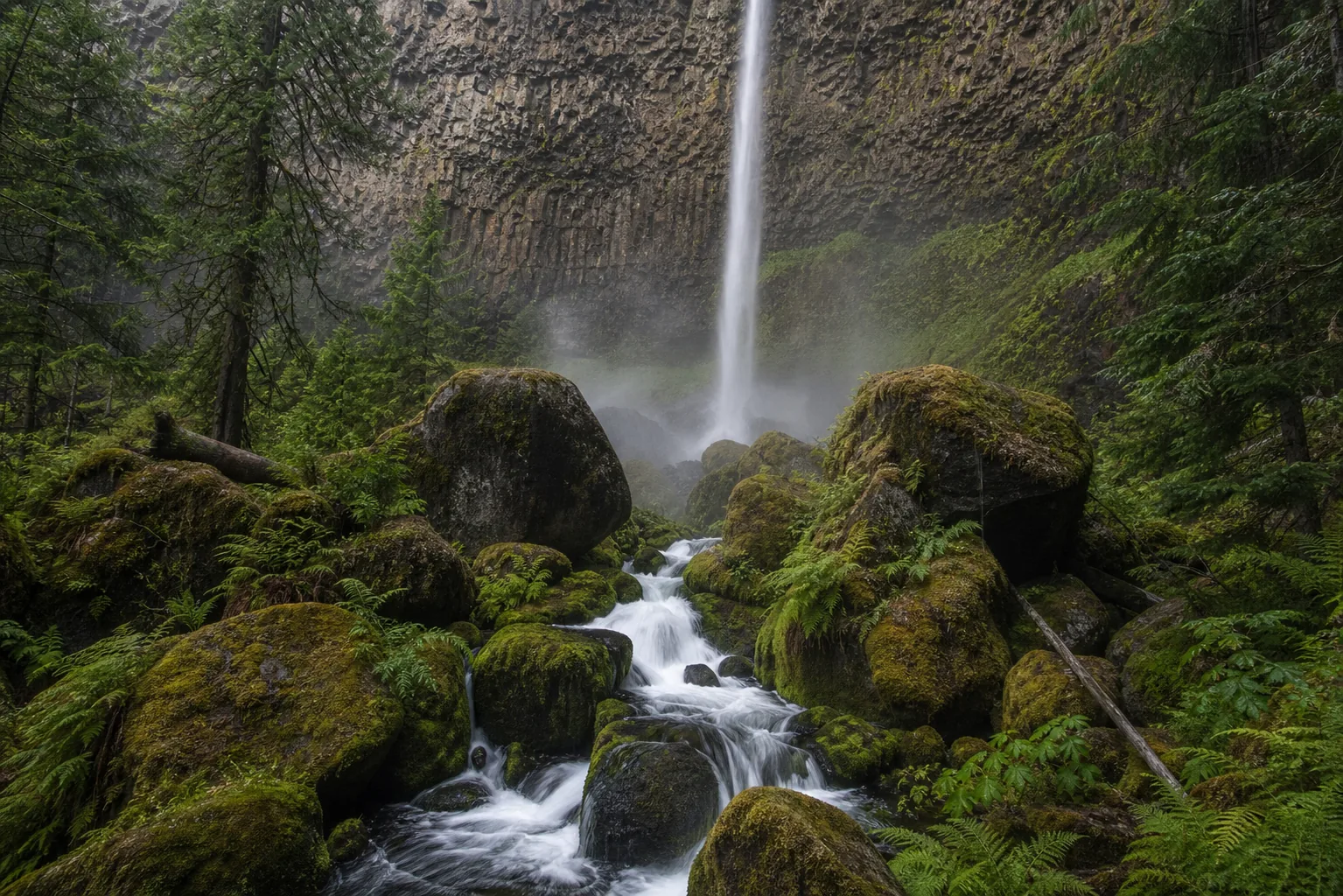
Watson Falls base and spray plume from the wooden footbridge below the plunge
Photo guide

Three angles of a 272-foot Cascade plunge.

Three photographer-tested viewpoints around Watson, arranged the way you would actually walk the trail: the wooden footbridge for the head-on lower frame, the mist-soaked deck just past the bridge for the close detail, and the switchback above the trailhead for the under-photographed top-down angle. Use the captions to decide which frame is worth the climb.

Watson Falls 272-foot single-tier plunge on Watson Creek in the Umpqua National Forest, Oregon
Watson Falls, hero composition
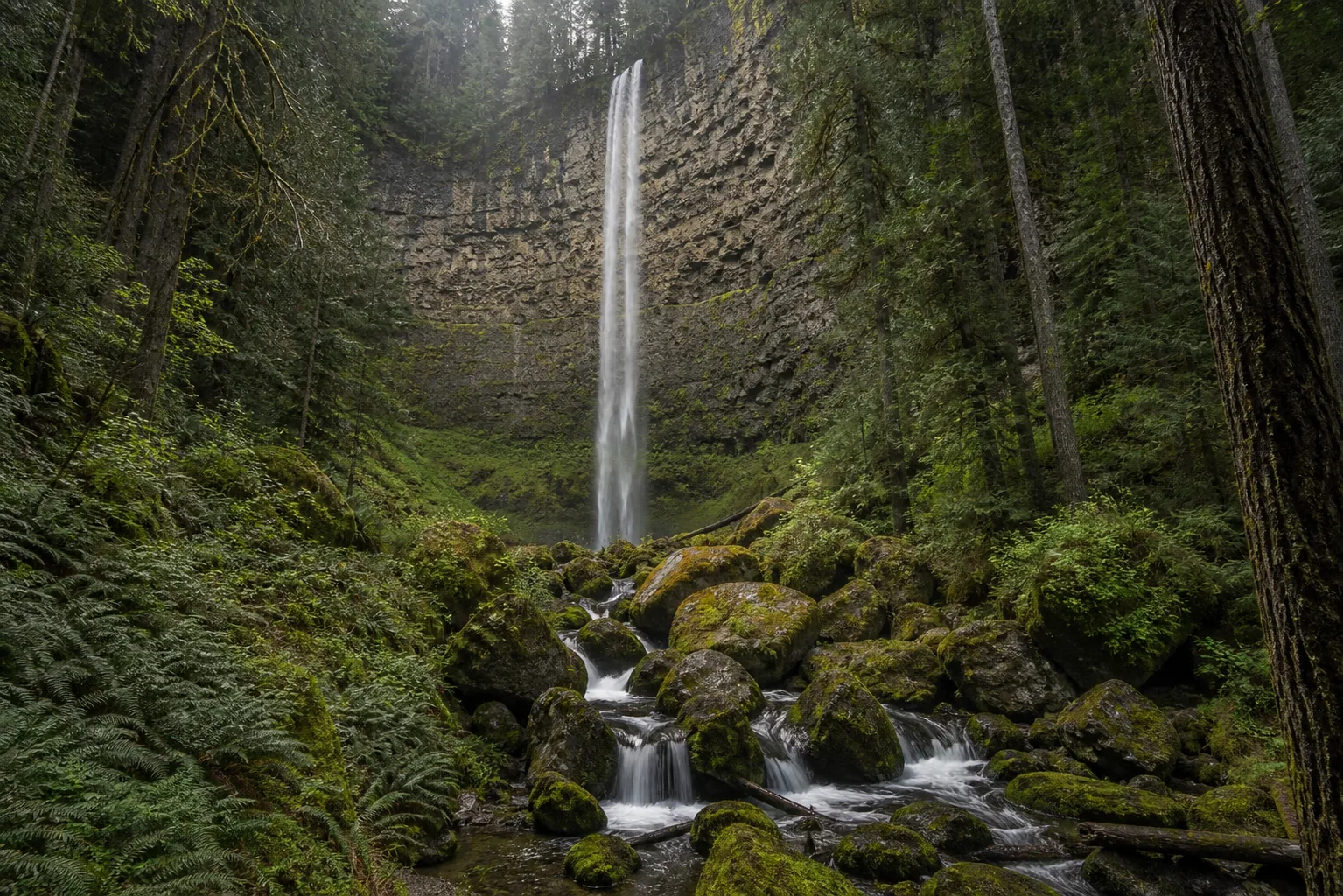
Watson Falls 272-foot single-tier plunge in the Umpqua National Forest with mossy basalt walls and the lower viewpoint footbridge in the foreground
Wide setting view: 272-foot single plunge over the Western Cascades andesite cap
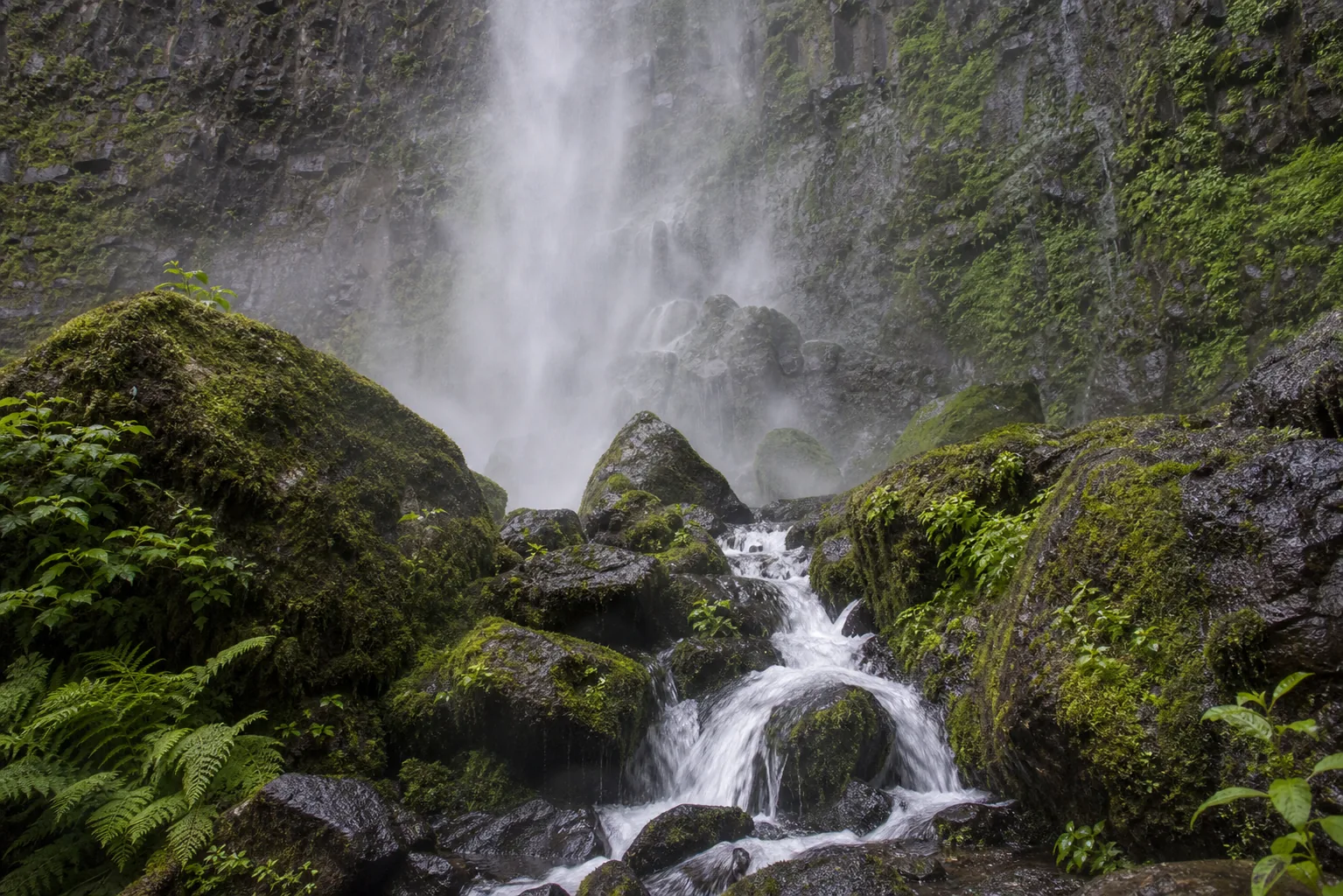
Watson Falls plunge pool and spray plume seen from the wooden footbridge at the lower viewpoint
Base and spray plume from the wooden footbridge below the plunge
Watson Falls upper cliff detail showing columnar-jointed Western Cascades andesite with white water tracing the basalt face below
Water and rock detail: columnar jointing visible in the andesite cap of the upper cliff
01Is Watson Falls flowing right now?

Watson Creek is ungaged, so this page uses the North Umpqua River at Toketee Falls (USGS 14315500) as a watershed proxy about 3.5 km away. Live data: USGS gauge 14315500. The 30-year daily-discharge median on the North Umpqua at Toketee is 78 cfs; the 75th percentile is 90.2 cfs; the 90th percentile is 204 cfs.

02How long is the walk?

Lower viewpoint: 0.6 miles round trip, about 300 feet of climb, 25 to 40 minutes. Full upper-viewpoint loop: 1.6 miles round trip, about 600 feet of cumulative gain, 60 to 90 minutes. The lower-viewpoint route is the standard visit and the one that ends at the wooden footbridge below the falls.

03How do you get there?

Watson Falls trailhead sits on Forest Road 37 about 100 feet south of OR-138, roughly 4 miles east of Toketee Falls and 60 miles east of Roseburg. From Roseburg, take OR-138 east; the signed turnoff is on the right just past milepost 60. Approximate drive times: Roseburg 90 minutes, Eugene 2 hours 5 minutes, Medford 2 hours 10 minutes, Bend 2 hours 30 minutes.

04Is there free parking?

Free trailhead picnic-area lot on Forest Road 37 immediately south of OR-138. NW Forest Pass ($5 day / $30 annual) or America the Beautiful Interagency Pass required. The lot holds about 20 vehicles and fills on summer weekends; overflow is along Forest Road 37 shoulder.

05Does it cost money?

The falls itself is free. Parking requires a NW Forest Pass ($5 day or $30 annual) or an America the Beautiful Interagency Pass ($80 annual; free for active-duty military, fourth graders, and US seniors at applicable rates). No reservation system.

06Trail variants

Lower viewpoint 0.6 mi round trip, 25-40 min, wooden footbridge crossing the lower stream, mist-soaked deck below the plunge.
Full loop with upper viewpoint 1.6 mi round trip, 60-90 min, switchbacks climb above the falls for a top-down angle, then drop back to the trailhead.
Combined Watson and Toketee day two trails, about 5 mi of driving between, half day, pair with Toketee Falls 4 mi west on OR-138 for two of the corridor's signature stops.
Rogue-Umpqua waterfall corridor drive itinerary, full day, Toketee, Watson, Whitehorse, and Clearwater fit one circuit along the byway.

Detailed maps and recent reviews: Falls route on AllTrails · Creek route on AllTrails

07Can you swim?

No. Swimming is not permitted at Watson Falls. The plunge pool sits beneath a 272-foot drop with falling-rock and saturated-log hazards. For safe swimming on the byway, the North Umpqua River at Boulder Flat and Diamond Lake (about 25 miles east) are the local options.

08Are dogs allowed?

Yes, on a leash. The Umpqua National Forest leash rule applies on the Watson Falls trail and at the picnic area. Keep dogs back from the wet rock and the footbridge handrails.

09Is it accessible?

The Watson Falls trail is not wheelchair accessible. It climbs about 300 feet over a third of a mile on a natural-surface tread and crosses a wooden footbridge. The picnic area near the trailhead is the only step-free portion.

Field notes

Watson Falls at a glance.

272-foot single-tier plunge on Watson Creek, a tributary of the Clearwater River, in the Umpqua National Forest, Douglas County, Oregon. 0.6-mile trail to the lower viewpoint. NW Forest Pass required. Managed by the USFS Diamond Lake Ranger District.

Height 272 ft USGS 3DEP
Type Plunge (single tier) USGS
County Douglas Douglas County, OR
Managed by U.S. Forest Service USFS
Water source Watson Creek (tributary of the Clearwater River) USGS
Elevation 3412 ft USGS NED
Park area 983,239 acres USFS
Hours Day-use trailhead, open year-round; access road typically clear May through October and snow-affected the rest of the year USFS
When to visit

Two windows that justify the drive, one that fills the gap.

May through early June for the loudest snowmelt and the heaviest spray on the footbridge. The first half of October for fall color in the vine-maple along the gorge. The summer middle (July through September) is fine for a casual stop but the falls reads thinner and the trail is hotter than the rest of the byway.

PEAK FLOW

Peak flowMay - early June (snowmelt)
Ice / low flowDec - Mar (road may be snow-affected)
Most crowdedWeekends and midday
Best photosSunrise or weekdays

Live water context

Discharge data -- Live reading from North Umpqua River at Toketee Falls, OR (USGS 14315500) refreshes on the next build. Open the gauge link below for the current cubic-feet-per-second reading.

USGS 14315500 · North Umpqua River at Toketee Falls, OR

Why is it called Watson Falls?

The falls takes its name from Watson Creek, the stream that drops over the lip. The creek was given the name during the late-1800s homesteading and exploration era around the upper North Umpqua and Clearwater drainages, and the name carried over to the waterfall when USFS trail surveyors mapped the area in the early twentieth century.

Several other Watson Falls exist in the United States (Watson Falls in Vermont, the Watson Falls cascade in New York, and the seasonal Watson Falls in Tennessee). For directions and trail reports, search the full string Watson Falls Oregon or Watson Falls Umpqua National Forest to avoid landing on the wrong waterfall.

What else to do at Umpqua National Forest

Watson Falls sits inside the Umpqua National Forest along the OR-138 Rogue-Umpqua Scenic Byway, the corridor that strings together the southwest Oregon waterfall belt between Roseburg and Diamond Lake. Toketee Falls is 4 miles west on the same byway and is the natural pair for a half-day stop. Two more easy roadside waterfalls (Whitehorse Falls and Clearwater Falls) sit a few miles east of Watson and round out a full-day waterfall circuit along the byway.

  • Watson Falls Trailhead and picnic area. Free trailhead lot off Forest Road 37, just south of OR-138, with vault toilets and a small day-use picnic area. NW Forest Pass or America the Beautiful pass required to park.
  • Lower viewpoint and footbridge. A short climb (about 300 feet over a third of a mile) ends at a wooden footbridge that crosses the lower stream right below the spray line; the deck just past it is the standard photo viewpoint.
  • Upper viewpoint via loop. Switchbacks above the trailhead climb to a top-down view of the lip, then drop back to the parking area for a 1.6-mile loop with about 600 feet of cumulative gain.
  • Rogue-Umpqua Scenic Byway corridor. Toketee Falls 4 miles west, Whitehorse Falls about 5 miles east, and Clearwater Falls about 6 miles east. All four sit within a 15-mile stretch of OR-138.

Why it looks this way

Watson Falls drops over the volcanic stack of the Western Cascades, an older arc of basalt and andesite flows that pre-dates the much taller High Cascade volcanoes east of OR-138. A more erosion-resistant andesite cap forms the lip and upper cliff (with visible columnar jointing in the upper face), and a softer underlying basalt and weathered tuff have eroded back faster, leaving the 272-foot single-drop plunge. The geometry is the same caprock-undercut mechanic that produces most of Oregon's tall waterfalls; what gives Watson its height is that the resistant cap is unusually thick at this contact, which lets the cliff hold its shape for the full plunge rather than splitting into tiers.
Field guide deep dive

What you cannot tell from an AllTrails listing.

Western Cascades geology, the disputed third-tallest ranking, the 0.6-mile climb to a wooden footbridge, and the full Rogue-Umpqua waterfall corridor. Skim the headers, read what you need.

How Watson Falls formed

Watson Falls drops over the Western Cascades, the older volcanic arc that pre-dates the much taller High Cascade peaks east of OR-138. The Western Cascades stack here is a sequence of basalt and andesite flows, lahars, and reworked volcaniclastic material erupted between roughly 35 and 7 million years ago. Watson Creek cuts through that stack on its way down to the Clearwater River, and the falls is the spot where the creek meets a particularly resistant volcanic layer.

The lip and the upper cliff are formed by a thick, erosion-resistant andesite cap. Look closely at the upper face in dry-season photos and you can read the columnar jointing in that cap, the polygonal fracture pattern that volcanic flows develop as they cool and contract. The rock underneath is softer basalt and weathered volcaniclastic material that has eroded back faster than the cap. That contact between hard caprock and softer base is what gives Watson its height in a single drop: the cap holds together for the full plunge instead of breaking the descent into tiers.

The mechanic is the same caprock-undercut process that produces most of Oregon's tall waterfalls. What is unusual at Watson is the thickness of the resistant layer and the relatively low water volume of Watson Creek. A bigger stream on the same geometry would have either eroded the cap faster or split into multiple tiers; Watson holds a clean 272-foot single drop because the cap is robust and the creek is modest.

The 0.6-mile trail and the wooden footbridge

The Watson Falls trail is short and front-loaded with climb. From the picnic-area trailhead the path leaves the parking lot, crosses a small bench, and begins a steady ascent through Douglas-fir and western red-cedar. Total climb to the lower viewpoint is about 300 feet over roughly a third of a mile, so the trail averages a 15 to 18 percent grade. It is not technical, just steady; expect 25 to 40 minutes round trip at a moderate pace.

About two-thirds of the way up, the trail crosses Watson Creek on a wooden footbridge directly below the falls. The bridge sits inside the spray plume from May onward, which means the deck is wet, the handrails are slick, and the air temperature drops noticeably as you cross. The standard photo frame is taken from the bridge or from the small viewing deck just past it, both with the full 272-foot drop and the columnar-jointed upper cliff in view.

For more, take the switchbacks above the trailhead to the upper viewpoint and return on the loop. That option is 1.6 miles round trip and adds about 300 feet more cumulative gain. The upper view gives a top-down angle of the lip and the rim above the columns; it is the under-photographed frame on the trail and a better option for hot summer afternoons because most of the climb is shaded.

Is Watson really the third-tallest waterfall in Oregon?

Almost every roadside sign and tourism page calls Watson the third-tallest waterfall in Oregon. The claim is widespread (Travel Oregon, USFS Umpqua National Forest, AllTrails, TripAdvisor) but it is contested. Multnomah Falls in the Columbia River Gorge is unambiguously taller at 620 feet. Watson is therefore not number two, and the ranking question is really about positions three through ten.

The Northwest Waterfall Survey re-measured Watson in 2009 at 293 feet, slightly taller than the long-quoted 272-foot figure. Oregon Hikers' Field Guide notes that even at 293 feet, Watson does not actually crack the top three on the survey's own ranked list once seasonal and lesser-known waterfalls are counted. The 272-foot number is the figure on the original USFS sign and the one Wikipedia uses; both numbers refer to the same single drop measured differently.

The honest summary: Watson is one of Oregon's tallest waterfalls in a single uninterrupted plunge, comfortably top-ten by any methodology, and the tallest in southwest Oregon. The third-tallest claim is repeated often but does not survive a careful re-survey. This page reports the 272-foot figure as the canonical USFS number and flags the 293-foot survey result for visitors who want the more precise reading.

The Rogue-Umpqua waterfall corridor

OR-138 between Roseburg and Diamond Lake is the densest stretch of roadside waterfalls in southern Oregon. Four of the corridor's signature stops sit within a 15-mile arc, all on Western Cascades volcanics, all on or just off the byway. The natural day-trip order from west to east:

Toketee Falls (about 4 miles west of Watson) is a two-tier 120-foot plunge over a textbook columnar-basalt cliff, reached by a 0.8-mile trail with about 200 stairs. See the Toketee Falls guide for trail details and the lower-viewpoint scramble. Watson Falls is the height stop and the entry on this page. Whitehorse Falls sits about 5 miles east of Watson, a 14-foot wide-curtain drop viewable from the picnic-area overlook with essentially no walk. Clearwater Falls is another mile or so east, a 30-foot tiered drop on the Clearwater River with a 200-foot stroll from the picnic area.

Total drive time between the four trailheads is under 30 minutes. Total walking time is 90 to 150 minutes depending on whether you do the upper-viewpoint loop at Watson. All four are free to visit; Toketee and Watson both require a NW Forest Pass or an Interagency Annual Pass for the trailhead lot.

Photography: mist, columns, and an October fall-color window

The lower-viewpoint deck just past the wooden footbridge is the position most photographers use, and it is wet from May through October. Bring a microfiber cloth and a rain shell; tripods are fine outside peak weekends but plan to wipe the front element between exposures. A polarizer takes the glare off wet rock and reveals the columnar jointing in the upper cliff. Neutral-density filters in the 3- to 6-stop range pull the curtain into the long-exposure smooth-water look at the cost of detail in the spray plume.

The falls faces roughly south, so direct sun reaches the cliff from late morning through mid-afternoon and blows out the white water against the dark basalt. The cleanest light is the first hour after sunrise (when the falls is in shade and the cliff above catches warm light) or any overcast day. The under-photographed window is the first two weeks of October, when vine-maple and big-leaf-maple in the lower gorge turn yellow and orange and the still-wet deck reflects the warm leaves into the foreground. Bring a longer lens (70 to 200 mm equivalent) for the mid-cliff column detail; the wide-angle frame from the bridge handles the full-height shot.

Winter access and the snow line

OR-138 is plowed year-round between Roseburg and Diamond Lake, but the Watson Falls turnoff onto Forest Road 37 is not consistently cleared. From roughly mid-December through mid-March the road is usually under snow, and even a short turnoff drift can block the lot. Most winter visitors park at the OR-138 pullout (where road conditions allow) and post-hole the last hundred yards in to the trailhead.

The trail itself stays open all year. Expect packed snow and ice on the climb to the footbridge, with a real possibility of ice rime on the bridge deck and handrails. Microspikes are the practical winter footwear; the bridge crossing is the most exposed section. In a hard freeze the spray plume builds ice rime on the lower cliff face and on the trees beside the bridge, which is the photogenic winter frame; in a mild wet winter the deck is just wet and slick.

If you are visiting between November and March, check the USFS Diamond Lake Ranger District alerts and the ODOT TripCheck conditions for OR-138 before driving from Roseburg. Snow chains can be required on the byway during winter storms even when the highway itself is plowed.

Map and route

Sixty miles east of Roseburg, four miles east of Toketee.

Watson Falls trailhead sits on Forest Road 37 about 100 feet south of OR-138, roughly 4 miles east of Toketee Falls and 60 miles east of Roseburg. From Roseburg, take OR-138 east; the signed turnoff is on the right just past milepost 60. Approximate drive times: Roseburg 90 minutes, Eugene 2 hours 5 minutes, Medford 2 hours 10 minutes, Bend 2 hours 30 minutes.

Photography and weddings

South-facing 272-foot drop, three working positions, USFS special-use rules for commercial work.

Three working positions. The wooden footbridge gives the standard lower-viewpoint frame with the full 272-foot drop and spray plume. The deck just past the bridge is closer and wetter and is where most of the published Watson Falls images are made. The switchback above the trailhead delivers an under-photographed top-down angle of the lip and the upper columnar-jointed cliff.

The falls faces roughly south, so direct sun lands on the cliff face from late morning through mid-afternoon and tends to blow out the white water against the dark basalt. Soft overcast light or the first hour after sunrise is the cleanest light of the day. October backlights yellow vine-maple in the gorge and is the best moment for an atmospheric long-exposure frame.

Personal photography from the trail and viewpoints does not require a permit. Tripods are fine outside peak weekends; commercial production, drone use, and any setup that blocks the trail or footbridge require USFS authorization.

Permits

Weddings and engagements

Watson Falls is not a practical ceremony location. The lower viewpoint deck is small, frequently wet from spray, and shared with hikers all day; small two-person engagement portraits work, larger setups do not.

USFS special-use authorization is required for any commercial photography or organized event on the Watson Falls trail. Contact the Diamond Lake Ranger District for current rates and lead times.

If you want a Rogue-Umpqua waterfall portrait, the Toketee Falls upper trail and the Whitehorse Falls picnic area handle small groups better than the Watson Falls footbridge.

Nearby waterfalls

Four Rogue-Umpqua waterfalls on one day along OR-138.

Watson pairs naturally with Toketee Falls 4 miles west and with Whitehorse and Clearwater falls a few miles east. All four sit on Western Cascades volcanics within a 15-mile stretch of the byway, and all four can be visited inside a single day without a wilderness permit.

Related questions

More questions visitors ask before driving to Watson Falls.

Height, hike length, dogs, swimming, fees, winter access, and the worth-visiting question. The full set is also indexed in the FAQ schema for AI answer engines.

01How tall is Watson Falls?

Watson Falls is 272 feet tall in a single uninterrupted plunge over a Western Cascades andesite cliff. A 2009 Northwest Waterfall Survey re-measurement put the drop at 293 feet; the USFS sign and most published references use the original 272-foot figure. Either number makes it the tallest waterfall in southwest Oregon.

02Where is Watson Falls?

Watson Falls is in the Umpqua National Forest, Douglas County, Oregon, on Watson Creek (a tributary of the Clearwater River). The trailhead sits just south of OR-138 on Forest Road 37, roughly 60 miles east of Roseburg and 4 miles east of Toketee Falls along the Rogue-Umpqua Scenic Byway.

03Is Watson Falls free to visit?

The falls itself is free, but the trailhead lot requires a Northwest Forest Pass ($5 day or $30 annual) or an America the Beautiful Interagency Pass ($80 annual). No additional reservation or entrance fee applies, and the pass is the same one used at Toketee Falls.

04When is the best time to visit Watson Falls?

The two strongest windows are May through early June for peak snowmelt, when the spray plume reaches the footbridge, and the first half of October for vine-maple fall color in the gorge. July through September are fine for casual stops but the falls reads thinner; winter access depends on Forest Road 37 being clear of snow.

05Is Watson Falls open in winter?

The trail is technically open year-round, but Forest Road 37 to the trailhead is not consistently plowed from about mid-December through mid-March. In hard winters the spray plume builds ice rime on the lower cliff and the bridge deck; microspikes are the practical winter footwear. Check Diamond Lake Ranger District alerts and ODOT TripCheck for OR-138 before driving.

Sources and data

Where the Watson Falls guide gets its facts.

USFS Umpqua National Forest trail page for the trail length, pass requirement, and height. Oregon Hikers Field Guide for the 2009 re-survey and the dispute over the third-tallest ranking. Live discharge from USGS NWIS gauge 14315500 (North Umpqua River at Toketee, used as a Watson Creek proxy). Western Cascades volcanic stratigraphy from DOGAMI and USGS publications.

USGS Streamflow: 14315500 North Umpqua River at Toketee Falls, OR waterdata.usgs.gov
USFS: Umpqua National Forest fs.usda.gov
Access, parking, and permit rules: fs.usda.gov
DOGAMI / USGS: Western Cascades volcanic stratigraphy (Sherrod and Smith): Douglas County bedrock pubs.usgs.gov
NOAA / NWS Medford forecast grid MFR 93,107 noaa.gov
USGS National Elevation Dataset 3DEP
Google Maps: embedded map and directions maps.google.com
Google Places: nearby restaurants and hotels places API
USFS Umpqua National Forest: Watson Falls Trail fs.usda.gov
Oregon Hikers Field Guide: Watson Falls Loop Hike oregonhikers.org
Travel Oregon: Watson Falls destination page traveloregon.com
Wikipedia: Watson Falls en.wikipedia.org
Wikidata: Watson Falls wikidata.org
AllTrails: Watson Falls alltrails.com
USGS NWIS: North Umpqua River at Toketee Falls (gauge 14315500, Watson Creek proxy) waterdata.usgs.gov
Wikimedia Commons: Watson Falls images commons.wikimedia.org
Fact checks
Height audit: USFS Umpqua National Forest and Wikipedia list Watson Falls at 272 feet; the Northwest Waterfall Survey's 2009 re-measurement (cited by Oregon Hikers) returned 293 feet. This guide uses the 272-foot figure as the canonical USFS number and flags the 293-foot survey result inline.
Third-tallest claim: USFS, Travel Oregon, AllTrails, TripAdvisor, and 10Adventures all describe Watson as the third-tallest waterfall in Oregon. The Oregon Hikers Field Guide notes the Northwest Waterfall Survey's ranked list does not actually place Watson third once all Oregon waterfalls are counted. This guide reports the popular ranking and the dispute side by side.
Pass audit: NW Forest Pass requirement at the Watson Falls trailhead is confirmed on the USFS Umpqua National Forest trail page. America the Beautiful Interagency Pass is accepted in lieu of the NW Forest Pass per USFS pass-program rules.
Geology audit: The Western Cascades volcanic stratigraphy (andesite over basalt, columnar jointing in the cap) is consistent with the DOGAMI and USGS Cascade Range mapping for this part of Douglas County.
Corrections: [email protected]