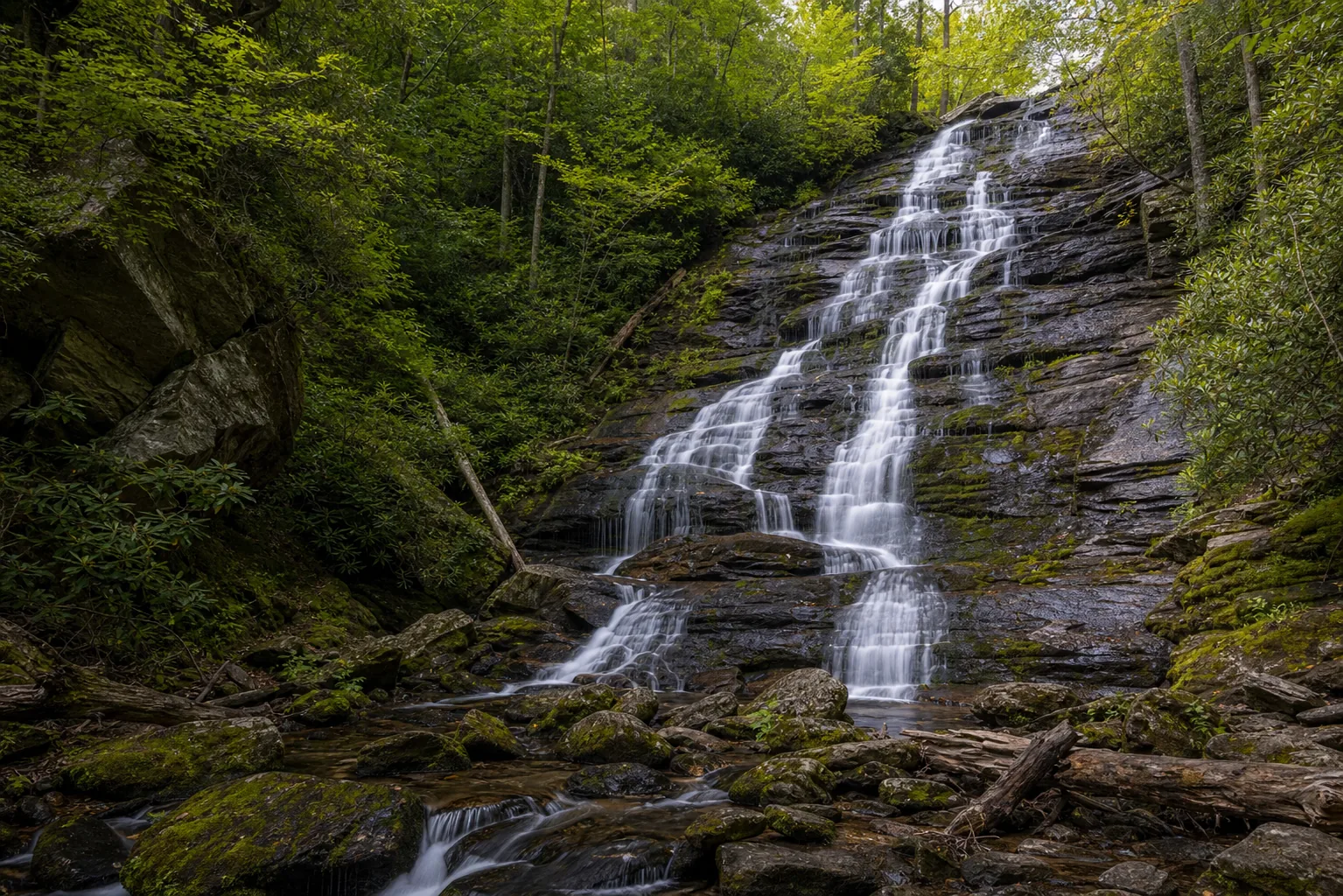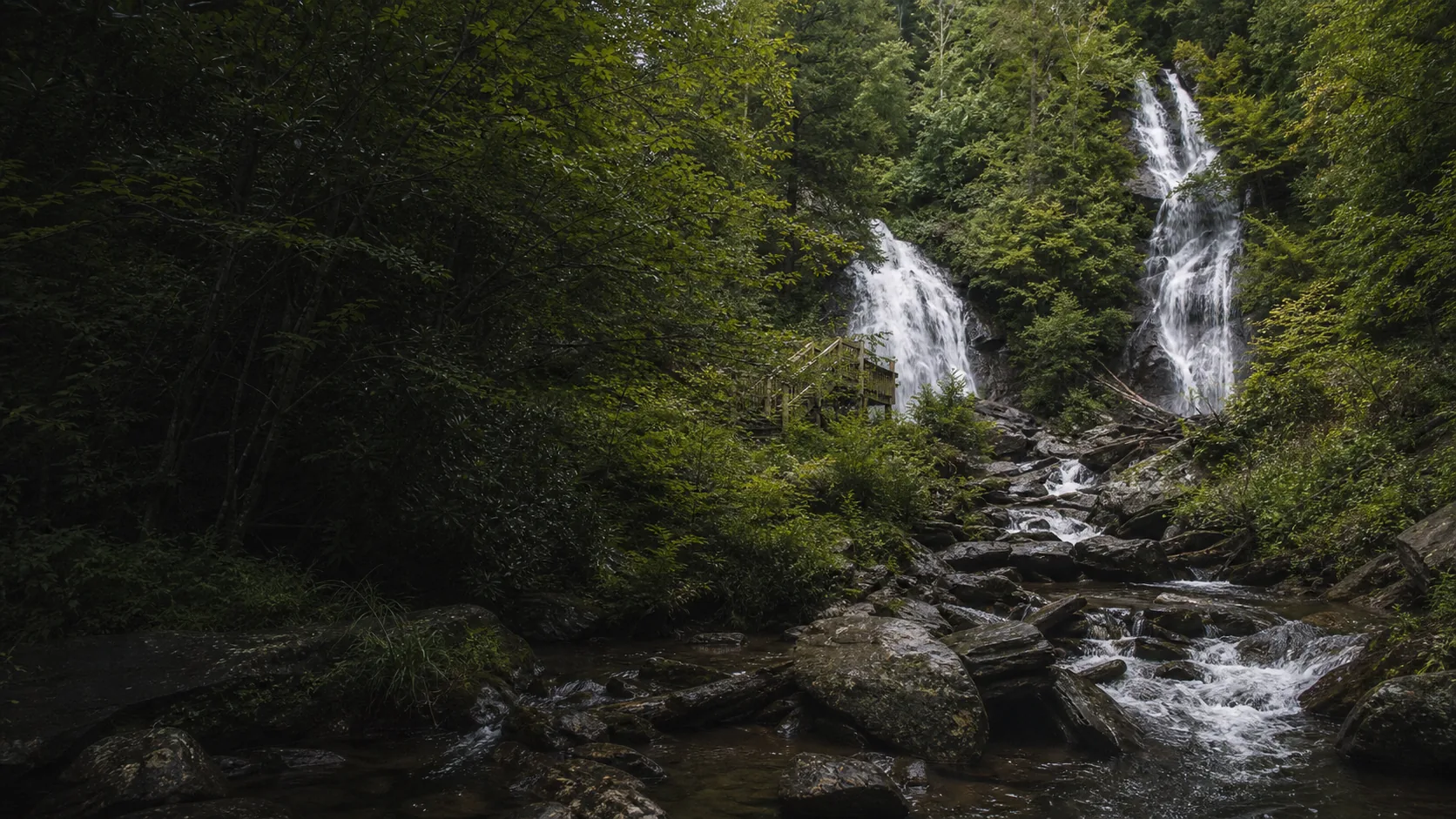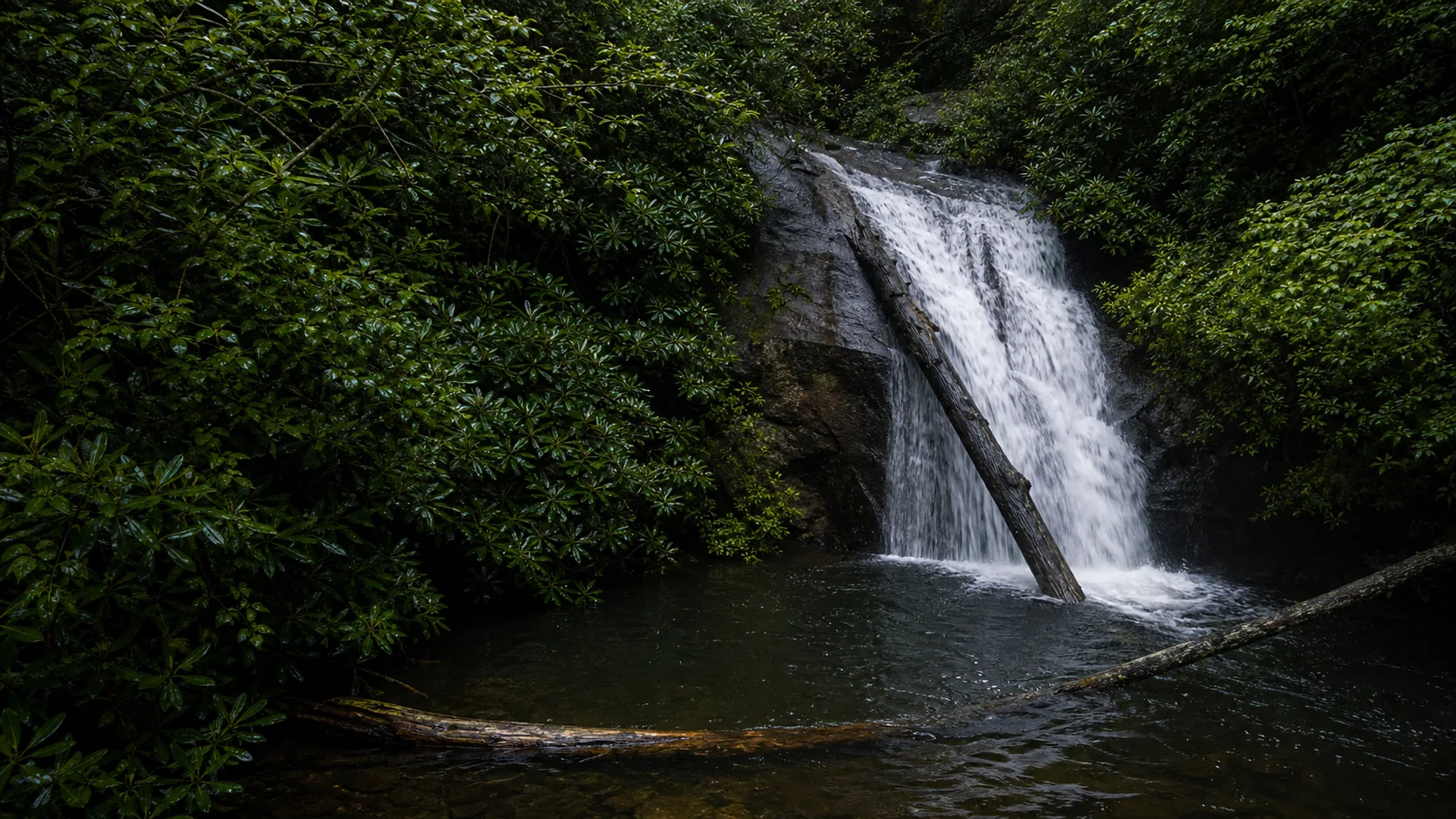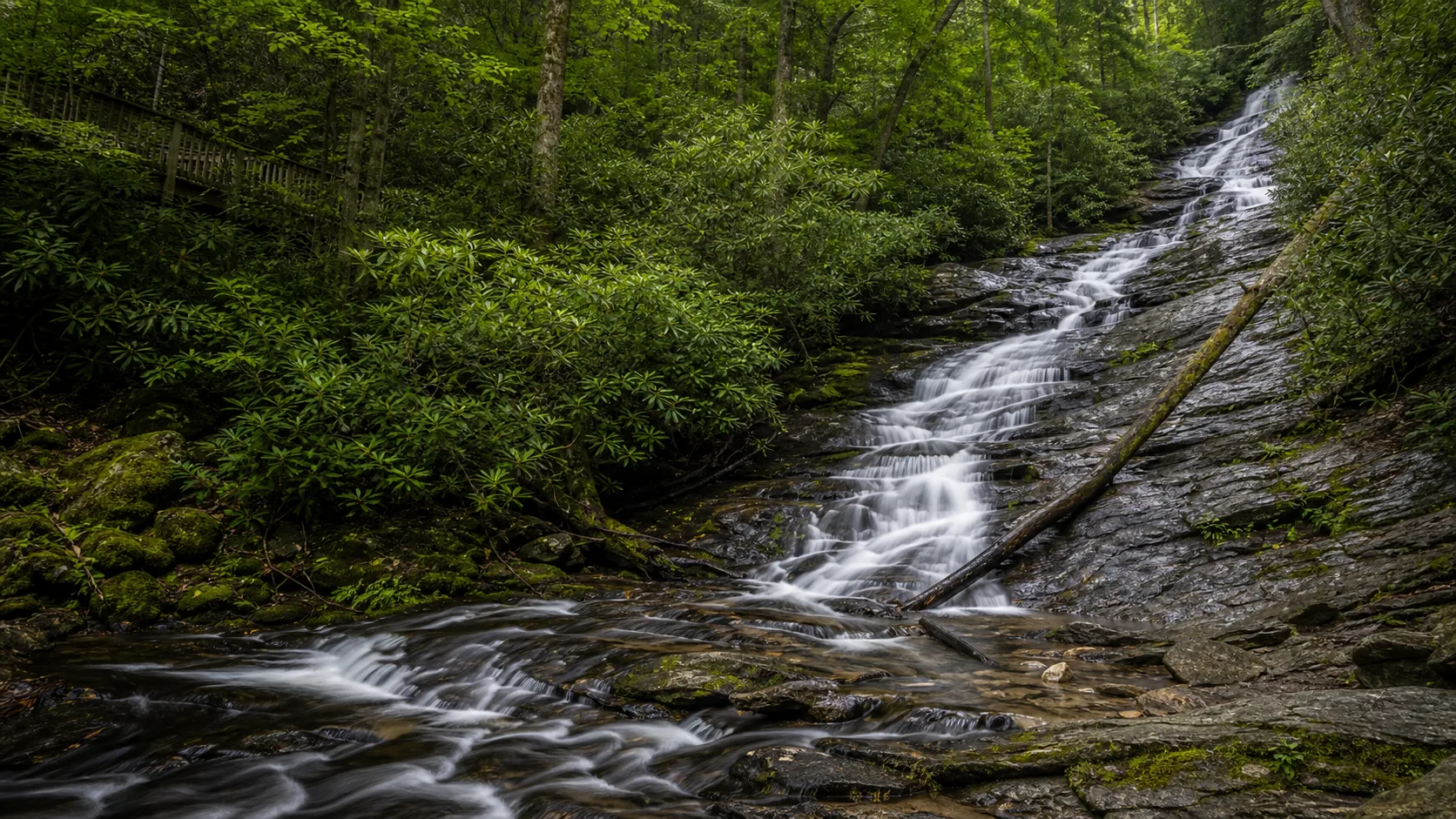
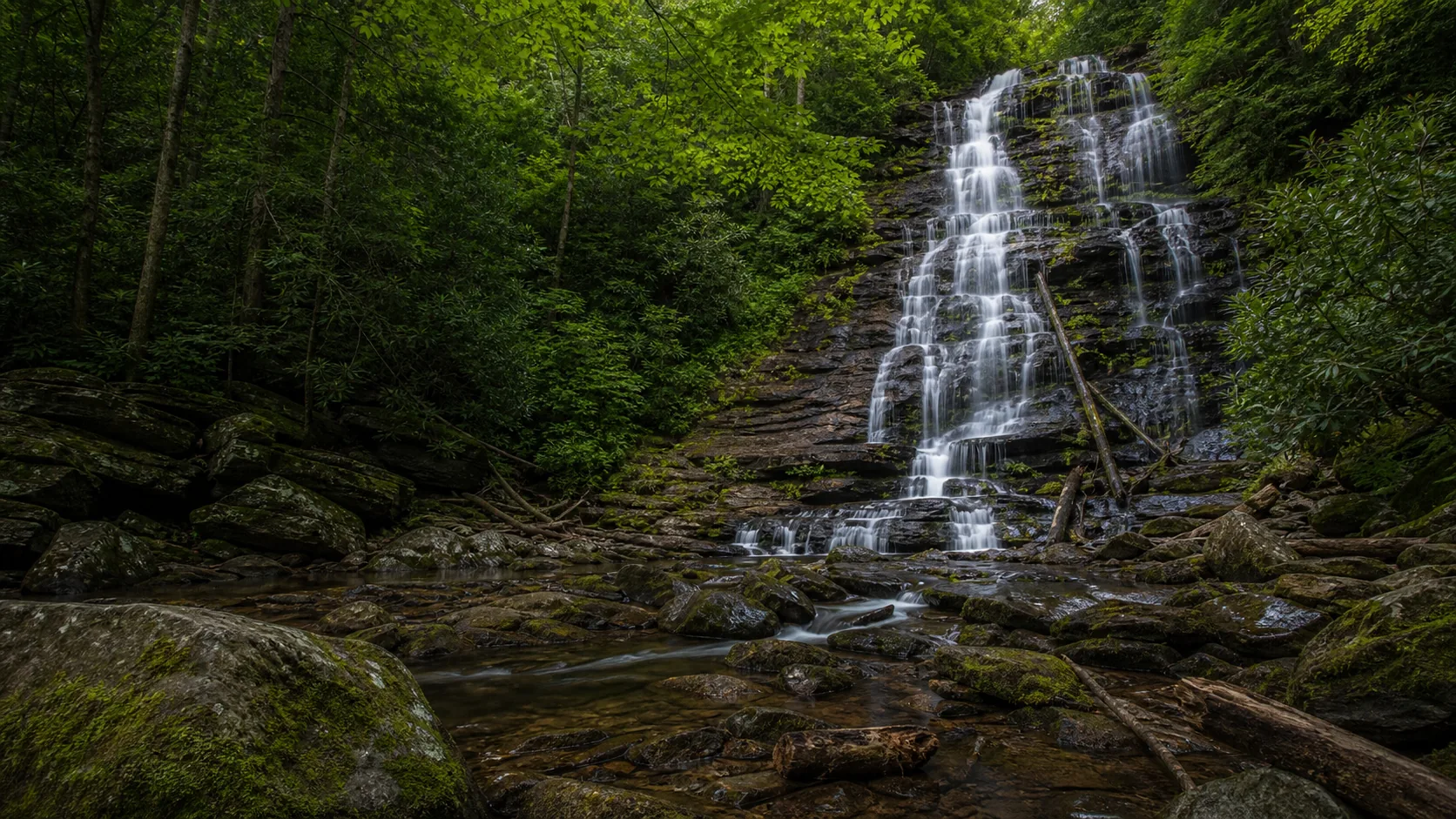
Issaqueena Falls 100-foot plunge in Sumter National Forest, near Walhalla, South Carolina
Walhalla, SC

Issaqueena Falls

Issaqueena Falls is a 100-foot single-drop plunge in the Oconee Ranger District of the Sumter National Forest, reached by a short gravel path from the Stumphouse Tunnel parking area near Walhalla, South Carolina. The falls is named for an Issaqueena, a figure from a regional Cherokee legend in which a young woman is said to have leapt from the lip to escape pursuers; the story is folklore, not historical record, and the same name attaches to several other features along the Cherokee Foothills Scenic Byway.

Last verified May 12, 2026 Visited Desk-verified May 2026 8 sources checked
Trail 0.3 mi 0.6 mi extended
Time 10-30 min Easy
Best season March-May, October March-May after rain
Parking Free day-use parking at Stumphouse Tunnel Park; lot fills on October weekends and spring waterfall days Stumphouse Tunnel Park (Sumter National Forest, Oconee Ranger District)
Quick answer

Is Issaqueena Falls worth visiting?

Yes, especially in March through May after Upstate rain and again in October when the hardwoods color the gorge. The visit is free, the parking lot is free, the trail from the Stumphouse Tunnel lot to the fenced overlook runs about a tenth of a mile downhill, and the falls runs year-round even in dry summers because Cane Creek drains a broad section of Stumphouse Mountain. Pair it with the 1850s Stumphouse Tunnel one minute away for a 60- to 90-minute combined stop.

  • 100-foot single-drop plunge in Sumter National Forest
  • Short 0.3 mi out-and-back from Stumphouse Tunnel lot
  • Free parking, no entrance fee
  • Best windows: March-May and October
  • Pair with the 1850s Stumphouse Tunnel
  • Sits on the SC-11 Cherokee Foothills Scenic Byway
Last verified May 12, 2026 Visited Desk-verified May 2026 8 sources checked
Distance 0.3 mi 0.6 mi extended
Round trip 10-30 min Short, gently descending gravel-and-dirt path; tree-root and rock footing in spots
Difficulty Easy Short, gently descending gravel-and-dirt path; tree-root and rock footing in spots
Location Walhalla, SC Stumphouse Tunnel Park (Sumter National Forest, Oconee Ranger District)
Parking Free day-use parking at Stumphouse Tunnel Park; lot fills on October weekends and spring waterfall days Oconee County / USFS
Transit No fixed-route transit Drive only; nearest commercial bus stops are in Greenville · 0 ft
Drive 7 mi 12 min from downtown
Best season March-May, October March-May after rain
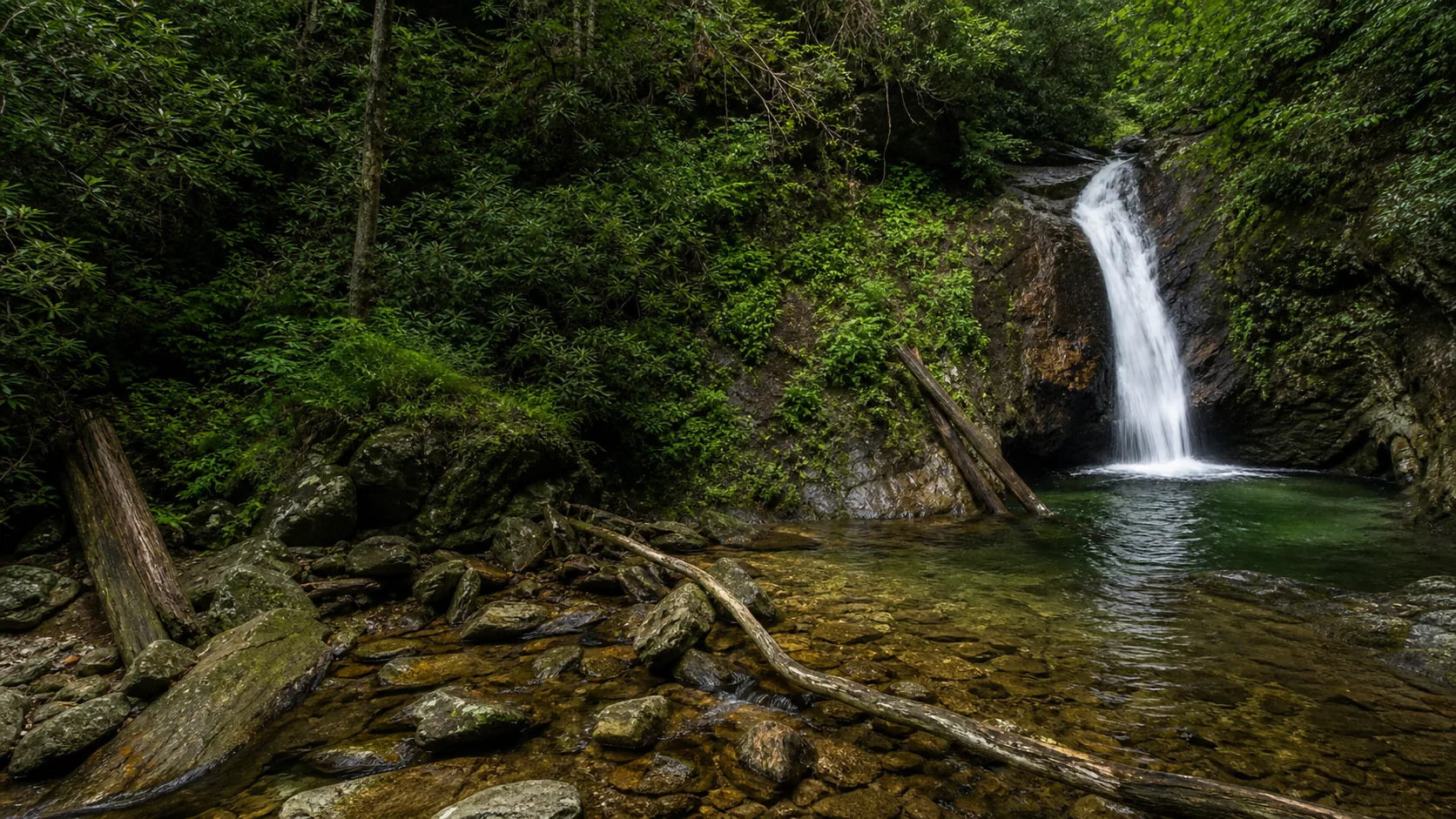
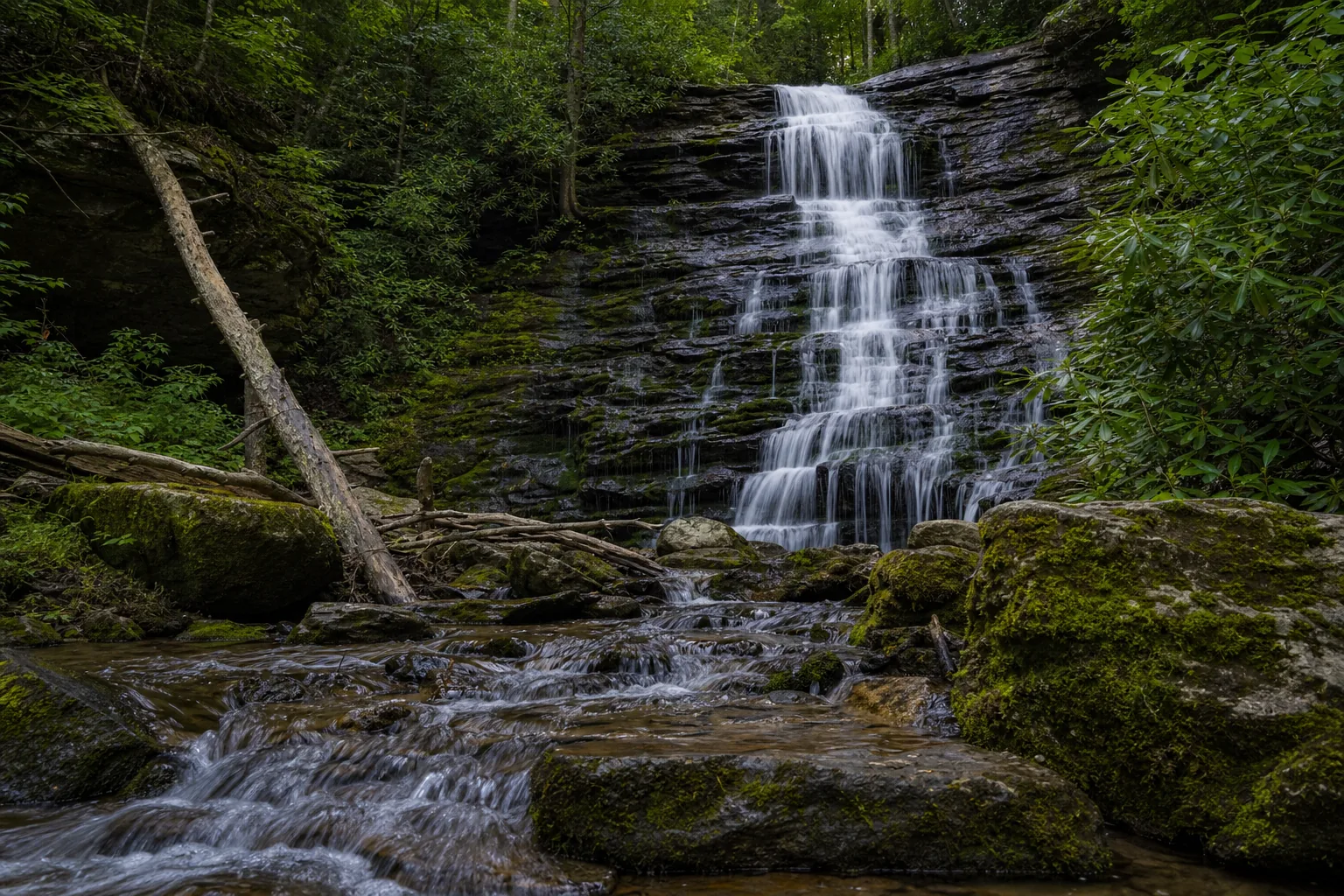
Issaqueena Falls base of issaqueena falls where cane creek lands on dark blue ridge gneiss and schist below the plunge
Photo guide

Three working angles on a 100-foot single-drop plunge.

Issaqueena Falls is essentially a one-position waterfall: the fenced upper overlook from Stumphouse Tunnel Park. The other two useful frames are the clearing just above the platform and an unofficial base view that is steep enough to skip on a casual trip.

Issaqueena Falls 100-foot plunge in Sumter National Forest, near Walhalla, South Carolina
Issaqueena Falls, hero composition
Issaqueena Falls 100-foot plunge seen from the Stumphouse Tunnel Park overlook above the gorge
Issaqueena Falls from the upper overlook, with the full 100-foot single-drop plunge framed by hardwood canopy
Issaqueena Falls base and plunge pool on metamorphic Blue Ridge bedrock
Base of Issaqueena Falls where Cane Creek lands on dark Blue Ridge gneiss and schist below the plunge
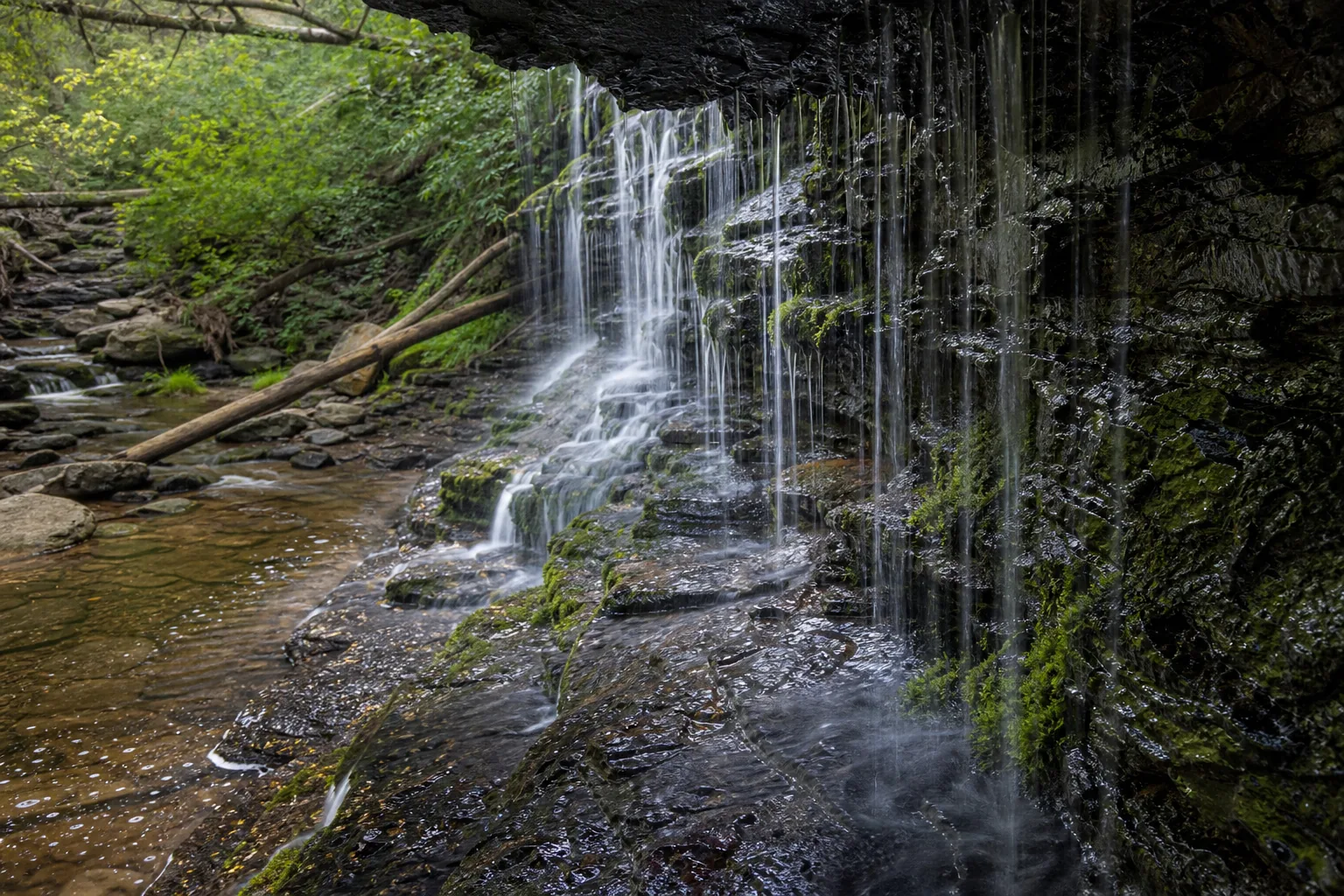
Issaqueena Falls water-on-rock detail with banded Blue Ridge gneiss texture
Water and rock detail on the plunge face, showing the foliated metamorphic banding typical of the Blue Ridge province
01Is Issaqueena Falls flowing right now?

This guide does not currently pair Issaqueena Falls with a verified real-time USGS discharge gauge, so the live flow chip is intentionally hidden.

Cane Creek is not paired with a USGS gauge at the falls, so this page uses a regional planning heuristic rather than a live flow chip: 24 to 48 hours after an inch of rain in Oconee County is reliably good; a dry late summer week will drop the flow to a thin twin curtain.

02How long is the walk?

About 0.15 mi downhill from the Stumphouse Tunnel Park lot to the fenced overlook, roughly a 5 to 10 minute walk depending on footing. Round trip is about 0.3 mi with a short climb back up to the parking area. The path is gravel and packed dirt with exposed tree roots and rock steps in places; trail shoes are enough.

03How do you get there?

From downtown Walhalla, drive about 7 miles north on SC-28; Stumphouse Tunnel Park is signed on the left. From Greenville, take US-123 to SC-28 north, about 70 minutes. From Atlanta, take I-85 north to US-123 east, then SC-28 north, about 2.5 hours. The address most navigation apps recognize is Stumphouse Tunnel Road, Walhalla, SC 29691.

04Is there free parking?

Free day-use parking at Stumphouse Tunnel Park. The lot is paved at the entrance and gravel at the edges. It fills early on October weekends and on spring waterfall days; arrive by mid-morning or visit on a weekday for room.

05Does it cost money?

Free. No entrance fee, no parking fee, no pass required. The Sumter National Forest does not charge a day-use fee at this site.

06Trail variants

Overlook quick stop 0.3 mi out-and-back, 10-15 min, main fenced viewing platform.
Stumphouse Tunnel + Issaqueena Falls combined 0.6-0.8 mi total walking, 60-90 min, park once and walk both.
Base scramble (unofficial) shorter but steep, 20-40 min, informal path; loose footing and not maintained for visitors.
Photo-first visit 0.3 mi out-and-back, 30-45 min, arrive early or use overcast light to balance the canopy and the white water.

Detailed maps and recent reviews: Falls route on AllTrails · Creek route on AllTrails

07Can you swim?

Swimming and wading at the base of Issaqueena Falls are not recommended. The plunge pool is shallow with submerged rocks, the approach from the overlook is steep and not maintained for visitors, and there is no posted safety service. For a real swim in the area, Lake Jocassee at Devils Fork State Park is the standard option.

08Are dogs allowed?

Yes, on a leash. The Sumter National Forest requires a 6-foot leash at developed recreation sites including Stumphouse Tunnel Park; the overlook platform is narrow, so keep dogs close.

09Is it accessible?

The overlook is reached by a short downhill path with packed dirt, tree roots, and a couple of stone steps. It is not ADA-rated and is not a smooth wheelchair surface. The Stumphouse Tunnel approach is firmer but the historic tunnel interior is uneven and not accessible.

Field notes

Issaqueena Falls at a glance.

100-foot single-drop plunge, Blue Ridge metamorphic gneiss and schist, managed jointly by Oconee County and the Sumter National Forest, free to visit, day-use only. Sourced from the USFS Sumter NF Oconee Ranger District pages and the Wikipedia entry.

Height 100 ft USGS 3DEP
Type Plunge (single drop) USGS
County Oconee Walhalla, SC
Managed by Oconee County and USDA Forest Service, Sumter National Forest Oconee County / USFS
Water source Cane Creek (Little Cane Creek tributary) USGS
Elevation 1224 ft USGS NED
Park area Not listed Oconee County / USFS
Hours Day use only; gate hours and seasonal closures change, verify with Oconee County and the Sumter NF before driving Oconee County / USFS
When to visit

Two windows that justify the trip.

March through May for the loudest spring flow on Cane Creek. October for hardwood color in the gorge. Summer is doable but the falls is at its thinnest, and winter is reliably wet rather than reliably frozen at this elevation.

PEAK FLOW

Peak flowMarch-May after rain
Ice / low flowRare partial ice in deep cold snaps
Most crowdedWeekends and midday
Best photosSunrise or weekdays

Live water context

Discharge data -- This guide does not currently pair Issaqueena Falls with a verified real-time USGS discharge gauge, so the live flow chip is intentionally hidden.

Why is it called Issaqueena Falls?

The falls is named after Issaqueena (sometimes rendered Isaqueena or Issaquena), a young woman from a Cherokee legend who reportedly rode through the night to warn white settlers of an impending raid, was pursued back into the mountains, and is said to have leapt from the lip of these falls. The most common version has her landing on a hidden ledge, hiding through the night, and escaping the next morning. It is a legend, not a historical record; there is no contemporary documentary evidence for the leap, and at least one regional account links the name to a real 18th-century interpreter named Cataeechee whose biography was later romanticized.

Whatever the historical core, the name has spread across the region. Issaqueena Lake, Issaqueena Trail, and Lake Issaqueena Park all share the same root, and the legend itself is treated as folklore by the upstate historical societies that have written about it.

What else to do at Stumphouse Tunnel Park (Sumter National Forest, Oconee Ranger District)

Issaqueena Falls sits inside Stumphouse Tunnel Park, a small day-use area on the edge of the Sumter National Forest's Oconee Ranger District just north of Walhalla, South Carolina. The same parking lot serves the 1850s Stumphouse Tunnel, an abandoned Blue Ridge Railroad bore that is now one of the more memorable engineering ruins in the Southeast, plus a network of multi-use trails managed by Clemson University. Walhalla, a German-heritage town founded in 1850, is the closest base for food and lodging, and SC-28 puts you at the trailhead in about ten minutes.

  • Issaqueena Falls upper overlook. A fenced wooden platform built into the gorge wall about 0.15 mi from the lot, with a tree-screened head-on view of the 100-foot plunge.
  • Stumphouse Tunnel. An 1850s railroad tunnel bore about a quarter mile uphill from the falls trailhead; cool year-round, hard hats not required for the public section, and worth a flashlight.
  • Yellow Branch Falls connection. A separate trailhead about two miles up SC-28 leads to a 50-foot tiered cascade and the Yellow Branch Picnic Area, a common pairing for a fuller day.
  • Clemson Experimental Forest singletrack. Mountain-bike and hiking trails radiate from Stumphouse Tunnel Park; the falls overlook itself is foot traffic only.

Why it looks this way

Issaqueena Falls drops over metamorphic bedrock of the Blue Ridge province, the same belt of foliated gneiss and schist that forms most of the Upcountry South Carolina escarpment. Unlike the layered limestone-and-sandstone caprock that produces classic plunges in the Midwest, these Blue Ridge rocks were folded and recrystallized deep in the crust during the Paleozoic and have been slowly stripped to the surface ever since. The result is a hard, banded face that resists weathering as a single tall step rather than a stairstep, which is why Cane Creek drops 100 feet in one clean fall rather than several smaller tiers. Stumphouse Mountain itself, looming above the trailhead, is built of the same metamorphic rocks, which is why the 1850s tunnel project a few hundred yards uphill turned into such a costly engineering problem.
Field guide deep dive

What the tourism listings leave out about Issaqueena Falls.

Blue Ridge geology, the Cherokee legend vs the historical record, the Stumphouse Tunnel pairing, and the SC-11 waterfall day. Skim the headers, read what you need.

How Issaqueena Falls formed

Issaqueena Falls drops over the metamorphic backbone of the Blue Ridge province, a belt of foliated gneiss and schist that runs from north Georgia through the South Carolina Upcountry into western North Carolina. These rocks started life as ordinary sediments and volcanics hundreds of millions of years ago, then were squeezed and recrystallized deep in the crust during the long collision that built the Appalachians. By the time erosion finally stripped them back to daylight, the original layering had been replaced by a tight foliation of micas and quartz that weathers as a hard, slabby face rather than as the stack-of-pancakes look you get from sedimentary caprock.

That is why the falls reads as a single 100-foot plunge instead of a tiered cascade. Cane Creek is a small stream by Blue Ridge standards, but it has spent a long time cutting down through resistant metamorphic bedrock, and the lip of the falls sits where a particularly hard band of gneiss happens to cross the streambed. Below the lip, the gorge widens into the steep tree-walled bowl visible from the overlook. Stumphouse Mountain immediately east is built of the same rock, which is the reason the 1850s Blue Ridge Railroad ran into a slow, expensive engineering problem when crews tried to tunnel through it a few hundred yards uphill.

Issaqueena vs Cataeechee: the legend and the historical record

The standard Cherokee legend at Issaqueena Falls is the version most visitors arrive with. A young woman, usually said to be Cherokee but sometimes Choctaw, learns that her tribe is planning a raid on white settlers in the Carolina Upcountry. She rides through the night to warn them, is pursued back into the mountains, and is cornered at the lip of the falls. Rather than be captured, she leaps. The most retold ending has her landing on a hidden ledge, hiding through the night under the spray, and slipping away the next morning.

It is a good story. It is also folklore. There is no contemporary 18th-century document, Cherokee oral record, or settler account that confirms the leap, and the name Issaqueena does not show up in the historical record in a way that lines up cleanly with the legend. At least one regional history, summarized by the Upcountry Historical Foundation, ties the name instead to a real interpreter named Cataeechee whose biography was reworked into the romantic version sometime in the 19th century as the Cherokee Foothills filled in with travelers, hotels, and naming opportunities.

Either way, the name has stuck across the upstate map. Lake Issaqueena, Issaqueena Trail, and several lesser features all share it, and the legend is now an established piece of regional folklore even though it is not history. We flag this here because most tourism literature presents the leap as fact; the more honest framing is that the legend is a tradition, that it has cultural weight, and that the documentary record does not back it.

The Stumphouse Tunnel pairing

Issaqueena Falls and Stumphouse Tunnel share a parking lot for a reason, and the tunnel is the more historically substantive half of the stop. The Blue Ridge Railroad Company began boring through Stumphouse Mountain in 1852, aiming to push a rail line from Anderson, South Carolina to Knoxville, Tennessee and across the southern Appalachians to the Mississippi Valley. Crews worked the bore by hand and black powder, advancing roughly a foot a day through the same Blue Ridge gneiss that makes Issaqueena Falls a hard plunge. The Panic of 1857 stopped the funding, the Civil War finished the project off, and the company never laid a single rail through the mountain.

What is left is a 1,617-foot dead-end tunnel, cool and damp year-round, that you can walk into for hundreds of feet with a flashlight. Clemson University used a side chamber for blue-cheese aging from the 1950s into the 1970s, which is why some older signage refers to it as the Clemson Blue Cheese tunnel. The USFS and Oconee County manage the site jointly today, and the tunnel was briefly closed in May 2026 after a small sinkhole appeared in the surface above it. Verify current status before driving; the falls itself stayed open during that closure.

From a planning standpoint, this is a one-lot, two-stop visit. Sixty to ninety minutes covers both with photo time.

The short trail from the parking lot

The walk from the Stumphouse Tunnel Park lot to the Issaqueena Falls overlook is short and gently downhill. The path is roughly 0.15 mi each way, packed gravel and dirt with a few exposed tree roots and shallow stone steps where the grade pitches. Most visitors reach the fenced overlook in 5 to 10 minutes and budget another 10 to 20 minutes at the platform itself. Round trip is about 0.3 mi.

The view at the overlook is head-on and slightly above the lip of the falls, screened by canopy on both sides. If the leaves are off (December through early April) you also get a cleaner line through the trees from the clearing just before the platform. There is an informal scramble down to the base, but it is steep, loose, often muddy, and not maintained for visitors; AllTrails reviewers regularly flag it as harder than the route description suggests. For a casual visit, the overlook is the answer.

Trail shoes or sneakers are enough. There are no restrooms at the overlook itself; the only restroom is at the Stumphouse Tunnel parking area.

A Cherokee Foothills Scenic Byway waterfall day

Issaqueena pairs with several other falls along SC-11, the Cherokee Foothills Scenic Byway, in a way that makes for a strong one-day Upcountry waterfall loop. The byway runs along the base of the Blue Ridge escarpment from Gaffney west through Pickens and Oconee Counties, and most of the named SC waterfalls within an hour of Walhalla sit just off it.

A reasonable order from a Walhalla base: start with Issaqueena and Stumphouse Tunnel (60 to 90 min), drive 2 miles up SC-28 to Yellow Branch Falls and the Yellow Branch Picnic Area (1.5 to 2 hours round trip), then cross to the SC-11 corridor for Whitewater Falls (a 411-foot tiered drop just over the North Carolina line, 1 hour), and finish at Lake Jocassee via Devils Fork State Park for an evening view. The total is about 100 miles of driving and four to six waterfalls.

If you have an extra half day, the Helen, Georgia falls cluster sits about an hour southwest of Walhalla and includes Anna Ruby Falls, Dukes Creek Falls, and Helton Creek Falls on the Georgia side of the same Blue Ridge escarpment. DeSoto Falls is a similar drive west on US-129.

Photography practical at the overlook

Issaqueena Falls is a high-contrast subject. The white water is bright, the wet metamorphic rock behind it is nearly black, and the surrounding canopy is dense. The cleanest light of the day is mid-morning, when sun hits the upper part of the plunge without blowing out the curtain or backlighting it through leaves. Midday hard sun spotlights the curtain through gaps in the canopy and produces an exposure split that is genuinely hard to balance in a single frame.

Overcast days flatten the gorge in a useful way and let the dark rock hold detail behind the falling water. Bring a polarizer for any sun day; it cuts glare off wet rock and helps separate the spray from the dark face. Tripods work on the overlook but the platform is narrow, so be ready to move for other visitors. Long exposures are easy because the gorge is dim and the platform is stable; quarter-second to one-second shutter gives the silk-water look without losing the texture of the plunge.

October backlight through hardwood color is the best moment of the year. Spring high-water frames after a Carolina rain are the loudest. Winter, with leaves off, gives the cleanest geometric read of the 100-foot single drop.

Map and route

Seven miles north of Walhalla on SC-28.

From downtown Walhalla, drive about 7 miles north on SC-28; Stumphouse Tunnel Park is signed on the left. From Greenville, take US-123 to SC-28 north, about 70 minutes. From Atlanta, take I-85 north to US-123 east, then SC-28 north, about 2.5 hours. The address most navigation apps recognize is Stumphouse Tunnel Road, Walhalla, SC 29691.

Photography and weddings

Good light, safer footing, fewer surprises.

Three working positions cover Issaqueena Falls. The fenced upper overlook is the brochure shot, head-on and slightly above the lip. The clearing just before the overlook gives a cleaner sky frame when the leaves are off. The unofficial base scramble exists, gets you a bottom-up view of the plunge pool, and is steep and slick enough that it is not the right call for a casual visit.

The falls faces roughly southeast inside a steep tree-walled gorge, so the cleanest light is mid-morning, when sun reaches the upper plunge without blowing out the white water. Midday hard sun spotlights the curtain through the canopy and produces an unforgiving exposure split. Overcast days flatten the gorge in a useful way and let the dark metamorphic rock hold detail behind the falling water. October backlight through hardwood color is the best moment of the year.

Personal photography from the public overlook does not require a permit. Drone use is restricted around Sumter National Forest developed recreation sites and prohibited over designated wilderness; check the current Forest Service order and FAA airspace before flying. Commercial shoots, large-group portrait sessions, and any setup that blocks the overlook may require Forest Service or Oconee County permission.

Permits

Weddings and engagements

Issaqueena Falls is small-ceremony scale, not destination-wedding scale. Couples occasionally use the overlook clearing for elopements and engagement portraits; the platform itself is too narrow to host a party.

Verify current Sumter National Forest and Oconee County rules before planning any ceremony, portrait session with props, or drone work. Special-use permits exist for commercial and group activities on Forest Service land and may apply.

Plan a backup; the overlook can fill quickly on October weekends, and the only restroom is at the Stumphouse Tunnel lot.

Nearby waterfalls

A SC-11 Cherokee Foothills Scenic Byway waterfall day.

Issaqueena Falls pairs naturally with Stumphouse Tunnel in the same parking lot, Yellow Branch Falls two miles up SC-28, and the bigger Whitewater Falls and Lake Jocassee waterfalls on the SC-11 corridor. A full day from Walhalla covers four to six waterfalls without much driving.

Related questions

More questions visitors ask before driving to Issaqueena Falls.

Hike length, fees, height, dogs, swimming, the legend, and whether the stop is worth it. Indexed in the FAQ schema for AI answer engines.

01Is Issaqueena Falls free?

Yes. There is no entrance fee, no parking fee, and no pass requirement. Stumphouse Tunnel Park, which contains the falls trailhead, is a free day-use site managed jointly by Oconee County and the Sumter National Forest.

02How tall is Issaqueena Falls?

Issaqueena Falls is 100 feet (about 30 meters) tall and drops in a single plunge rather than a stairstep cascade. The height is recorded on the Wikipedia entry and the USFS Sumter National Forest pages, and the single-drop form is a function of the underlying Blue Ridge gneiss and schist.

03Where is Issaqueena Falls?

Issaqueena Falls is in Oconee County, South Carolina, in the Oconee Ranger District of the Sumter National Forest, about 7 miles north of Walhalla on SC-28. The trailhead shares a parking lot with the historic Stumphouse Tunnel.

04What is the legend of Issaqueena Falls?

The legend says Issaqueena, a young Cherokee (sometimes told as Choctaw) woman, rode through the night to warn white settlers of a raid, was pursued back into the mountains, and leapt from the lip of the falls to escape capture, landing on a hidden ledge and slipping away the next morning. It is folklore, not historical record; there is no contemporary documentary source for the leap, and the same name attaches to Lake Issaqueena and other regional features.

05Is Issaqueena Falls worth visiting?

Yes, especially if you are on the Cherokee Foothills Scenic Byway or basing in Walhalla. The 100-foot single-drop plunge, the short walk from the lot, the free parking, and the Stumphouse Tunnel pairing make for a strong 60- to 90-minute stop. The best windows are March through May after rain and October for hardwood color.

Sources and data

Where the Issaqueena Falls guide gets its facts.

USFS Sumter National Forest Oconee Ranger District pages for access, leash, and drone policy. Discover South Carolina and Visit Oconee tourism pages for the trail and parking practicalities. Wikipedia for the height and Sumter NF district context. Upcountry Historical and Newberry Observer for the Cherokee legend framing. NOAA NWS GSP forecast grid for current weather.

Oconee County / USFS: Stumphouse Tunnel Park (Sumter National Forest, Oconee Ranger District) fs.usda.gov
Access, parking, and permit rules: fs.usda.gov
South Carolina Geological Survey: Blue Ridge province metamorphic rocks (gneiss and schist): Walhalla bedrock dnr.sc.gov
NOAA / NWS Greer (GSP) forecast grid 38,38 noaa.gov
USGS National Elevation Dataset 3DEP
Google Maps: embedded map and directions maps.google.com
Google Places: nearby restaurants and hotels places API
USDA Forest Service: Sumter National Forest, Oconee Ranger District (Stumphouse Tunnel area) fs.usda.gov
Discover South Carolina: Stumphouse Tunnel and Issaqueena Falls discoversouthcarolina.com
Visit Oconee: Destination Issaqueena Falls visitoconeesc.com
Wikipedia: Issaqueena Falls en.wikipedia.org
Wikimedia Commons: Issaqueena Falls image category commons.wikimedia.org
AllTrails: Issaqueena Falls Trail (current trail reviews and conditions) alltrails.com
Upcountry Historical Foundation: The Legend of Issaqueena Falls upcountryhistorical.org
SC Picture Project: Issaqueena Falls (Oconee County) scpictureproject.org
Fact checks
Height audit: 100 ft (30 m) single-drop plunge is sourced to the Wikipedia entry and corroborated by Discover South Carolina, Visit Oconee, and SC Picture Project. The single-drop form (rather than tiered cascade) is consistent across the Wikimedia Commons reference photos used for this page.
Legend audit: the Issaqueena/Cataeechee story is consistently described as legend or folklore in the Upcountry Historical Foundation write-up, the Newberry Observer feature, and Visit Oconee tourism copy. There is no contemporary 18th-century documentary source for the leap; this guide treats the legend as tradition rather than history.
Fee status audit: free day-use parking and no entrance fee at Stumphouse Tunnel Park are documented by the USFS Sumter National Forest pages, Discover South Carolina, and Visit Oconee. No federal pass, state-park pass, or reservation is required as of May 12, 2026.
Access audit: trail length (~0.3 mi out-and-back), gravel-and-dirt surface, and the fenced overlook description are corroborated by the AllTrails listing and the SCTrails and Visit Oconee pages. Stumphouse Tunnel pairing is documented by Discover South Carolina and the joint Oconee County / USFS management arrangement.
Corrections: [email protected]