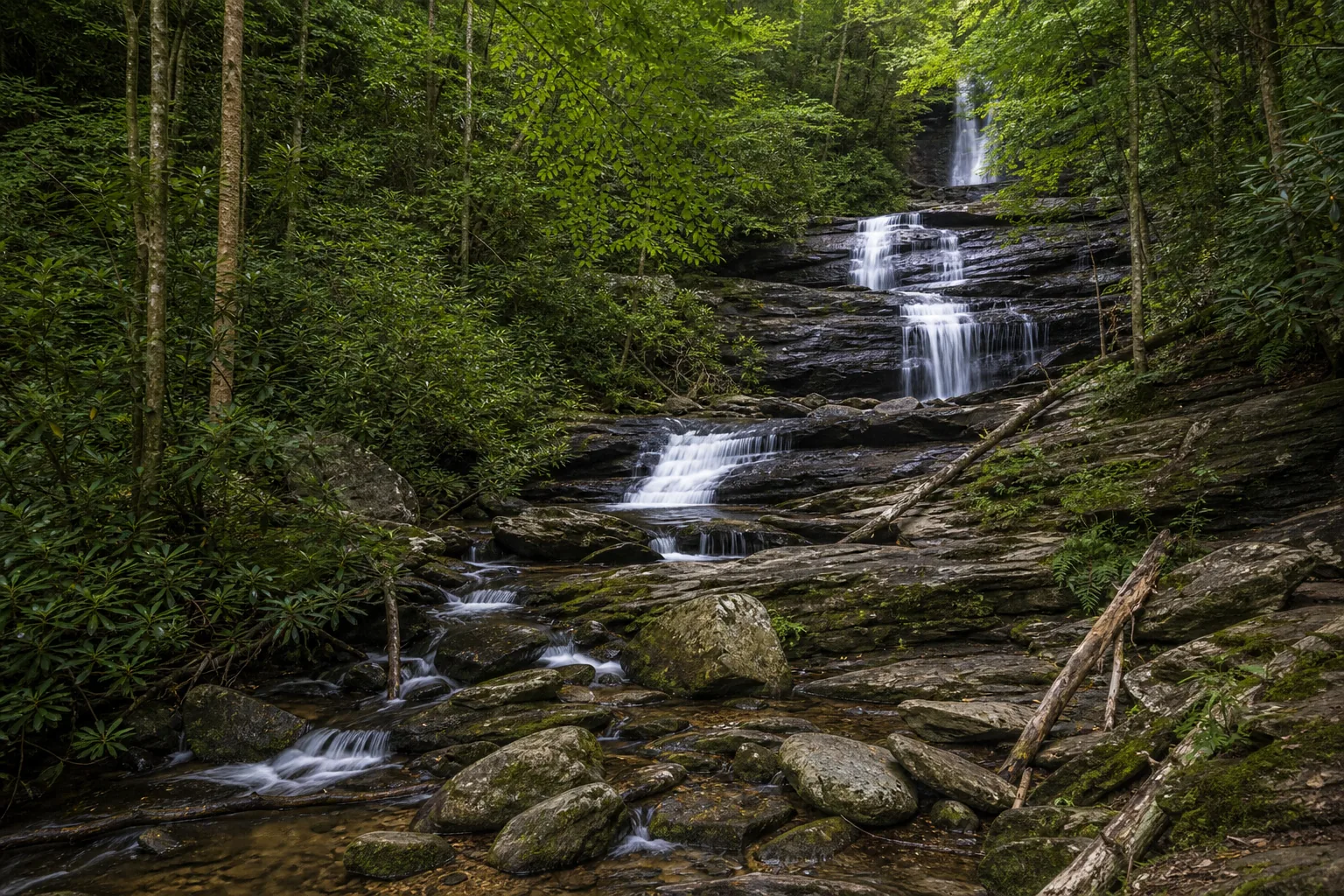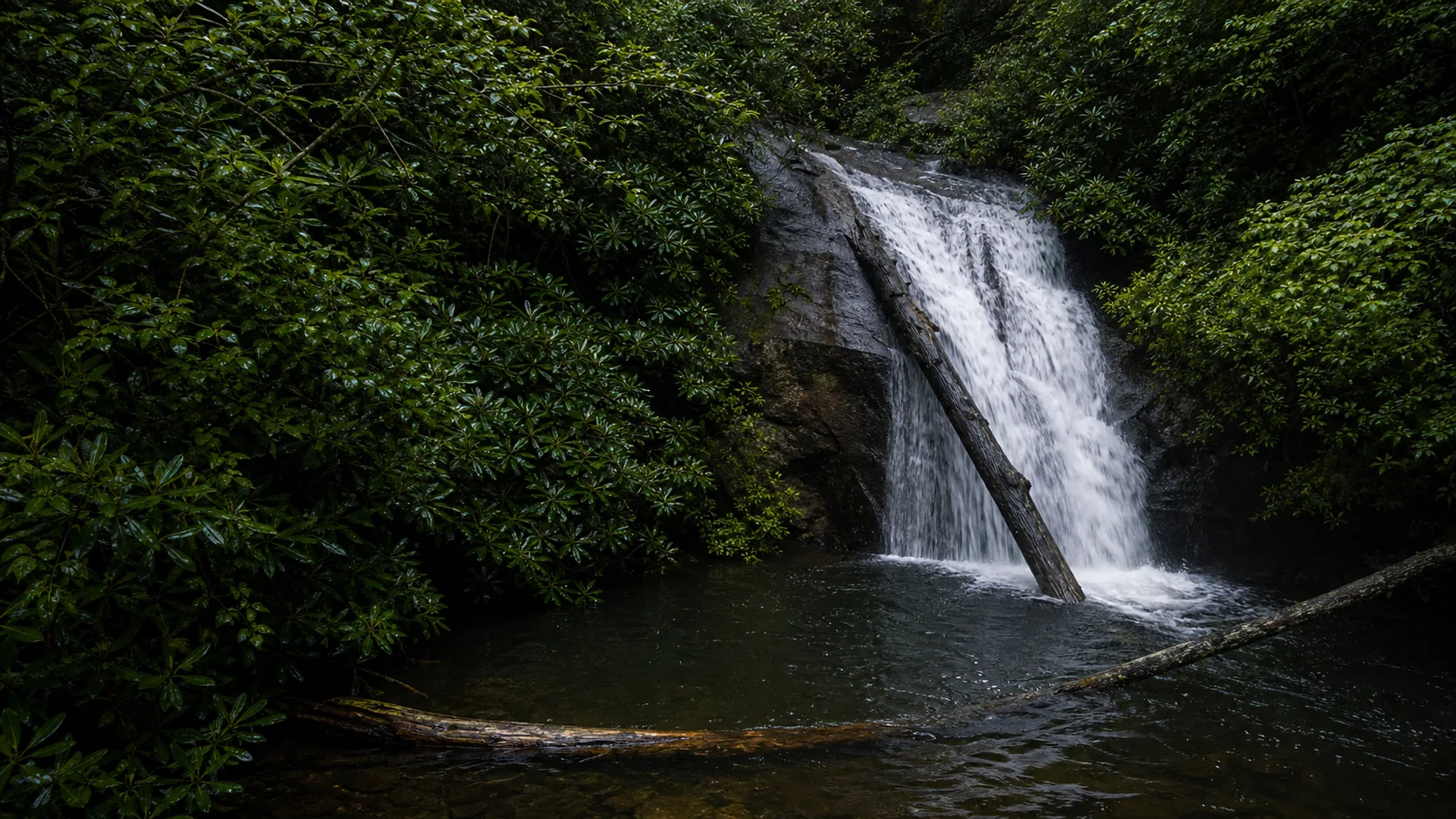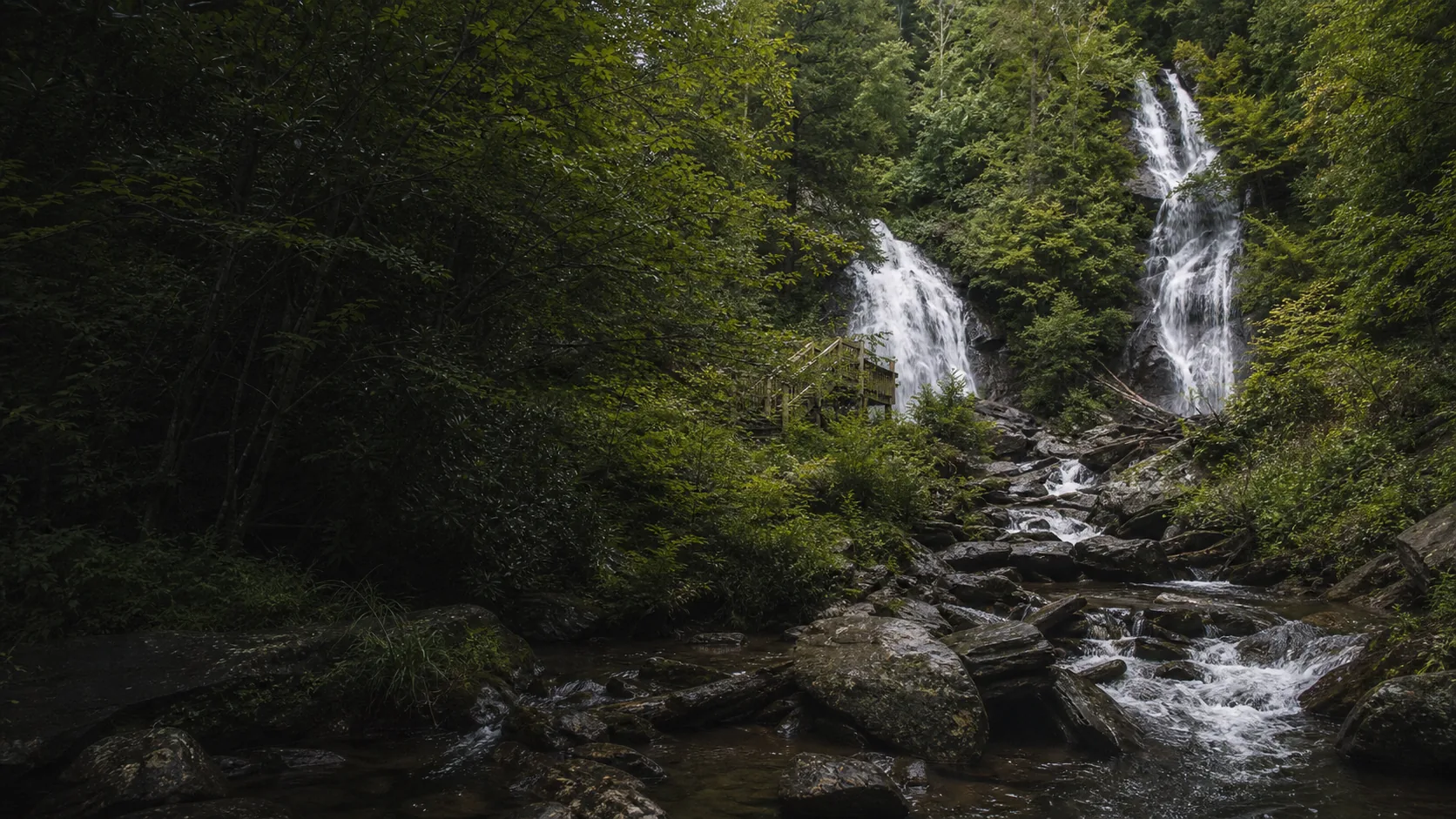
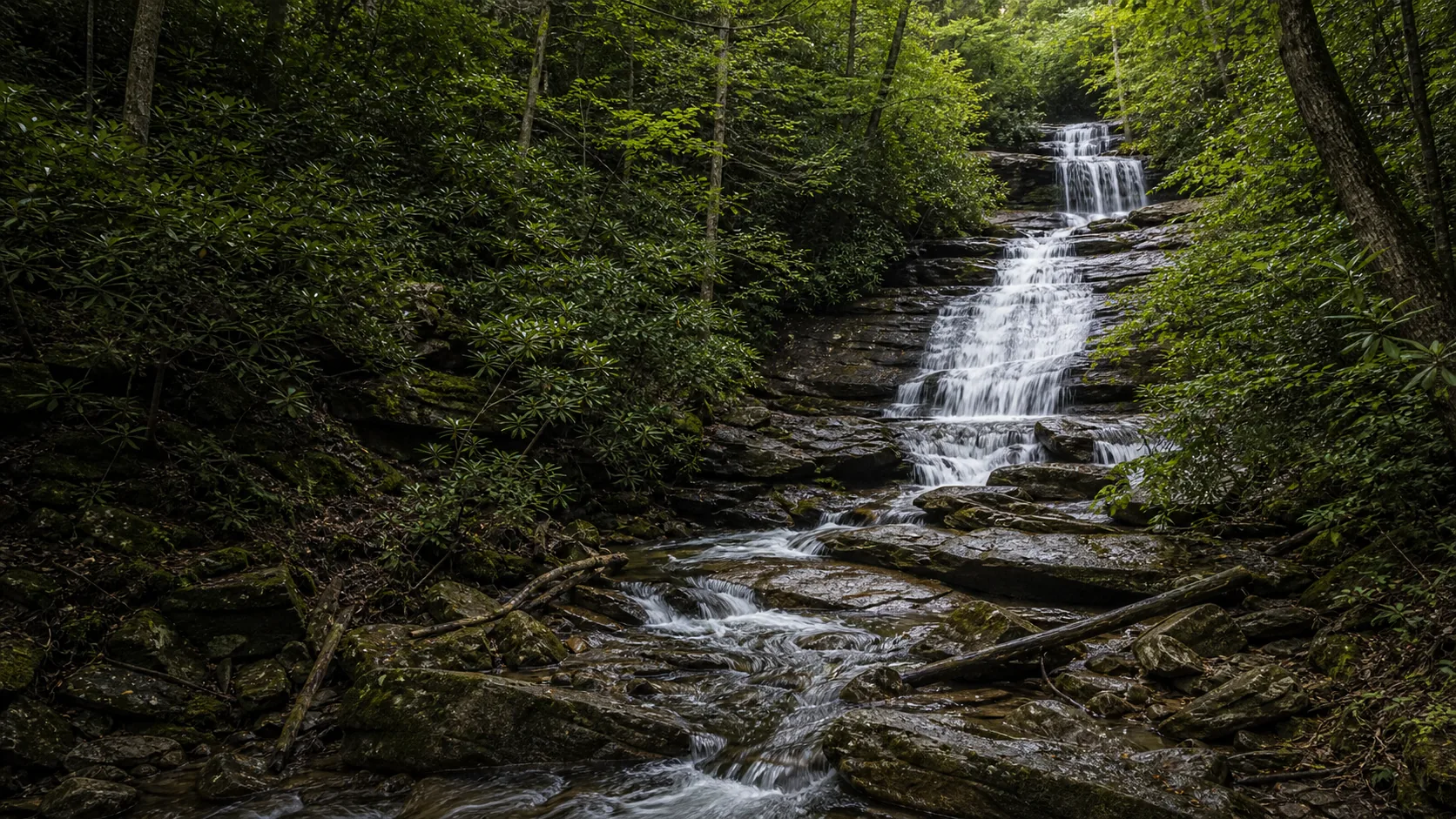
DeSoto Falls waterfall and surrounding setting
Lumpkin County, GA

DeSoto Falls

DeSoto Falls is a multi-tier waterfall system on Frogtown Creek inside the 650-acre DeSoto Falls Recreation Area in the Chattahoochee-Oconee National Forest, about 15 miles north of Dahlonega, Georgia. A 2.2-mile loop trail from a developed 24-site campground visits two named cascades: the Lower Falls, a roughly 30-foot drop reached in under a quarter mile, and the Upper Falls, a multi-tier cascade dropping around 80 feet through several stepped ledges. The trailhead has a $5 per vehicle day-use fee, leashed dogs are welcome, and the day-use area is open year-round during daylight hours.

Last verified May 4, 2026 Visited Desk-verified May 2026 5 sources checked
Trail 2.2 mi Round-trip route varies
Time 60-120 min Easy to moderate
Best season Late winter through early spring for peak flow after rain; mid-October for fall color along Frogtown Creek After rain or snowmelt
Parking Recreation area lot, $5 per vehicle DeSoto Falls Recreation Area
Quick answer

Is DeSoto Falls worth hiking?

Yes. The 2.2-mile DeSoto Falls Trail visits two cascades on Frogtown Creek, with the Lower Falls (about 30 feet) reached in under a quarter mile and the Upper Falls (a roughly 80-foot multi-tier drop) just over a mile in. The best windows are March through May for peak flow after Blue Ridge rains and late October for hardwood color on the trail. Plan for a $5 per vehicle day-use fee at the recreation area, arrive before 10 a.m. on weekends, and skip the swim plans; the pools are slick and the Forest Service signs ask you to stay on the wooden viewing platforms.

  • 2.2-mile out-and-back trail to both Lower and Upper DeSoto Falls
  • $5 per vehicle parking fee at the recreation area
  • Open year-round during daylight hours; lot fills on weekends
  • Leashed dogs welcome on the full trail
  • No swimming; pools are surrounded by slick rock and fast water
  • Wooden viewing platforms at both falls; do not climb on the cascades
Last verified May 4, 2026 Visited Desk-verified May 2026 5 sources checked
Distance 2.2 mi Loop distance varies
Round trip 60-120 min 2.2-mile out-and-back with a wooden bridge over Frogtown Creek, gentle switchbacks, and rolling elevation through a rhododendron and old-growth pine forest
Difficulty Easy to moderate 2.2-mile out-and-back with a wooden bridge over Frogtown Creek, gentle switchbacks, and rolling elevation through a rhododendron and old-growth pine forest
Location Lumpkin County, GA DeSoto Falls Recreation Area
Parking Recreation area lot, $5 per vehicle U.S. Forest Service
Transit No fixed-route transit verified Drive and verify the current trailhead or access point · 0 ft
Drive Verify route Downtown route varies
Best season Late winter through early spring for peak flow after rain; mid-October for fall color along Frogtown Creek After rain or snowmelt
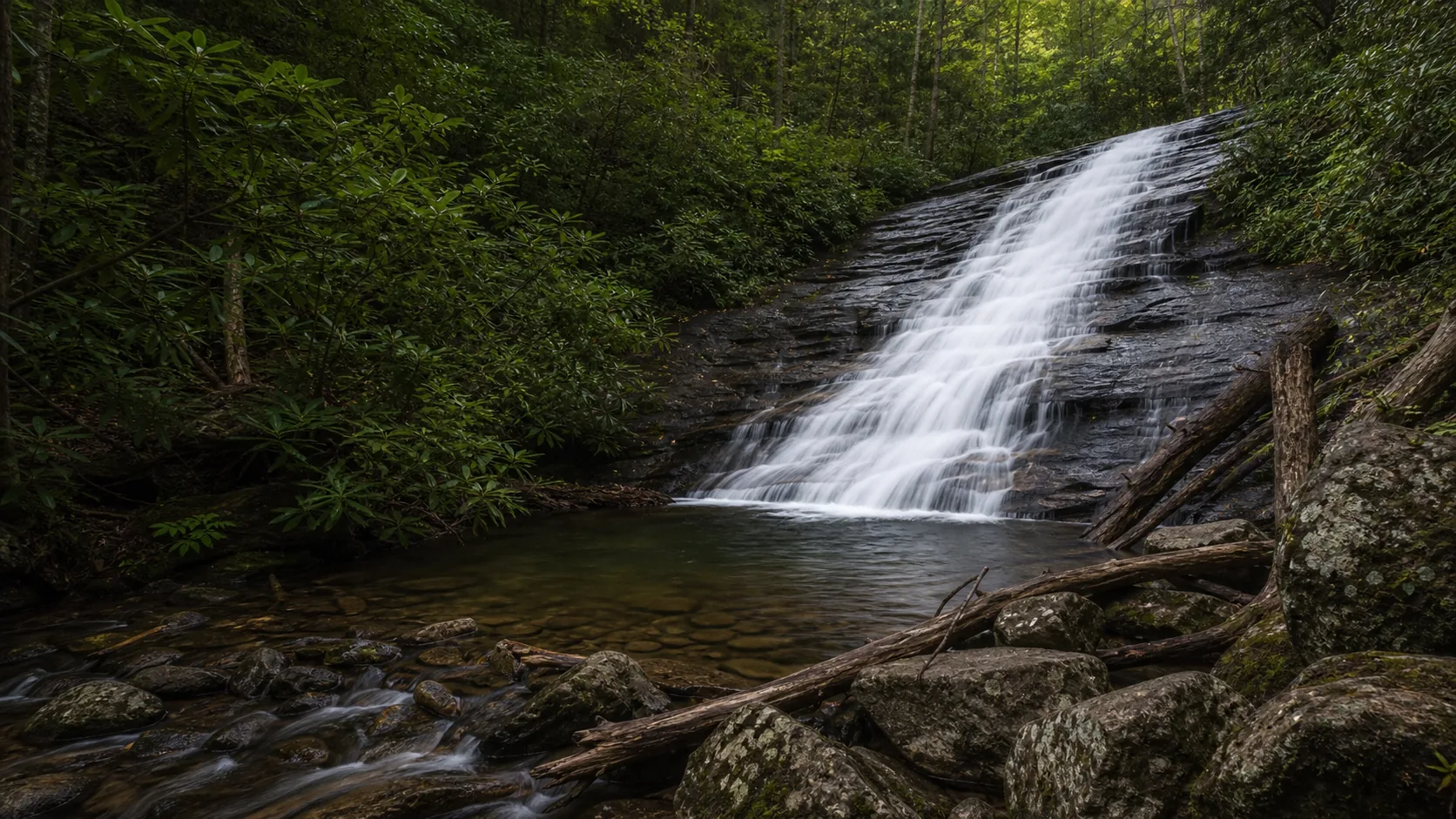
DeSoto Falls lower falls plunge into the boulder-rimmed pool below the wooden viewing platform
Photo guide

Two cascades, one creek, three working viewpoints.

The two wooden viewing platforms (Lower Falls at under 0.25 mile, Upper Falls at just over a mile) are the only legal vantages on the multi-tier system. Use the captions to pick which tier you want to spend the most time at before you commit to the longer leg of the loop.

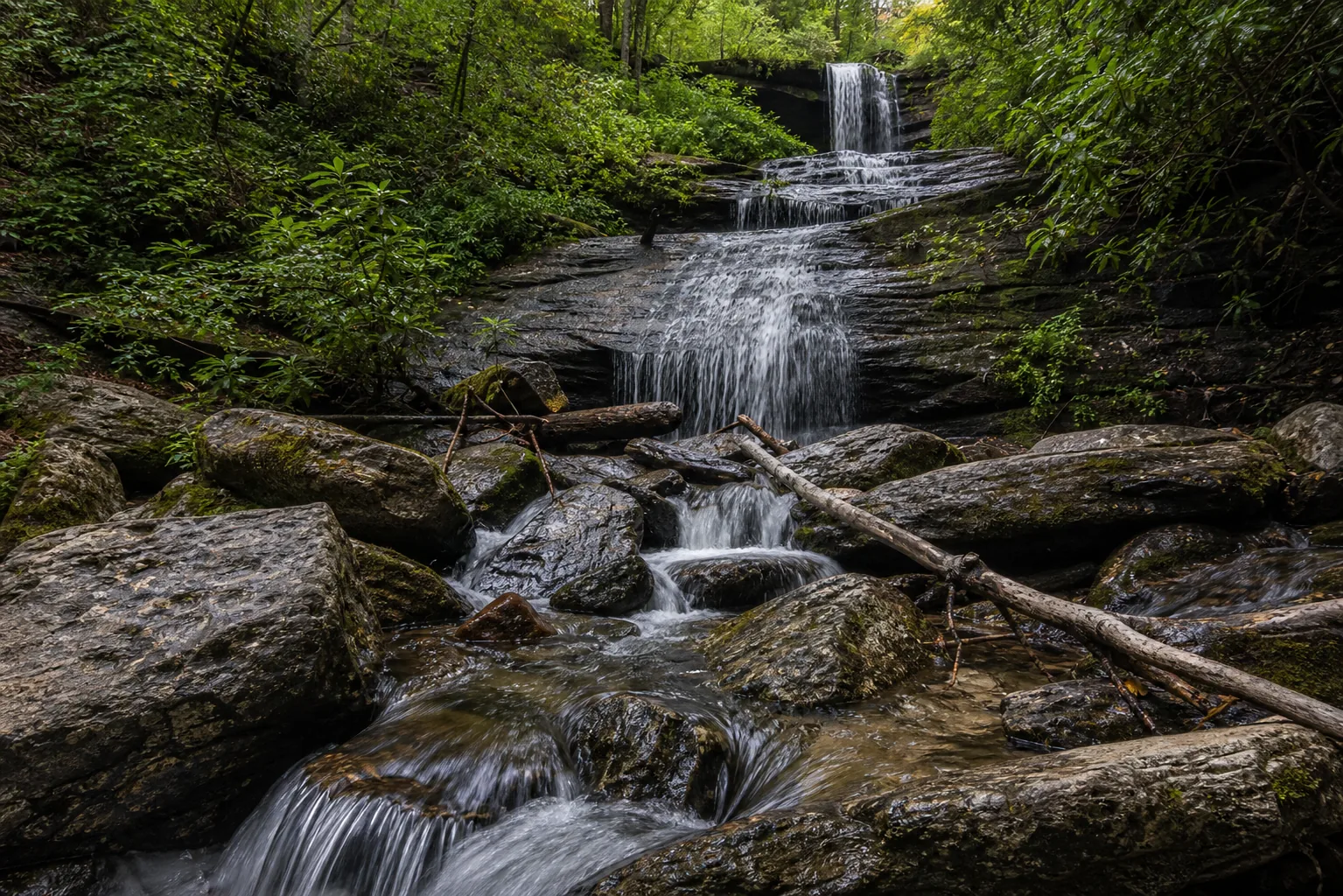
DeSoto Falls waterfall and surrounding setting
DeSoto Falls, hero composition
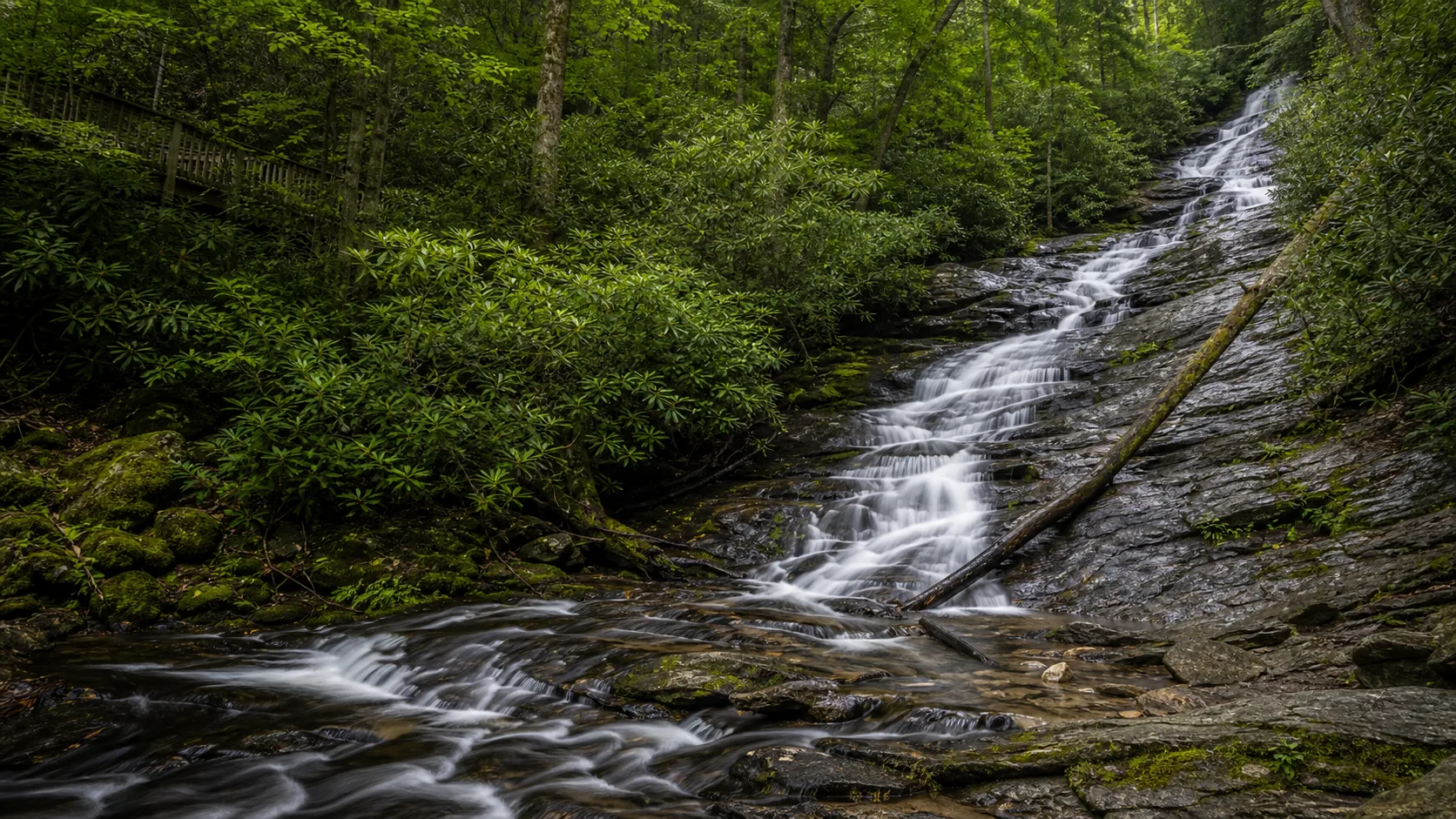
DeSoto Falls Upper Falls multi-tier cascade on Frogtown Creek, Chattahoochee-Oconee National Forest, Georgia
Upper Falls multi-tier cascade through the rhododendron understory along Frogtown Creek
DeSoto Falls Lower Falls plunge pool framed by lichen-covered boulders near Dahlonega, Georgia
Lower Falls plunge into the boulder-rimmed pool below the wooden viewing platform
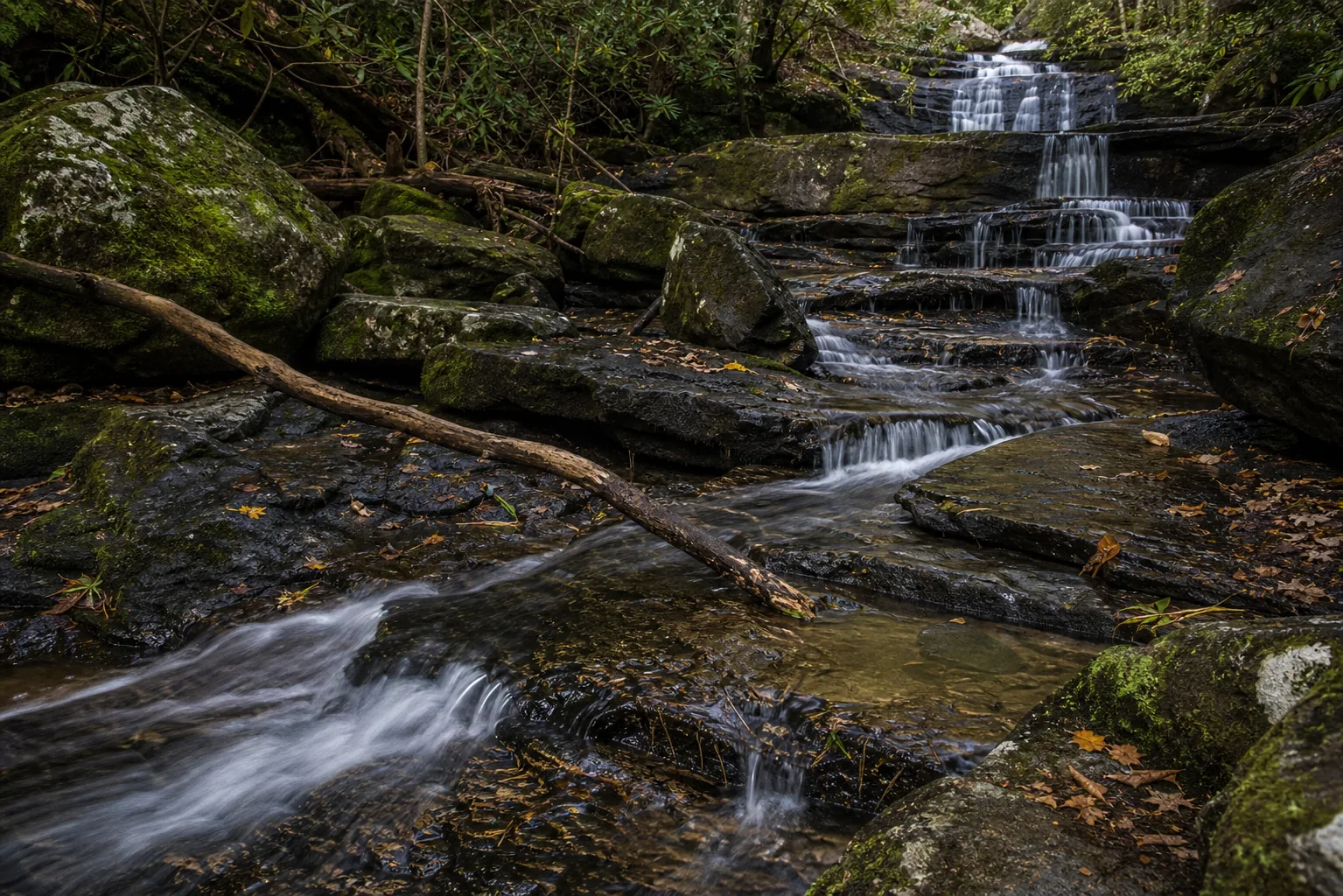
DeSoto Falls Upper Falls stepped tier detail across southern Blue Ridge metamorphic bedrock
Stepped ledges and slides on the Upper Falls, where the creek crosses alternating bands of schist and gneiss
01Is DeSoto Falls flowing right now?

There is no live USGS gauge paired specifically to Frogtown Creek at DeSoto Falls. The closest useful proxy is the Chestatee River near Dahlonega gauge - it tracks the same rainfall pattern. Use the NWS forecast for Dahlonega for the live answer.

DeSoto Falls runs strongest in late winter and early spring when Frogtown Creek is fed by consistent rainfall. Summer flow drops noticeably and a dry August can leave the Lower Falls thin; a fall remnant tropical system can bring it back overnight.

02How long is the walk?

2.2 miles round trip total, with the Lower Falls platform reached in under 0.25 mile and the Upper Falls platform at just over 1 mile in. Plan 60-90 minutes for the full out-and-back at a relaxed pace; rolling elevation, no sustained climb.

03How do you get there?

From Dahlonega, take US 19 N / US 129 N about 15 miles toward Cleveland and Vogel State Park; the DeSoto Falls Recreation Area entrance is on the left, well-signed, before you reach Vogel. From Helen, take GA-75 N to GA-180, then US 129 S about 4 miles. The trailhead address is US 129/19 N, Dahlonega, GA 30533.

04Is there free parking?

Park at the DeSoto Falls Recreation Area lot at the trailhead. Fee is $5 per vehicle and there is no overflow or roadside option; the lot regularly fills capacity on fall-color weekends, so arrive before 10 a.m. or come on a weekday.

05Does it cost money?

$5 per vehicle day-use fee, paid at the trailhead. The fee covers parking and trail access. America the Beautiful federal passes are honored at most Chattahoochee-Oconee NF day-use sites; check the trailhead kiosk on arrival.

06Trail variants

Lower Falls only ~0.5 mi round trip, 30-45 min, Shortest option; turn left at the trail junction past the bridge to the lower viewing platform.
Upper Falls only ~2.0 mi round trip, 60-90 min, Follows Frogtown Creek upstream to the multi-tiered upper cascade.
Full DeSoto Falls Trail 2.2 mi round trip, 60-120 min, Visits both Lower and Upper DeSoto Falls; the standard hike.
Pair with Helton Creek Falls Drive itinerary, Half day, Add Helton Creek Falls (about 0.6 mi round trip) 25 minutes north for a two-waterfall day.

Detailed maps and recent reviews: Falls route on AllTrails · Creek route on AllTrails

07Can you swim?

Swimming is not recommended at DeSoto Falls. Wet rock and fast current at both pools are dangerous and the Forest Service signs ask visitors not to climb on the cascades. Drive 25 minutes north to Helton Creek Falls for a small unsupervised pool or 15 minutes to Lake Trahlyta at Vogel State Park for a seasonal swim beach.

08Are dogs allowed?

Leashed dogs are welcome on the full DeSoto Falls Trail. Use a 6-foot leash, pack out waste, and keep your dog off the wet rock at the viewing platforms.

09Is it accessible?

The DeSoto Falls Trail is not wheelchair accessible - it includes a wooden bridge, switchbacks, and natural-surface tread with rolling elevation. The picnic area near the trailhead has accessible tables and restrooms.

Field notes

DeSoto Falls at a glance.

Multi-tier waterfall system on Frogtown Creek, Lower Falls about 30 ft, Upper Falls about 80 ft, 2.2-mile trail, $5 day-use fee, managed by the U.S. Forest Service in the Chestatee Ranger District. Sourced from the Forest Service recreation area page and the Dahlonega Visitors Center.

Height Not listed Source pending
Type Waterfall USGS
County Lumpkin Lumpkin County, GA
Managed by U.S. Forest Service, Chattahoochee-Oconee National Forest U.S. Forest Service
Water source Local creek or river USGS
Elevation 2789 ft USGS NED
Park area 650 acres U.S. Forest Service
Hours Day-use area open year-round during daylight hours; campground open seasonally U.S. Forest Service
When to visit

Two windows that justify the drive, one that fills the gap.

March through May for the loudest spring flow after Blue Ridge rains saturate the Frogtown Creek drainage. Late October for hardwood color along the trail with cascade flow still reading. A late-summer drought thins both falls, and a fall remnant tropical system can bring them back overnight.

PEAK FLOW

Peak flowAfter rain or snowmelt
Ice / low flowWinter varies
Most crowdedWeekends and midday
Best photosSunrise or weekdays

Live water context

Discharge data -- There is no live USGS gauge paired specifically to Frogtown Creek at DeSoto Falls. The closest useful proxy is the Chestatee River near Dahlonega gauge - it tracks the same rainfall pattern. Use the NWS forecast for Dahlonega for the live answer.

Why is it called DeSoto Falls?

DeSoto Falls is named for the Spanish conquistador Hernando de Soto, whose 1539-1542 expedition through what is now the southeastern United States is loosely associated with this stretch of the southern Appalachians. Local legend holds that a piece of Spanish armor, attributed to a member of the de Soto party, was found near the falls in the 19th century, and the name stuck on regional maps from there. The Georgia falls share their name with the much taller DeSoto Falls in Alabama, a 104-foot single plunge on the West Fork of the Little River near Mentone in DeSoto State Park; the two are unrelated waterfalls in different states, both honoring the same expedition. The Georgia falls sit on Frogtown Creek, which drains the southern slope of Blood Mountain on its way to the Chestatee River.

What else to do at DeSoto Falls Recreation Area

DeSoto Falls Recreation Area covers 650 acres in the Chestatee Ranger District of the Chattahoochee-Oconee National Forest, along US 129/19 about 15 miles north of Dahlonega and roughly halfway between Dahlonega and Vogel State Park. The site bundles a developed 24-site campground (reservable through Recreation.gov), the day-use trailhead, and a creekside picnic area along Frogtown Creek; Cleveland (20 minutes east on GA-115) and Dahlonega (20 minutes south) are the practical base towns for a weekend on the North Georgia waterfall circuit. Cell service is patchy in the gap, the day-use parking lot regularly fills on fall-color weekends, and the campground season typically runs late March through October.

  • Trailhead lot. $5 per vehicle, no overflow parking, no roadside parking allowed; arrive before 10 a.m. on weekends.
  • DeSoto Falls Trail. 2.2 miles round trip to both Lower and Upper falls along Frogtown Creek, crossing a wooden bridge near the start.
  • Picnic area. Tables and grills near the trailhead under a shaded canopy; a useful lunch stop before or after the hike.
  • Campground. Seasonal sites near Frogtown Creek for a weekend basecamp; reservations through Recreation.gov.
  • Frogtown Creek. Boulder-strewn, rhododendron-lined creek that runs alongside most of the trail and supplies both falls.

Why it looks this way

DeSoto Falls drops through the metamorphic bedrock of the southern Blue Ridge province, where roughly 500-million-year-old schist and gneiss (with bands of more resistant quartzite and amphibolite) were folded and deformed by the Appalachian-building Alleghanian orogeny. Frogtown Creek cuts down through this Precambrian-to-Paleozoic basement off the southern slope of Blood Mountain, and the multi-tier configuration is the visible signature of differential erosion: harder, more resistant bands of rock form the ledges that hold up each step of the upper cascade, while softer layers between them erode out faster and create the short vertical drops between tiers. The Lower Falls reads as a near-vertical drop over a single resistant outcrop into a boulder-rimmed pool; the Upper Falls steps down a long inclined exposure as a stacked series of slides and short plunges rather than one clean column. The lichen-covered boulders at the base of both falls are blocks calved off the cliff face as the creek undercuts weaker layers behind the resistant cap rock.

Field guide deep dive

What you cannot tell from a Tripadvisor listing.

Multi-tier geology, the Hernando de Soto armor legend, the Georgia-vs-Alabama disambiguation, the loop options, and a North Georgia waterfall day trip. Skim the headers, read what you need.

How DeSoto Falls formed

DeSoto Falls is a multi-tier waterfall system, not a single drop, and the visible geometry of the two named cascades is a direct readout of the bedrock underneath them. Frogtown Creek descends off the southern flank of Blood Mountain (4,458 ft, the highest point on the Georgia Appalachian Trail) and cuts through the metamorphic basement of the southern Blue Ridge province on its way south to the Chestatee River. That basement is roughly 500-million-year-old schist and gneiss, with interleaved bands of harder quartzite and amphibolite that were folded and deformed during the Alleghanian mountain-building event roughly 300 million years ago.

Multi-tier waterfalls form where a stream encounters alternating layers of harder and softer rock. The harder layers hold up briefly as the creek erodes around them, creating short vertical drops; the softer layers wash out faster and produce inclined slides between the drops. At the Upper Falls, the creek steps down a long exposure of foliated rock in a stacked sequence of slides and short plunges rather than collapsing in a single column. At the Lower Falls, the cascade is dominated by a single more resistant outcrop and reads as a near-vertical drop into a boulder-rimmed pool. The lichen-covered boulders at the base of both falls are slabs calved off the cliff faces as the creek undercuts the weaker layers behind the resistant caps; that is the same caprock-and-undercut mechanic that produces most Appalachian waterfalls, just expressed across multiple beds instead of one.

Upper vs Lower: what each platform shows

The DeSoto Falls Trail is a 2.2-mile out-and-back system from the day-use parking lot, with the two cascades on opposite legs of a short loop reached after crossing Frogtown Creek on a wooden bridge near the trailhead. The Lower Falls platform is the easier leg: under a quarter mile from the bridge through rhododendron and mixed pine-hardwood forest, ending at a wooden deck looking up at a roughly 30-foot drop into a small pool. It is the right destination if you only have 45 minutes, are hiking with small kids, or want a quick stop on the way north to Vogel State Park.

The Upper Falls platform is the longer leg: a little over a mile from the trailhead following Frogtown Creek upstream through old-growth pine, with gentle switchbacks and a few rolling grades. The reward is the full stacked view of the roughly 80-foot Upper Falls; from the platform you can read the multi-tier structure end to end, including the slides between the stepped ledges. Most visitors who walk the full 2.2-mile out-and-back say the Upper Falls is the better photo and the more memorable view; the Lower Falls is the consolation prize on a short visit.

The standard hike walks both legs as one continuous out-and-back, with the wooden bridge over Frogtown Creek as the natural pivot point between them. Plan 60 to 90 minutes for the full route at a relaxed pace, and arrive before 10 a.m. on fall-color weekends because the day-use lot regularly fills and there is no overflow parking allowed.

The Hernando de Soto armor legend

The name DeSoto Falls comes from a piece of Spanish armor that local accounts say was found near the falls sometime in the 19th century and attributed to a member of Hernando de Soto's 1539-1542 expedition. De Soto landed on the west coast of Florida in May 1539 with about 600 men and several hundred horses, and spent four years marching through what is now the southeastern United States in search of gold; he died on the banks of the Mississippi in 1542 without finding it. His route from Florida north through Georgia and into the southern Appalachians is documented in three contemporary chronicles, but the specific path through North Georgia is debated by historians, and there is no archaeological consensus that the expedition passed through the Frogtown Creek drainage in particular.

The armor itself, if it was real, has not survived in any verifiable museum collection, and modern historians treat the local-legend version with caution. What is clear is that the name was in use on regional maps by the late 1800s, well before the Forest Service acquired the recreation area, and that the Lower Falls plunge pool was a known landmark for early Lumpkin County settlers. The Dahlonega Visitors Center repeats the armor story as local tradition rather than historical fact, which is the honest framing; treat the etymology as a 19th-century legend that gave the falls a memorable name, not as documented history.

DeSoto Falls GA vs DeSoto Falls AL: which one are you looking at?

This is the most common source of confusion at this name. There are two unrelated DeSoto Falls in the United States, both named for the same Spanish conquistador, and the SERP for "DeSoto Falls" usually mixes results for them. The short version: the Alabama fall is taller and more dramatic; the Georgia fall is a two-cascade hike inside a developed campground.

DeSoto Falls, Alabama is a single 104-foot plunge on the West Fork of the Little River near Mentone, Alabama, inside DeSoto State Park on Lookout Mountain. It is operated by the Alabama State Parks system, charges a small per-vehicle fee, and is reachable by a very short trail with an overlook above the drop. The drainage and the rock are completely different from the Georgia fall: Alabama's DeSoto sits on sedimentary Pottsville sandstone of the Cumberland Plateau rather than southern Blue Ridge metamorphic basement.

DeSoto Falls, Georgia (this guide) is a multi-tier waterfall system on Frogtown Creek inside the DeSoto Falls Recreation Area in the Chattahoochee-Oconee National Forest, about 15 miles north of Dahlonega in Lumpkin County. It is operated by the U.S. Forest Service, charges $5 per vehicle, and is reached by a 2.2-mile out-and-back trail to two cascades (Lower Falls about 30 ft, Upper Falls about 80 ft as a stacked multi-tier drop). If a result you are reading mentions Mentone, Fort Payne, Lookout Mountain, the West Fork of the Little River, or a 104-foot plunge, it is the Alabama fall.

A North Georgia waterfall day trip

DeSoto Falls is most efficient as one stop on a North Georgia waterfall loop rather than a standalone destination. The cleanest pairing is with Helton Creek Falls, 25 minutes north on US 129 toward Blairsville: two stacked drops on Helton Creek, a 0.6-mile round-trip hike, and the closest legal swim option to DeSoto. Add Dukes Creek Falls in the Smithgall Woods area near Helen (45 minutes east on GA-348) for a 250-foot double cascade overlook on a 2-mile round-trip trail, or Anna Ruby Falls just outside Helen for the largest twin cascade in the region (153-foot Curtis Creek and 50-foot York Creek) reached by a paved half-mile path.

A practical itinerary: spend the night at the DeSoto Falls campground or in Dahlonega, hike DeSoto first thing in the morning before the day-use lot fills, drive 25 minutes north to Helton Creek for a mid-morning swim stop, then loop east on GA-180 and GA-348 (the Russell-Brasstown Scenic Byway) to Anna Ruby and Helen for lunch. Total drive time is under two hours, and you visit three or four waterfalls on the same southern Blue Ridge bedrock without backtracking.

Seasonal photography: north-facing tiers and leaf color

Frogtown Creek runs roughly north-to-south through the recreation area, and both DeSoto cascades sit in deeply shaded ravines under closed canopy. The wooden viewing platforms face the falls from positions that read best in overcast or shaded light; midday direct sun in summer creates harsh highlights on the wet rock and bleaches the white of the cascade. Photographers who care about the shot should aim for an overcast morning or the hour after a fall-color storm clears, when the rhododendron and hardwood foreground sit in even soft light and the wet rock holds detail across the multi-tier face.

The seasonal window with the strongest combination of flow and light is late October into the first week of November, when Lumpkin County hardwoods (yellow tulip poplar, scarlet maple, russet oak) are at peak color, recent rain has refilled the creek, and the sun angle is low enough to backlight the canopy without burning the cascade. March through May is the second-best window: flow is highest after Blue Ridge spring rains, but the deciduous canopy is still bare or just leafing out, so the surrounding forest is less photogenic. A tripod is allowed on the platforms; drones and commercial shoots require a Chattahoochee-Oconee National Forest special-use permit and are not authorized in developed recreation areas without one.

Map and route

Fifteen miles north of Dahlonega, four miles south of Vogel State Park.

From Dahlonega, take US 19 N / US 129 N about 15 miles toward Cleveland and Vogel State Park; the DeSoto Falls Recreation Area entrance is on the left, well-signed, before you reach Vogel. From Helen, take GA-75 N to GA-180, then US 129 S about 4 miles. The trailhead address is US 129/19 N, Dahlonega, GA 30533.

Photography and weddings

Good light, safer footing, fewer surprises.

The two wooden viewing platforms - one at the Lower Falls (under 0.25 mi in) and one at the Upper Falls (just past 1 mi) - are the only legal vantages. The Upper Falls platform frames the full multi-tiered cascade.

Overcast mornings give the cleanest exposure on the wet granite. The forest canopy is dense, so shaded conditions hold detail in both the cascade and the rhododendron in foreground.

Personal photography and tripods are fine on the platforms. Drones, commercial shoots, and any large lighting setup require a Chattahoochee-Oconee National Forest special-use permit.

Permits

Weddings and engagements

The platforms are too small and too public for a ceremony, but engagement portraits work on weekday mornings before the lot fills.

Any organized event - including small ceremonies - requires a special-use permit from the Chattahoochee-Oconee National Forest, Chattooga or Blue Ridge Ranger District.

Plan for a tiny footprint, weekday timing, and an indoor backup; summer thunderstorms hit this stretch of the Blue Ridge hard.

Nearby waterfalls

Three North Georgia waterfalls on one weekend loop.

DeSoto pairs naturally with Helton Creek Falls (25 minutes north, the swim option) and Anna Ruby Falls (45 minutes east, the larger double cascade on Smith Creek). All three sit on the same southern Blue Ridge metamorphic basement and read best in the same March-May and late-October windows.

Related questions

More questions visitors ask before driving to DeSoto Falls.

Hike length, hours, dogs, camping, the GA vs AL disambiguation, and the actual answer to the worth-visiting question. The full set is also indexed in the FAQ schema for AI answer engines.

01Where is DeSoto Falls located?

DeSoto Falls is in the Chattahoochee-Oconee National Forest at US 129/19 N, Dahlonega, GA 30533, in Lumpkin County, Georgia. The day-use entrance is about 15 miles north of Dahlonega and 4 miles south of Vogel State Park, on the west side of the highway. Note that there is a separate, unrelated DeSoto Falls in Alabama near Mentone; this is the Georgia fall.

02Can you camp at DeSoto Falls?

Yes. The DeSoto Falls Recreation Area has a developed 24-site campground along Frogtown Creek with drinking water, vault toilets, and picnic tables; sites are reservable through Recreation.gov. The campground operates seasonally, typically late March through October, and is one of the better Chattahoochee-Oconee basecamps for a North Georgia waterfall weekend pairing DeSoto with Helton Creek and Anna Ruby Falls.

03What is the difference between DeSoto Falls GA and DeSoto Falls Alabama?

They are two unrelated waterfalls in different states, both named for the same 16th-century Spanish conquistador Hernando de Soto. The Georgia fall is a multi-tier system on Frogtown Creek in the Chattahoochee-Oconee National Forest near Dahlonega, with a Lower Falls of about 30 feet and an Upper Falls of about 80 feet across stacked tiers. The Alabama fall is a single 104-foot plunge on the West Fork of the Little River near Mentone, inside DeSoto State Park on Lookout Mountain. Different rock, different drainage, different state agency; if a search result mentions Mentone, Fort Payne, or Lookout Mountain, it is the Alabama fall.

04Is DeSoto Falls worth visiting?

Yes, especially in March through May for peak flow after Blue Ridge spring rains and in late October for hardwood color on the trail. The 2.2-mile trail efficiently delivers two waterfalls on one short hike, the developed campground at the trailhead makes it a clean overnight basecamp, and the Upper Falls multi-tier cascade is one of the better-photographed drops in the Dahlonega corridor. Skip a midsummer-drought trip when both falls thin to a trickle, and arrive before 10 a.m. on weekends because the day-use lot regularly fills.

Sources and data

Where the DeSoto Falls guide gets its facts.

Recreation area information from the U.S. Forest Service Chattahoochee-Oconee National Forest and Recreation.gov. Geology from Georgia Geological Survey references on the southern Blue Ridge province. Etymology cross-checked against Wikipedia's DeSoto Falls (Georgia) entry and the Dahlonega Visitors Center. Live weather from NOAA NWS forecast grid FFC/64,131.

U.S. Forest Service: DeSoto Falls Recreation Area fs.usda.gov
Access, parking, and permit rules: fs.usda.gov
Georgia Geological Survey: Blue Ridge Province metamorphic basement (schist and gneiss): Lumpkin County bedrock epd.georgia.gov
NOAA / NWS Peachtree City forecast grid FFC 64,131 noaa.gov
USGS National Elevation Dataset 3DEP
Google Maps: embedded map and directions maps.google.com
Google Places: nearby restaurants and hotels places API
U.S. Forest Service: DeSoto Falls Recreation Area (Chattahoochee-Oconee National Forest) fs.usda.gov
Recreation.gov: DeSoto Falls Campground (24 sites, seasonal) recreation.gov
Georgia Department of Natural Resources: State Parks and recreation portal gastateparks.org
Explore Georgia: DeSoto Falls and DeSoto Falls Recreational Area exploregeorgia.org
Dahlonega Visitors Center: DeSoto Falls (local etymology and trail notes) dahlonega.org
Wikipedia: DeSoto Falls (Georgia) en.wikipedia.org
AllTrails: DeSoto Falls Trail (current conditions and reviews) alltrails.com
Wikimedia Commons: DeSoto Falls (Georgia) image category commons.wikimedia.org
Fact checks
Disambiguation audit: this page covers DeSoto Falls in Lumpkin County, Georgia (multi-tier system on Frogtown Creek, Chattahoochee-Oconee National Forest). The unrelated 104-foot DeSoto Falls in Alabama (West Fork of the Little River near Mentone, DeSoto State Park) dominates several top SERP results for the bare term and was filtered out of every source used here.
Photo audit: waterfall image slots use Wikimedia Commons files and AI-original visuals grounded in DeSoto Falls (Georgia) reference photos only. The Alabama Lookout Mountain DeSoto Falls files were excluded.
Access audit: $5 per vehicle day-use fee, 24-site campground capacity, and 2.2-mile trail length cross-checked against the U.S. Forest Service Chattahoochee-Oconee DeSoto Falls Recreation Area page and the Recreation.gov campground listing in May 2026.
Etymology audit: the Hernando de Soto Spanish-armor naming legend is framed as 19th-century local tradition rather than documented history, consistent with how the Dahlonega Visitors Center and Wikipedia present it; there is no archaeological consensus that the 1539-1542 expedition passed through the Frogtown Creek drainage.
Corrections: [email protected]