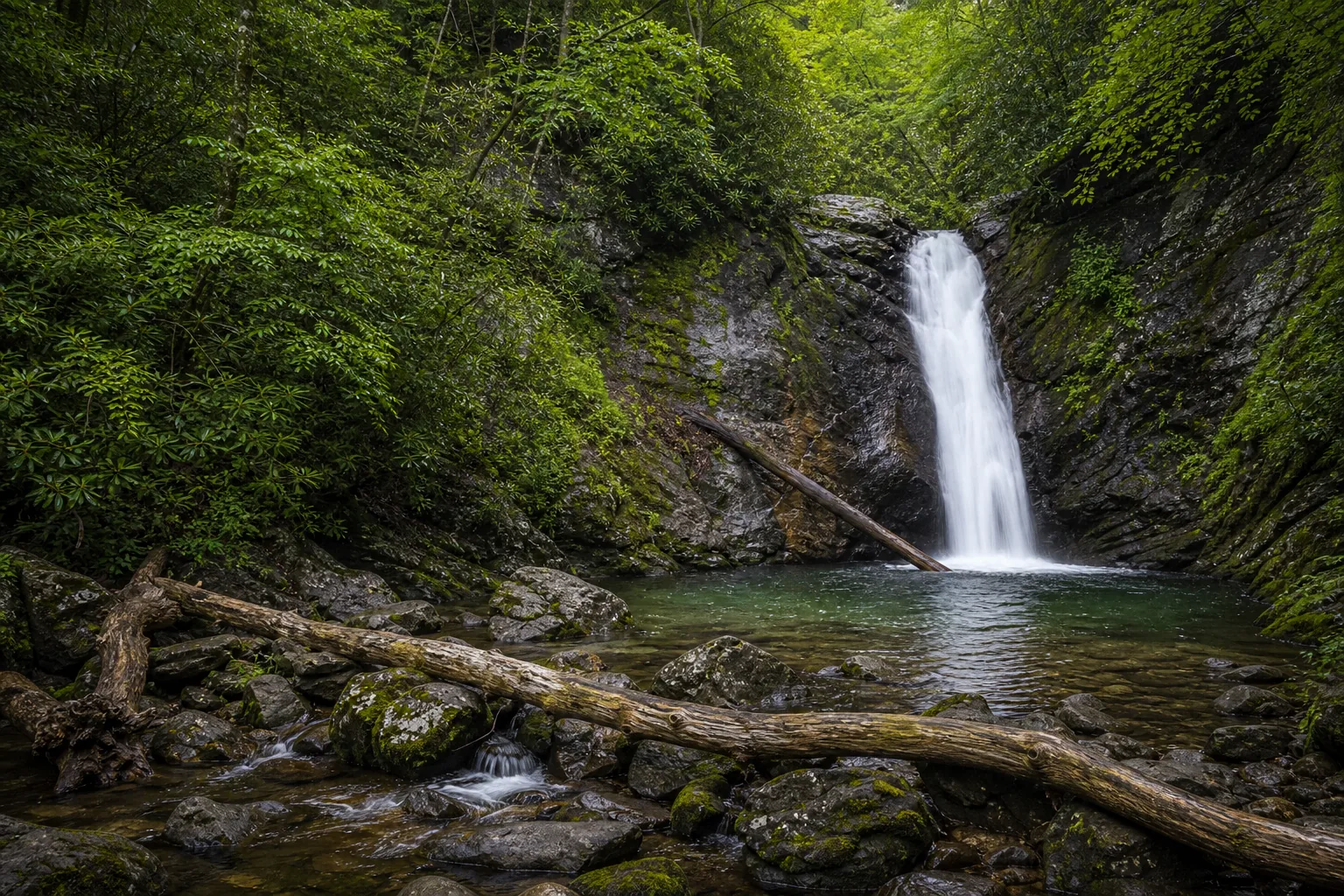
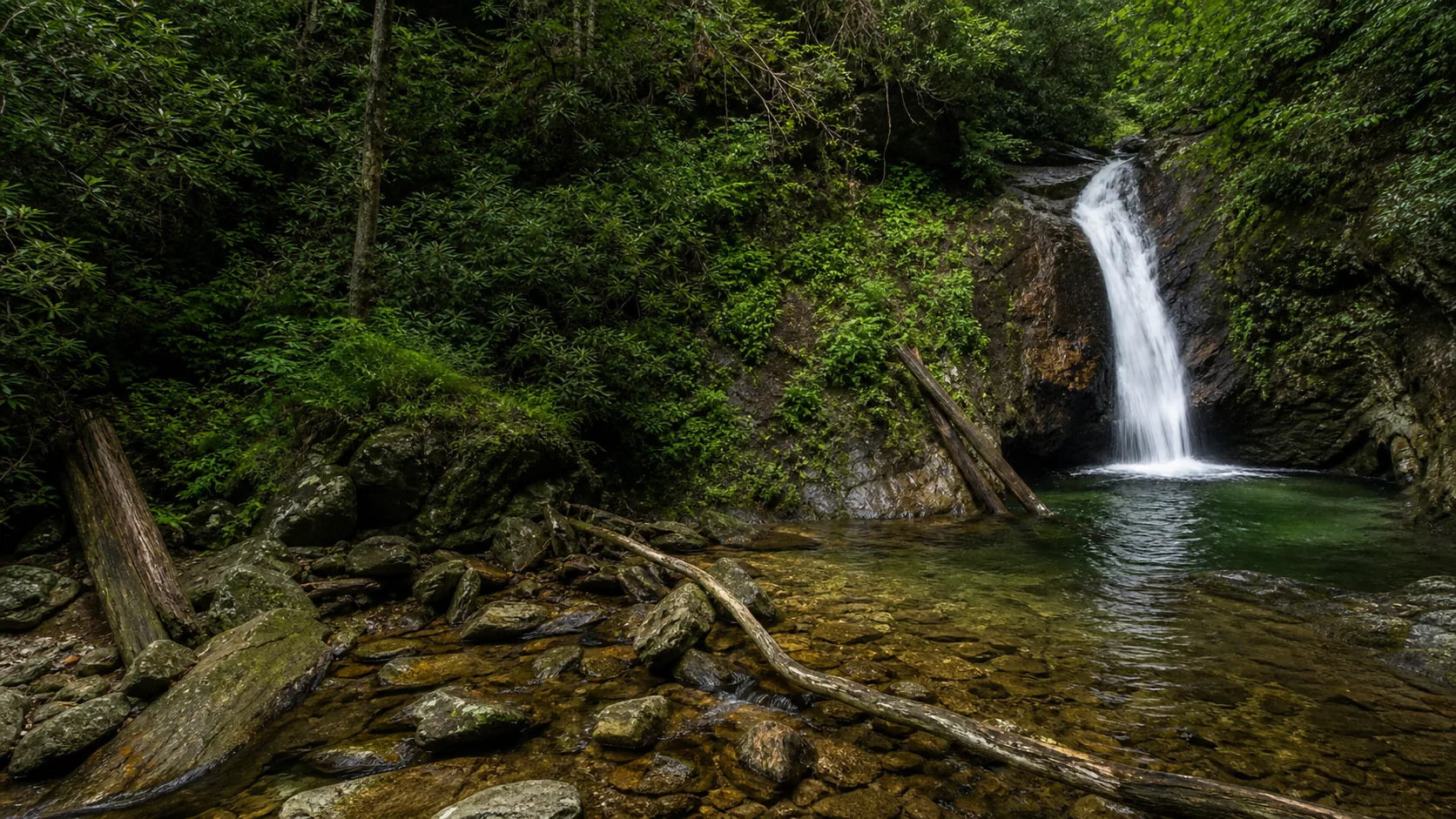
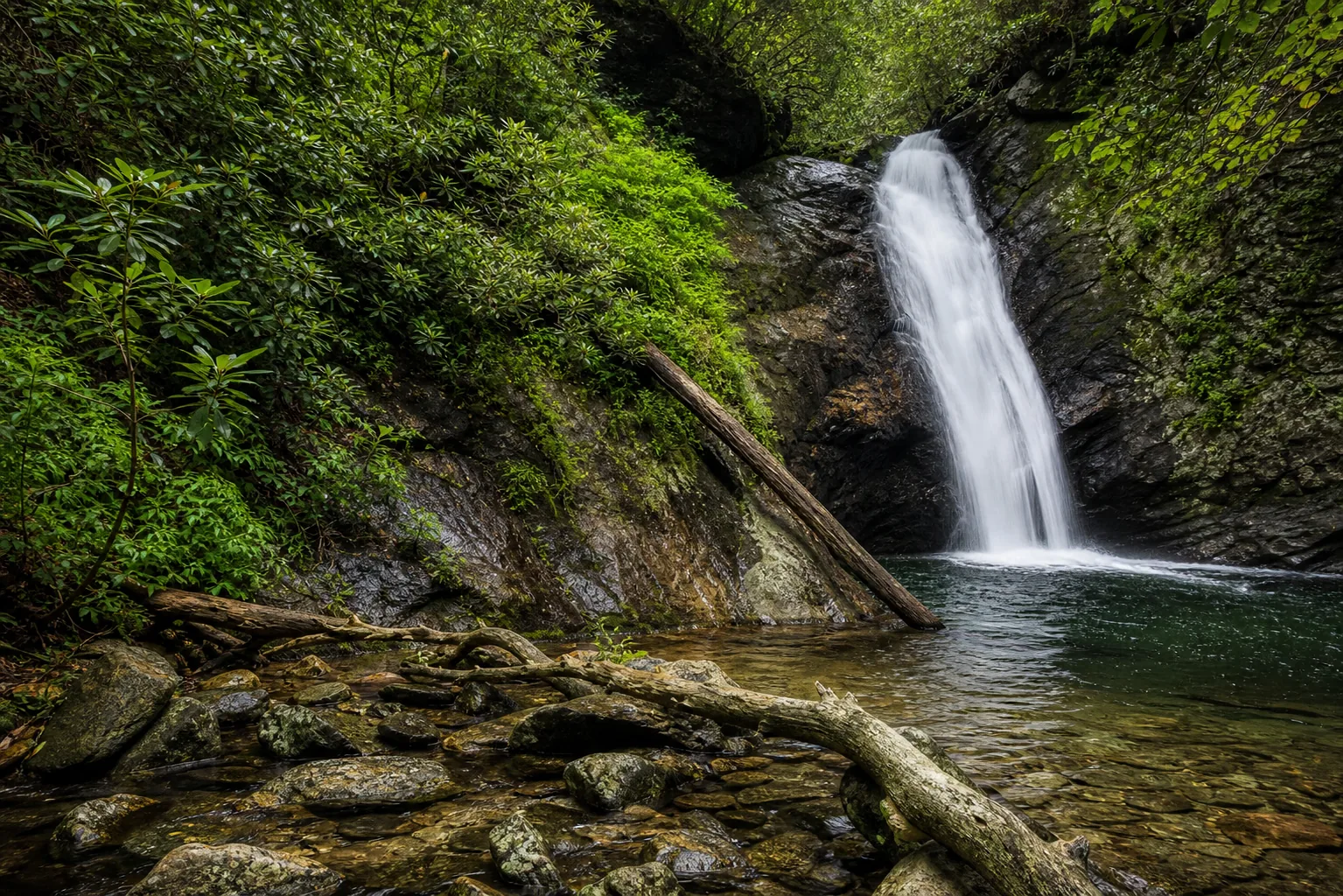
Courthouse Falls 45-foot plunge into a turquoise pool inside a cathedral-like rock amphitheater in Pisgah National Forest
Transylvania County, NC

Courthouse Falls

Courthouse Falls is a 45-foot plunge in Pisgah National Forest where Courthouse Creek drops through a narrow chute into a turquoise pool inside a small cathedral-like rock amphitheater, the feature that gives the falls its name. The walk in is a 0.8-mile out-and-back from a gravel pullout on Forest Road 140, one of the shortest payoff-per-step hikes in western North Carolina.

Last verified May 12, 2026 Visited Desk-verified May 2026 7 sources checked
Trail 0.8 mi 3.8 mi extended
Time 30-60 min Easy
Best season Mar to May runoff and October color Mar to May runoff
Parking Free trailhead pullout off Forest Road 140; no fee, no pass required, but the gravel road is rough and the lot holds only 8 to 10 cars Pisgah National Forest
Quick answer

Is Courthouse Falls worth visiting?

Yes. The two windows that justify the drive are March through May, when snowmelt and spring rain push the chute into a full curtain, and October, when the gorge fills with hardwood color and the flow holds up after the first cold-front rains. Late summer can drop to a thin ribbon. The trail is 0.8 mi round trip with a short, slick spur down to the base, and the plunge pool is one of the few in the Pisgah corridor where swimming is informally tolerated by visitors who respect the hydraulic at the base.

  • 45-foot plunge into a turquoise pool
  • Cathedral-like rock amphitheater
  • 0.8 mi out-and-back from FR 140
  • Peak flow: Mar to May and October
  • Free; no fee, no pass
  • Cold, deep pool; respect the hydraulic
Last verified May 12, 2026 Visited Desk-verified May 2026 7 sources checked
Distance 0.8 mi 3.8 mi extended
Round trip 30-60 min 0.8 mi out-and-back with a short, slick spur down to the base; log bridges and wooden steps stay damp
Difficulty Easy 0.8 mi out-and-back with a short, slick spur down to the base; log bridges and wooden steps stay damp
Location Transylvania County, NC Pisgah National Forest
Parking Free trailhead pullout off Forest Road 140; no fee, no pass required, but the gravel road is rough and the lot holds only 8 to 10 cars Pisgah NF
Transit No fixed-route transit Drive only; Forest Road 140 trailhead · 0 ft
Drive 36 mi 60 min from downtown
Best season Mar to May runoff and October color Mar to May runoff
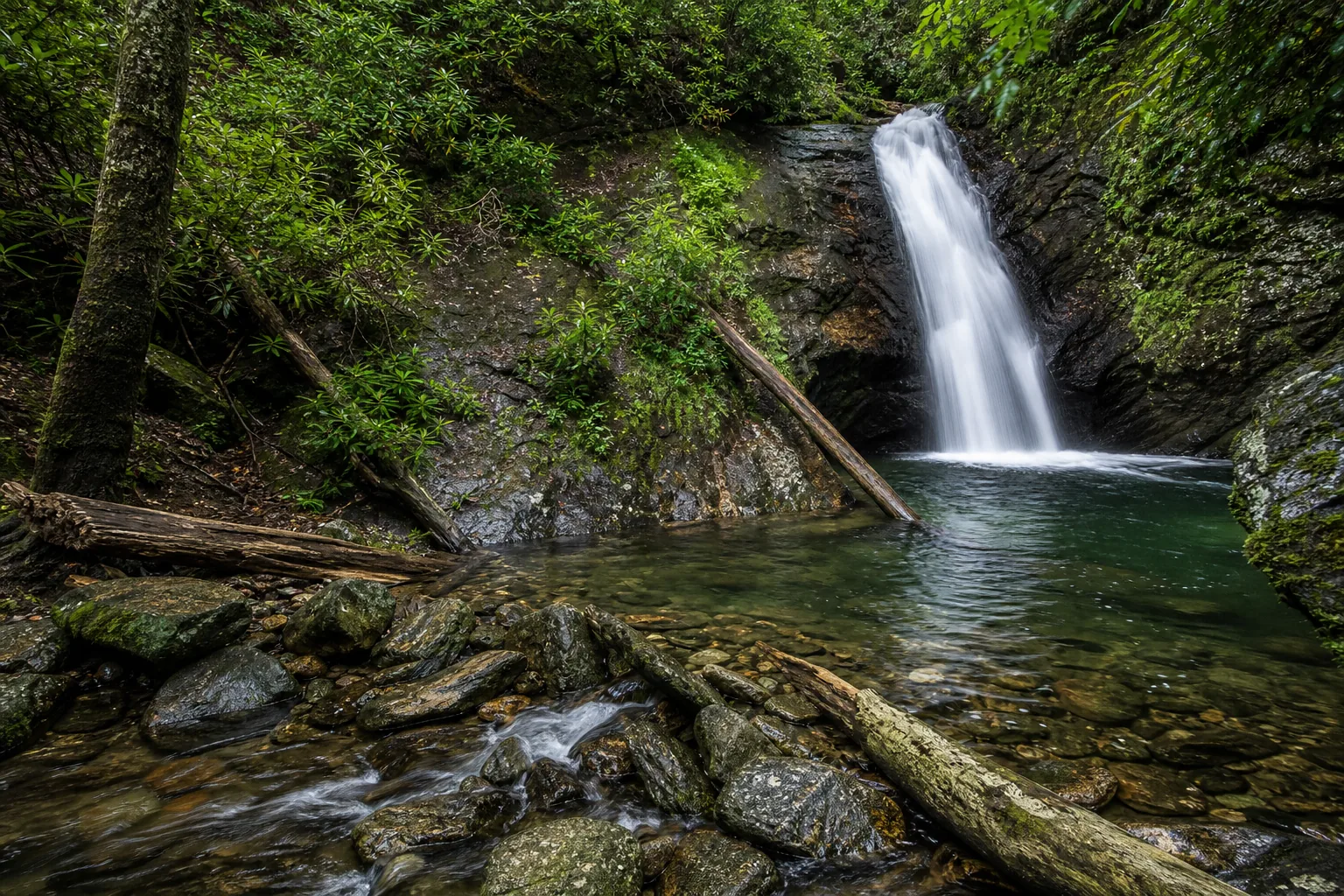
Courthouse Falls base of the 45-foot chute and the hydraulic at the head of the plunge pool
Photo guide

Three working positions in a small amphitheater.

Courthouse is a tight setting. The cove overlook is the standard shot; the base spur is the bottom-up frame; everything else is variation on those two. Use the captions to pick before you commit to the spur, which is slick year-round.

Courthouse Falls 45-foot plunge into a turquoise pool inside a cathedral-like rock amphitheater in Pisgah National Forest
Courthouse Falls, hero composition
Wide view of Courthouse Falls dropping into its turquoise plunge pool inside a curving rock amphitheater in Pisgah National Forest
Wide view of Courthouse Falls in its cathedral-like rock amphitheater on Courthouse Creek
Base of Courthouse Falls showing the 45-foot chute hitting the turquoise plunge pool and the white turbulence at the base
Base of the 45-foot chute and the hydraulic at the head of the plunge pool
Detail of Courthouse Falls water dropping through the Blue Ridge gneiss chute with the curving amphitheater walls visible
Water and Blue Ridge gneiss detail at the chute, showing the joint-plane seam the creek exploits
01Is Courthouse Falls flowing right now?

This guide does not pair Courthouse Falls with a real-time USGS discharge gauge because there is no monitoring station on Courthouse Creek itself.

Courthouse Creek does not have a paired USGS gauge at the falls. The closest functional proxy is the Davidson River gauge downstream, and the practical read is the previous 72 hours of rain in the Brevard area plus the snowmelt window in late winter and spring.

02How long is the walk?

0.8 mi round trip from the Forest Road 140 trailhead to the overlook and back, with a short 0.15-mi spur down to the base of the falls. Plan 30 to 45 minutes at a slow pace, 60 minutes with photo stops, longer if you swim.

03How do you get there?

From Brevard, take US 64 W for about 10 minutes, turn right onto NC 215 N, and continue about 10 miles past Balsam Grove. Turn right onto Forest Road 140 (gravel, unmaintained); the trailhead pullout is about 3 miles in on the right. The gravel is rough but passable in a passenger car when dry.

04Is there free parking?

Small free gravel pullout at the FR 140 trailhead, 8 to 10 cars. No fee, no pass required. The lot fills by 10 a.m. on October Saturdays; spillover parks along FR 140 itself.

05Does it cost money?

Free. Pisgah National Forest does not charge a fee at the Courthouse Falls trailhead and no America the Beautiful pass is required.

06Trail variants

Out-and-back to the base 0.8 mi, 30 to 45 min, from Forest Road 140 trailhead.
Viewpoint only 0.6 mi, 20 to 30 min, stop at the cove overlook above the falls.
Summey Cove approach 3.8 mi, 2 to 2.5 hr, longer route from NC 215, harder, fewer crowds.
Photo-first visit 0.8 mi, 45 to 60 min, overcast or early light for the turquoise pool.

Detailed maps and recent reviews: Falls route on AllTrails · Creek route on AllTrails

07Can you swim?

Swimming in the plunge pool is informally tolerated. The pool is deep (reportedly 8 to 12 feet) and the water is cold year-round (typically 55 to 62 F in summer). Stay clear of the falling water and the hydraulic at the base, where the recirculating current can pin a swimmer underwater. Rescues here are slow because the trailhead is a long drive from any staffed station.

08Are dogs allowed?

Dogs are allowed on leash on Pisgah National Forest trails. Keep dogs leashed across the log bridge and wooden steps, which stay damp and slick, and out of the plunge pool when other swimmers are present.

09Is it accessible?

Not wheelchair accessible. The trail descends a rooted slope with wooden steps and a log footbridge, and the short spur to the base is a scramble on damp rock.

Field notes

Courthouse Falls at a glance.

45-foot plunge over Blue Ridge gneiss and schist, 0.8 mi out-and-back from Forest Road 140 in Pisgah National Forest, managed by the Pisgah Ranger District, free to enter, open year-round. Height and trail length sourced from the Forest Service trail page and corroborated SERP references.

Height 45 ft USGS 3DEP
Type Plunge (single tier) USGS
County Transylvania Transylvania County, NC
Managed by USDA Forest Service, Pisgah Ranger District Pisgah NF
Water source Courthouse Creek USGS
Elevation 3451 ft USGS NED
Park area 512,000 acres Pisgah NF
Hours Trail open year-round; Forest Road 140 (gravel) is the only access and may close after snow or storms Pisgah NF
When to visit

Two windows that justify the drive.

March through May for snowmelt-and-rain flow, and October for color in the cove with reliable flow. Late summer can drop to a ribbon; winter access depends entirely on FR 140 conditions.

PEAK FLOW

Peak flowMar to May runoff
Ice / low flowLate Dec to early Feb
Most crowdedWeekends and midday
Best photosSunrise or weekdays

Live water context

Discharge data -- This guide does not pair Courthouse Falls with a real-time USGS discharge gauge because there is no monitoring station on Courthouse Creek itself.

Why is it called Courthouse Falls?

The name is descriptive. Early Pisgah-area travelers thought the smooth, vertical rock walls of the amphitheater around the falls looked like the interior of a courthouse, and the label stuck to both the waterfall and the creek that feeds it. Courthouse Creek and the broader Courthouse Valley share the same naming logic, and the better-known Devils Courthouse a few miles up the Blue Ridge Parkway uses the same metaphor for a different rock feature. There is no Cherokee origin and no legal-history origin; it is purely a geometry observation that became a place name.

What else to do at Pisgah National Forest

Courthouse Falls sits in the Pisgah Ranger District of Pisgah National Forest, the same 512,000-acre block that holds the Looking Glass Falls and Sliding Rock corridor along US 276 and the Davidson River campground network. The practical base town is Brevard, about an hour south of the trailhead by way of US 64 and NC 215. Most visitors stack Courthouse with two or three other Pisgah waterfalls in a single day rather than treating it as a standalone trip, because the drive in from anywhere is longer than the hike.

  • Forest Road 140 trailhead. Small free gravel pullout off NC 215 about 6 miles north of Balsam Grove. Holds 8 to 10 cars; expect roadside spillover on October weekends.
  • Cove overlook. A wooden-railed viewpoint above the falls at the bottom of the main trail, the only spot most visitors actually reach.
  • Base spur trail. Steep, slick, root-laced short spur off the main trail down to the plunge pool. About 0.15 mi from the overlook; not signed.
  • Courthouse Creek crossings. One log footbridge and a set of wooden steps on the main trail; they never dry out because the cove holds little sunlight.
  • Summey Cove Trail link. Optional longer approach from NC 215 north, 3.8 mi round trip, used by hikers who want a real walk instead of a short waterfall stop.

Why it looks this way

Courthouse Falls is cut into the metamorphic basement rock of the Blue Ridge Province, a mix of Mesoproterozoic gneiss and schist that originated as deep continental crust roughly 1.1 billion years ago and was deformed again during the Appalachian orogeny. The amphitheater shape comes from differential erosion. Courthouse Creek exploits a near-vertical joint plane in the gneiss, while the surrounding rock resists, so the stream has slowly carved a narrow chute and a curving rock bowl rather than a broad ledge. The turquoise color of the plunge pool is a function of depth (the pool is reportedly 8 to 12 feet at the base) and the suspended mineral-flour fines that wash off the surrounding gneiss during high flow.
Field guide deep dive

What a Tripadvisor listing leaves out about Courthouse Falls.

Geology, the courthouse name, the FR 140 access, the Pisgah waterfall day, the truth about swimming, and how to photograph a chute in a shaded amphitheater.

How Courthouse Falls formed

Courthouse Falls is cut into the metamorphic basement rock of the southern Blue Ridge, a mix of Mesoproterozoic gneiss and schist that started as deep continental crust roughly 1.1 billion years ago. The same rock package was folded, faulted, and re-cooked again during the Appalachian orogeny, the long slow continental collision that built the Appalachians between roughly 480 and 270 million years ago. By the time the Atlantic finished opening and erosion went to work, what was left was a hard, banded, vertically jointed crystalline rock that fractures along planes rather than dissolving evenly.

That structural geometry is what produces the courthouse shape. Courthouse Creek does not flow over a soft caprock-on-sandstone contact the way Niagara and St. Anthony Falls do; it exploits a near-vertical joint plane in the gneiss. The stream cuts down along the weakest seam, the surrounding rock resists, and the result is a narrow chute about as wide as a doorframe with a curving rock bowl around it. The 45-foot drop is the height of that one structural seam, not a lithologic contact. The turquoise plunge pool comes from the depth of the bowl (the pool is reportedly 8 to 12 feet at the base) and the suspended fine sediments that mineral-flour the water column during high flow.

Why it is called Courthouse Falls

The name is descriptive, not historical. Early travelers in the Pisgah area thought the smooth, vertical, curving rock walls of the amphitheater around the falls looked like the interior of a courthouse, the kind of formal civic room with paneled walls and a high ceiling, and the label stuck. Courthouse Creek and the broader Courthouse Valley take their name from the same observation. The much better-known Devils Courthouse a few miles up the Blue Ridge Parkway uses the same metaphor for a different rock feature, a bare exposed cliff at 5,720 feet that is visually unrelated to the falls but borrows the same image of a hard rock room.

The amphitheater is small. From the overlook the rock walls feel close enough to touch even though the chute is 45 feet tall, and the acoustic effect is dramatic on a high-flow day, when the noise of the falling water bounces back at you from all three walls. It is one of the more enclosed waterfall settings in western North Carolina, which is what most current trip reports flag as the standout feature, ahead of even the turquoise pool.

The 0.8-mile trail and Forest Road 140 access

The standard route is short. From the gravel pullout on Forest Road 140, the Courthouse Falls Trail drops about 200 feet through hardwood and rhododendron to a wooden-railed overlook at the head of the cove. Total round-trip distance is 0.8 mi; total time is 30 to 45 minutes at a normal pace. The trail crosses Courthouse Creek on a log footbridge with a single handrail and has a short set of wooden steps where the slope steepens. Both stay damp because the cove holds little direct sunlight, and the Forest Service trail page specifically notes that all log bridges and wooden steps can be slippery.

The unsigned base spur is where most visitors actually want to go. About 0.15 mi past the overlook, an obvious user path drops left toward the plunge pool. It is rooted, slick, and steep enough that you will use both hands on the descent, but it is short. The spur is the only way to reach the swimming pool, and the only angle from which the curving rock walls fully read as an amphitheater.

Forest Road 140 itself is the real access question. It is unmaintained gravel branching off NC 215 about 6 miles north of Balsam Grove, rough but passable in a passenger car when dry. After significant rain or any snow it can rut deeply, and in winter it is regularly impassable for low-clearance vehicles. There is no fee, no America the Beautiful pass requirement, and no formal lot. The pullout holds 8 to 10 cars, fills by 10 a.m. on October Saturdays, and spillover parks along FR 140 on the shoulder.

A Pisgah waterfall day

Most visitors do not drive to Courthouse Falls alone. The most common pairing is a single-day loop that combines Courthouse with the headline waterfalls on the US 276 side of the Pisgah Ranger District. Start at Courthouse in the morning while the cove is still in soft shade, then drive south on NC 215 and east on US 64 to Brevard, then north on US 276 to Sliding Rock, the 60-foot natural rock slide where Looking Glass Creek hits a smooth granite slope. From there it is another few minutes north to Looking Glass Falls, the most-photographed roadside waterfall in North Carolina.

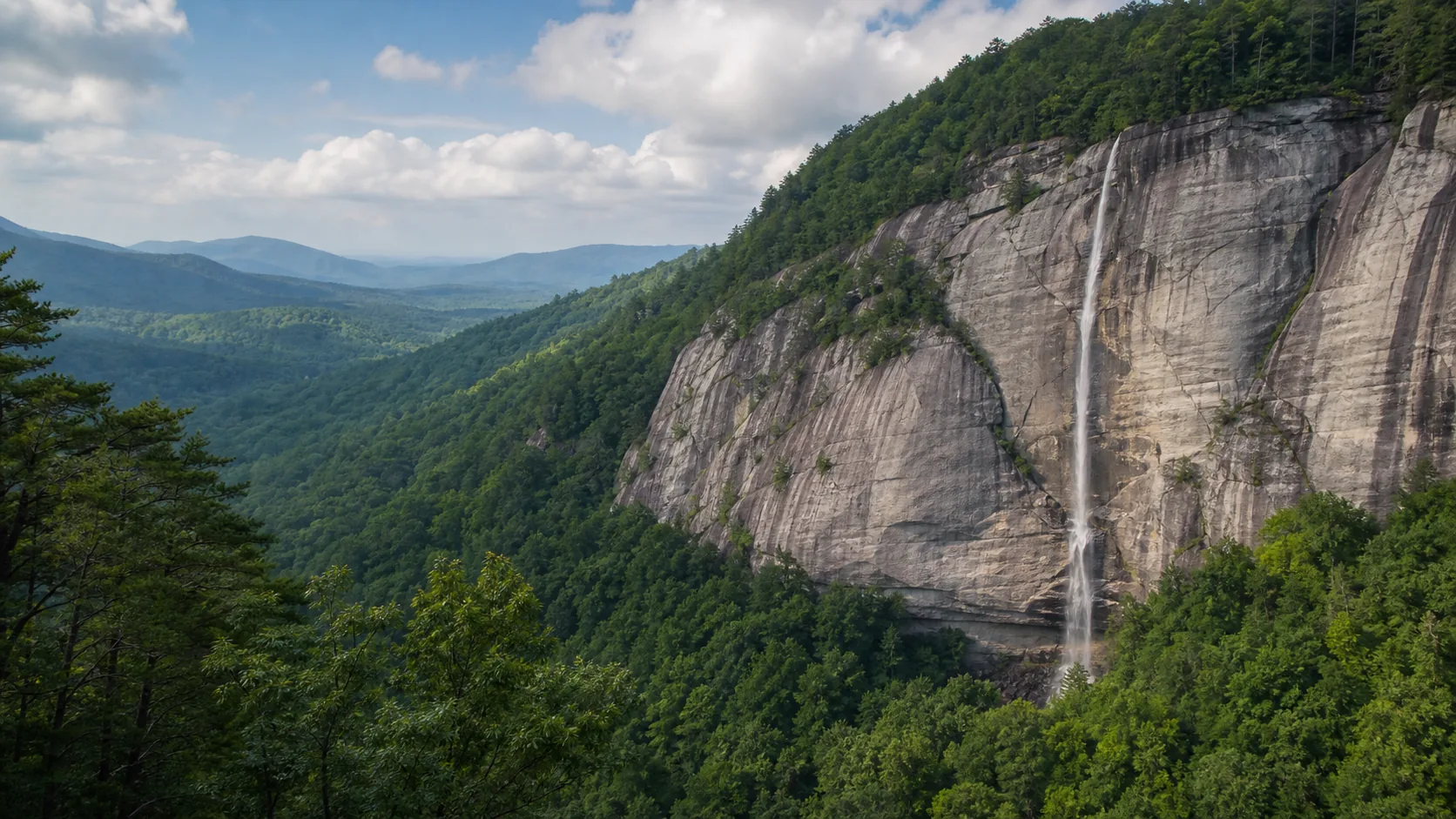
If you want a longer waterfall day that crosses the Blue Ridge front, swing east instead, into the Hickory Nut Gorge corridor toward Lake Lure. Hickory Nut Falls in Chimney Rock State Park is a 404-foot multi-tier drop that sits in a geologically related but visually different rock setting, a near-vertical Henderson Gneiss wall instead of the closed Courthouse amphitheater. For a quieter alternative, Roaring Fork Falls in Pisgah National Forest north of Marion is a short walk to a 100-foot cascade that gets a fraction of the Courthouse foot traffic.

Brevard is the practical base for any of these loops. It has the food, lodging, and gear options, sits at the intersection of US 64 and US 276, and is about an hour from the Courthouse Falls trailhead by way of NC 215.

Swimming, the cold pool, and the hydraulic at the base

Swimming at Courthouse Falls is informally tolerated rather than officially endorsed. The Pisgah Ranger District does not post the pool as closed, and the use pattern is decades old, but the Forest Service does not maintain it as a swimming area and there are no lifeguards, no posted depth markers, and no rescue infrastructure within fast reach. The pool itself is deep, reportedly 8 to 12 feet at the base, with clean cold water that holds between roughly 55 and 62 degrees Fahrenheit even in July and August. The bottom is gravel and rock, not a hidden ledge.

The real hazard is the hydraulic. At the foot of the chute the water plunges hard enough to set up a recirculating current that can pin a swimmer underwater for several seconds at a time, longer at high flow. The standard practice is to enter from the downstream side of the pool, swim toward the falls but stop well short of the falling water, and stay clear of the white turbulence at the base entirely. Local trip reports note that people occasionally jump from rocks above the pool; this guide does not endorse jumping, because the depth measurements are informal and conditions change with sediment and woody debris after high flow.

Cold-water shock is the under-discussed risk. The pool is deep enough that even on an 85-degree summer day, body temperature drops fast and grip strength fades within minutes. Plan for short swims and have a towel and warm layer waiting on the bank.

Photographing a chute in a shaded amphitheater

Courthouse rewards three setups. The first is the cove overlook with a wide lens (14 to 24 mm full-frame equivalent), framing the chute vertically with the amphitheater walls on both sides. The second is the base spur with a standard zoom (24 to 70 mm), bottom-up on the turquoise pool with the curving rock walls closing in. The third is a tight detail shot of the water-and-rock interaction at the base, a 70 to 200 mm crop that isolates the texture without trying to fit the full amphitheater in.

Light is the easy part. The cove faces roughly south and the surrounding gneiss walls keep direct sun off the falls for most of the day, which is why Courthouse photographs well in conditions that would blow out a roadside waterfall like Looking Glass. Overcast days are the cleanest. On bright days, the first hour after sunrise and the last hour before sunset are workable, but the contrast between the lit rim and the shaded chute is high enough that you will want to bracket exposures or accept the dynamic range loss. A polarizer cuts glare off the wet rock and brings the pool color forward; a 6-stop neutral density filter is the standard tool for long-exposure work that smooths the falling water into a single ribbon. A tripod is necessary for any exposure longer than about a quarter-second, which means a tripod is necessary for almost any Courthouse shot you actually want.

Map and route

About an hour from Brevard, longer from Asheville.

From Brevard, take US 64 W for about 10 minutes, turn right onto NC 215 N, and continue about 10 miles past Balsam Grove. Turn right onto Forest Road 140 (gravel, unmaintained); the trailhead pullout is about 3 miles in on the right. The gravel is rough but passable in a passenger car when dry.

Photography and weddings

South-facing cove, two working positions, no fee for personal photography.

Courthouse is a portrait-orientation waterfall. The chute is taller than it is wide, the amphitheater walls frame the shot on three sides, and the turquoise pool anchors the bottom. The cove overlook is the standard angle; the base spur gives a tighter, bottom-up frame that catches the curving rock walls. Side angles are limited because the amphitheater itself is the limit.

The cove faces roughly south and the surrounding gneiss walls keep direct sun off the falls for most of the day, which is what makes this an easy photo target. Overcast days are the cleanest; on bright days, the first hour after sunrise and the last hour before sunset are workable but the contrast between lit rim and shaded chute is high. Long-exposure work with a tripod and a polarizer brings out the pool color.

Personal photography does not require a permit on Pisgah National Forest land. Commercial filming, paid portrait sessions, and any work that blocks the trail or overlook requires a Forest Service special use authorization through the Pisgah Ranger District. Recreational drone flights follow standard FAA Part 107 rules; commercial drone use needs the same special use authorization.

Permits

Weddings and engagements

Courthouse can work for small elopement portraits but not full ceremonies. The overlook is narrow, the base spur is single-file, and there is no level ground large enough for chairs. Most photographers use Courthouse as one stop on a Pisgah elopement day that also includes Looking Glass Falls or Triple Falls.

Pisgah Ranger District requires a special use authorization for commercial photography and for any organized event. The minimum non-commercial photography permit is typically free; commercial rates scale with crew size.

Plan a weekday in shoulder season, skip props and amplified sound, and have a covered backup location in Brevard for rain, which is common in this drainage.

Nearby waterfalls

Three Pisgah waterfalls in a single day.

Courthouse pairs naturally with Sliding Rock and the Looking Glass corridor on US 276, or with Hickory Nut Falls in Chimney Rock for a longer Blue Ridge waterfall day. All three are in the same Pisgah-and-Hickory-Nut-Gorge geology family.

Related questions

More questions visitors ask before driving to Courthouse Falls.

Hike length, parking, dogs, swim rules, FR 140 condition, and the actual answer to the worth-visiting question. The full set is indexed in the FAQ schema for AI answer engines.

01How tall is Courthouse Falls?

Courthouse Falls is about 45 feet tall, a single plunge through a narrow chute in the Blue Ridge gneiss into a deep turquoise pool at the base. Some older sources list the height as 35 feet, but the consensus across current trip reports and the Wikipedia entry is 45 feet.

02Where is Courthouse Falls?

Courthouse Falls is in Pisgah National Forest in Transylvania County, North Carolina, about an hour from Brevard. The trailhead is on Forest Road 140 off NC 215, about 6 miles north of Balsam Grove.

03Is Courthouse Falls free to visit?

Yes. Courthouse Falls is on Pisgah National Forest land and there is no fee, no parking charge, and no America the Beautiful pass required at the Forest Road 140 trailhead.

04What is the condition of Forest Road 140?

Forest Road 140 is unmaintained gravel off NC 215. It is rough but passable in a passenger car when dry. After heavy rain or any snow it can rut deeply, and in winter it is regularly impassable for low-clearance vehicles. The trailhead pullout holds 8 to 10 cars.

05Is Courthouse Falls worth visiting?

Yes, especially in March through May for spring runoff or October for fall color in the gorge. It is one of the shortest payoff-per-step hikes in western North Carolina, with a 45-foot plunge into a turquoise pool inside a small cathedral-like rock amphitheater. Most visitors pair it with Sliding Rock and Looking Glass Falls for a full Pisgah waterfall day.

Sources and data

Where the Courthouse Falls guide gets its facts.

Trail and access from the US Forest Service Pisgah Ranger District page. Geology from the North Carolina Geological Survey Blue Ridge Province description. Weather from the NOAA NWS GSP forecast grid. Descriptive details cross-referenced with current SERP listings.

Pisgah NF: Pisgah National Forest fs.usda.gov
Access, parking, and permit rules: fs.usda.gov
North Carolina Geological Survey: Blue Ridge Belt (Mesoproterozoic gneiss and schist basement rock of the southern Blue Ridge): Transylvania County bedrock deq.nc.gov
NOAA/NWS Greenville-Spartanburg forecast grid GSP/44,60 noaa.gov
USGS National Elevation Dataset 3DEP
Google Maps: embedded map and directions maps.google.com
Google Places: nearby restaurants and hotels places API
US Forest Service: Courthouse Falls Trail, Pisgah Ranger District fs.usda.gov
AllTrails: Courthouse Creek Falls Trail (current trip reports and conditions) alltrails.com
Wikipedia: Courthouse Falls en.wikipedia.org
Wikimedia Commons: Courthouse Falls image category commons.wikimedia.org
NOAA/NWS forecast grid GSP/44,60 weather.gov
Romantic Asheville: Courthouse Falls NC (descriptive details and pool depth) romanticasheville.com
Blue Ridge Mountain Life: Courthouse Falls NC (current visitor reports) blueridgemountainlife.com
NC Tripping: How to Reach Courthouse Falls (directions and FR 140 conditions) nctripping.com
Fact checks
Height audit: 45 ft sourced from the Wikipedia entry and corroborated by romanticasheville.com ("about 45 ft"). Older Romantic Asheville listing references 35 ft for the same waterfall; the page uses the 45 ft figure from the more recent sources.
Trail length audit: 0.8 mi round trip from FR 140 sourced from the US Forest Service Pisgah Ranger District trail page and corroborated by current AllTrails trip reports (range 0.7 to 0.8 mi). The AllTrails 1.9 mi figure appears to include a longer FR 140 walk-in some users do when the trailhead is full.
Geology audit: Blue Ridge gneiss and schist sourced from the North Carolina Geological Survey description of the Blue Ridge Belt. The amphitheater erosion mechanic (joint-plane exploitation in crystalline rock) is the standard explanation for chute-and-bowl waterfalls in the southern Blue Ridge.
Etymology audit: the descriptive courthouse-rock-walls origin of the name is the consensus across romanticasheville.com, blueridgemountainlife.com, and the Wikipedia entry. Courthouse Creek and Courthouse Valley share the same naming logic.
Swim audit: swimming is informally tolerated rather than officially endorsed. The Forest Service trail page does not post the pool as closed; the swimming-hole use is documented in current Facebook, Reddit, and Tripadvisor trip reports cited in the SERP set.
Keyword pass: page targets Courthouse Falls, Courthouse Falls NC, Courthouse Falls trail, Courthouse Falls hike, Courthouse Falls swimming, Courthouse Falls directions, Courthouse Falls parking, and how to get to Courthouse Falls.
Photo audit: waterfall slots use exact Wikimedia Commons files matched to Courthouse Falls plus AI-original renders grounded in the verified local reference set; unrelated park context photos are excluded from waterfall slots.
Flow audit: no live flow chip is shown unless a gauge is manually paired and verified.
Access audit: fee, swimming, dog, and accessibility copy is conservative unless the page has a specific source.
Corrections: [email protected]