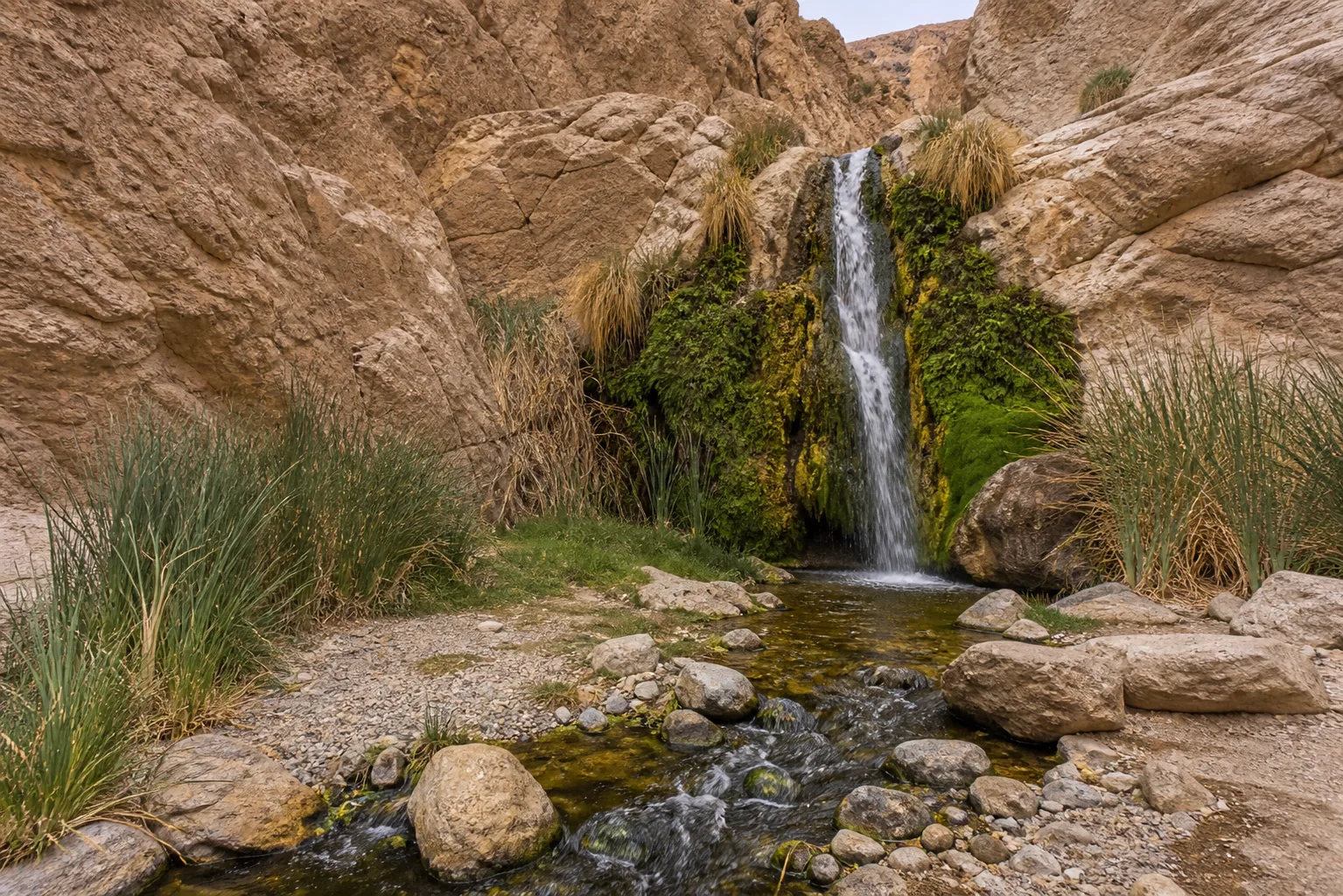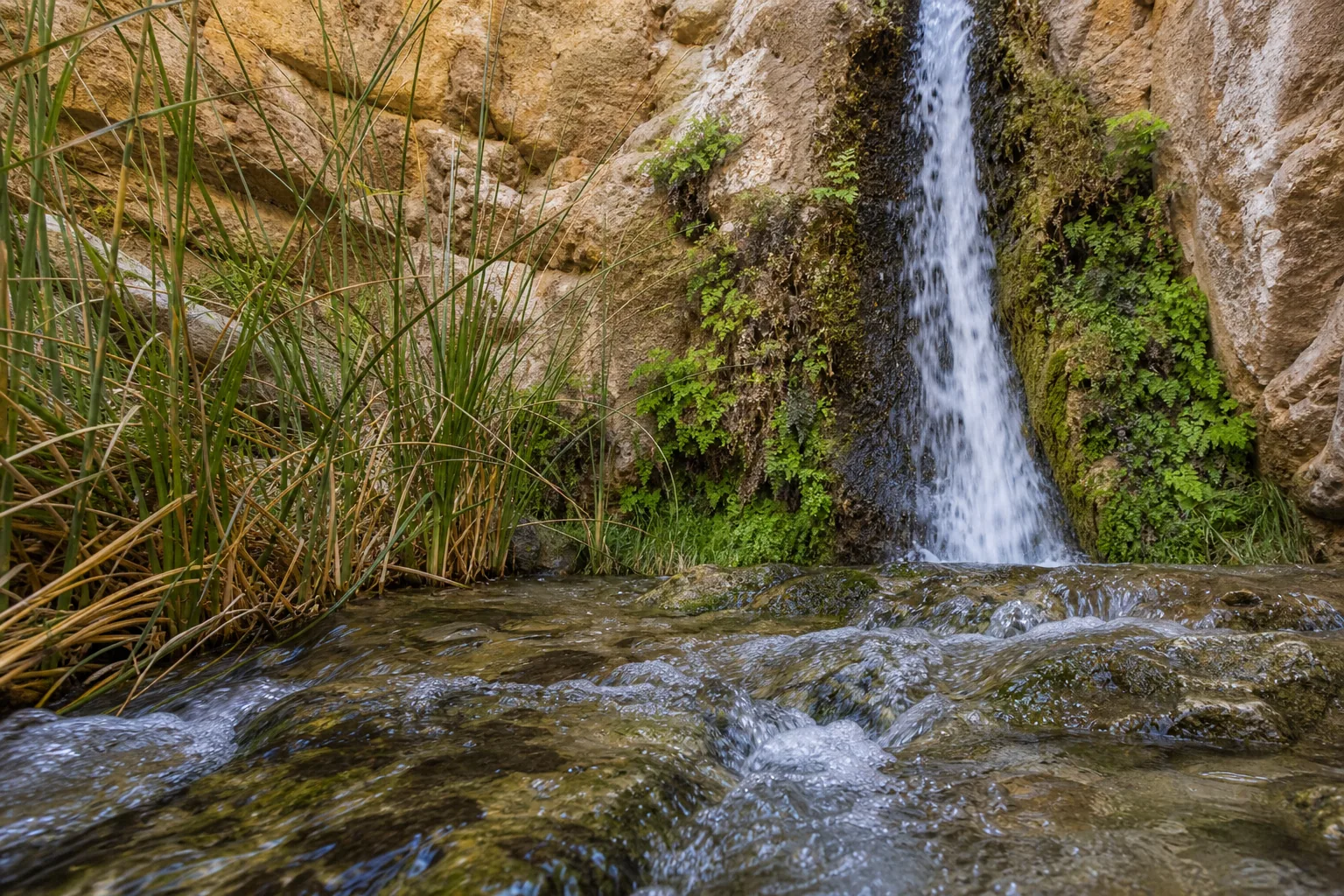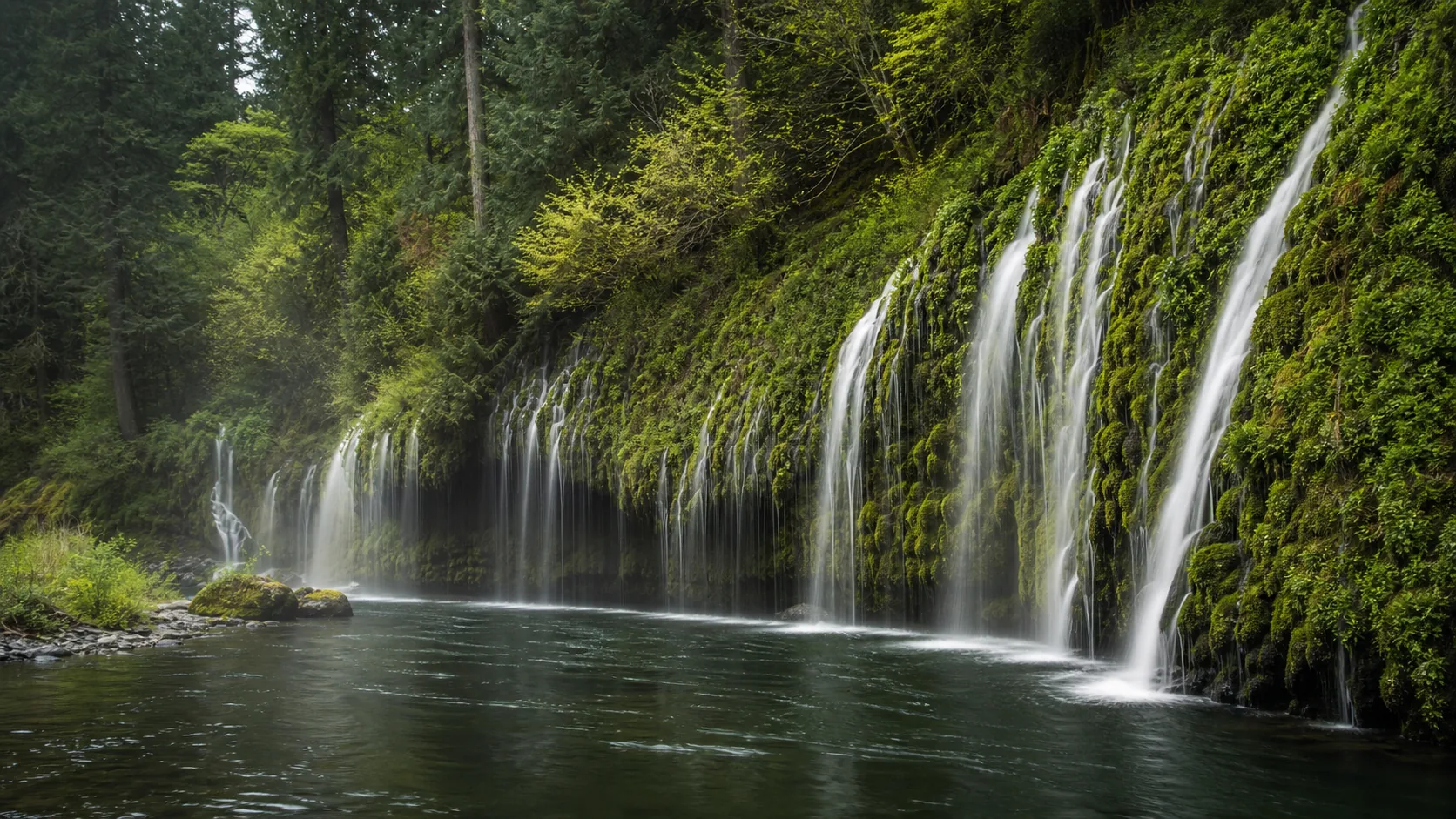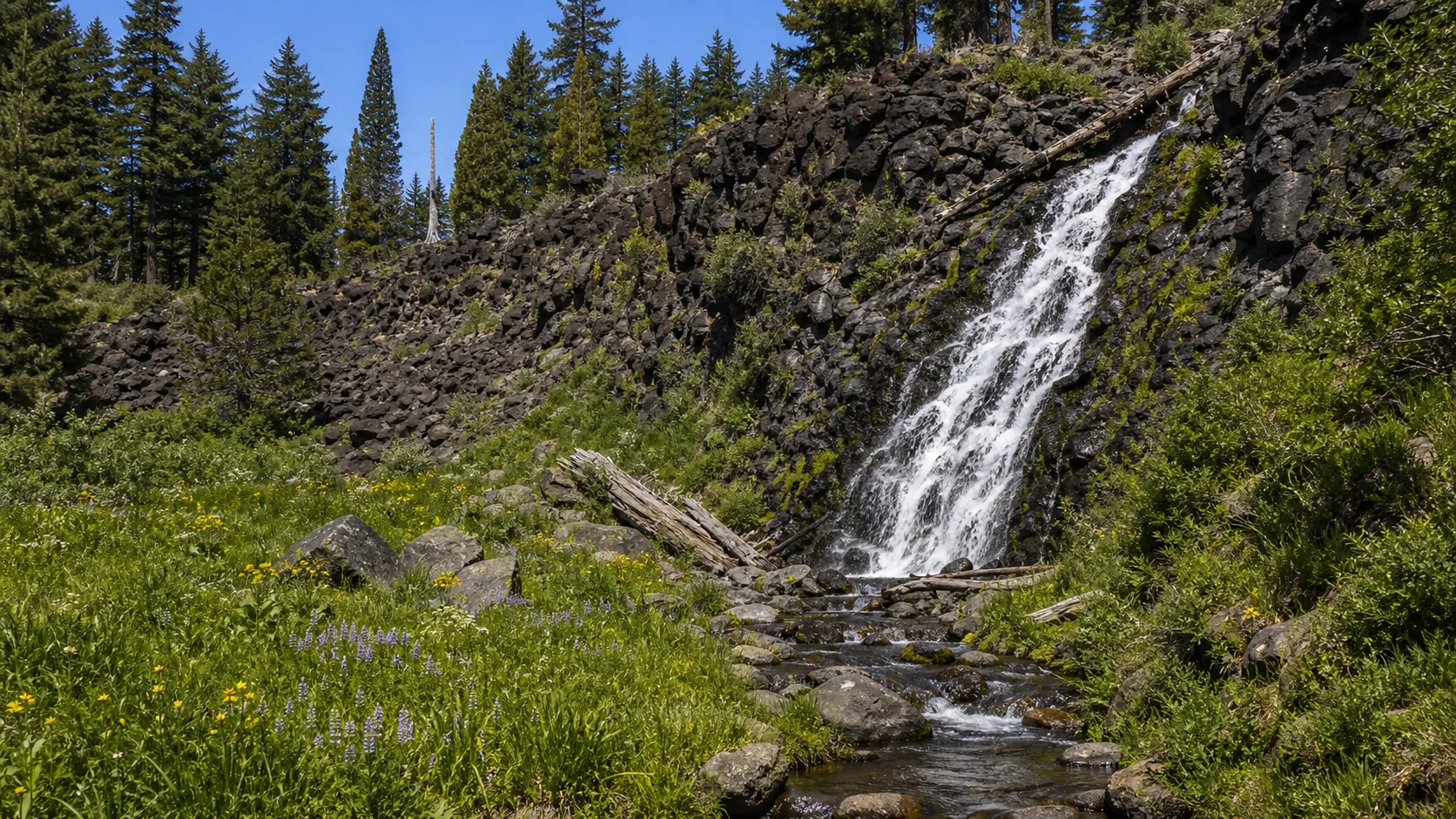
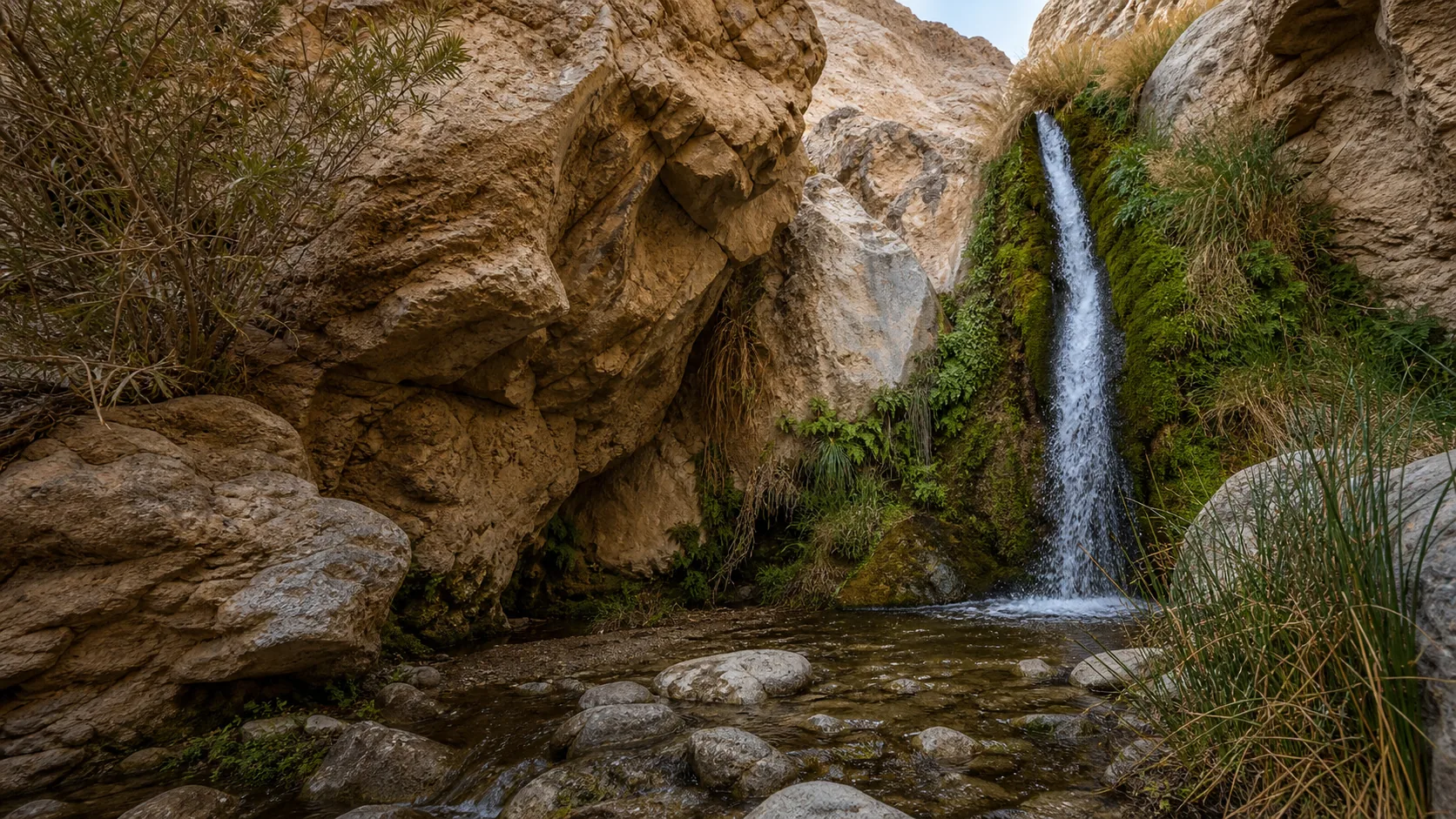
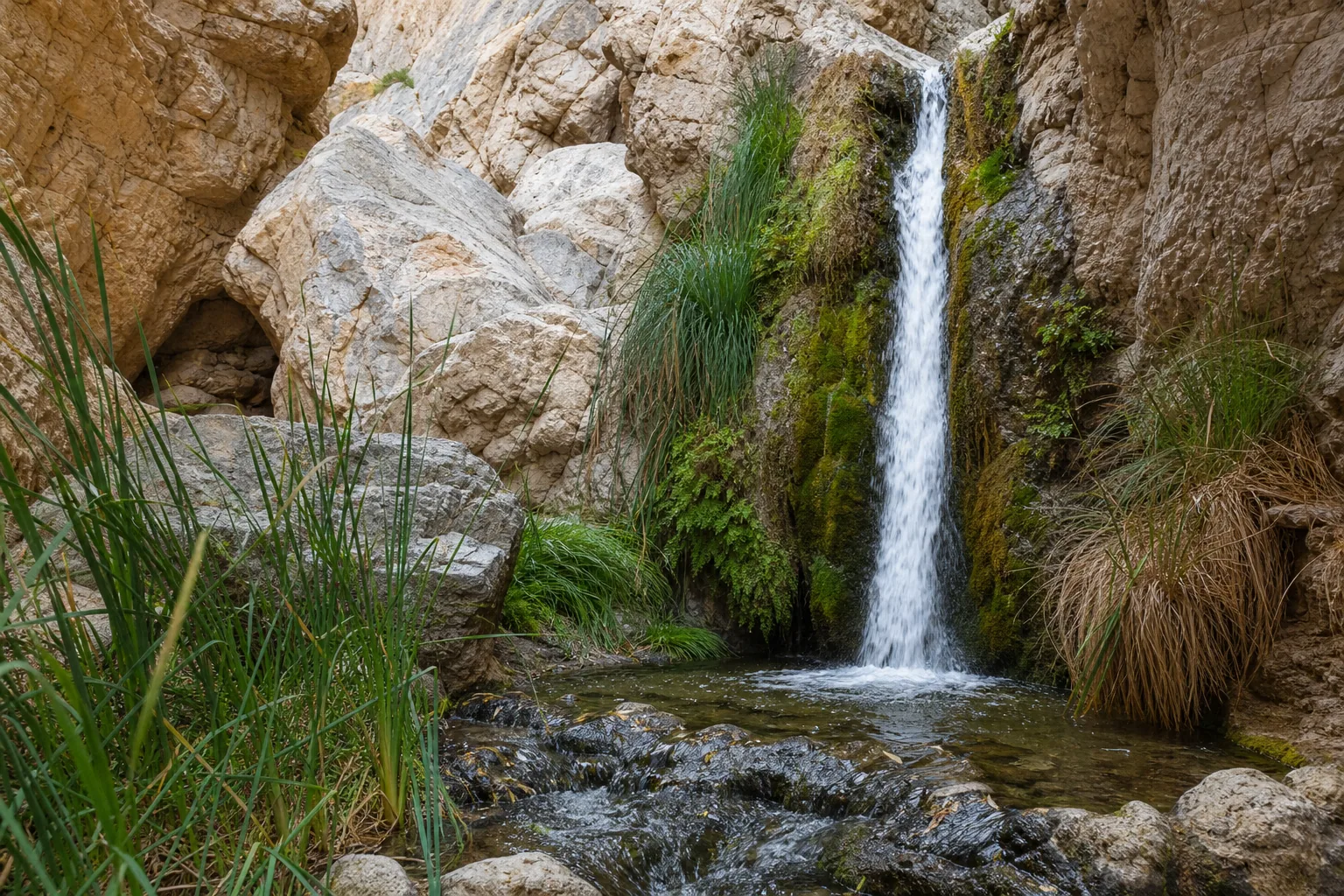
Darwin Falls waterfall and surrounding setting
Inyo County, CA

Darwin Falls

Darwin Falls is an 80-foot, multi-tier, spring-fed waterfall hidden inside a willow-lined canyon on the western edge of Death Valley National Park, Inyo County, California. The lower visible drop most hikers reach is roughly 18 feet, with two more unseen tiers stacked above. The system is one of the only year-round water sources in the driest national park in the country: cattails, cottonwoods, monkeyflower, ferns, and tree frogs against a Panamint Range backdrop. A rough 2.5-mile dirt access road off CA-190 leads to the trailhead, then a 2-mile out-and-back walks the wash and rocky canyon to the falls. Free to hike, $30 Death Valley vehicle entrance, no dogs, no swimming.

Last verified May 12, 2026 Visited Desk-verified May 2026 7 sources checked
Trail 2.0 mi 3.0 mi extended
Time 60-180 min Moderate
Best season November through March, when desert temperatures stay walkable and the spring still flows; avoid summer afternoons when canyon temperatures climb past 100°F After rain or snowmelt
Parking Free dirt pullout at trailhead (or CA-190 shoulder); $30 park entry Death Valley National Park
Quick answer

Is Darwin Falls worth hiking?

Yes, if you treat it as the desert oasis it is rather than as a Yosemite-scale cascade. Darwin Falls is one of only a handful of year-round waterfalls in Death Valley National Park, fed by a permanent spring that surfaces inside a canyon you would never guess held water. The lower drop visible from the maintained trail is about 18 feet; two additional upper tiers stack to roughly 80 feet for the full system. The approach is a rough 2.5-mile dirt road off CA-190 (slow but passenger-car possible in dry conditions) plus a 2-mile out-and-back hike with rock scrambles and no shade. No swimming, no dogs, $30 park entry.

  • 2 miles round trip from the trailhead, ~200 ft of gain on a rocky desert wash
  • Access by a rough 2.5-mile dirt road off CA-190; passenger car possible but slow in dry conditions
  • 80-foot multi-tier spring-fed system; lower visible drop is roughly 18 ft
  • Free to hike; $30 Death Valley vehicle entrance, valid 7 days
  • Year-round flow from a permanent spring; one of the only reliable waterfalls in Death Valley
  • No dogs on any park trail, no swimming (the pool is a drinking-water source)
Last verified May 12, 2026 Visited Desk-verified May 2026 7 sources checked
Distance 2.0 mi 3.0 mi extended
Round trip 60-180 min 2 miles round trip from the trailhead with roughly 200 ft of gain on an unmarked rocky wash and a short canyon scramble; access is by 2.5 miles of rough dirt road off CA-190 (passenger car possible but slow in dry conditions, high clearance preferred). No shade for the first half mile, frequent stream crossings inside the canyon. Conditions can change after flash floods; check the Death Valley alerts page before driving in.
Difficulty Moderate 2 miles round trip from the trailhead with roughly 200 ft of gain on an unmarked rocky wash and a short canyon scramble; access is by 2.5 miles of rough dirt road off CA-190 (passenger car possible but slow in dry conditions, high clearance preferred). No shade for the first half mile, frequent stream crossings inside the canyon. Conditions can change after flash floods; check the Death Valley alerts page before driving in.
Location Inyo County, CA Death Valley National Park
Parking Free dirt pullout at trailhead (or CA-190 shoulder); $30 park entry U.S. National Park Service
Transit No fixed-route transit verified Drive and verify the current trailhead or access point · 0 ft
Drive Verify route Downtown route varies
Best season November through March, when desert temperatures stay walkable and the spring still flows; avoid summer afternoons when canyon temperatures climb past 100°F After rain or snowmelt
Darwin Falls base and water force
Photo guide

Three angles of a desert-canyon oasis.

The visible Darwin Falls frames are the split lower drop into its plunge pool, the willow-and-cottonwood walls of the canyon just below the falls, and the wet-rock detail where the spring water polishes the bedrock. The upper tiers are not photographed here because most hikers never reach them and the scramble is not maintained. Use the captions to pick angles before you commit to the drive in.

Darwin Falls waterfall and surrounding setting
Darwin Falls, hero composition
Darwin Falls wide setting view
Wide setting view
Darwin Falls base and water force
Base and water force
Darwin Falls water and rock detail
Water and rock detail
01Is Darwin Falls flowing right now?

There is no USGS streamgage on Darwin Creek or its spring. The nearest weather reference is the NWS Las Vegas (VEF) forecast grid for the Panamint Springs area; check the Death Valley National Park alerts page for current road and trail conditions before you drive in.

Darwin Falls runs year-round because it is fed by a permanent spring discharging from fractured bedrock at the head of the canyon, not by seasonal runoff. Flow is remarkably steady across the calendar, which is what makes the falls so unusual in Death Valley: the canyon environment swings dramatically (cool and pleasant November through March, dangerously hot June through September), but the water itself does not. There is no live gauge.

02How long is the walk?

About 2 miles round trip from the dirt-road trailhead with roughly 200 feet of elevation gain, on an unmarked rocky wash that narrows into a canyon with stream crossings and a short scramble at the lower drop. Plan 1-2 hours at a relaxed pace. If the access road is closed after a storm, the walk-in from CA-190 adds about 5 miles round trip on the dirt road itself.

03How do you get there?

From Panamint Springs Resort on CA-190, drive 1.2 miles west to the unmarked Darwin Falls Road turnoff on the south side of the highway. Follow the rough dirt road south about 2.5 miles to the small trailhead at road's end. The road is slow but passenger-car possible in dry conditions; high-clearance is more comfortable, and after big winter storms it can be temporarily impassable. Coming from Lone Pine on US-395, follow CA-190 east about 45 miles. Coming from Furnace Creek, follow CA-190 west about 1 hour 20 minutes.

04Is there free parking?

Small dirt pullout at the end of Darwin Falls Road. There is no developed lot, no shade, and no facilities at the trailhead. The closest restrooms, gas, food, and water are at Panamint Springs Resort, 5 minutes east. On peak winter weekends arrive before mid-morning to find a spot at the trailhead.

05Does it cost money?

No fee for the falls itself. The Death Valley National Park entrance fee is $30 per vehicle and is valid 7 days; America the Beautiful federal passes are accepted in lieu of the entrance fee. The fee covers all of Death Valley, including Badwater Basin, Zabriskie Point, and Mesquite Flat Sand Dunes.

06Trail variants

Lower falls out-and-back 2 mi round trip, 1-2 hr, Walk the wash and canyon from the dirt-road trailhead to the 18-foot lower drop; the standard visit.
Photo-first morning visit 2 mi round trip, 2-3 hr, Start at first light for canyon shade and to beat the heat; allow extra time at the pool.
Upper tiers scramble Adds 0.5-1 mi, Adds 1-2 hr, Class 3 scramble around the lower drop to reach the upper tiers of the 80-foot system; route-finding required, not maintained.
Park-on-CA-190 walk-in (post-flood years) ~7 mi round trip, 3-5 hr, If the dirt road is closed or rutted from recent storms, park on the CA-190 shoulder and walk the road plus trail.

Detailed maps and recent reviews: Falls route on AllTrails · Creek route on AllTrails

07Can you swim?

No swimming. The pool below Darwin Falls is the drinking water source for Panamint Springs Resort and entering it is prohibited under park rules. There is no legal swim hole near the falls; treat the pool, the stream, and the wet rock as fully off-limits to soaking. The closest substitute is Saline Valley Warm Springs, a long high-clearance drive away.

08Are dogs allowed?

No. Death Valley National Park prohibits pets on all trails, including being carried in arms or in a pack. Do not leave a dog in a parked vehicle anywhere in the park; even in cooler months, desert temperatures can spike inside a car within minutes and animals die quickly. Rangers at the Furnace Creek visitor center can suggest dirt roads outside the trail system where leashed pets are allowed.

09Is it accessible?

Not wheelchair accessible. The route is an unmarked rocky wash that narrows into a high-walled canyon with stream crossings and slick boulders. There is no paved alternative viewpoint, no developed overlook, and no graded path.

Field notes

Darwin Falls at a glance.

80-foot multi-tier spring-fed waterfall on the western edge of Death Valley National Park, Inyo County, California. Lower visible drop roughly 18 feet. About 2 miles round trip from the trailhead, accessed by a 2.5-mile rough dirt road off CA-190. Free hike; $30 Death Valley vehicle entry. Sourced from the NPS Darwin Falls page and BLM Darwin Falls Wilderness page.

Height 80 ft USGS 3DEP
Type Waterfall USGS
County Inyo Inyo County, CA
Managed by U.S. National Park Service, Death Valley National Park U.S. National Park Service
Water source Darwin Creek (perennial spring-fed) USGS
Elevation 2864 ft USGS NED
Park area 3,400,000 acres U.S. National Park Service
Hours Death Valley National Park is open 24 hours year-round; hiking Darwin Falls is not advised after 10 a.m. in summer due to extreme heat U.S. National Park Service
When to visit

One window that works, two that do not.

November through March is the window. Daytime temperatures in the Panamint Valley stay walkable, the spring still flows at its steady year-round rate, and the canyon shade arrives at a reasonable hour. June through September is dangerous in the canyon and the NPS specifically warns against hiking Darwin Falls after 10 a.m. in summer. Spring (March-April) is the bonus season if CA-190 catches a desert wildflower year.

PEAK FLOW

Peak flowAfter rain or snowmelt
Ice / low flowWinter varies
Most crowdedWeekends and midday
Best photosSunrise or weekdays

Live water context

Discharge data -- There is no USGS streamgage on Darwin Creek or its spring. The nearest weather reference is the NWS Las Vegas (VEF) forecast grid for the Panamint Springs area; check the Death Valley National Park alerts page for current road and trail conditions before you drive in.

Why is it called Darwin Falls?

Darwin Falls, Darwin Canyon, the Darwin Mining District, and the small still-occupied silver town of Darwin all carry the name of Dr. Erasmus Darwin French, an army physician and prospector who came west during the Mexican-American War in 1846 and worked the silver veins in the surrounding hills through the 1860s and 1870s. The mining district was named for him first; the canyon and waterfall took the name from the district. There is no link to the English naturalist Charles Darwin, who is the name most readers reach for. The overlap is coincidence: Erasmus Darwin French was named for the 18th-century English physician and poet Erasmus Darwin, who was Charles's grandfather. The waterfall, in other words, is named for the doctor, not the theory.

What else to do at Death Valley National Park

Death Valley National Park covers roughly 3.4 million acres across Inyo County, California, and into southern Nevada, the largest national park in the contiguous United States. Darwin Falls sits on the park's far western edge near Panamint Springs, about an hour and twenty minutes by road from Furnace Creek and 45 miles east of Lone Pine on CA-190. The trailhead is reached by a rough 2.5-mile dirt road (Darwin Falls Road) that turns south off CA-190 about 1.2 miles west of Panamint Springs Resort. The road is unmaintained, washes deeply in flash-flood seasons, and changes year to year. Passenger cars can usually make it slowly in dry conditions; high-clearance is more comfortable, and after major storms the road sometimes closes entirely.

  • Panamint Springs Resort. The closest services - gas, lodging, food, and the only flush restrooms within several miles of the trailhead - sit 1.2 miles east of the Darwin Falls turnoff on CA-190.
  • Darwin Falls Wilderness (BLM). A neighboring 8,600-acre BLM wilderness on the Darwin Plateau, all non-motorized; the spring that feeds the falls rises just outside its northeast boundary inside the national park.
  • Father Crowley Vista Point. About 9 miles west on CA-190, a fighter-jet training viewpoint over Rainbow Canyon - a worthwhile add-on the same morning.
  • Mosaic Canyon and Mesquite Flat Sand Dunes. Roughly an hour east toward Stovepipe Wells; pair with Darwin Falls if you are crossing the park west to east.
  • Darwin ghost town. Off CA-190 just west of the park, a small still-occupied silver-mining town tied to Erasmus Darwin French's prospecting era.

Why it looks this way

Darwin Falls sits at the head of Darwin Canyon on the northeast flank of the Argus and Inyo ranges, where a permanent spring surfaces just outside the northeast boundary of the BLM-managed Darwin Falls Wilderness. The exposed rock in the canyon is a mix of Mesozoic granitic intrusions and older Paleozoic metasedimentary and volcanic units typical of the Inyo Range, fractured and recharged by snowmelt and winter precipitation on the higher ground above. Water moves slowly through that fractured bedrock, emerges as a steady spring discharge near the falls, supports a strip of willows and cottonwoods through the canyon, and disappears back into the wash before it reaches the canyon mouth (which is why the desert you walk up looks bone-dry until the last bend). The full 80-foot system stacks three tiers; the lower drop visible from the trail is roughly 18 feet of bright water over polished, fractured rock, with two upper drops accessible only by a Class 3 scramble.
Field guide deep dive

What you should know before driving into Darwin Canyon.

Geology of the spring, the rough dirt road, the 2-mile hike, the paradox of a year-round waterfall in the driest park in the country, and how Darwin Falls compares to Death Valley's other wet spots. Skim the headers, read the section you need.

How Darwin Falls formed

Darwin Falls runs because of geology, not weather. The exposed rock at the head of Darwin Canyon is a mix of Mesozoic granitic intrusions from the Inyo Range batholith and older Paleozoic metasedimentary and volcanic units that were folded and faulted long before the granite pushed up through them. That rock is heavily fractured, which is exactly the kind of plumbing a desert spring needs.

Precipitation and snowmelt on the higher ground above the canyon (the Argus and Inyo ridges, well over 5,000 feet of elevation) percolates slowly through the fractured bedrock and emerges at a permanent spring just outside the northeast boundary of the BLM-managed Darwin Falls Wilderness. The discharge is small but constant: enough to support willows, cottonwoods, monkeyflower, ferns, and tree frogs in the canyon, and enough to keep the lower drop running through every month of the year. The water surfaces, runs maybe a quarter mile through the canyon, then disappears back into the gravel of the wash before it reaches the canyon mouth. That is why the desert you walk up from the trailhead looks bone-dry until the last bend.

The paradox: a year-round waterfall in Death Valley

Death Valley records the highest reliably measured air temperatures on Earth and averages roughly two inches of precipitation a year on the valley floor. The accepted mental model of the park is salt flat, sand dune, and badland, not running water. Darwin Falls is the working counterexample. It is one of fewer than ten year-round water sources in the park's 3.4 million acres, and the only one that drops as a recognizable waterfall reachable on a day hike.

The resolution to the paradox is the difference between climate and hydrology. Climate is what falls from the sky at the falls' elevation; hydrology is what comes out of the rock. Darwin's spring is fed from a recharge area at higher elevation and on rock with thousands of years of stored fracture-flow groundwater. The waterfall is not a desert anomaly so much as an exposed window into a hidden aquifer. The cottonwoods and willows that line the lower canyon are tracking that aquifer, and the same goes for the small population of Panamint daisy and other endemic plants that hold on in this drainage. It is a park feature that hides in plain sight: a green stripe inside a brown landscape, kept alive by water that fell as snow on the Inyos centuries ago.

The 2.5-mile rough dirt access road

The drive in is the first decision point on a Darwin Falls trip, and it is honestly the part most visitors underestimate. From CA-190 the unmarked Darwin Falls Road turns south about 1.2 miles west of Panamint Springs Resort. The road is unmaintained dirt and gravel, runs roughly 2.5 miles to a small trailhead pullout, and crosses the wash multiple times. In dry conditions a careful driver in a stock sedan can usually make it slowly. After a major winter storm or summer thunderstorm, the same road can be deeply rutted, sand-loaded, or temporarily impassable.

What to actually do: check the Death Valley National Park alerts page the morning of, then make a judgment call at the turnoff. If the first 100 yards look chewed up, the rest of the road probably is too; park on the wide CA-190 shoulder at the mouth of the road and walk in. Adding 5 miles of dirt-road walking on top of the 2-mile trail is a real commitment (the round trip is then closer to 7 miles and 3-5 hours), but it is straightforward terrain. Whichever way you drive in, the parking at road's end is a small dirt pullout with no facilities, no shade, and no water. Top off everything at Panamint Springs Resort first.

The 2-mile hike: wash, scramble, canyon

From the trailhead the route follows the wash south and then bends into the canyon. The first half mile is open, rocky, and unshaded, with footing on cobbles and small ledges; trekking poles help, dedicated hiking shoes help more. The canyon walls close in gradually and the trail becomes a route rather than a tread: you are walking up a streambed in places, hopping a few stones, and squeezing between willow stands.

The last quarter mile is where the trail earns its character. Cottonwoods and willows form a continuous canopy overhead, the air temperature drops, the soundscape switches from desert silence to running water, and the rock walls press in to maybe 20 feet apart at the narrowest. The lower drop appears around the final bend as a split fall of bright water over polished bedrock into a small pool. The visible drop is about 18 feet; two upper tiers are stacked above and add roughly another 60 feet, for the 80-foot total that surveyors and canyoneers report. Reaching the upper tiers is a Class 3 scramble around the lower drop with no maintained route and real exposure; skip it unless you have route-finding experience and the day to spend.

Darwin Falls vs Death Valley's other wet spots

Darwin is the easiest year-round water in the park to actually see on foot, but it is not the only one. Salt Creek near the Devil's Cornfield holds water seasonally (winter through spring) and supports the endemic Salt Creek pupfish on a short boardwalk. Cottonwood and Marble canyons in the Cottonwood Mountains have intermittent surface water and are long high-clearance drives to reach. Surprise Canyon above Ballarat has a multi-tier waterfall system that is harder, longer, and far more committing than Darwin. Saline Valley Warm Springs are exactly that, warm springs in a remote north-park drainage that requires a long high-clearance approach.

What makes Darwin singular is the combination of perennial flow, easy mileage, and proximity to a paved highway with services. It is the best entry point to the idea that Death Valley is a desert with hidden hydrology rather than a desert with none. Sitting Bull Falls in the Chihuahuan Desert of New Mexico is the closest analog elsewhere in our guide library: a spring-fed perennial waterfall in a hot desert canyon, with similar mechanics and a similar reading on arrival. If you are mapping a desert-waterfall trip across the Southwest, the two pair well as bookends.

Panamint Springs base, photography, and a practical plan

Panamint Springs Resort, 1.2 miles east of the Darwin Falls Road turnoff on CA-190, is the only logical base for a Darwin Falls trip. It has the closest gas, food, water, restrooms, lodging, and beer line on the park's west side. The resort runs a small motel and a tent and RV campground; both fill quickly on winter and spring weekends. Lone Pine on US-395 is the next-best base, 45 miles west on CA-190, with a larger selection of motels and the eastern Sierra views; Furnace Creek is an option for crossing-the-park itineraries but adds an hour and twenty minutes of driving each way.

For photography, plan for canyon shade in the morning. The falls faces a direction that catches even, indirect light through about 10 a.m., which is the cleanest exposure window. Midday spotlights the upper rock face and crushes shadow detail in the pool. Overcast days are forgiving for both the wet rock and the surrounding vegetation. Tripods are fine off the immediate trail on durable surfaces; drones are prohibited park-wide under NPS Policy Memorandum 14-05. The practical plan most visitors will want: arrive at Panamint Springs the night before, drive the dirt road at first light, be at the falls before 9 a.m., back to the resort for breakfast, then continue east into the park or west toward Father Crowley Vista. Drink twice as much water as you think you need.

Map and route

Forty-five miles east of Lone Pine, an hour and twenty minutes west of Furnace Creek.

From Panamint Springs Resort on CA-190, drive 1.2 miles west to the unmarked Darwin Falls Road turnoff on the south side of the highway. Follow the rough dirt road south about 2.5 miles to the small trailhead at road's end. The road is slow but passenger-car possible in dry conditions; high-clearance is more comfortable, and after big winter storms it can be temporarily impassable. Coming from Lone Pine on US-395, follow CA-190 east about 45 miles. Coming from Furnace Creek, follow CA-190 west about 1 hour 20 minutes.

Photography and weddings

Narrow canyon, willow-framed pool, no clean uphill vantage.

The pool at the base of the main drop is the only frame that captures both streams of the split cascade. Vegetation is thick and there is no clean uphill vantage; back up to the last set of stepping stones for context shots that include canyon walls and cottonwoods.

Canyon shade through about 10 a.m. gives the most even exposure on water and rock. Midday sun spotlights the upper rock face and crushes shadow detail in the pool; overcast days are ideal.

Personal photography is fine. Tripods are allowed off-trail only on durable surfaces. Drones are prohibited park-wide. Commercial filming or still shoots with crew or models require an NPS commercial use permit through Death Valley.

Permits

Weddings and engagements

Darwin Falls is too narrow, too fragile, and too remote for a practical ceremony - the canyon barely fits two hikers passing each other, and pets, large groups, and props are not appropriate.

Death Valley National Park requires a Special Use Permit for any wedding regardless of size; contact the park's permits office. Most weddings in the area are held at Furnace Creek instead.

Skip Darwin Falls for the ceremony itself. Use it for a small post-ceremony portrait session at sunrise on a weekday and keep the group to two or three people.

Related questions

More questions visitors ask before driving to Darwin Falls.

Hike length, road condition, height of the falls, swimming, dogs, fees, and the worth-visiting question. The full set is also indexed in the FAQ schema for AI answer engines.

01Is the road to Darwin Falls OK for cars?

Usually yes, but slowly. The 2.5-mile Darwin Falls Road off CA-190 is rough, unmaintained dirt and gravel that crosses the wash several times. In dry conditions a careful driver in a stock passenger car can typically make it; high-clearance is more comfortable and is the better choice after rain. Check the Death Valley alerts page before driving and look at the first 100 yards at the turnoff; if it is deeply rutted, park on the CA-190 shoulder and walk in.

02Is Darwin Falls free?

There is no separate fee for the hike or the falls. Death Valley National Park charges a $30 per vehicle entrance fee that is valid 7 days and covers the entire park, including Darwin Falls. America the Beautiful federal passes are accepted in place of the entrance fee.

03How tall is Darwin Falls?

The full multi-tier system is about 80 feet. The lower drop you see from the maintained route is roughly 18 feet of bright water over polished bedrock into a small pool; two upper tiers stack above and are reachable only by a Class 3 scramble most visitors skip. The 80-foot figure that surveyors and canyoneers report is for the system as a whole.

04When is the best time to visit Darwin Falls?

November through March, when daytime temperatures in the Panamint Valley stay walkable and the spring still flows at its steady year-round rate. Avoid June through September; the National Park Service specifically warns against hiking Darwin Falls after 10 a.m. in summer because canyon temperatures climb past 100 degrees Fahrenheit. Late fall (October into early November) is the sweet spot for cool temperatures, low crowds, and golden cottonwood color in the canyon.

05Is Darwin Falls worth visiting?

Yes, if you treat it as the desert oasis it is rather than as a tall, photogenic cascade. It is one of the only year-round waterfalls in Death Valley National Park, a green pocket of willows, cottonwoods, ferns, and tree frogs inside the driest national park in the country, and the only one of those wet spots reachable on a short day hike from a paved highway. The lower drop is modest at 18 feet, but the experience of finding running water in this landscape is the point.

Sources and data

Where the Darwin Falls guide gets its facts.

National Park Service Darwin Falls place page for the year-round flow claim and the lower-drop height. BLM Darwin Falls Wilderness page and Wilderness.net entry for the spring location and willow/cottonwood gallery. AllTrails for alternate-route mileages in post-storm years. NWS Las Vegas forecast grid for Panamint Springs weather. Wikipedia for the Erasmus Darwin French / Darwin Mining District etymology.

U.S. National Park Service: Death Valley National Park nps.gov
Access, parking, and permit rules: nps.gov
Inyo Range granitic and metamorphic bedrock (conservative geology note grounded in regional USGS Inyo Mountains geologic mapping): Inyo County bedrock nps.gov
NOAA/NWS forecast grid VEF/39,118 (Panamint Springs area) noaa.gov
USGS National Elevation Dataset 3DEP
Google Maps: embedded map and directions maps.google.com
Google Places: nearby restaurants and hotels places API
National Park Service: Darwin Falls place page (Death Valley National Park) nps.gov
BLM: Darwin Falls Wilderness blm.gov
Wilderness.net: Darwin Falls Wilderness (spring location and willow/cottonwood gallery) wilderness.net
AllTrails: Darwin Falls Trail via Old Toll Road (current conditions and post-storm reroutes) alltrails.com
Wikipedia: Darwin Falls (Erasmus Darwin French and Darwin Mining District cross-reference) en.wikipedia.org
Wikimedia Commons: Darwin Falls image category commons.wikimedia.org
NOAA/NWS forecast grid VEF/39,118 weather.gov
Fact checks
Height audit: the 80-foot figure refers to the multi-tier system surveyors and canyoneers report; the visible lower drop from the maintained trail is described as roughly 18 feet, matching the NPS place-page figure.
Etymology audit: Darwin Falls and the Darwin Mining District are named for Dr. Erasmus Darwin French; the connection to Charles Darwin is explicitly ruled out (Erasmus Darwin French shares a first name with Charles's grandfather, the English physician Erasmus Darwin).
Access audit: the 2.5-mile dirt access road off CA-190 is currently described as passenger-car possible but slow in dry conditions, with a post-storm walk-in variant preserved for years when the road is rutted or closed.
Photo audit: visible gallery slots use AI-original images grounded in the Darwin Falls local reference set; unrelated park context photos are excluded from waterfall slots.
Flow audit: no live flow chip is shown. Darwin Creek has no USGS streamgage; the page references the NWS VEF forecast grid for Panamint Springs weather only.
Access audit: fee, swimming, dog, and accessibility copy is conservative and sourced to the NPS Darwin Falls page and Death Valley superintendent rules.
Corrections: [email protected]