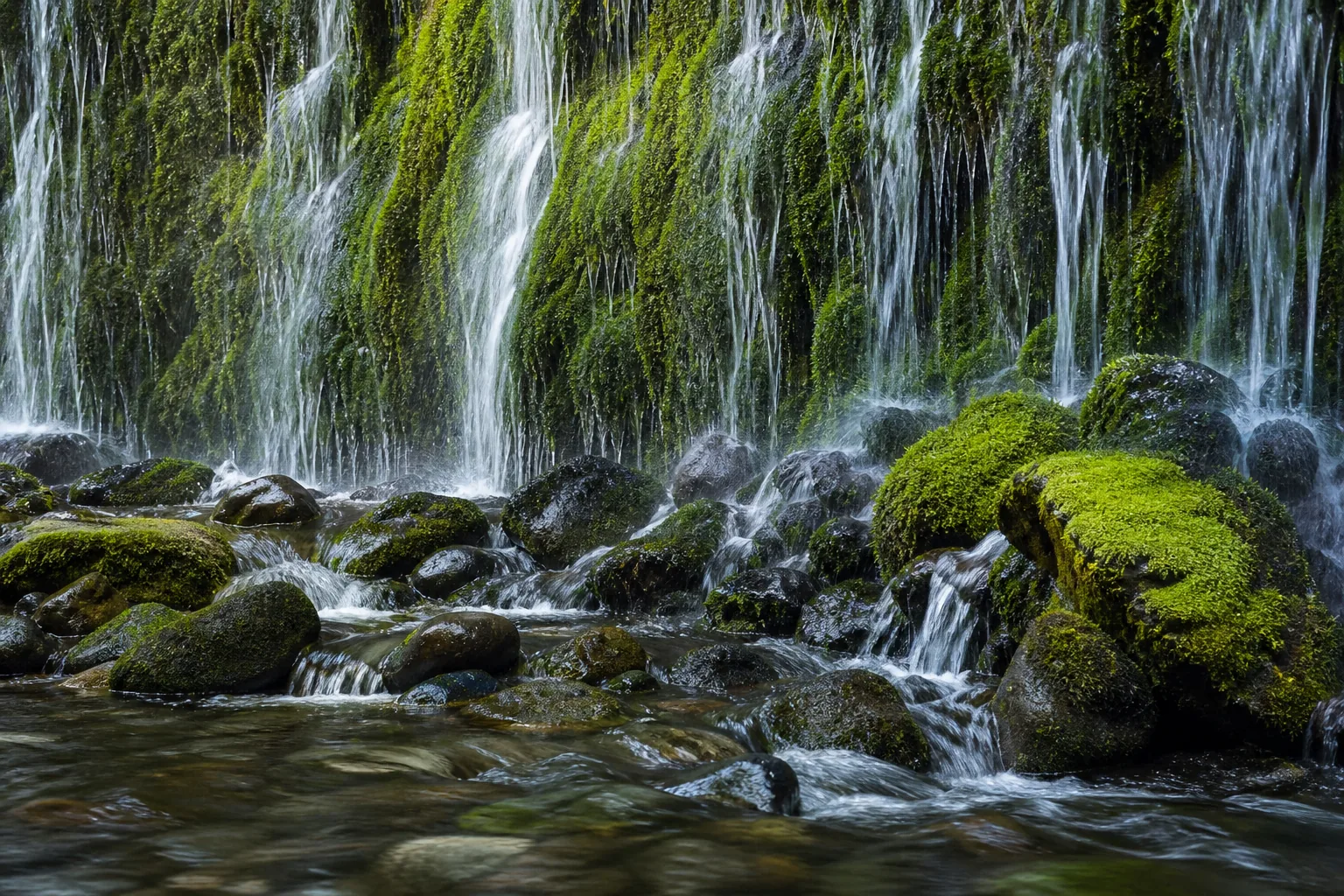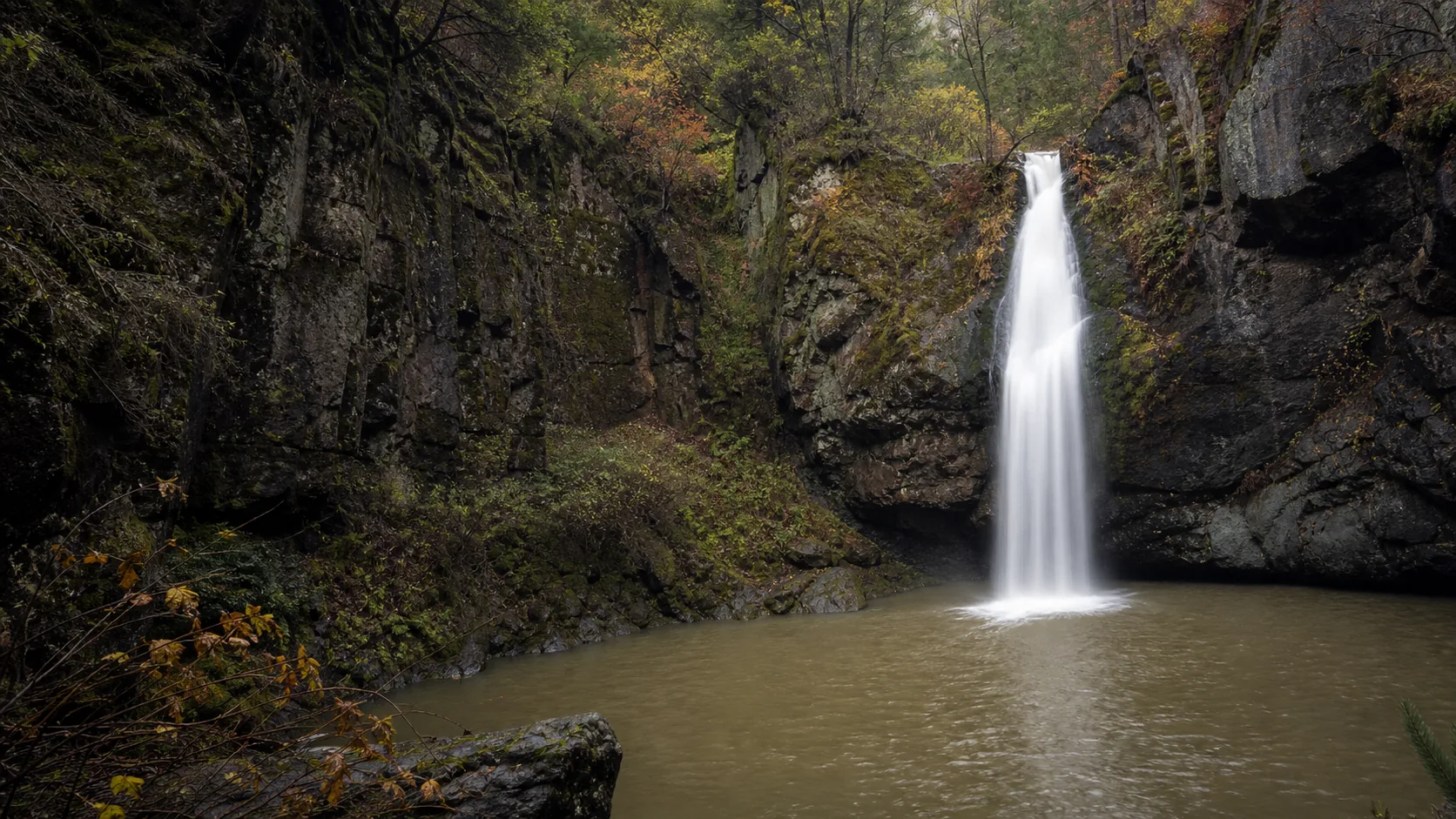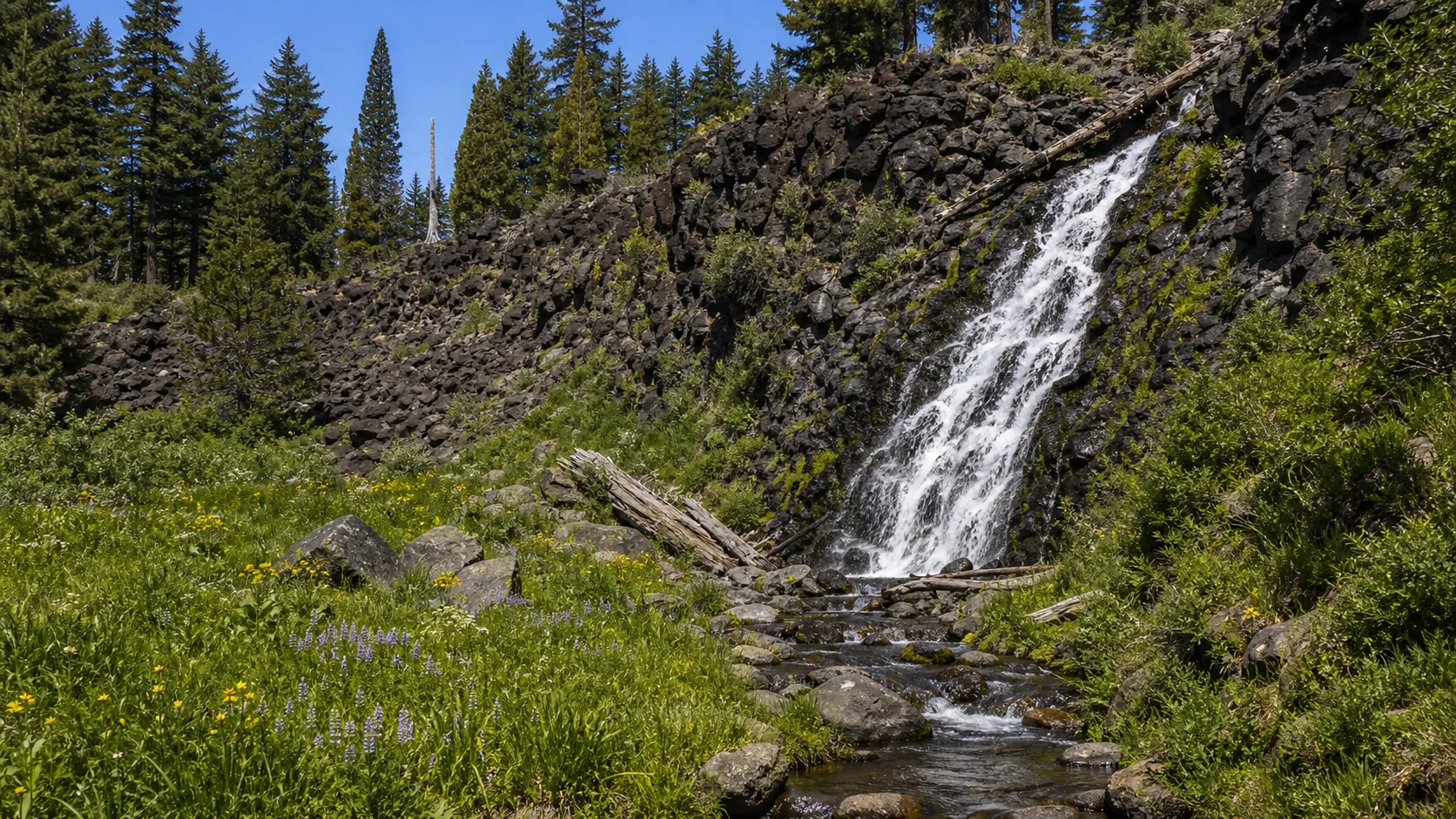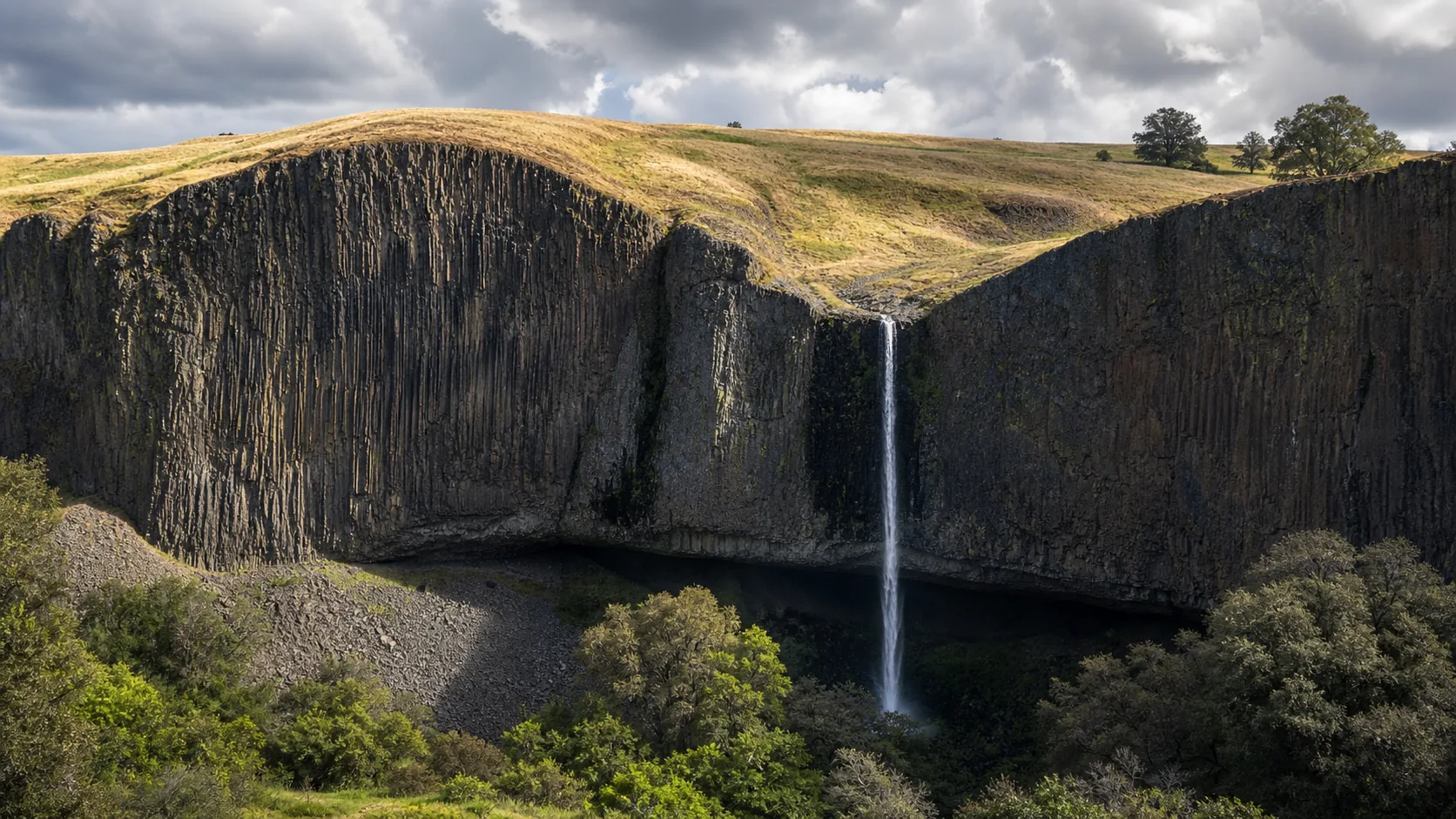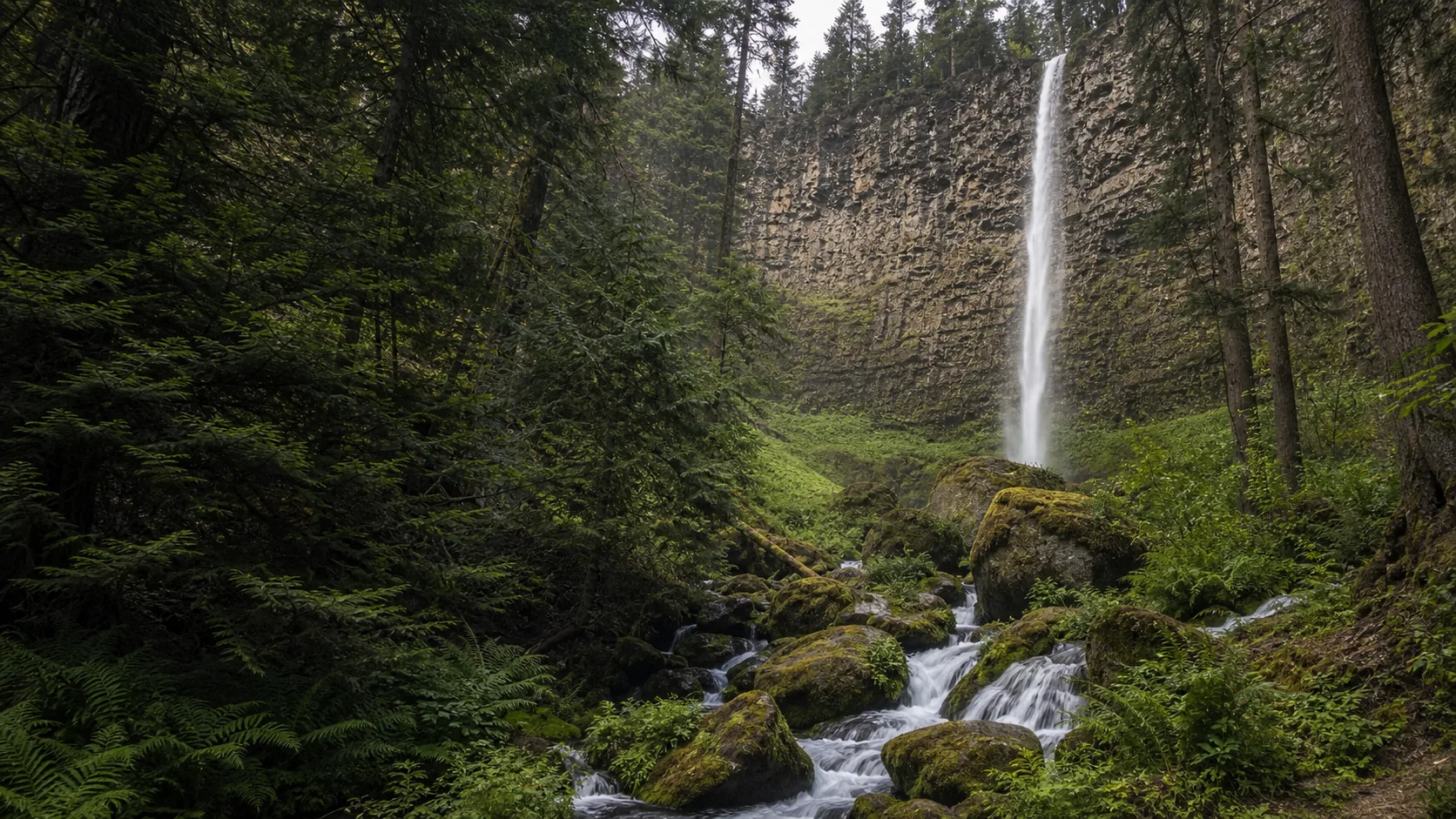
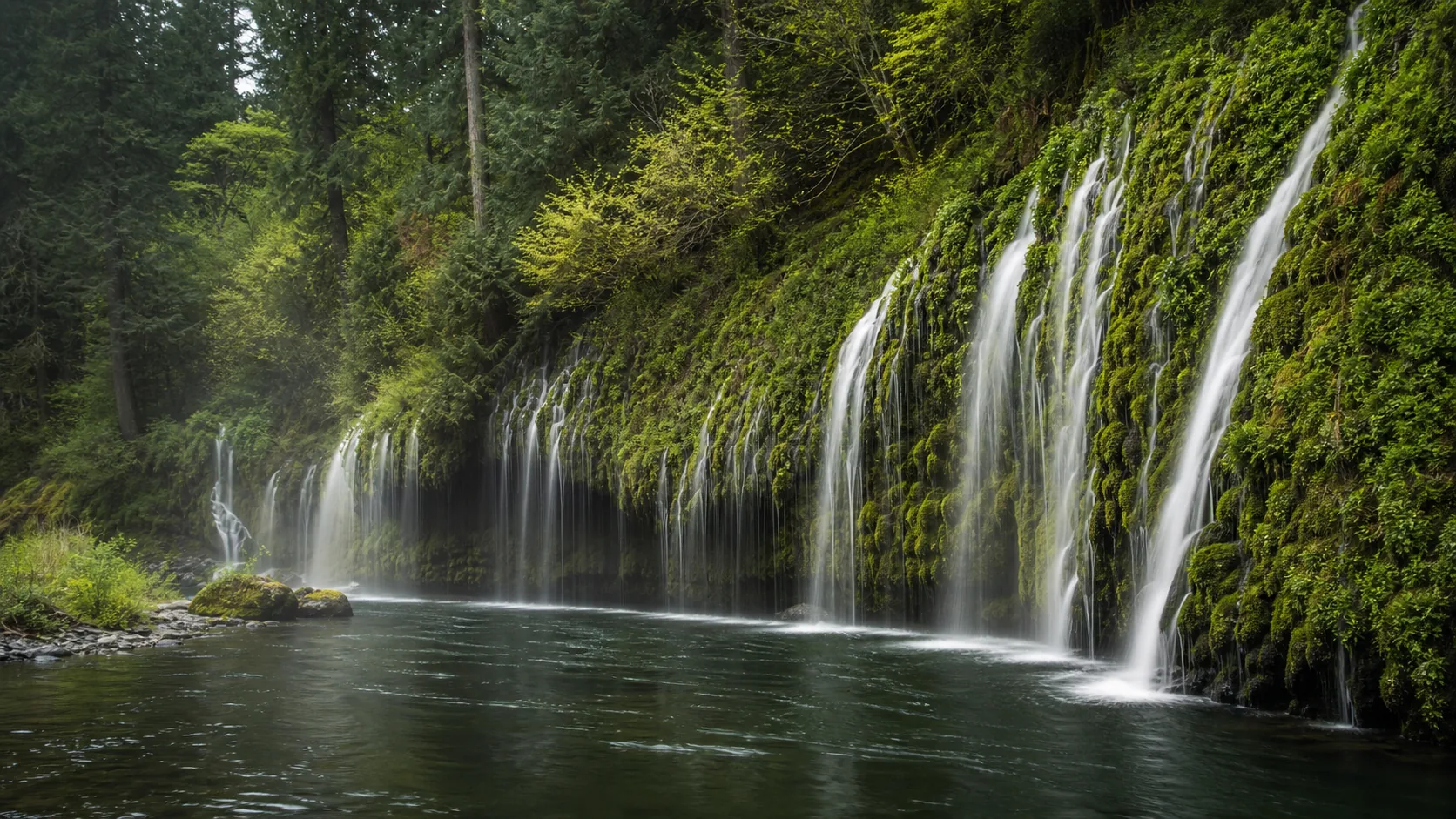
Mossbrae Falls springs emerging from a mossy basalt cliff and fanning across the Sacramento River bank near Dunsmuir, California
Siskiyou County, CA

Mossbrae Falls

Mossbrae Falls is a spring-fed fan of water roughly 50 feet tall and 175 feet wide where groundwater emerges directly from a mossy basalt cliff and spills into the Sacramento River near Dunsmuir, California. The view is one of the most photographed in the Shasta Cascade, but the famous "trail" people post online is a trespass walk along Union Pacific's active mainline track. There is no legal public footpath; legal access is by river-paddle or through the private Shasta Retreat homeowners' community.

Last verified May 12, 2026 Visited Desk-verified May 2026 with local-news cross-check on access status 8 sources checked
Trail Verify route Round-trip route varies
Time 0-0 min No legal walking trail
Best season Year-round (springs run constant); spring snowmelt slightly enhances the upper seepage Year-round (constant springs)
Parking No legal Mossbrae Falls parking exists. Visitors who park at Hedge Creek and walk the railroad tracks are trespassing on UPRR property. Sacramento River canyon (private land at Shasta Retreat)
Quick answer

Can you legally hike to Mossbrae Falls?

No. The 1.5-mile route from Dunsmuir's Hedge Creek trailhead crosses onto Union Pacific Railroad property and along an active mainline track, and visitors have been cited for trespassing. The only legal ways to see Mossbrae are by raft or kayak on the Sacramento River, or by invitation through a resident of the private Shasta Retreat community. The springs run roughly constant year-round, so timing matters less than access logistics; spring snowmelt only slightly enhances the upper seeps.

  • Spring-fed fan; flow is roughly constant year-round
  • No legal walking trail (UPRR trespass)
  • Legal access: river paddle or Shasta Retreat invitation
  • Hedge Creek Falls is the legal Dunsmuir stop instead
  • Best photo light: soft overcast or late afternoon
  • Visitors cited for walking the tracks
Last verified May 12, 2026 Visited Desk-verified May 2026 with local-news cross-check on access status 8 sources checked
Distance Verify route Loop distance varies
Round trip 0-0 min The popular Hedge Creek / railroad-tracks route is trespass on Union Pacific property and is regularly cited. There is no legal public trail to Mossbrae Falls.
Difficulty No legal walking trail The popular Hedge Creek / railroad-tracks route is trespass on Union Pacific property and is regularly cited. There is no legal public trail to Mossbrae Falls.
Location Siskiyou County, CA Sacramento River canyon (private land at Shasta Retreat)
Parking No legal Mossbrae Falls parking exists. Visitors who park at Hedge Creek and walk the railroad tracks are trespassing on UPRR property. Private + UPRR
Transit Amtrak Coast Starlight Dunsmuir Amtrak Station (the train passes Mossbrae but does not stop there) · 0 ft
Drive 1 mi 5 min from downtown
Best season Year-round (springs run constant); spring snowmelt slightly enhances the upper seepage Year-round (constant springs)
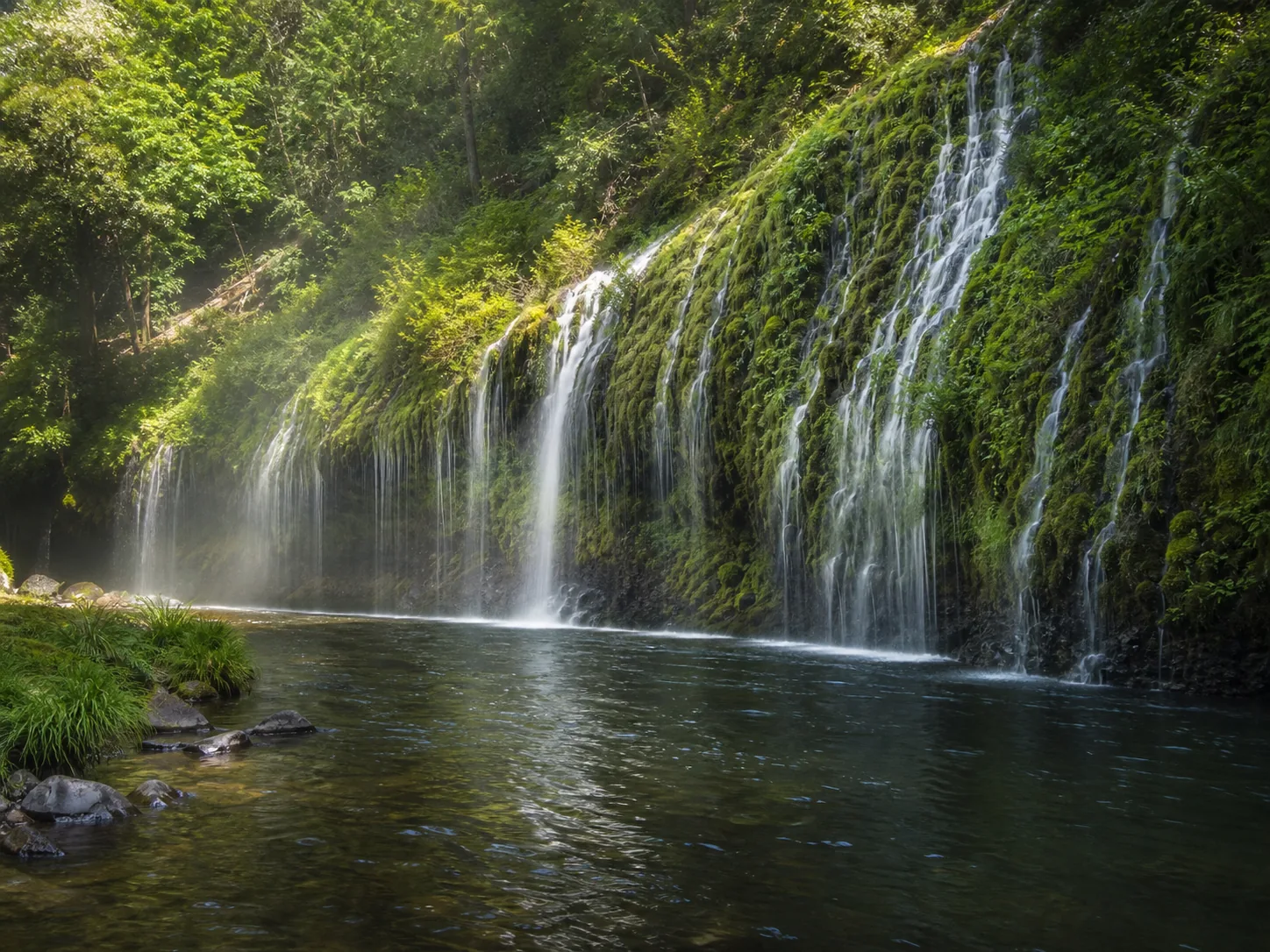
Mossbrae Falls springs emerge directly from the basalt and slide over a mossy ledge into the sacramento river
Photo guide

Three working positions for the spring-fed fan.

Mossbrae is one of the harder major California waterfalls to photograph legally because the only public vantage is from the Sacramento River itself. The wide cross-river frame, the upstream-bend frame, and the close moss-and-seep detail are the three frames that pay off the trip.

Mossbrae Falls springs emerging from a mossy basalt cliff and fanning across the Sacramento River bank near Dunsmuir, California
Mossbrae Falls, hero composition
Mossbrae Falls fan-shaped spring curtain spread across the mossy basalt cliff above the Sacramento River
Fan-shaped curtain spread across roughly 175 feet of Sacramento River bank
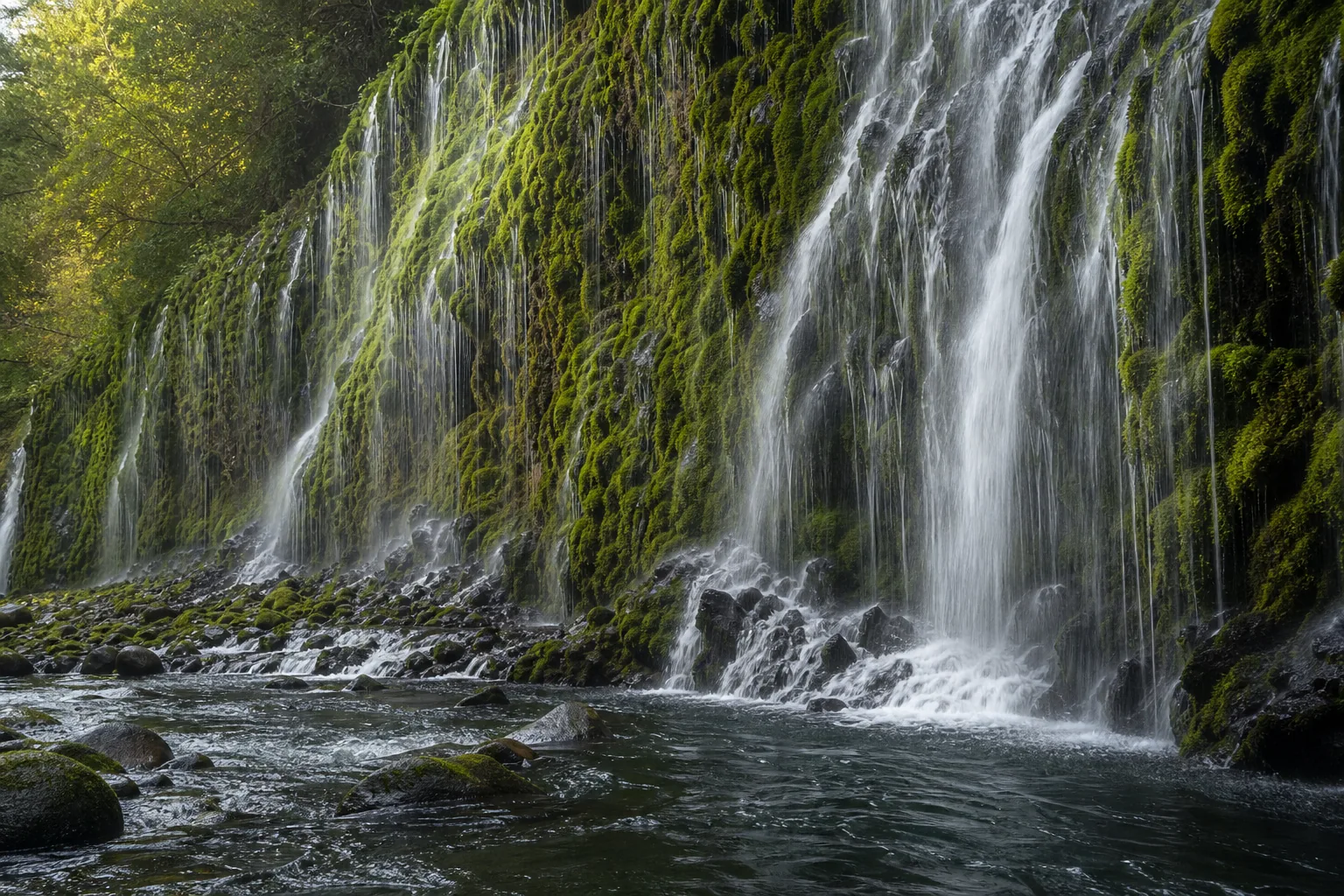
Mossbrae Falls springs emerging from basalt cliff face and dropping onto a mossy ledge along the Sacramento River
Springs emerge directly from the basalt and slide over a mossy ledge into the Sacramento River
Mossbrae Falls close detail of moss, ferns, and groundwater seepage threads on the basalt cliff
Close detail of moss, fern, and seep lines along the basalt face
01Is Mossbrae Falls flowing right now?

Mossbrae is intentionally not paired with a live USGS gauge. The springs that feed the falls are buffered groundwater discharge with very low seasonal variability, so a live flow chip would be misleading rather than useful.

Mossbrae is not gauge-driven. The fall is a sheet of springs emerging from a basalt aquifer at roughly constant discharge, so unlike most California falls it does not drop in late summer or in drought years. Plan for water any week of the year; let the calendar decision come down to legal access logistics, weather, and crowd timing rather than flow.

02How long is the walk?

There is no legal walking trail to Mossbrae Falls. The popular Hedge Creek-to-tracks route is trespass on Union Pacific Railroad property. Legal access is by river paddle (half-day raft or kayak trip from upstream) or by invitation through the private Shasta Retreat community.

03How do you get there?

Mossbrae Falls is on the Sacramento River in Dunsmuir, California, about 60 miles north of Redding off I-5. The Wikipedia and Google Maps pins are accurate at 41.2420 N, 122.2664 W, but the route those map apps suggest is the trespass route. The legal river put-in for paddle access is upstream of Dunsmuir; outfitter trips run from the Mount Shasta area.

04Is there free parking?

There is no legal Mossbrae Falls parking. The Hedge Creek Falls city lot in Dunsmuir is the staging spot for the illegal route. If you are launching a paddle trip, follow your outfitter's put-in instructions; if you are visiting through Shasta Retreat, follow the homeowner's instructions.

05Does it cost money?

There is no entry fee because there is no legal public access point. A guided raft trip on the upper Sacramento runs roughly $100 to $200 per person depending on outfitter and itinerary. Trespass citations on UPRR property can exceed $500.

06Trail variants

River paddle (legal) Float-in by raft or kayak from upstream, Half day, Outfitter trip or experienced river permit; class II water near the falls.
Shasta Retreat (legal, restricted) Private community access via homeowner, Short walk on private land, Not open to the public; requires invitation.
Hedge Creek / UPRR tracks (illegal) ~1.5 mi each way along active mainline track, 60-90 min, Trespass on Union Pacific property and a working railroad; visitors are routinely cited and trains pass roughly hourly.
Dunsmuir town view (legal, partial) Drive to Hedge Creek Falls overlook, 15-30 min, You can see the Sacramento River canyon but not Mossbrae itself from any legal vantage in town.

Detailed maps and recent reviews: Falls route on AllTrails · Creek route on AllTrails

07Can you swim?

There is no legal swim access. The Sacramento River here is cold (springs are roughly 50F), current is steady, and the banks are private or active rail right-of-way. For swimming, Lake Siskiyou (7 miles north) and Castle Lake (14 miles northwest) are the local options.

08Are dogs allowed?

Do not bring dogs to walk the Union Pacific tracks. If you are on a guided raft trip, ask the outfitter about dogs in advance.

09Is it accessible?

There is no accessible viewpoint. Hedge Creek Falls in Dunsmuir has a short paved approach and an overlook that is closer to step-free.

Field notes

Mossbrae at a glance.

Roughly 50 feet tall and 175 feet wide, spring-fed from a basalt aquifer, year-round constant flow, on private land in Dunsmuir, Siskiyou County, California.

Height 50 ft USGS 3DEP
Type Spring-fed fan / cascade USGS
Rock Western Cascade basalt with hydrothermal-spring discharge USGS Open-File Report: Western Cascades volcanic stratigraphy and Sacramento headwaters springs
County Siskiyou Siskiyou County, CA
Managed by Private land (Shasta Retreat homeowners) and Union Pacific Railroad right-of-way Private + UPRR
Water source Basalt-aquifer springs along the Sacramento River USGS
Elevation 2589 ft USGS NED
Park area Not listed Private + UPRR
Hours There is no public trailhead. Legal access is by water (raft or kayak) or by invitation through the Shasta Retreat homeowners' community. Private + UPRR
When to visit

Year-round, but pick a week with manageable river flow.

Because the springs are constant, the calendar choice is about the Sacramento River itself, not the falls. Late spring through early fall is the safest paddle window; winter river levels can be cold and pushy.

PEAK FLOW

Peak flowYear-round (constant springs)
Ice / low flowRare full freeze
Most crowdedWeekends and midday
Best photosSunrise or weekdays

Live water context

Discharge data -- Mossbrae is intentionally not paired with a live USGS gauge. The springs that feed the falls are buffered groundwater discharge with very low seasonal variability, so a live flow chip would be misleading rather than useful.

Why is it called Mossbrae Falls?

The name Mossbrae is a 19th-century compound that pairs moss (for the dense bryophyte and fern cover on the basalt face) with the Scottish word brae, meaning a hillside or steep bank. The form shows up in California guidebooks and Southern Pacific Railroad timetables by the 1880s, when the upper Sacramento canyon was being marketed to Bay Area tourists arriving by train. The Wintu, whose ancestral territory includes this stretch of the river, have their own names for the springs; those are not in common written use today.

What else to do at Sacramento River canyon (private land at Shasta Retreat)

Mossbrae Falls is not in a park. The falls is on private land owned by the Shasta Retreat homeowners' association, immediately adjacent to Union Pacific Railroad's Black Butte Subdivision mainline along the Sacramento River. The nearest town is Dunsmuir (population about 1,650), a former Southern Pacific division-point town on I-5 in Siskiyou County. The regional anchor is Mount Shasta, 12 miles north, and the nearest public land is the Shasta-Trinity National Forest, which surrounds Dunsmuir but does not include the falls itself.

  • Sacramento River canyon. The falls drops directly into a Class II stretch of the upper Sacramento River, a designated Wild Trout water managed by California Department of Fish and Wildlife.
  • Shasta Retreat (private). A small 19th-century railroad-era summer community on the west bank that holds the only legal pedestrian access; the homeowners control who walks through.
  • Union Pacific Black Butte Subdivision. Active mainline between Roseville and Klamath Falls; through-freight runs roughly hourly, plus the daily Amtrak Coast Starlight.
  • Hedge Creek Falls (legal alternative). A 35-foot walk-behind falls in Dunsmuir with a free city trailhead, often confused with the Mossbrae route because the trespass route starts from the same parking area.
  • Shasta-Trinity National Forest. Surrounds the canyon and offers legal hiking, swimming, and forest-road driving within a short drive of Dunsmuir.

Why it looks this way

Mossbrae sits in the upper Sacramento River canyon at the boundary between the Klamath Mountains and the Cascade Range, where Western Cascade volcanic deposits sit above older marine sediments. Cold groundwater moves laterally through fractured basalt and porous lava-flow contacts before emerging along the canyon wall as a sheet of springs rather than from a single mouth, which is why the fall reads as a fan instead of a chute. Regional hydrologic estimates put combined spring discharge feeding the upper Sacramento at roughly 3,000 cubic feet per second; Mossbrae is the most visible single face of that aquifer. Because the source is groundwater stored over decades, discharge is buffered against drought and snowmelt and stays near-constant year-round.
Field guide deep dive

What the AllTrails listing and the railroad-tracks photos do not tell you.

The geology of the springs, the legal-access dispute, the proposed bridge that has been on the books for over a decade, and a frank read on whether the trip is worth it.

How Mossbrae Falls actually formed

Mossbrae is not a creek waterfall. Nothing falls over the lip of an upstream stream channel. Cold groundwater stored inside a stack of Western Cascade volcanic rocks moves laterally along permeable layers and emerges directly from the cliff face as a sheet of springs, then slides over a mossy ledge into the Sacramento River. The result is a fan roughly 50 feet tall and 175 feet wide, fed from many points instead of one mouth.

Regional studies of the upper Sacramento headwaters describe combined spring discharge feeding this stretch of river on the order of 3,000 cubic feet per second when all the canyon springs are counted together; Mossbrae is the most visible single face of that aquifer. Cold meteoric water from the Mount Shasta volcanic complex moves underground through fractured basalt for years to decades before re-emerging at a canyon-wall contact, slightly mineralized but very clean. Because the source is groundwater with a long residence time, the flow is buffered against weather: Mossbrae does not spike after a storm and does not drop in a drought, which is why the page deliberately does not attach a USGS flow chip.

The access controversy in plain language

The popular Mossbrae Falls "trail" begins at Hedge Creek Falls in downtown Dunsmuir, crosses a small footbridge onto Union Pacific Railroad property, and follows the active Black Butte Subdivision mainline along the Sacramento River for about a mile and a half. That walk is trespass under federal railroad-safety law and California Penal Code. Union Pacific has posted signs, local law enforcement has issued citations, and the City of Dunsmuir's own Mossbrae Falls Trail page openly states there is no legal public access.

The trains are not theoretical: the Black Butte Subdivision carries through-freight roughly hourly plus the daily Amtrak Coast Starlight, and the corridor is narrow enough that visitors stand within a few feet of moving consists. At least one fatality and several serious injuries have been documented over the past two decades.

The two legal paths are narrower than most blog posts admit. The Shasta Retreat homeowners' community on the west bank holds the only legal pedestrian approach, by invitation from a resident rather than as a public right. The Sacramento River itself is a navigable public waterway in California up to ordinary high-water; a raft or kayak trip from upstream is the most reliable legal way to see Mossbrae for non-residents, typically run by Mount Shasta outfitters as a half-day Class II float.

The proposed legal bridge that has not happened

A legal public trail to Mossbrae has been on regional planning documents since the late 2000s. The Mount Shasta Trail Association and the City of Dunsmuir have iterated on a proposal that would build a pedestrian bridge across the Sacramento River, run the public trail on the west side away from the UPRR right-of-way, and route around Shasta Retreat by easement. MSTA published an updated trail concept in 2018.

The project has not been built. The Los Angeles Times covered the public-access debate in April 2025, describing the bridge as still hung up on funding, environmental review on the river crossing, and easement negotiations with private landowners on both banks. There is no funded construction schedule as of this guide's verification date. Until the bridge is built, the City of Dunsmuir's official guidance and ours are aligned: do not walk the railroad tracks.

Why Mossbrae looks the same in August as in April

Most California waterfalls drop sharply in late summer. Yosemite Falls often goes dry by August. Potem Falls in Shasta County loses most of its volume by late summer in dry years. Mossbrae does not, because it is not snowmelt-fed in any meaningful sense. The groundwater that emerges from the basalt has spent years to decades underground, so what you see this week is rain and snowmelt that fell over Mount Shasta several years ago. That long residence time is the natural buffer that produces the constant-flow look.

The practical implication for visit planning is that the calendar choice should be driven by the Sacramento River, not by the falls. Late spring through early fall is the safest paddle window because river flow is moderate and water temperature is workable. Winter and big-runoff weeks raise the river level and current; that does not affect the falls itself but it does affect whether the float is fun or scary. If you are visiting through Shasta Retreat by invitation, weather and crowds are the only seasonal considerations.

What else is legal and nearby

If you have made the drive to Dunsmuir and you are not going to walk the tracks, the surrounding region holds enough legal water to fill a weekend. Hedge Creek Falls, the staging trailhead the trespass route starts from, is a clean 35-foot walk-behind falls with a short path from the city park, a 30-minute stop. The McCloud River three-tier complex (Lower, Middle, Upper) is 20 miles east on State Route 89 inside Shasta-Trinity National Forest, all legal, all photogenic, all together a half-day loop.

McArthur-Burney Falls Memorial State Park, about 60 miles east, holds the spring-fed Burney Falls: a 129-foot moss-and-basalt curtain that is the legal cousin of Mossbrae, fed from a similar aquifer with public trails and viewpoints built around it. For most Mossbrae-curious travelers, Burney is the trip that scratches the itch without the legal problem.

Photographing the springs (long exposure, west-facing fan)

The Mossbrae fan rewards long exposure because the multi-source springs collapse into a single unified curtain at shutter speeds between 1 and 4 seconds. Below a quarter-second the individual seep ribbons are visible and the frame looks busier; above 8 seconds the moss detail washes out. The canonical Mossbrae frame is a tripod-stable wide angle from the gravel bar across the river or from a moored raft, with the full fan visible plus a slice of cool basalt above and the river bank along the bottom.

Light direction matters because the face is roughly west-facing. Late afternoon backlights the spray through the canyon's east-side trees and is the cleanest light of the day for a long exposure. Soft overcast is the most forgiving. Avoid noon in summer; the highlights on the white water will clip and the shadows on the mossy face will lose detail. A 6-stop ND filter and a small aperture (f/11 to f/16) are typical settings.

Should you go? A frank read

The honest answer depends on which Mossbrae you want. If you want the railroad-tracks Instagram trip that shows up in every Reddit thread, the answer is no: that walk is trespass, the citations are real, the trains are not toys, and the City of Dunsmuir explicitly asks you not to do it. If you want the legal Mossbrae, a guided raft or kayak trip on the upper Sacramento is the most accessible option: budget a half day and roughly $100 to $200 per person through a Mount Shasta or Dunsmuir outfitter. A Shasta Retreat homeowner invitation is the closest pedestrian access and requires a personal connection.

For a lot of travelers, the better single recommendation is Burney Falls 60 miles east: geologically similar, legally accessible, and visually outstanding in its own right. Mossbrae is real, it is photogenic, and on the right day from a raft it is unforgettable. It is also the only major California waterfall on this site we cannot recommend a walk-up plan for, because no legal walk-up exists. Until the proposed bridge is built, that is the situation in plain language.

Map and route

Dunsmuir, the Sacramento River canyon, and the access boundary.

Mossbrae Falls is on the Sacramento River in Dunsmuir, California, about 60 miles north of Redding off I-5. The Wikipedia and Google Maps pins are accurate at 41.2420 N, 122.2664 W, but the route those map apps suggest is the trespass route. The legal river put-in for paddle access is upstream of Dunsmuir; outfitter trips run from the Mount Shasta area.

Photography and weddings

West-facing fan, river-only legal access, no tripods on the tracks.

If you are photographing Mossbrae legally (river paddle or Shasta Retreat invitation), the working positions are the upstream river bend, the gravel bar opposite the central fan, and a closer water-level frame from a moored raft. The classic brochure shot is the wide cross-river view that takes in the full fan plus a slice of cool basalt above. Close detail of moss, fern, and individual seep ribbons is the second strongest frame and is hard to get from anywhere but a boat.

The face is roughly west-facing, so direct morning light puts the cliff in shadow and the river in glare; late afternoon backlights the spray through the trees and is the cleanest light of the day. Soft overcast is the most forgiving for showing detail in both the white sheet water and the dark mossy basalt. Long-exposure work (1 to 4 seconds) collapses the multi-source fan into a unified curtain and is the canonical Mossbrae look.

Personal photography from a boat in the public navigable channel does not require a permit. Tripod use, drone takeoff or landing on the Shasta Retreat side, and any commercial shoot require explicit Shasta Retreat permission, and overflight rules apply over the UPRR right-of-way. Do not stage a shoot from the railroad tracks.

Permits

Weddings and engagements

Mossbrae is occasionally used for elopement photography by Shasta Retreat homeowners and their guests; it is not a venue and there is no public ceremony space.

Any ceremony or commercial portrait session requires Shasta Retreat homeowner permission. Photographers who walk the tracks risk citation and the photos getting flagged.

If you want a Dunsmuir-area falls portrait that does not involve private-land politics, Hedge Creek Falls in town and Burney Falls at McArthur-Burney State Park (60 miles east) are both legal and photogenic.

Nearby waterfalls

A two-day Shasta Cascade waterfalls loop from Dunsmuir.

Hedge Creek Falls (in Dunsmuir), Mossbrae from the river or Shasta Retreat, McCloud's three-tier complex, and Burney Falls. All four are within 70 miles and all four have legal public viewpoints (Mossbrae the lone exception).

Related questions

More questions visitors ask before driving to Dunsmuir.

How tall it is, whether it is a real spring, dogs, the proposed bridge, and what cited visitors have actually been charged with.

01How do you get to Mossbrae Falls legally?

Two ways. First, by river: a half-day raft or kayak trip on the upper Sacramento River with a Mount Shasta or Dunsmuir outfitter, typically $100 to $200 per person. Second, by invitation through a homeowner in the private Shasta Retreat community on the west bank. The popular Hedge Creek-to-railroad-tracks route is trespass on Union Pacific Railroad property and visitors are routinely cited.

02Is the Mossbrae Falls trail closed?

There is no legal public Mossbrae Falls trail and there never has been a sanctioned one. AllTrails lists the route as CLOSED. The City of Dunsmuir Mossbrae Falls Trail page openly states there is no legal public access. The walk people share online is on Union Pacific Railroad property, between the rails of an active mainline track.

03Can you visit Mossbrae Falls?

Yes, but only legally by boat on the Sacramento River or by invitation through the private Shasta Retreat community. A guided raft trip is the most realistic option for most travelers. The proposed legal pedestrian bridge has been on regional plans since the late 2000s but is not built as of May 2026.

04How tall is Mossbrae Falls?

About 50 feet tall and roughly 175 feet wide. The shape is a fan rather than a single plunge because the springs emerge from many points along the basalt cliff face rather than from a single stream channel.

05Is Mossbrae Falls a spring?

Yes. Mossbrae is groundwater discharge from a basalt aquifer rather than a stream-fed waterfall. Cold meteoric water from the Mount Shasta volcanic complex moves underground for years to decades before emerging along the canyon wall, which is why the falls runs at roughly constant flow year-round and does not spike after storms or drop in droughts.

06Is Mossbrae Falls worth visiting?

The view is genuinely outstanding, but the legal trip is a half-day raft expedition rather than a casual stop. If the river trip fits your budget and timeline, yes. If you wanted a roadside waterfall walk, Burney Falls 60 miles east at McArthur-Burney Falls State Park is geologically similar, equally photogenic, and has public trails, parking, and overlooks.

Sources and data

Where the Mossbrae guide gets its facts.

City of Dunsmuir trail page, Mount Shasta Trail Association project history, Los Angeles Times public-access reporting, USGS and California Geological Survey on Western Cascade volcanics and Sacramento headwaters springs, Shasta-Trinity National Forest land status, Wikipedia, and Wikimedia Commons.

Private + UPRR: Sacramento River canyon (private land at Shasta Retreat) ci.dunsmuir.ca.us
Access, parking, and permit rules: ci.dunsmuir.ca.us
USGS Open-File Report: Western Cascades volcanic stratigraphy and Sacramento headwaters springs: Siskiyou County bedrock pubs.usgs.gov
NOAA / NWS Medford forecast grid MFR 115,20 (Dunsmuir-Mount Shasta canyon) noaa.gov
USGS National Elevation Dataset 3DEP
Google Maps: embedded map and directions maps.google.com
Google Places: nearby restaurants and hotels places API
City of Dunsmuir: Mossbrae Falls Trail (official statement that no legal public access exists) ci.dunsmuir.ca.us
Mount Shasta Trail Association: Proposed new Mossbrae Falls Trail (2018 project update) mountshastatrailassociation.org
Los Angeles Times: This California town has a breathtaking waterfall and a public-access fight (Apr 26, 2025) latimes.com
Wikipedia: Mossbrae Falls en.wikipedia.org
Wikimedia Commons: Mossbrae Falls image category commons.wikimedia.org
Visit Dunsmuir tourism guide visitdunsmuir.com
Discover Siskiyou: regional travel context discoversiskiyou.com
Shasta-Trinity National Forest: surrounding public lands fs.usda.gov
AllTrails: Mossbrae Falls (listed CLOSED; route description tracks trespass corridor) alltrails.com
Fact checks
UPRR trespass status: cross-checked against the City of Dunsmuir Mossbrae Falls Trail page (which states there is no legal public access), the Mount Shasta Trail Association 2018 project page (which describes the existing route as trespass on an active rail line), and Reddit r/norcalhiking reports of cited visitors; confirmed accurate as of May 12, 2026.
Spring discharge claim: the ~3,000 cfs figure is presented as the combined output of springs feeding the upper Sacramento River headwaters complex (Mossbrae plus adjacent springs), drawn from USGS Western Cascade volcanic and Sacramento headwaters literature; Mossbrae alone is not separately gauged and the long-form is explicit about that distinction.
Legal access options: river paddle (navigable-waters public-trust doctrine in California, with the river bed up to ordinary high-water line as the limit) and Shasta Retreat invitation are the only two legal pedestrian paths verified as of May 2026. A proposed legal bridge remains unfunded; if and when the City of Dunsmuir page updates, that becomes the canonical legal route.
Height and width: ~50 ft tall and ~175 ft wide are the figures consistent across Wikipedia, the thewave.info northern California maps reference, and SERP descriptions; an exact USGS-style survey is not published.
Corrections: [email protected]