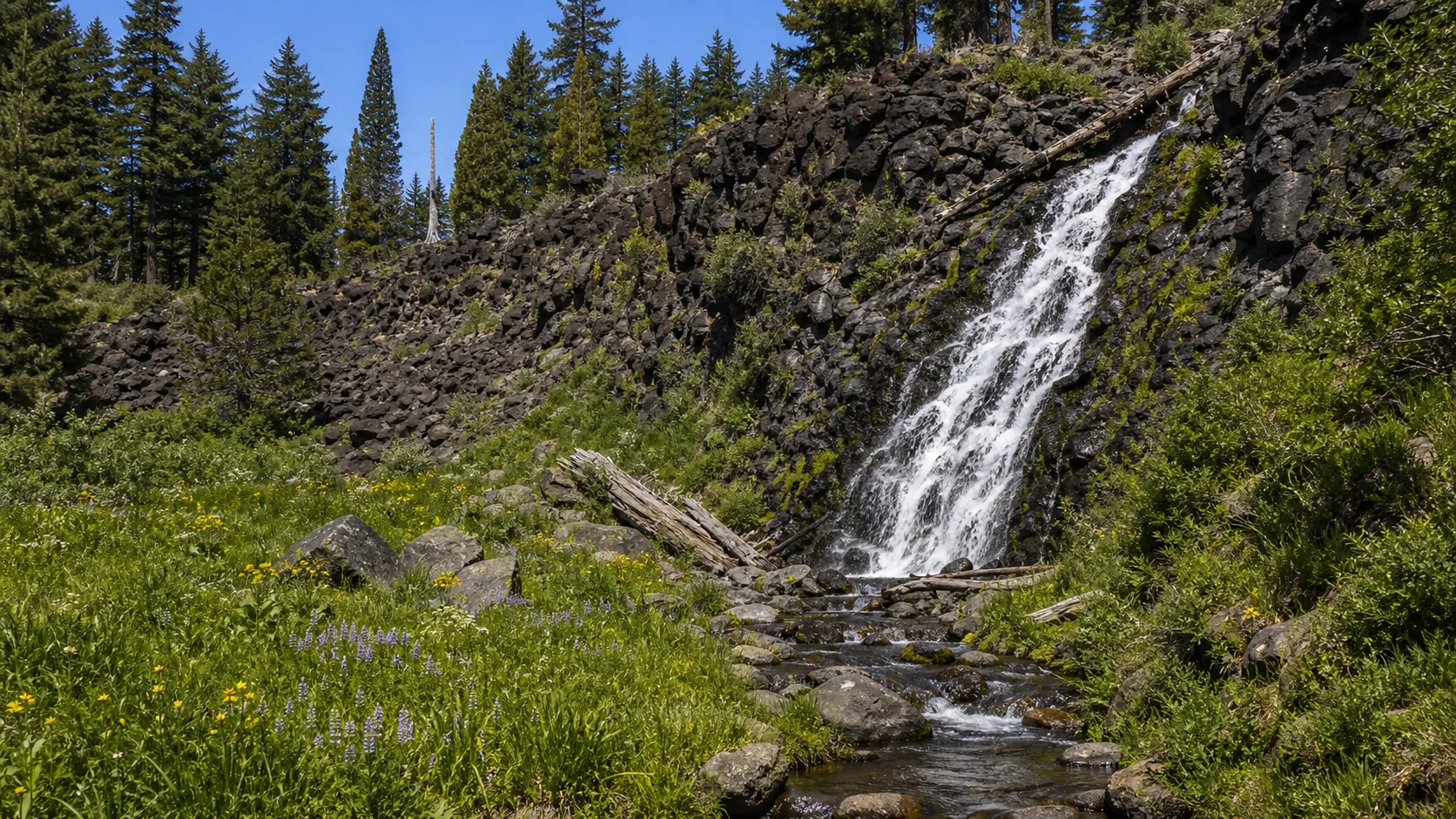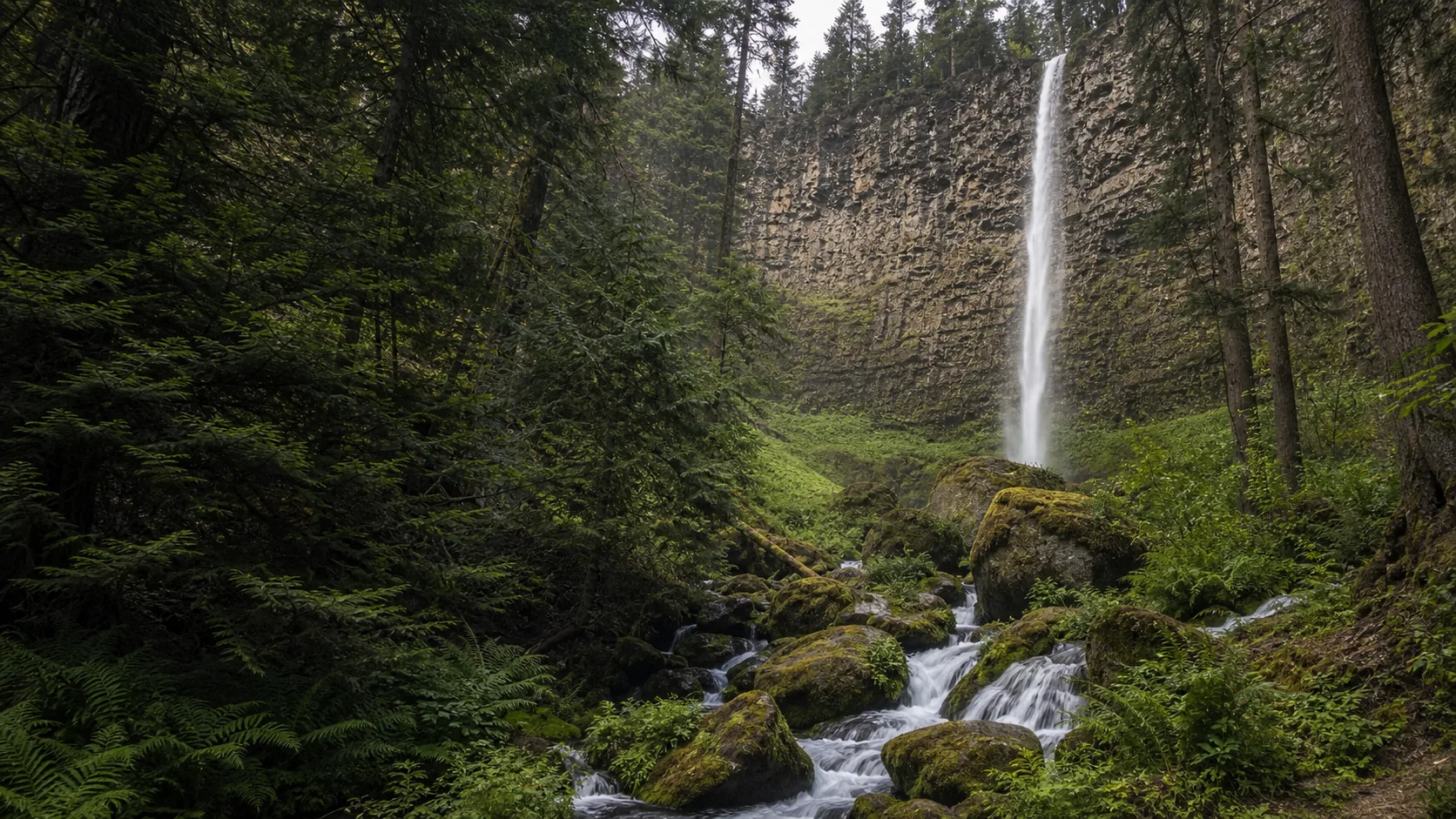
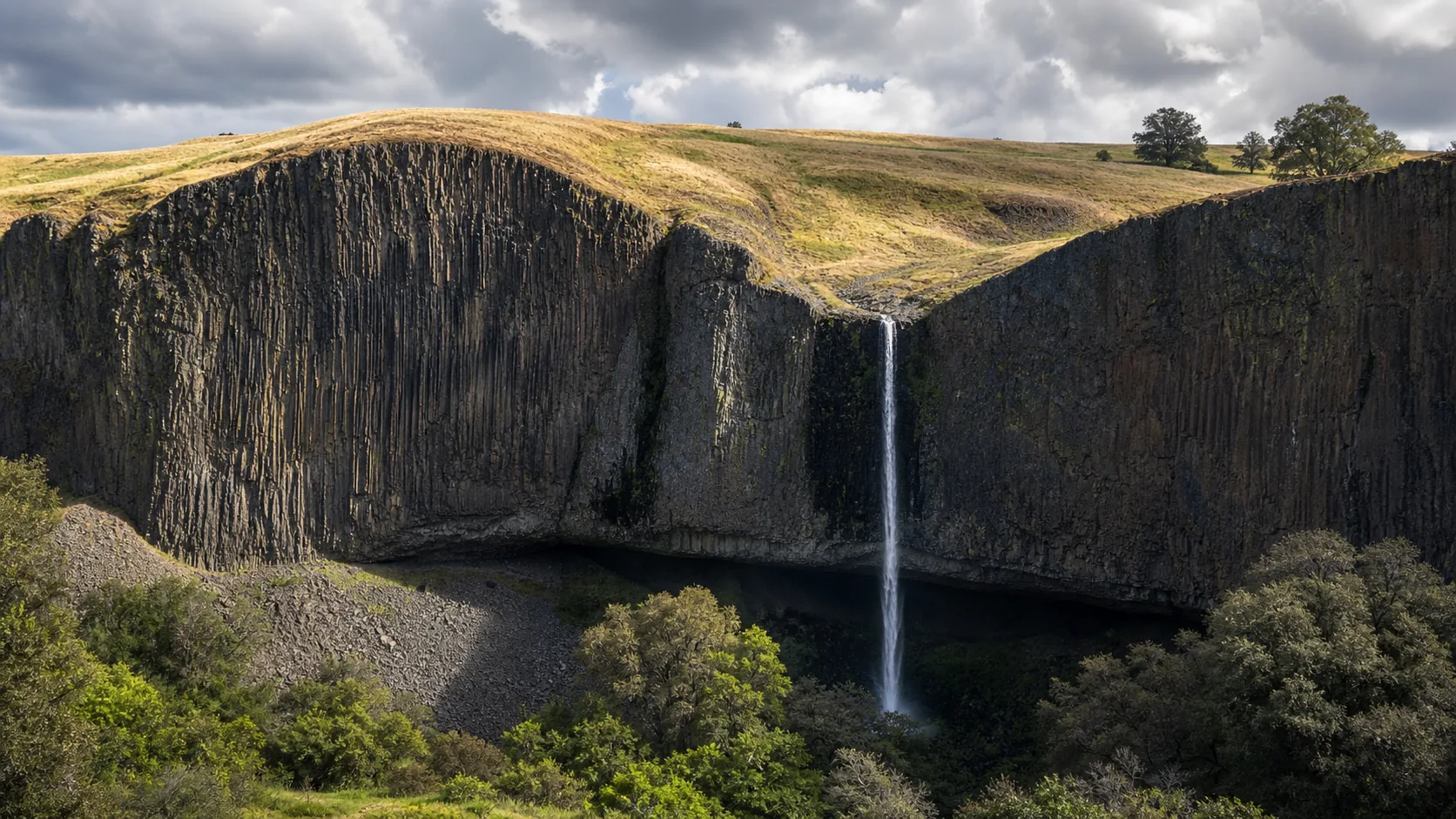
Phantom Falls 164-foot plunge off the volcanic plateau in North Table Mountain Ecological Reserve
Oroville, CA

Phantom Falls

Phantom Falls is a 164-foot single-drop waterfall that pours off the volcanic edge of North Table Mountain near Oroville, California. It only runs after winter rain. By Memorial Day in most years the lip is bone-dry, which is why the name fits: for seven months out of twelve the falls is essentially a rumor. The reliable window is mid-March through mid-April, and it pairs with one of the best wildflower super-blooms in the state.

Last verified May 12, 2026 Visited Desk-verified May 2026 8 sources checked
Trail 3.0 mi 3.9 mi extended
Time 90-150 min Moderate
Best season March through April after wet winters Mid-March to mid-April
Parking Free dirt lot at the reserve gate on Cherokee Road; fills before 10 a.m. on peak spring Saturdays North Table Mountain Ecological Reserve
Quick answer

Is Phantom Falls running right now?

Probably not. Phantom Falls is a wet-weather-only seasonal waterfall, and by early May the creek that feeds it has usually stopped flowing. The dependable window is mid-March through mid-April after a normal-to-wet winter, with peak volume in the two weeks after a Pacific storm. From late May through November the lip is almost always dry and the 3-mile hike is a wildflower or geology walk rather than a waterfall trip. Check the NOAA forecast and a recent trip report from the past 7 days before driving.

  • 164-foot single-drop plunge
  • Wet-weather only: March-April peak
  • 3.0-3.9 mi round trip, 495 ft gain
  • North Table Mountain Ecological Reserve (CDFW)
  • Wildflower super-bloom pairs with peak flow
  • Free; sunrise to sunset; leashed dogs OK
Last verified May 12, 2026 Visited Desk-verified May 2026 8 sources checked
Distance 3.0 mi 3.9 mi extended
Round trip 90-150 min Open meadow walking; mud, basalt rubble, and unmarked use trails. Bring a downloaded map.
Difficulty Moderate Open meadow walking; mud, basalt rubble, and unmarked use trails. Bring a downloaded map.
Location Oroville, CA North Table Mountain Ecological Reserve
Parking Free dirt lot at the reserve gate on Cherokee Road; fills before 10 a.m. on peak spring Saturdays CDFW
Transit No fixed-route transit to the reserve Drive from Oroville via Cherokee Road · 0 ft
Drive 11 mi 25 min from downtown
Best season March through April after wet winters Mid-March to mid-April
Phantom Falls spring runoff fanning over the lovejoy basalt lip
Photo guide

Three angles that capture a 164-foot seasonal plunge.

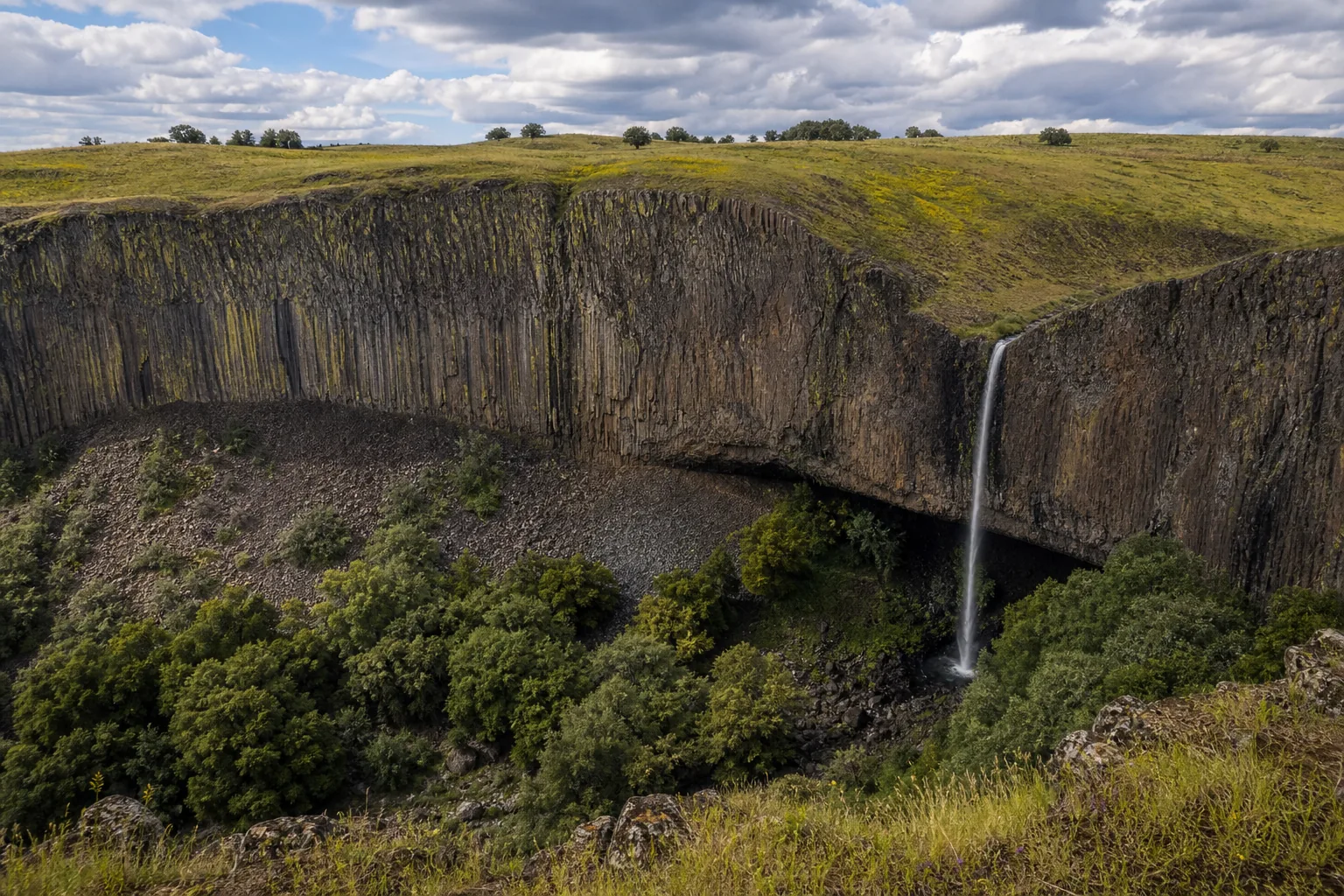
The plateau-edge frame for the iconic drop into Coal Canyon, the spring-runoff lip shot for the basalt geometry, and the column detail for the caprock texture. There is no railed overlook; treat every position as exposed and stay back from any wet rock.

Phantom Falls 164-foot plunge off the volcanic plateau in North Table Mountain Ecological Reserve
Phantom Falls, hero composition
Wide view of Phantom Falls dropping off the basalt plateau into Coal Canyon
Plateau-edge view of the 164-foot drop into Coal Canyon
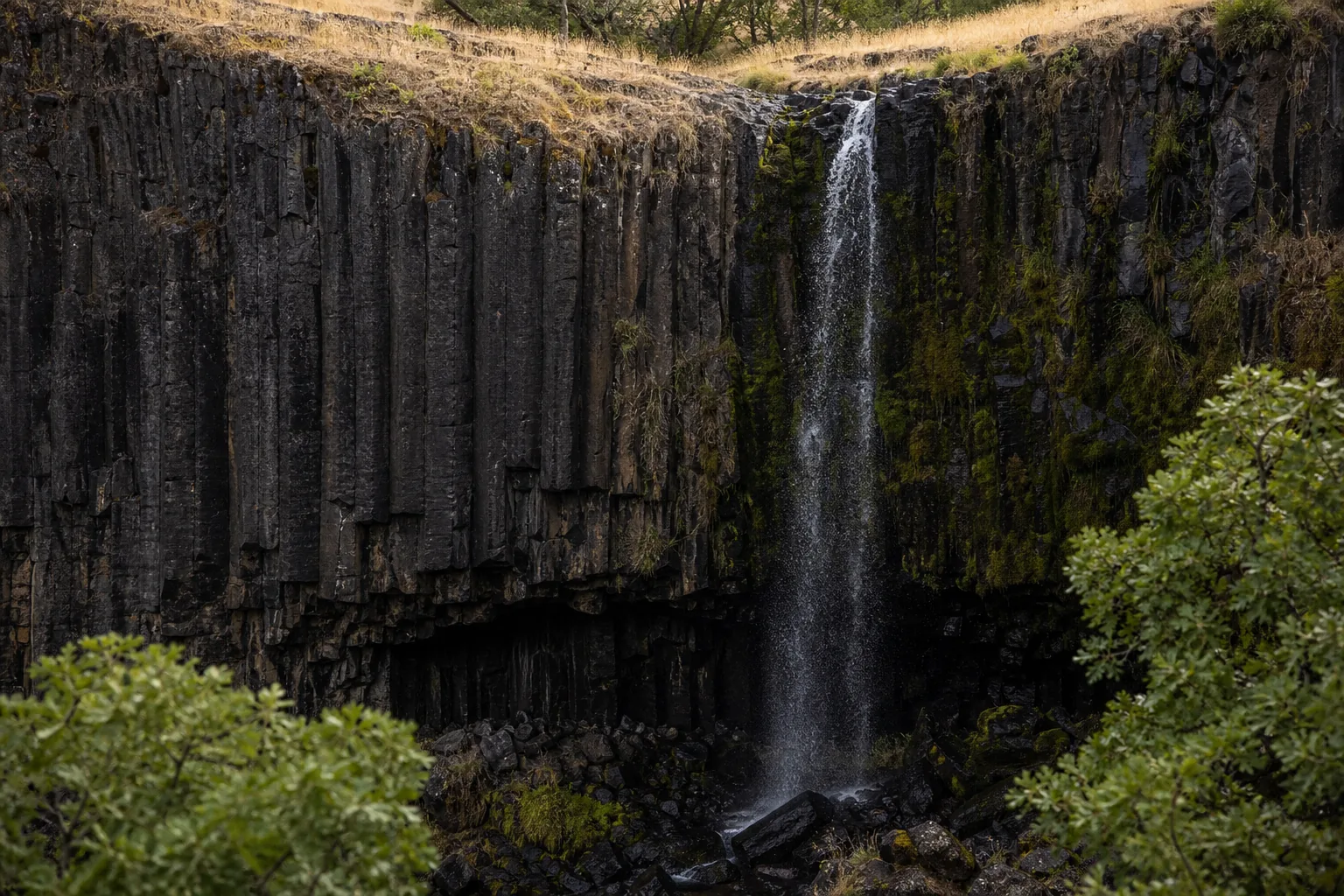
Phantom Falls spring runoff fanning over the basalt lip at peak flow
Spring runoff fanning over the Lovejoy Basalt lip
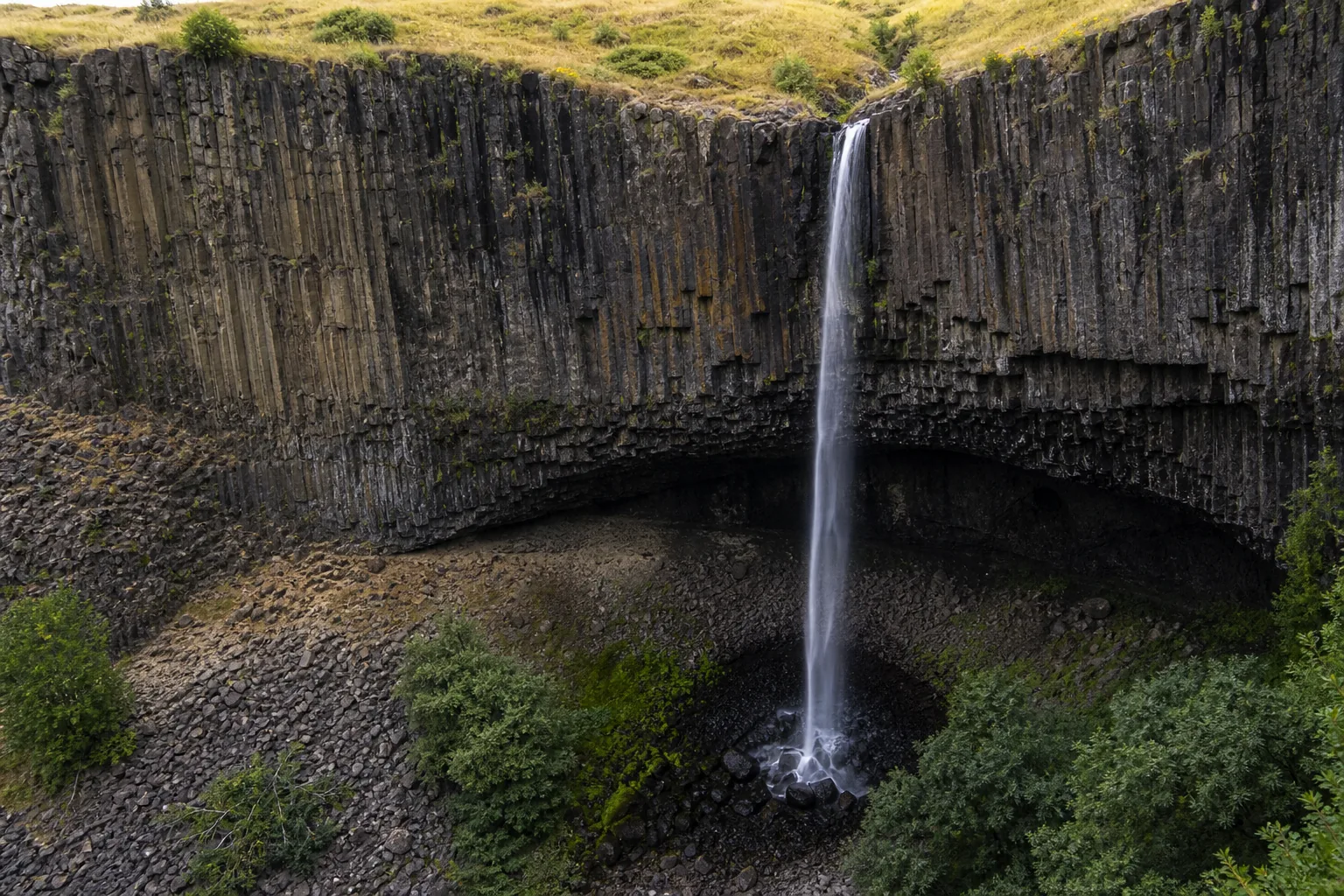
Detail of columnar basalt and the upper lip of Phantom Falls
Columnar basalt and the upper lip of the falls
01Is Phantom Falls flowing right now?

This guide does not pair Phantom Falls with a live USGS discharge gauge because the creek is intermittent and not monitored.

Phantom Falls is a wet-weather-only waterfall fed by Coal Canyon Creek, an intermittent stream. There is no paired USGS gauge. The practical check is: did the last 7 to 14 days include measurable rain in the Oroville foothills, and is the long-range forecast for the visit day dry enough that the trail will be passable but the falls still running? Both have to be true.

02How long is the walk?

The Phantom Falls hike is 3.0 to 3.9 miles round trip from the Cherokee Road parking area, depending on the line you take. The AllTrails route reports about 495 feet of elevation gain. Plan 1.5 to 2.5 hours on the ground; longer if you wander the wildflower meadows.

03How do you get there?

From Highway 70 in Oroville, take Exit 48 (Grand Avenue) and turn east. Grand becomes Table Mountain Boulevard, then bear left onto Cherokee Road. The reserve entrance and dirt parking lot are about 6 miles up Cherokee Road on the left. The drive from downtown Oroville is about 25 minutes.

04Is there free parking?

Free dirt lot at the reserve entrance on Cherokee Road. No fee, no kiosk, no toilet. The lot fills before 10 a.m. on peak spring Saturdays; overflow parks along the shoulder.

05Does it cost money?

Free. The North Table Mountain Ecological Reserve is open to the public at no charge under CDFW management. Do not assume California State Park or federal-pass requirements apply here; they do not.

06Trail variants

Phantom Falls out-and-back 3.0 mi, 90-120 min, shortest line to the overlook.
AllTrails route (with Hollow Falls) 3.9 mi, 2-2.5 hr, adds the smaller Hollow Falls and a cleaner return loop.
Phantom Falls Loop (full plateau) 7 mi, 3-4 hr, longer loop, more wildflower meadows and stream crossings.
Wildflower-only short walk 1-1.5 mi, 45-60 min, wander the plateau bloom if the falls is already dry.

Detailed maps and recent reviews: Falls route on AllTrails · Creek route on AllTrails

07Can you swim?

There is no safe swimming at Phantom Falls. The plunge pool is small, hard to reach, and unstable underfoot, and the lip is unfenced with a 164-foot drop. Stay back.

08Are dogs allowed?

Dogs are allowed on leash. Common warnings: free-range cattle on the plateau, rattlesnakes from late spring through fall, and burrs and stickseed that lodge in fur. Bring water; the trail has no shade.

09Is it accessible?

Not accessible. The route crosses open grazing land, unmarked use trails, basalt rubble fields, and seasonal mud. There are no paved viewpoints.

Field notes

Phantom Falls at a glance.

164-foot single drop over the Lovejoy Basalt, North Table Mountain Ecological Reserve managed by CDFW, free to enter, sunrise to sunset, 3.0 to 3.9 mile round trip. Sourced from the CDFW reserve page, the California Geological Survey, and the published trail data.

Height 164 ft USGS 3DEP
Type Plunge (single drop) USGS
County Butte Oroville, CA
Managed by California Department of Fish & Wildlife CDFW
Water source Coal Canyon Creek (intermittent) USGS
Elevation 1214 ft USGS NED
Park area 3,315 acres CDFW
Hours Open daily, sunrise to sunset (CDFW) CDFW
When to visit

One window justifies the trip. The rest of the year, don't.

Mid-March through mid-April after a normal-to-wet winter, with peak in the two weeks following a Pacific storm. From late May through November the lip is almost always dry. The wildflower super-bloom on the plateau peaks in the same spring window, which is why the lot fills early on April Saturdays.

PEAK FLOW

Peak flowMid-March to mid-April
Ice / low flowRarely freezes
Most crowdedWeekends and midday
Best photosSunrise or weekdays

Live water context

Discharge data -- This guide does not pair Phantom Falls with a live USGS discharge gauge because the creek is intermittent and not monitored.

Why is it called Phantom Falls?

"Phantom" is a descriptive English nickname, not a Native or settler place name. It captures the practical reality of the falls: most months of the year it is not there. The creek dries up, the basalt rim turns the color of old bone, and visitors who arrive after a long dry spell see only the cliff. Locals have used the name informally since the late 20th century alongside the older descriptive label Coal Canyon Falls, which refers to the canyon below the lip. The canyon name predates the falls name and shows up on older USGS topo sheets. Both labels point to the same waterfall, but "Phantom Falls" is what almost every modern map, trail app, and reserve sign now uses, so it is the safer search term.

What else to do at North Table Mountain Ecological Reserve

Phantom Falls sits inside the North Table Mountain Ecological Reserve, a 3,315-acre plateau preserved by the California Department of Fish & Wildlife. The reserve is famous in California for two things: this waterfall in late winter and early spring, and a wildflower super-bloom that paints the plateau yellow, purple, and white through April. The base town is Oroville, about 11 miles south on Highway 70. Access is from a single dirt lot on Cherokee Road; there is no visitor center, no fee booth, and no maintained trail signage to speak of. The reserve is open sunrise to sunset and the hike to the falls is roughly 3 miles round trip across open pasture with free-range cattle.

  • Lovejoy Basalt plateau. The flat upper surface of North Table Mountain is the top of a 16-million-year-old volcanic flow, jointed into the dark blocks you walk across to reach the rim.
  • Wildflower super-bloom. Peak bloom typically runs late March through April, with goldfields, lupine, popcornflower, butter-and-eggs, and meadowfoam. The bloom and the falls peak in the same two-week window.
  • Vernal pools and seasonal streams. Shallow basins on the plateau hold water through spring and feed several of the smaller drops along the rim, including Hollow Falls and Ravine Falls.
  • Coal Canyon. The 500-foot-deep canyon below the falls is the local drainage; it cuts through the basalt cap and exposes the softer Tuscan Formation underneath.
  • Free-range cattle. The reserve is grazed under a CDFW lease. Cows are calm but watch for calves, give them space, and close gates behind you.

Why it looks this way

Phantom Falls drops straight off the edge of the Lovejoy Basalt, a Miocene volcanic flow about 16 million years old that forms the caprock of North Table Mountain. The Lovejoy is one of the most extensive basalt flows in California; it traveled from a vent near Susanville hundreds of kilometers across the northern Sacramento Valley before cooling into the dark, columnar plateau the reserve sits on top of today. Coal Canyon Creek runs across that nearly flat upper surface in the wet season, finds the cliff line, and falls 164 feet in a single drop into the softer Tuscan Formation breccia and reworked sediment below. The basalt is hard, jointed, and resistant; the sediments under it erode faster. That difference is what produces the sharp, undercut lip and the alcove behind the curtain. It is the same caprock-undercut mechanic at work at much more famous basalt falls in the Columbia Plateau, scaled down and seasonal.
Field guide deep dive

What the Tripadvisor listing leaves out.

Why the falls is a phantom, when it actually runs, what the wildflower super-bloom does to spring weekends, and how to read the volcanic plateau under your boots.

How Phantom Falls formed

Phantom Falls is a textbook basalt caprock waterfall. The top of North Table Mountain is the upper surface of the Lovejoy Basalt, a Miocene volcanic flow dated to roughly 16 million years ago. The flow originated near the Susanville area and traveled hundreds of kilometers across what is now the northern Sacramento Valley before pooling into the dark, jointed rock you walk across to reach the rim. Lovejoy is unusual for California; nothing else in this part of the state quite matches its extent or its column-forming character.

Coal Canyon Creek runs across the nearly flat upper surface of that flow in the wet season, finds the cliff line on the plateau's southern edge, and falls 164 feet in a single drop. Underneath the basalt sits the softer Tuscan Formation, a Pliocene volcanic mudflow and breccia that erodes faster than the cap. The differential erosion is what produces the sharp undercut lip and the alcove behind the curtain. It is the same caprock-undercut mechanic that produces the much larger basalt waterfalls of the Columbia Plateau in Oregon and Washington, scaled down and made seasonal by California's Mediterranean climate.

Why it is a phantom for seven months out of twelve

The catchment above the lip is small, the plateau is flat enough that almost nothing is stored, and the underlying basalt is jointed enough that what little water lingers tends to drain vertically rather than feed surface flow. In practical terms: when it rains, the falls runs; when it stops, it stops. There is no glacier, no snowpack of consequence, and no high lake to buffer the flow.

The reliable window is mid-March through mid-April after a normal-to-wet winter, with peak volume in the two weeks after a Pacific storm rolls through Oroville. By late April the flow is usually thinning even in good water years. By Memorial Day most years the lip is dry. From late May through October the falls is genuinely absent and the canyon rim is silent. November and December can occasionally pulse if the wet season starts early, but the trail itself is poorly suited to winter mud; ten cars on a wet day chew the route into a slick mess that takes weeks to recover. The best practice is: wait for a storm in March or early April, give it 24 to 48 hours to drain off the worst mud, and then drive.

The wildflower super-bloom is the second reason to come

The North Table Mountain plateau is one of the most reliable spring wildflower destinations in California outside the high desert. The peak bloom runs late March through April and overlaps almost exactly with peak waterfall flow, which is why a single April weekend can carry both the loudest version of the falls and the most colorful version of the plateau. Common species include Lasthenia californica (California goldfields), several Lupinus species, Plagiobothrys (popcornflower), Triphysaria (butter-and-eggs), and the white meadowfoam Limnanthes douglasii. Vernal pools on the plateau add a separate set of pool-edge specialists in the same window.

Two practical notes. First, the bloom is fragile; the plateau is not a hardened tourist site, and the difference between a trampled-out meadow and a thriving one is foot traffic. Stay on the use trails, do not lay down for staged portraits in the flowers, and keep dogs leashed. Second, the bloom is what makes the parking lot fill on April Saturdays. If you want quiet, target a weekday or arrive at sunrise. CDFW does not cap visitation, but the lot does cap itself; once it is full, cars line the shoulder of Cherokee Road and the walk in gets longer.

What the 3-mile hike actually feels like

From the dirt lot on Cherokee Road, the route crosses a stile and drops onto the open plateau. There is no signed trail in the conventional sense; you follow use paths trampled into the basalt and grass by past visitors. The shortest line to the Phantom Falls overlook is about 1.5 miles one way, the more common AllTrails route covers 3.9 miles round trip with a small detour to Hollow Falls, and the full Phantom Falls Loop variant runs roughly 7 miles. Elevation gain on the AllTrails line is about 495 feet, most of it picked up on small drops and climbs across the plateau rather than one sustained hill.

The footing is the hard part, not the elevation. Basalt rubble, cattle prints baked into spring mud, slick volcanic soil after rain, and unmarked stream crossings all conspire to make the hike feel more rugged than the numbers suggest. There is no shade and no water; bring more than you think you need. The overlook itself is an unrailed rim. Stay back from the wet basalt, walk the canyon edge cautiously, and respect the 164-foot drop. People have died here.

When the drive is worth it

The honest verdict, by month: March after a wet winter is the best version of the falls and a strong bloom; April is the most popular window because the bloom is at peak; early May is a coin flip in normal water years and a near-certain miss in dry years; late May through November the falls is essentially gone and the trail is a wildflower or geology walk rather than a waterfall trip; December through February the falls can run after storms but the trail is often unpleasant mud, and CDFW does not maintain the route.

If you are driving more than two hours, do not commit until you have either a recent trip report from within the past 7 days confirming flow or a Pacific storm in the 7-day rear view. The NOAA/NWS Sacramento gridpoint at STO/48,114 is the right forecast for Oroville. A reasonable rule of thumb: a half-inch of foothill rain in the previous week, paired with dry weather for the visit day, is the sweet spot. Two inches of rain inside 48 hours makes the trail genuinely miserable even if the falls is loud.

Photography on a falls that disappears

Phantom faces roughly east-northeast and is best photographed in the first two hours after sunrise, when low light catches the curtain head-on and the basalt columns still hold cool shadow. Midday flattens both the bloom and the cliff line; late afternoon backlights the spray and warms the rock, which makes a different but workable frame. Overcast spring days are forgiving for both the white water and the dark columns and are the editor's pick if the choice is between thin sun and clouds.

The two reliable compositions: a long-lens canyon-edge frame that isolates the 164-foot drop against the dark canyon wall, and a wider environmental frame that places the falls behind a foreground of wildflowers. Both require staying back from any wet basalt; the lip is unfenced and the rock is slick when it rains. Drone footage is the cleanest way to get a true plateau-edge frame, but CDFW prohibits drones on ecological reserves without a special-use permit, and enforcement on busy spring weekends is real. If you want aerial frames, apply for the permit in advance or skip them.

Map and route

25 minutes from Oroville on Cherokee Road.

From Highway 70 in Oroville, take Exit 48 (Grand Avenue) and turn east. Grand becomes Table Mountain Boulevard, then bear left onto Cherokee Road. The reserve entrance and dirt parking lot are about 6 miles up Cherokee Road on the left. The drive from downtown Oroville is about 25 minutes.

Photography and weddings

Good light, safer footing, fewer surprises.

Phantom Falls works in two completely different ways depending on the light and the flow. In peak runoff (mid-March to mid-April) the canyon-edge frame with the falls dropping into Coal Canyon is the iconic shot. Once the flow tails off, the wildflower foreground with the cliff line behind it becomes the better photograph. There is no railed overlook; the best clean view is from a short scramble down the canyon rim on the south side, which is also where the rock is least stable. Watch your footing and stay back from any wet basalt.

The falls faces roughly east-northeast, so early morning light hits the curtain head-on and is the cleanest light of the day for a long lens. Midday is harsh on the plateau and washes the bloom; the last hour before sunset backlights the spray and gives a warmer cast on the basalt. Overcast spring days are forgiving for both the white water and the dark columns and are the editor's pick.

Personal photography is fine. CDFW prohibits drone use on ecological reserves without a special-use permit and prohibits any commercial photography or filming without prior written authorization. Tripods are allowed but stay out of the bloom; foot traffic kills wildflower coverage faster than anything else here.

Permits

Weddings and engagements

Phantom Falls is occasionally requested for engagement portraits during the spring bloom but is not a viable ceremony site. The reserve is undeveloped, there is no parking near the rim, and the canyon edge is unfenced.

Any wedding or commercial portrait session inside the ecological reserve requires CDFW special-use authorization. Check current rules before planning anything more than a casual couple session walked in on foot.

If you do shoot portraits here, schedule for a weekday in late March or early April, walk in on foot from the main lot, and skip any setup that blocks the trail or tramples the bloom.

Nearby waterfalls

Pair with Oroville and the wider Sacramento Valley wet-season window.

Phantom is short enough to combine with Lake Oroville, Feather Falls (if open), and the Sacramento Valley wildflower drive. Plan the day for the falls in the morning and the bloom in the afternoon.

Related questions

More questions visitors ask before driving to Phantom Falls.

Whether it is running, how long the hike is, the 164-foot drop, dogs, drones, fees, and where the trailhead actually is. The full set is also indexed in the FAQ schema for AI answer engines.

01When is Phantom Falls running?

Phantom Falls runs only after winter rain. The dependable window is mid-March through mid-April, with peak flow in the two weeks after a Pacific storm. By late May the lip is usually dry and from June through November the falls is almost always gone. Check the NOAA forecast and a recent trip report from within the past 7 days before driving.

02How tall is Phantom Falls?

Phantom Falls is 164 feet tall in a single uninterrupted drop. It plunges off the basalt edge of North Table Mountain into Coal Canyon below.

03Is Phantom Falls free to visit?

Yes. The North Table Mountain Ecological Reserve is free to enter under California Department of Fish & Wildlife management. There is no fee booth, no day-use pass requirement, and no California State Park or federal-pass requirement at this site.

04What is the best time to visit Phantom Falls?

Mid-March through mid-April after a normal-to-wet winter, ideally 24 to 48 hours after a Pacific storm so the falls is running but the trail has drained. This window overlaps with the wildflower super-bloom on the plateau, which is the second reason to come.

05Is Phantom Falls worth visiting?

Yes, in spring, after rain. The 164-foot single drop and the surrounding wildflower super-bloom make it one of the most distinctive seasonal waterfalls in California. Outside that mid-March to mid-April window the falls is usually dry and the hike is a plateau and geology walk rather than a waterfall trip.

Sources and data

Where the Phantom Falls guide gets its facts.

Hours and access from CDFW. Trail metrics from AllTrails. Geology from the California Geological Survey. Height and name history cross-referenced with Wikipedia and Wikidata. Weather from NOAA/NWS Sacramento.

CDFW: North Table Mountain Ecological Reserve wildlife.ca.gov
Access, parking, and permit rules: wildlife.ca.gov
California Geological Survey: Lovejoy Basalt (Miocene volcanic flow): Oroville bedrock conservation.ca.gov
NOAA/NWS Sacramento forecast grid STO/48,114 noaa.gov
USGS National Elevation Dataset 3DEP
Google Maps: embedded map and directions maps.google.com
Google Places: nearby restaurants and hotels places API
California Department of Fish & Wildlife: North Table Mountain Ecological Reserve wildlife.ca.gov
AllTrails: Phantom Falls Trail (3.9 mi out-and-back, ~495 ft gain) alltrails.com
Wikipedia: Phantom Falls (Coal Canyon, Oroville, California) en.wikipedia.org
Wikimedia Commons - Phantom Falls images commons.wikimedia.org
Explore Butte County: Phantom Falls explorebuttecounty.com
World of Waterfalls: Phantom Falls world-of-waterfalls.com
Fact checks
Geology audit: 164-foot single-drop figure and the Coal Canyon location are cross-referenced between the Wikipedia Phantom Falls article and world-of-waterfalls.com. Lovejoy Basalt caprock and ~16 Ma age are sourced to the California Geological Survey description of the formation.
Trail audit: 3.9-mile out-and-back distance and ~495 ft elevation gain are taken from the AllTrails Phantom Falls Trail page; the 3.0-mile short-line figure is reported by chicohiking.org and CDFW visitor reports.
Access audit: hours (sunrise to sunset), free entry, leashed dogs, and drone restriction reflect the current CDFW North Table Mountain Ecological Reserve page; CDFW does not currently charge a day-use fee at this reserve.
Seasonality audit: the wet-weather-only flow window is consistent with the Explore Butte County tourism page, the World of Waterfalls listing, and multiple recent trip reports; the guide does not assert flow outside the mid-March to mid-April window without storm-driven evidence.
Name audit: the alternate name 'Coal Canyon Falls' is documented in the Wikipedia article and in older USGS topographic references to Coal Canyon.
Corrections: [email protected]