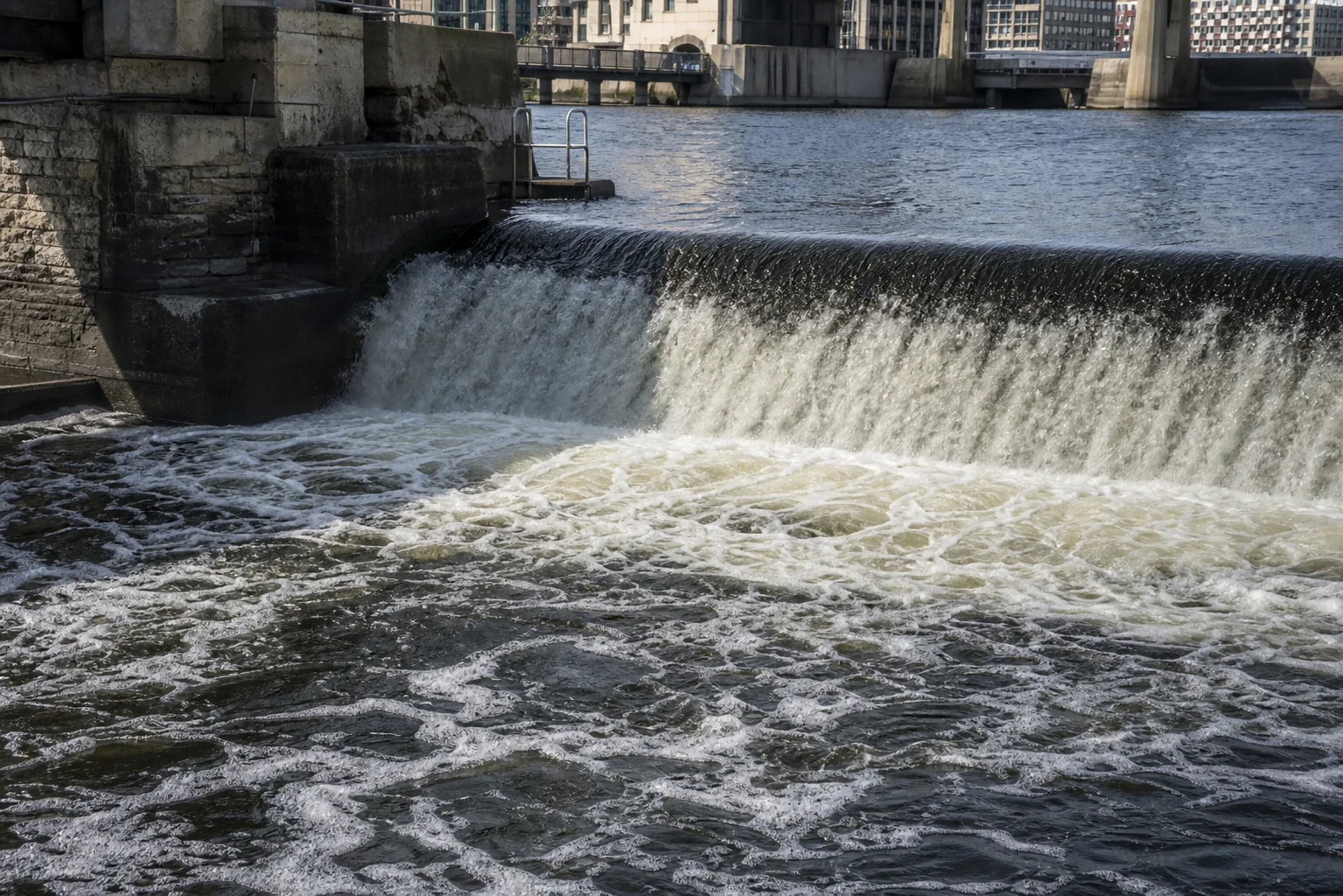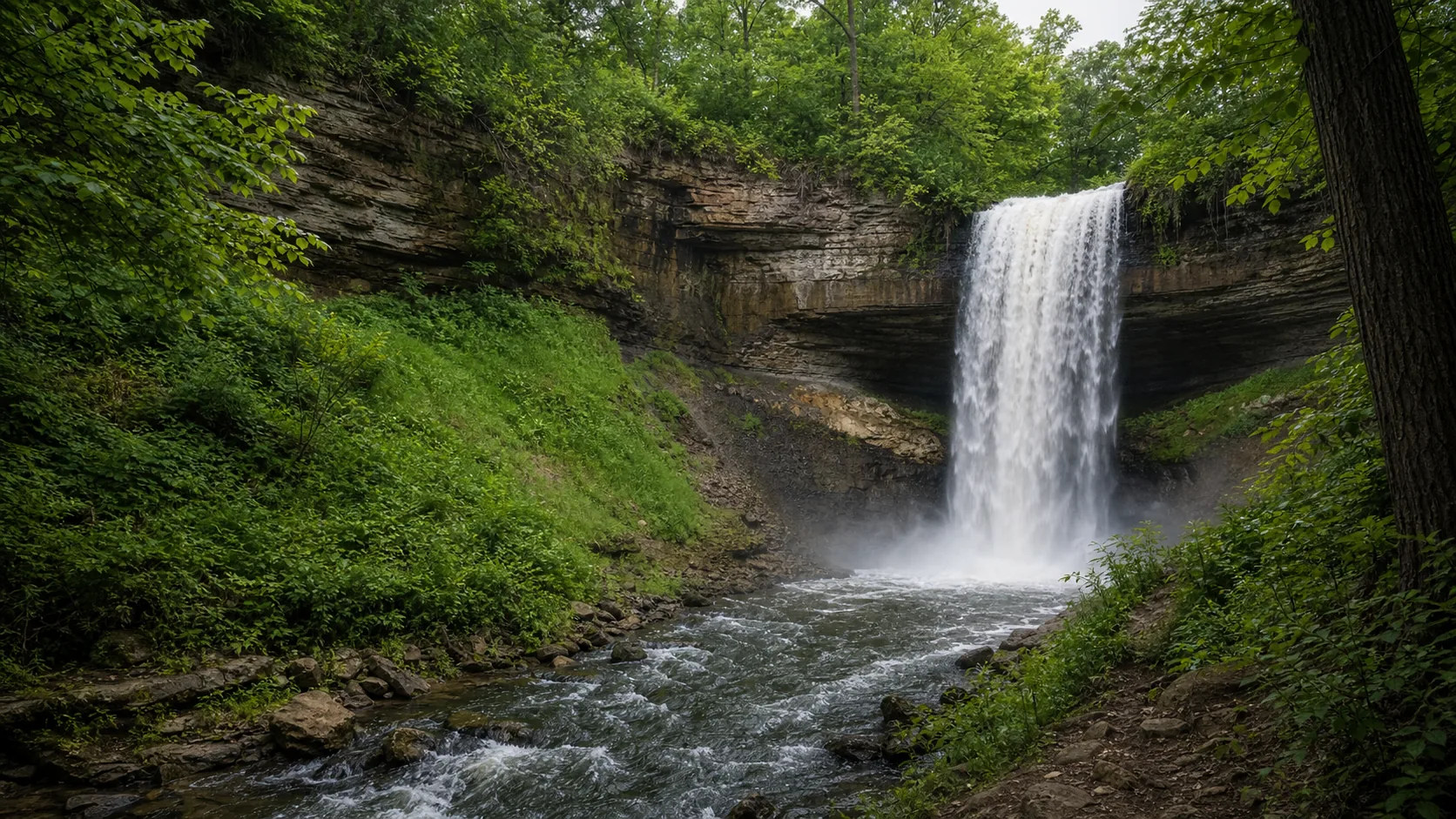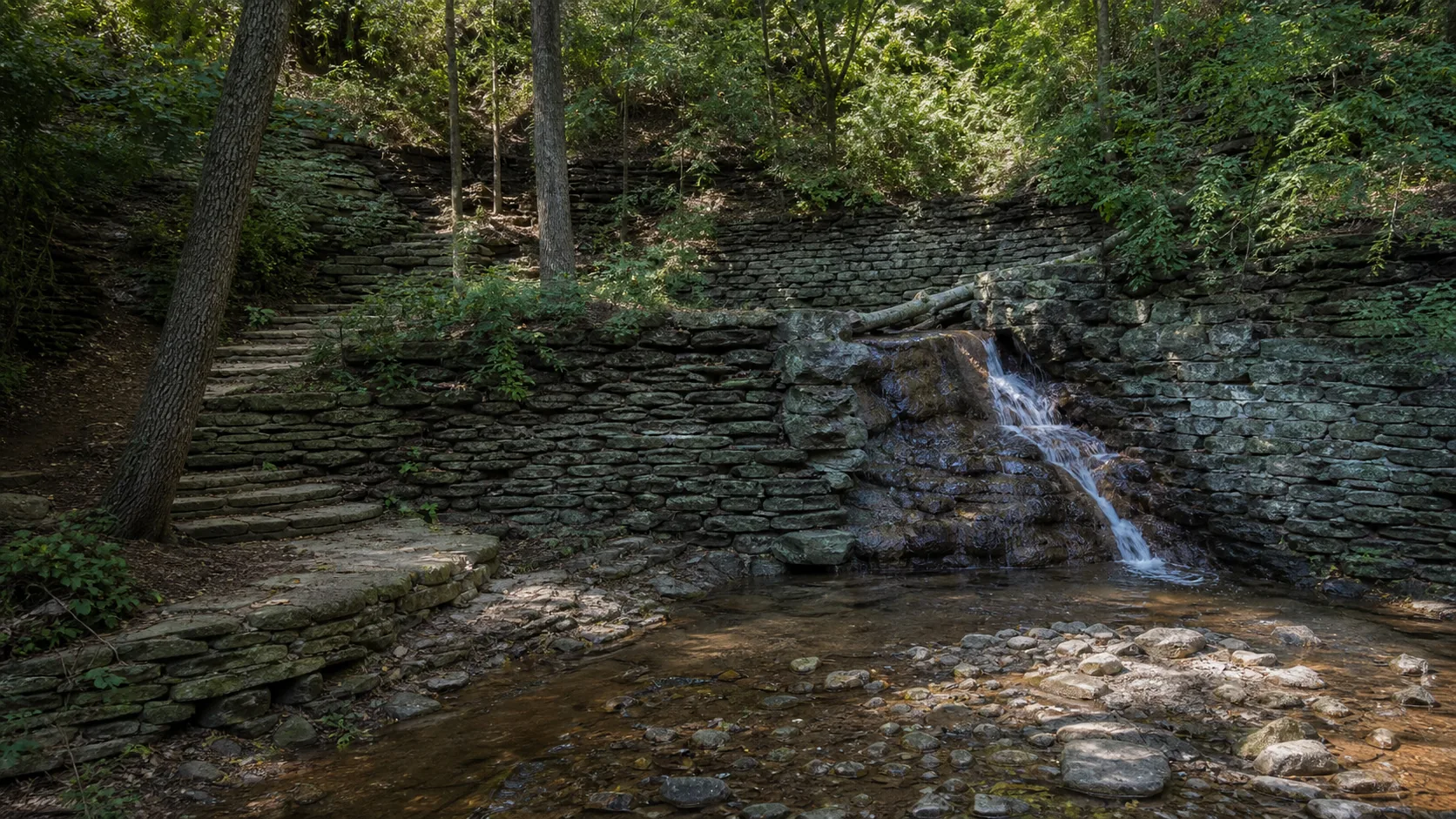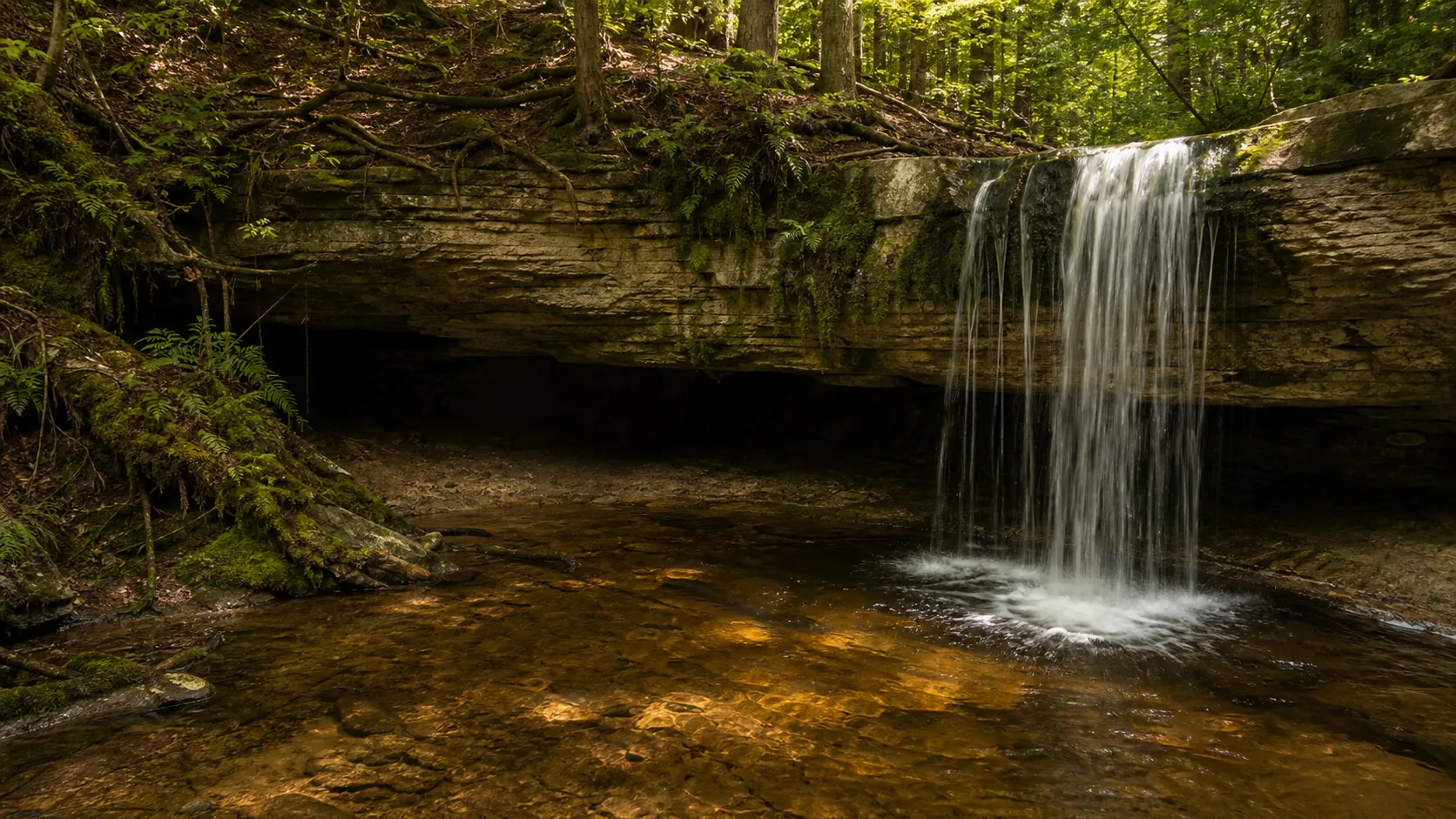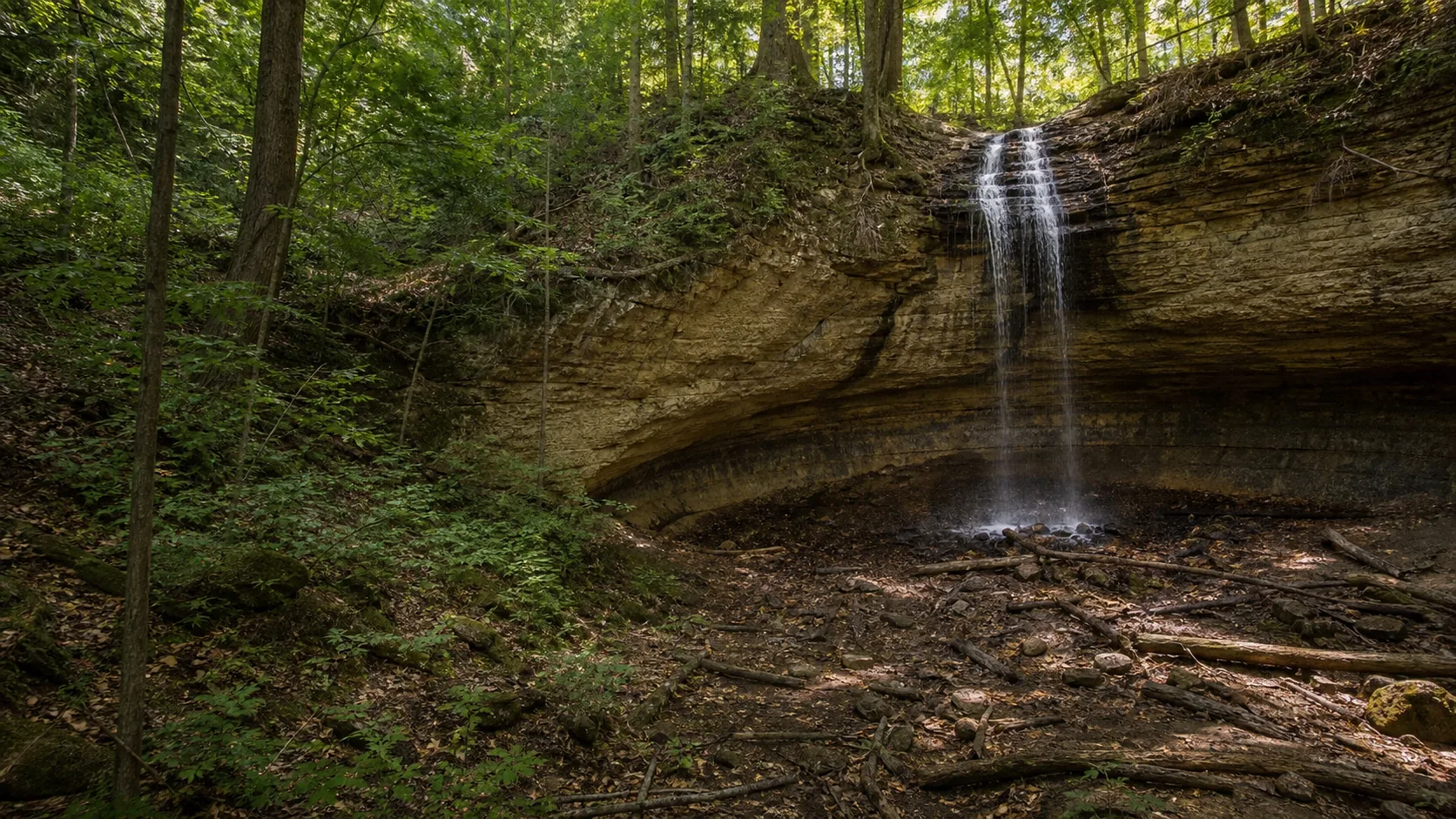
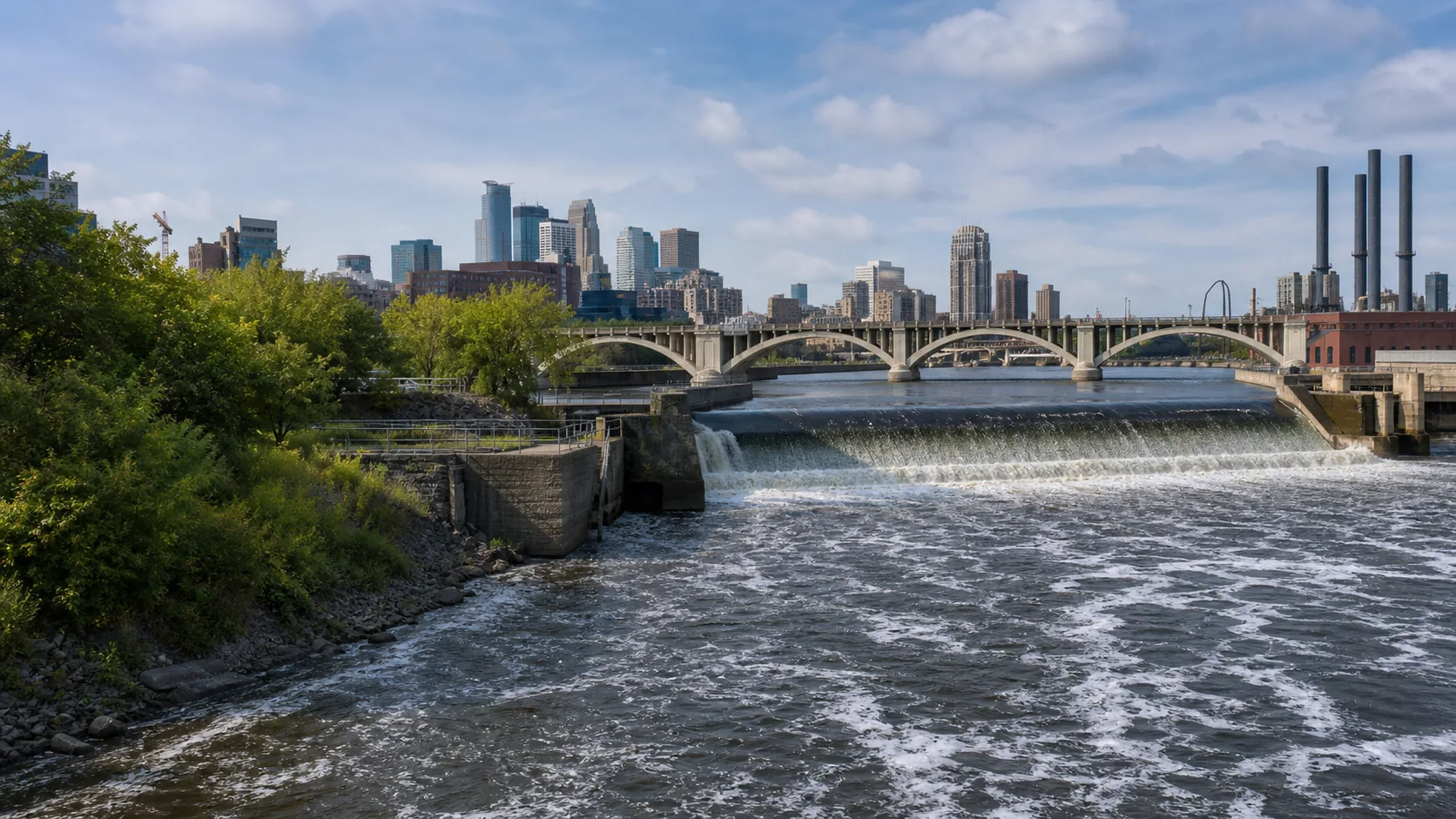
St. Anthony Falls waterfall and surrounding setting
Minneapolis, MN

St. Anthony Falls

St. Anthony Falls is the only true waterfall on the Mississippi River, a roughly 50-foot drop in downtown Minneapolis now held in place by a US Army Corps of Engineers lock-and-dam and a concrete spillway. The classic view is from the Stone Arch Bridge looking upstream into the Mill District, with the Mill City Museum on the south bank. It sits on the same Platteville Limestone over St. Peter Sandstone caprock that produces Minnehaha Falls and Hidden Falls a few miles south.

Last verified May 12, 2026 Visited April 2026 8 sources checked
Trail 1.8 mi 2.5 mi extended
Time 45-90 min Easy
Best season May–Oct, year-round views Apr – Jun (Mississippi spring runoff)
Parking Several paid ramps within 0.2 mi · Limited street parking on Main St SE Mill Ruins Park
Quick answer

Is St. Anthony Falls worth visiting?

Yes, and unlike most waterfalls it works year-round because the Mississippi never stops flowing. The two strongest visits are April through June for spring runoff over the spillway and January through February when the surrounding river ices in and frames the rushing apron in white. It is free, fully urban, fully accessible from the Stone Arch Bridge, and pairs in a single afternoon with Minnehaha Falls and Hidden Falls.

  • Only true waterfall on the Mississippi
  • Stone Arch Bridge is the iconic view
  • Mill City Museum adjacent
  • Year-round flow over the spillway
  • Fully paved, step-free access
  • Free, open 6 a.m. to 10 p.m.
Last verified May 12, 2026 Visited April 2026 8 sources checked
Distance 1.8 mi 2.5 mi extended
Round trip 45-90 min Paved, fully accessible
Difficulty Easy Paved, fully accessible
Location Minneapolis, MN Mill Ruins Park
Parking Several paid ramps within 0.2 mi · Limited street parking on Main St SE MPRB
Transit METRO Blue Line / Northstar Downtown East / Target Field · 800 ft
Drive 0.5 mi 5 min from downtown
Best season May–Oct, year-round views Apr – Jun (Mississippi spring runoff)
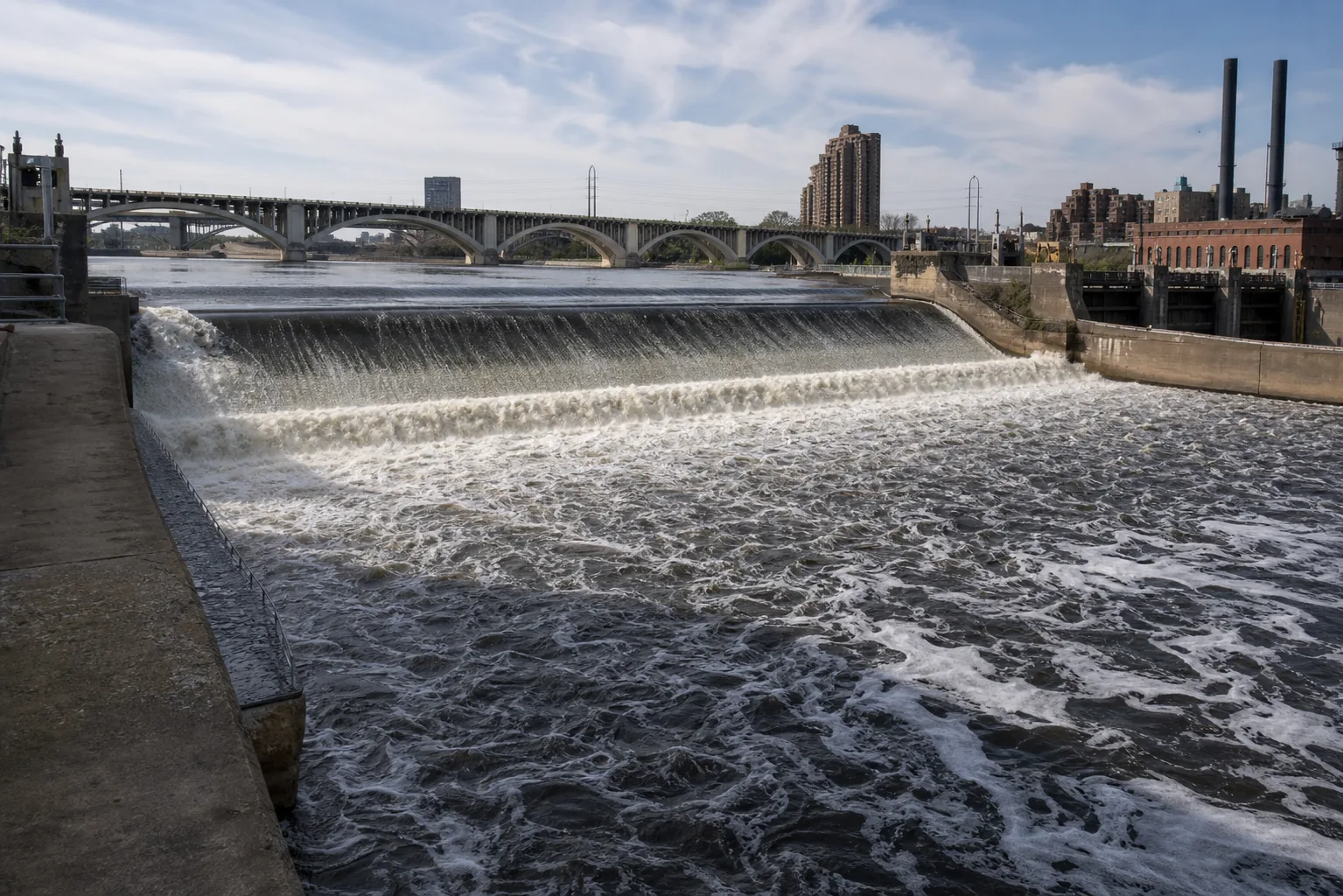
St. Anthony Falls base and water force
Photo guide

Five angles on the only waterfall on the Mississippi.

Stone Arch Bridge mid-span for the wide upstream frame, the Water Power Park overlook on Hennepin Island for the closest legal look at the lip, the Mill City Museum rooftop Observation Deck for the elevated downstream angle, the Third Avenue Bridge for the alternate side-on frame, and the Lower St. Anthony Falls Lock viewpoint for the apron and tailrace.

St. Anthony Falls waterfall and surrounding setting
St. Anthony Falls, hero composition
St. Anthony Falls wide setting view
Wide setting view
St. Anthony Falls base and water force
Base and water force
St. Anthony Falls water and rock detail
Water and rock detail
01Is St. Anthony Falls flowing right now?

The St. Anthony Falls Flume gauge (USGS 05288918) does not publish discharge values; it is a research flume operated by the University of Minnesota St. Anthony Falls Laboratory. The Mississippi runs year-round through the engineered spillway, with the strongest visible flow during spring runoff (April-June) and the most dramatic frozen-river frame in January and February.

Live data: USGS gauge 05288918 ↗ at the St. Anthony Falls Flume. Park status: NPS Mississippi NRRA ↗ and Mill Ruins Park ↗. The Mississippi runs year-round through the engineered spillway with the strongest visible flow during spring runoff (April-June) and a frozen-river frame in January and February.

02How long is the walk?

Five minutes across the Stone Arch Bridge for the iconic view, no stairs. The 1.8-mile Mill Ruins and Heritage Trail loop takes about 45 minutes; the extended 2.5-mile Mississippi Riverfront walk takes about 90 minutes. All routes are paved.

03How do you get there?

Main entrance: 102 Portland Ave S (Mill Ruins Park) on the south bank, or Main Street SE on the north bank. METRO Blue Line stops at Downtown East / Target Field, an 800-ft walk. From MSP airport, 20 minutes via I-35W. From downtown Minneapolis, 5 minutes on foot.

04Is there free parking?

Limited metered street parking on Main Street SE and along West River Parkway. Several paid ramps within 0.2 mi in Downtown East and East Hennepin. Rates run $2-4/hr, $15-20 daily. The free Mill District ramp at the Guthrie Theater (after 6 p.m. and weekends) is the local hack.

05Does it cost money?

No. The falls, Stone Arch Bridge, and surrounding parks are free 24 hours. Mill City Museum charges admission ($15-20 adult, less for kids and seniors). Drone permits $75 one-time through MPRB; the Upper Lock is in restricted FAA airspace.

06Trail variants

Stone Arch Bridge 0.5 mi paved, 15 min, fully accessible.
Mill Ruins loop 1.8 mi, 45 min.
Mississippi Riverfront extended 2.5 mi, 90 min.

Detailed maps and recent reviews: Falls route on AllTrails · Creek route on AllTrails

07Can you swim?

No. The Mississippi current and the spillway hydraulics below the apron are lethal. Swimming, wading, and boating above the dam are prohibited and enforced.

08Are dogs allowed?

Yes, on leash, across the Stone Arch Bridge, Mill Ruins Park, and the entire West River Parkway. Mill City Museum interior is service animals only.

09Is it accessible?

Stone Arch Bridge and the Mill Ruins Park paths are fully wheelchair and stroller accessible with no stairs from either end. Mill City Museum is fully accessible including the rooftop Observation Deck via elevator. Water Power Park on Hennepin Island is paved.

Field notes

St. Anthony Falls at a glance.

Roughly 50-foot drop over Platteville Limestone and St. Peter Sandstone, the only true waterfall on the Mississippi River, stabilized in concrete after the 1869 Eastman Tunnel collapse, inside the NPS Mississippi National River and Recreation Area, free to visit, day use 6 a.m. to 10 p.m. on the Minneapolis Park & Rec side.

Height 50 ft USGS 3DEP
Type Concrete spillway (stabilized) USGS
Rock Platteville limestone over St. Peter sandstone Geological Survey
County Hennepin Minneapolis, MN
Managed by Minneapolis Park & Rec Board MPRB
Water source Mississippi River USGS
Elevation 802 ft USGS NED
Park area 22 acres MPRB
Hours 6am to 10pm daily MPRB
When to visit

Three windows that justify the trip.

April through June for the loudest spring runoff over the spillway, late January through mid-February for the frozen-river frame around the white apron, and mid-October for fall color along the Stone Arch Bridge approach. The Mississippi never stops flowing, so any month delivers a falls; these three deliver a photograph.

PEAK FLOW

Peak flowApr – Jun (Mississippi spring runoff)
Ice / low flowJan – Feb
Most crowdedWeekends and midday
Best photosSunrise or weekdays

Live water context

Discharge data -- Live reading from St. Anthony Falls Flume (Mississippi R) at Minneapolis (USGS 05288918) refreshes on the next build. Open the gauge link below for the current cubic-feet-per-second reading.

USGS 05288918 · St. Anthony Falls Flume (Mississippi R) at Minneapolis

Why is it called St. Anthony Falls?

Named Saint Anthony Falls in 1680 by Father Louis Hennepin, a Belgian Franciscan missionary traveling with a French exploring party, in honor of his patron saint Anthony of Padua. The older name in the language of the place is the Dakota Owámniyomni, often translated as turbulent water or whirlpool. An active community-led initiative through the Owamniyomni Falls Foundation works to restore the Dakota name and stewardship at the site.

What else to do at Mill Ruins Park

The falls sits inside the Mississippi National River and Recreation Area, a 72-mile NPS-managed corridor through the Twin Cities, with the immediate site shared between the National Park Service, the US Army Corps of Engineers, and the Minneapolis Park & Recreation Board. The classic walk is across the Stone Arch Bridge (1883), James J. Hill's curved limestone railroad bridge now reserved for pedestrians and cyclists, with the Mill City Museum built into the burned-out shell of the Washburn A Mill on the south bank and Mill Ruins Park just below it. Water Power Park on Hennepin Island gives the closest legal view of the lip.

  • Stone Arch Bridge (1883). James J. Hill's curved 23-arch limestone railroad bridge across the Mississippi, now pedestrian and bike-only and the iconic falls viewpoint.
  • Mill City Museum. Minnesota Historical Society museum built into the burned-out shell of the 1880 Washburn A Mill, with a rooftop Mill City Observation Deck looking out over the falls and Stone Arch Bridge.
  • Mill Ruins Park. 22-acre Minneapolis Park & Rec site of excavated 19th-century mill foundations and tailrace channels along the south bank.
  • Upper St. Anthony Falls Lock and Dam. US Army Corps of Engineers lock closed to commercial navigation in 2015 to stop the spread of invasive carp; the visitor observation deck reopens seasonally.
  • Water Power Park. Xcel Energy and MPRB overlook on Hennepin Island at the head of the falls, the closest legal view of the lip itself.
  • St. Anthony Falls Historic District. National Register district covering the riverfront mills, the Pillsbury A-Mill on the east bank, and the lock-and-dam system.

Why it looks this way

St. Anthony Falls drops over a hard band of Platteville Limestone caprock with a much softer St. Peter Sandstone underneath. The sandstone erodes faster than the limestone, the limestone overhangs, then collapses in slabs, and the lip retreats upstream a small amount each century. That caprock-undercut mechanic moved the falls roughly 8 miles upstream from its original position near the Mississippi-Minnesota confluence at Fort Snelling over the past 12,000 years since glacial Lake Agassiz drained. It is the same geology that produces Minnehaha Falls and Hidden Falls a few miles south, and by 1869 it had nearly destroyed St. Anthony itself, which is why the falls today is stabilized in concrete.
Field guide deep dive

What you cannot tell from the Wikipedia page.

The 1869 tunnel collapse that nearly destroyed the falls, why this is technically the only waterfall on the Mississippi, how the same caprock built three Twin Cities falls, and the Dakota name the city is now learning to use.

How St. Anthony Falls formed and why it moved 8 miles upstream

St. Anthony Falls is a textbook caprock waterfall on a continental scale. A hard band of Platteville Limestone caps the lip and a much softer St. Peter Sandstone sits underneath. The Mississippi wears the sandstone away faster than it can wear the limestone, the limestone overhangs, slabs break off into the plunge pool, and the lip retreats upstream a small amount with each collapse.

The mechanic is the same one that produced Minnehaha Falls and Hidden Falls a few miles south, but the scale here is larger because the Mississippi carries far more water than Minnehaha Creek. When glacial Lake Agassiz drained roughly 12,000 years ago, the falls stood near the present-day confluence of the Mississippi and Minnesota Rivers at Fort Snelling. Since then it has retreated about 8 miles upstream to its current position in downtown Minneapolis, leaving the deep Mississippi gorge between Minneapolis and St. Paul as the visible signature of that retreat. Hidden Falls on the gorge wall is essentially St. Anthony's old neighborhood; Minnehaha is the smaller tributary version of the same process.

The 1869 collapse: how the falls nearly destroyed itself

By the 1860s Minneapolis was already a mill town built on the power of the falls, and millers wanted more head and more turbines. In 1868 the developer William Eastman began tunneling under Nicollet Island just upstream of the lip, planning to draw water under the island and discharge it back into the river below the falls for additional industrial power. The tunnel was driven through the soft St. Peter Sandstone underneath the Platteville cap.

On October 5, 1869, water broke through the tunnel roof. The river poured into the hole, scoured the sandstone out from under the limestone cap at terrifying speed, and threatened to undercut the entire falls in a single event. If the cap had failed, the Mississippi at Minneapolis would have become a series of rapids and the entire industrial future of the city would have ended that week. Volunteers, mill owners, and federal engineers spent the next decade plugging the tunnel and stabilizing the lip. The US Army Corps of Engineers eventually built a sloping wooden apron across the entire face of the falls, later rebuilt in concrete, which is the engineered spillway visible today. The natural waterfall was effectively saved by being frozen in place.

Why Minneapolis became Mill City

The 50-foot drop at St. Anthony Falls was the only large source of hydropower on the upper Mississippi, and from roughly the 1860s through the 1930s it powered the largest concentration of flour milling in the world. The south bank of the river held the Washburn A Mill, owned by Cadwallader Washburn and later expanded by his successor company General Mills; the east bank held the Pillsbury A-Mill, run by the Pillsbury family. At their peak in 1890 these two complexes and a dozen smaller mills produced enough flour to feed an estimated 12 million people a year, and the brand names "Pillsbury" and "Gold Medal" became household words far beyond Minnesota.

Milling at the falls collapsed in the 1930s as the industry decentralized to cheaper power and closer rail markets. The Washburn A Mill burned in 1991 and was rebuilt as the Mill City Museum, with its limestone shell preserved as an open-air ruin around a modern interpretive core. The Pillsbury A-Mill was converted to artist lofts in 2015. Mill Ruins Park, just below the Stone Arch Bridge on the south bank, displays the excavated tailrace channels and foundation walls of the smaller mills that did not survive.

The Stone Arch Bridge

The view that defines St. Anthony Falls in nearly every photograph is taken from the Stone Arch Bridge, a 2,100-foot curved limestone span built in 1883 by railroad baron James J. Hill to carry his Great Northern trains into a new Minneapolis depot. The bridge is unusual for two reasons: it curves, which most stone bridges do not, and it was built entirely of locally quarried Platteville Limestone in 23 arches. It served freight and passenger rail until 1978, was converted to a pedestrian and bicycle bridge in 1994, and has been closed to motor vehicles ever since.

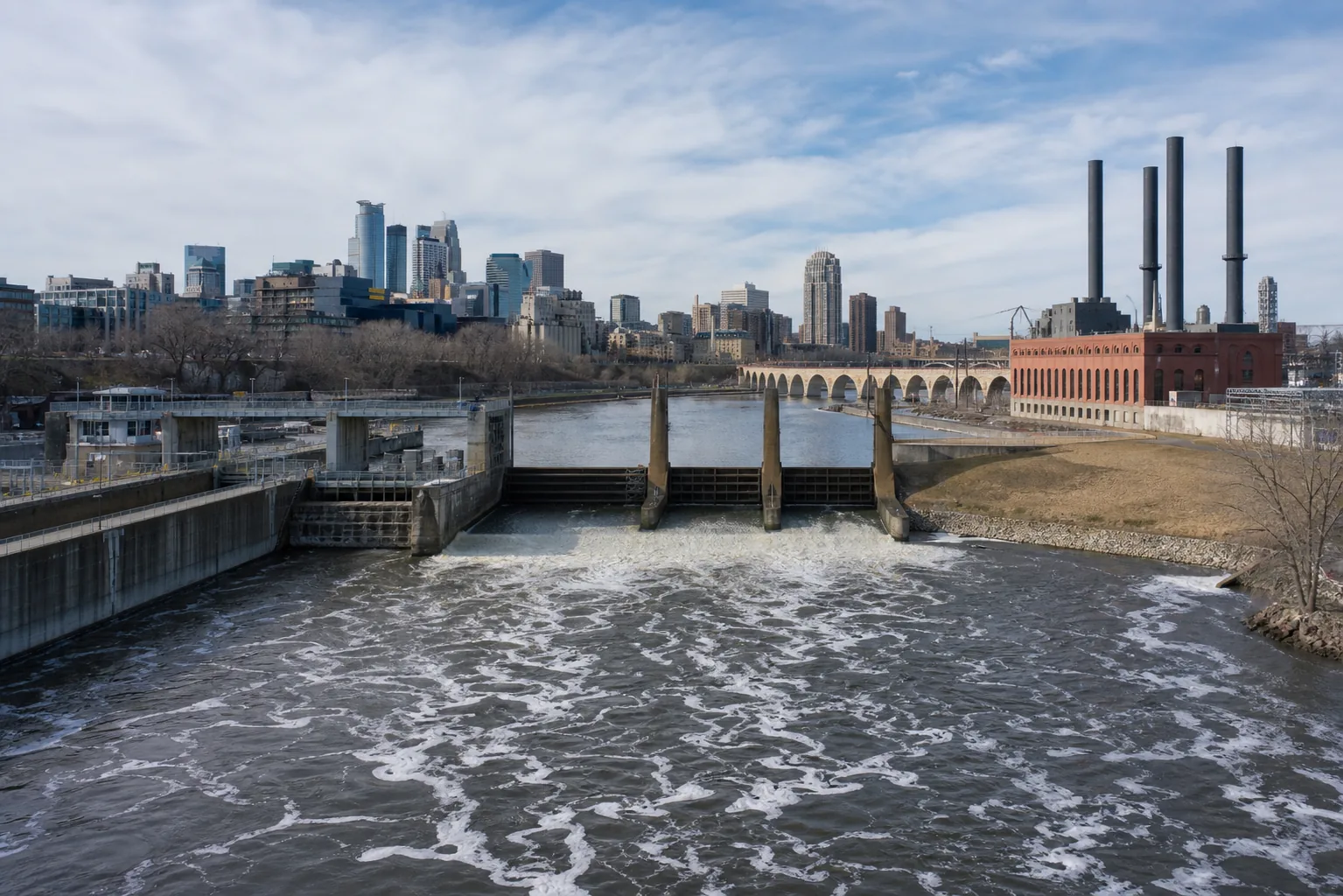
The bridge sits immediately downstream of the falls, which means a walk across the deck gives a continuous head-on view of the spillway, the Mill City Museum on the south bank, and the Pillsbury A-Mill on the north bank. The middle three arches sit directly over the lock chambers of the Upper St. Anthony Falls Lock and Dam; the rest span the post-spillway Mississippi. From mid-span at sunset on a spring evening, the spillway audibly roars and the limestone bridge deck warms back to gold. It is the single best urban waterfall photograph in the United States.

Owamniyomni: the older name and the work to restore it

The Dakota name for the falls is Owámniyomni, usually translated as turbulent water or whirlpool. The site is sacred in Dakota tradition, a place of spiritual power and gathering for thousands of years before European contact, and is part of the broader sacred landscape of Bdote at the Minnesota-Mississippi confluence. The name Saint Anthony Falls dates from 1680 and reflects a single afternoon's encounter by Father Louis Hennepin, who was traveling under captivity with a Dakota party and named the falls for his Franciscan patron saint Anthony of Padua.

The Owamniyomni Falls Foundation, founded in 2020, partners with the National Park Service, the Minneapolis Park & Recreation Board, and Dakota communities to restore a 5-acre stretch of land on the west bank near the Stone Arch Bridge as native green space and to support broader use of the Dakota name on signs, maps, and interpretive material. The St. Anthony Falls Historic District page on the City of Minneapolis website now leads with Owamniyomni; the NPS visitor pages reference both names; and the Bdote Memory Map remains the canonical reference for the Dakota geography of the site. The Dakota name is the older name and the more accurate one for what the place is, not just what one missionary in 1680 happened to call it.

The Twin Cities waterfall trio in one afternoon

St. Anthony pairs naturally with two other Twin Cities falls because all three sit on the same Platteville Limestone over St. Peter Sandstone contact. Start at the Stone Arch Bridge and Mill City Museum at St. Anthony Falls (30 to 60 minutes including a quick museum lap). Drive south 15 minutes on West River Parkway to Minnehaha Falls for the 53-foot plunge over the same caprock into a sandstone amphitheater (30 to 45 minutes including the stone staircases into the glen).

Then drop another 10 minutes south to Hidden Falls Regional Park in St. Paul, a quiet 25-foot drop into a Mississippi side channel that roughly marks where St. Anthony Falls used to stand before 12,000 years of upstream retreat. Total drive time about 30 minutes, total visit time 90 to 120 minutes, all three free, all reachable by the METRO Blue and Green Lines. It is the cleanest single-afternoon way to read a piece of glacial-river geology in any major American city.

Map and route

Five minutes from downtown, on the Blue Line.

Main entrance: 102 Portland Ave S (Mill Ruins Park) on the south bank, or Main Street SE on the north bank. METRO Blue Line stops at Downtown East / Target Field, an 800-ft walk. From MSP airport, 20 minutes via I-35W. From downtown Minneapolis, 5 minutes on foot.

Wildlife

Bald eagles, mergansers, and the surprising urban Mississippi.

Bald eagles fish the Mississippi corridor through the Twin Cities year-round and are most reliably spotted from the Stone Arch Bridge in winter when open water concentrates them at the spillway. Common mergansers and mallards work the tailrace, and great blue herons stalk the slower water below the Lower Lock.

Bald Eagle
Bald Eagle
Haliaeetus leucocephalus
Great Blue Heron
Great Blue Heron
Ardea herodias
Common Merganser
Common Merganser
Mergus merganser
Mallard
Mallard
Anas platyrhynchos
Photography and weddings

Stone Arch Bridge mid-span, three rooftops, and the Upper Lock no-fly zone.

For personal use, no permit is usually required. Stay on signed trails and overlooks, and avoid climbing wet rock near the falls.

Best light is early morning and the last hour of daylight; midday sun can flatten the water and blow out highlights.

For commercial photography, drone use, or large equipment, check permit rules with Minneapolis Park & Rec Board.

Permits

Weddings and engagements

Engagement and wedding shoots are common at accessible overlooks and bridge viewpoints.

For ceremonies or reserved areas, check availability and permit rules with Minneapolis Park & Rec Board.

Reserve early for popular weekends and bring any needed power, audio, and weather backup yourself.

Nearby waterfalls

Three Twin Cities waterfalls on the same Platteville-St. Peter geology.

St. Anthony pairs naturally with Minnehaha Falls and Hidden Falls because all three drop over the same caprock-undercut contact. All three are free, all three are reachable by light rail, and together they tell the full story of how the Mississippi sliced 8 miles north over 12,000 years.

Related questions

More questions visitors ask before walking to St. Anthony Falls.

Is it real, how tall, where to see it, dogs, cost, the Stone Arch Bridge, and the worth-visiting question. The full set is also indexed in the FAQ schema for AI answer engines.

01Can you see St. Anthony Falls?

Yes. The best public view is from the Stone Arch Bridge, a 2,100-foot pedestrian-only bridge that crosses the Mississippi immediately downstream of the falls. The Mill City Museum rooftop Observation Deck and the Water Power Park overlook on Hennepin Island give the next two best angles. All three are open to the public; the bridge and Water Power Park are free.

02Where is St. Anthony Falls?

In downtown Minneapolis on the Mississippi River, between the Mill District on the south bank and the St. Anthony neighborhood on the north bank. The closest address for visitors is Mill Ruins Park at 102 Portland Avenue South, Minneapolis. The METRO Blue Line stops at Downtown East / Target Field, an 800-foot walk to the Stone Arch Bridge.

03Is St. Anthony Falls a real waterfall?

Yes, with an asterisk. It is the only true waterfall on the entire 2,340-mile Mississippi River and dropped about 50 feet over a natural Platteville Limestone ledge for thousands of years. After the 1869 Eastman Tunnel collapse nearly destroyed the lip, the US Army Corps of Engineers stabilized the falls with a wooden apron (later rebuilt in concrete) that is now part of the Upper St. Anthony Falls Lock and Dam. The waterfall is real; the surface you see is engineered.

04How tall is St. Anthony Falls?

About 50 feet from the top of the spillway to the tailrace below. The natural pre-engineering height varied with river level and erosion of the underlying sandstone. The current stabilized drop is held in place by the concrete spillway and the lock-and-dam system.

05Is the Stone Arch Bridge at St. Anthony Falls?

Yes. The Stone Arch Bridge crosses the Mississippi immediately downstream of the falls and is the iconic viewpoint. It was built in 1883 by railroad baron James J. Hill as a curved 23-arch limestone railroad bridge for the Great Northern Railway, carried trains until 1978, and was converted to a pedestrian and bicycle bridge in 1994.

06Is St. Anthony Falls free?

Yes. The falls, the Stone Arch Bridge, Mill Ruins Park, and Water Power Park are all free and open 24 hours (the parks themselves are signed 6 a.m. to 10 p.m.). The only paid components nearby are Mill City Museum admission ($15-20 adult), paid parking ramps in the Mill District ($2-4/hr), and any MPRB permits (drone $75, weddings from $250).

07Is St. Anthony Falls worth visiting?

Yes. It is the only true waterfall on the Mississippi River, the historic engine of the Minneapolis flour-milling industry, and the view from the Stone Arch Bridge is one of the best urban waterfall scenes in the United States. Spring runoff (April through June) is the loudest visit and the frozen-river frame (January through February) is the most photogenic, but the Mississippi never stops flowing so any month delivers a falls.

Sources and data

Where the St. Anthony Falls guide gets its facts.

NPS Mississippi National River and Recreation Area, US Army Corps of Engineers St. Paul District, Mill City Museum and Minnesota Historical Society, Owamniyomni Falls Foundation, Bdote Memory Map, Minnesota Geological Survey for the Platteville and St. Peter sequence, and the USGS gauge metadata for the St. Anthony Falls Flume.

USGS Streamflow: 05288918 St. Anthony Falls Flume (Mississippi R) at Minneapolis waterdata.usgs.gov
MPRB: Mill Ruins Park minneapolisparks.org
Access, parking, and permit rules: minneapolisparks.org
Geological Survey: Minneapolis bedrock macrostrat.org
NOAA Climate Normals (Minneapolis) noaa.gov
USGS National Elevation Dataset 3DEP
Wikidata: Q1141930 (St. Anthony Falls) wikidata.org
Google Maps: embedded map and directions maps.google.com
Google Places: nearby restaurants and hotels places API
Corrections: [email protected]