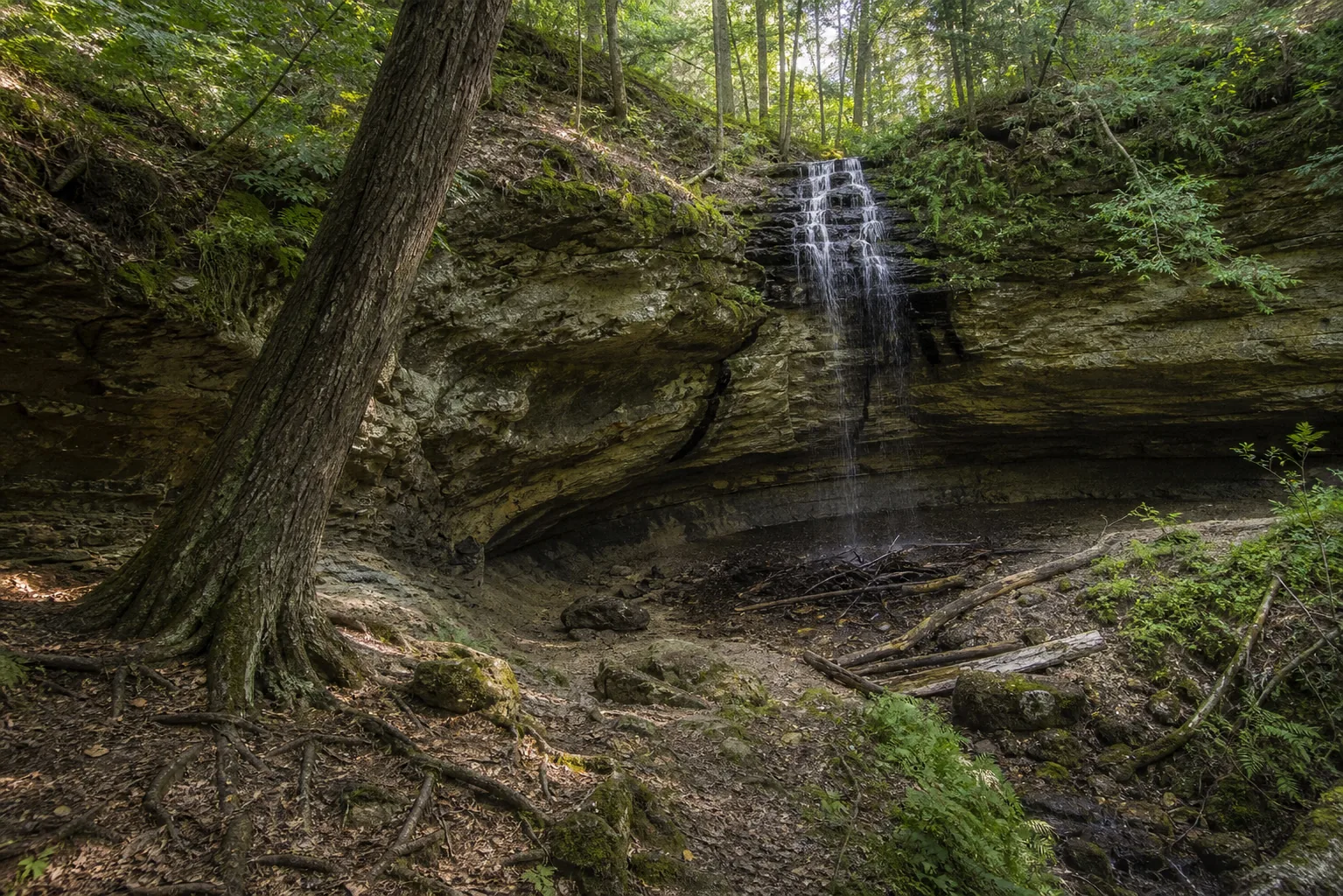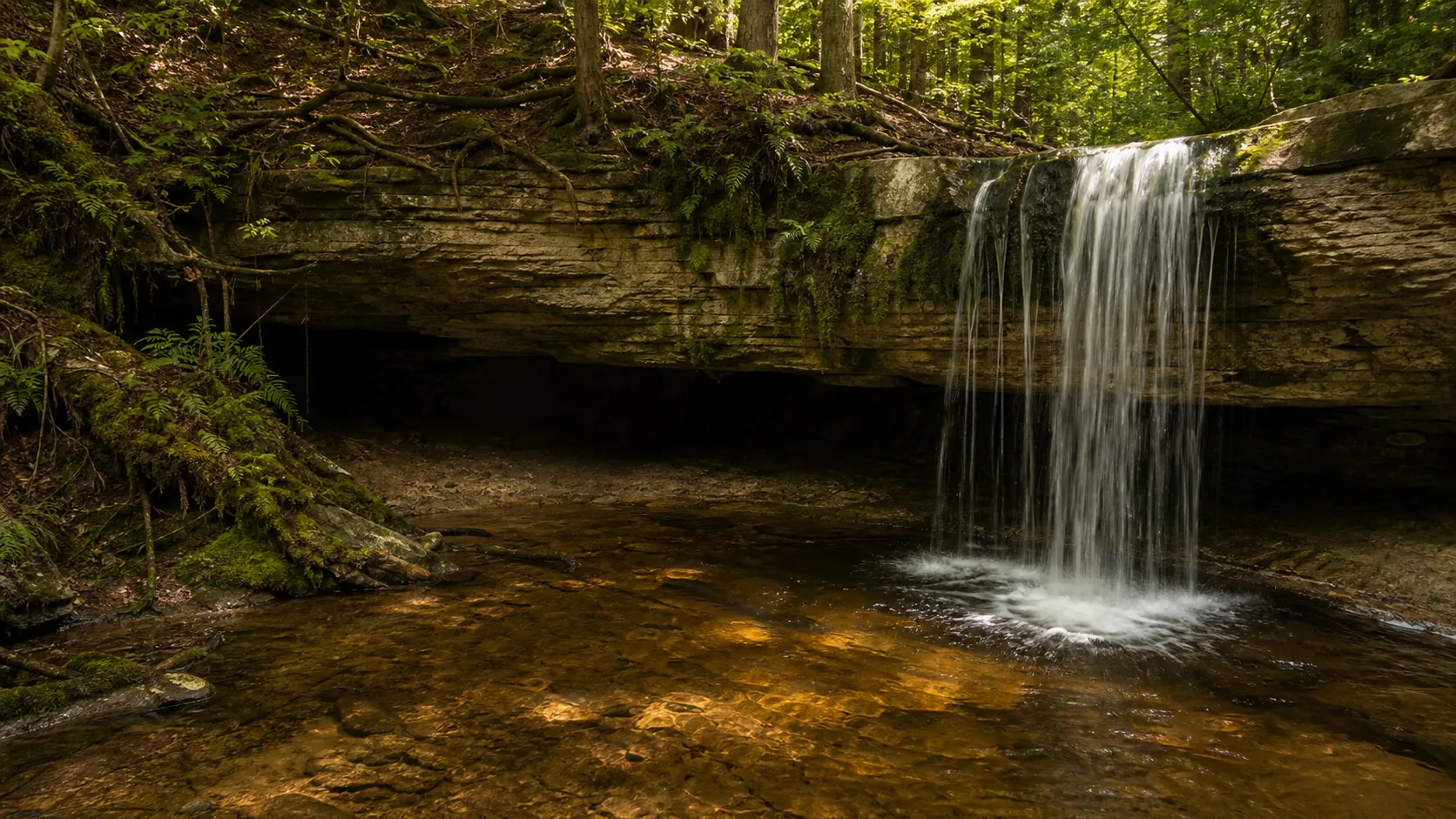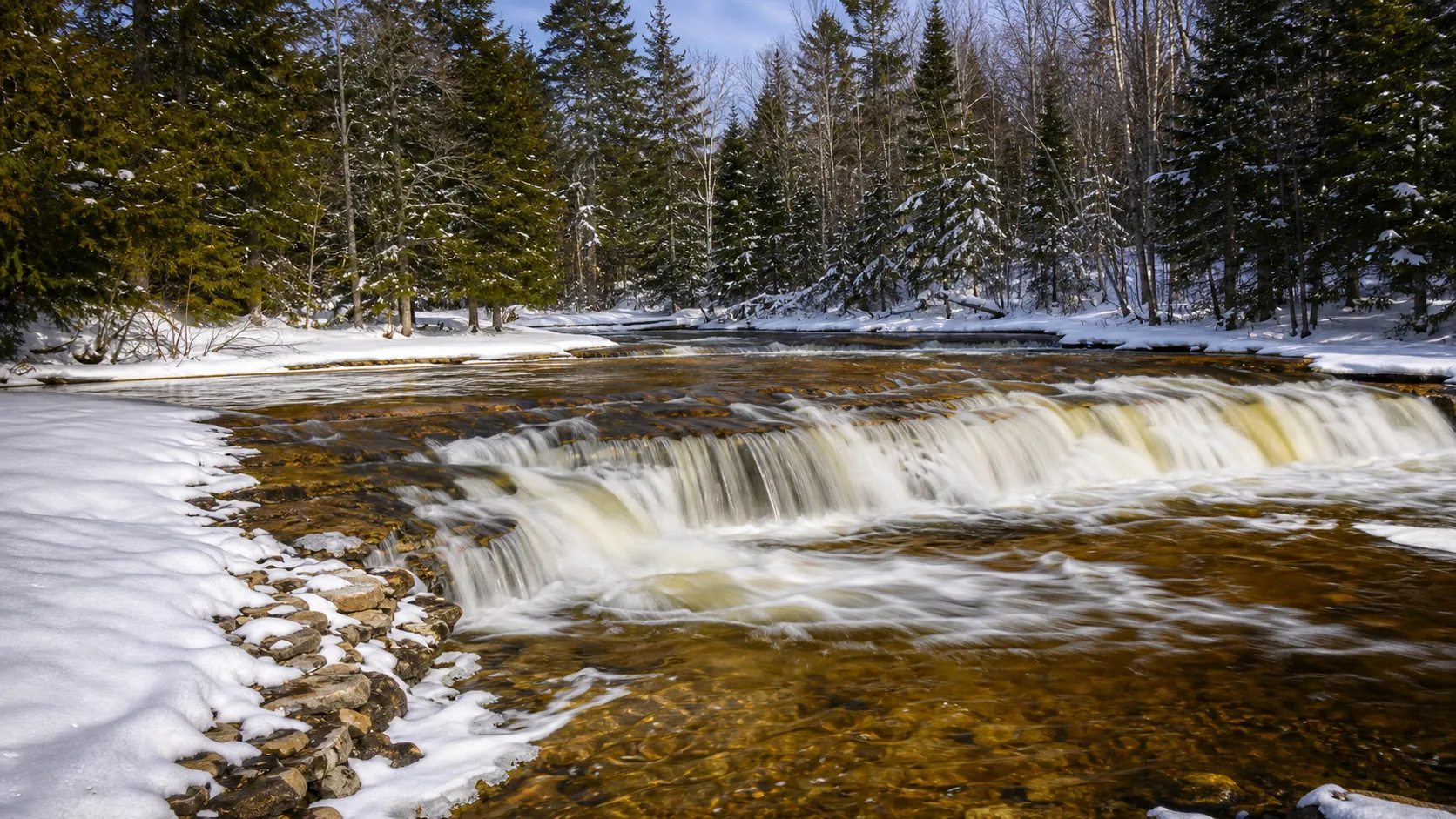
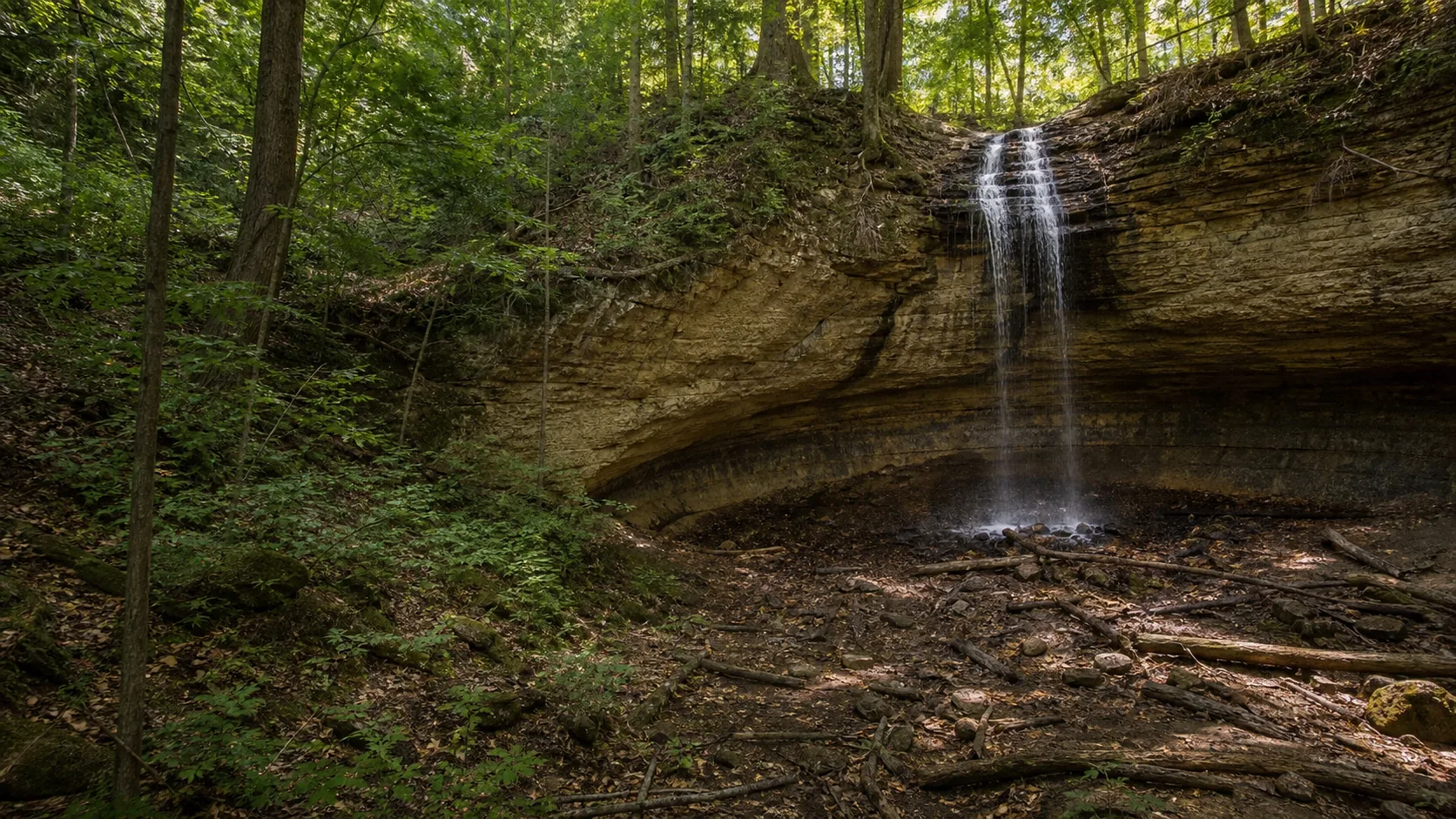
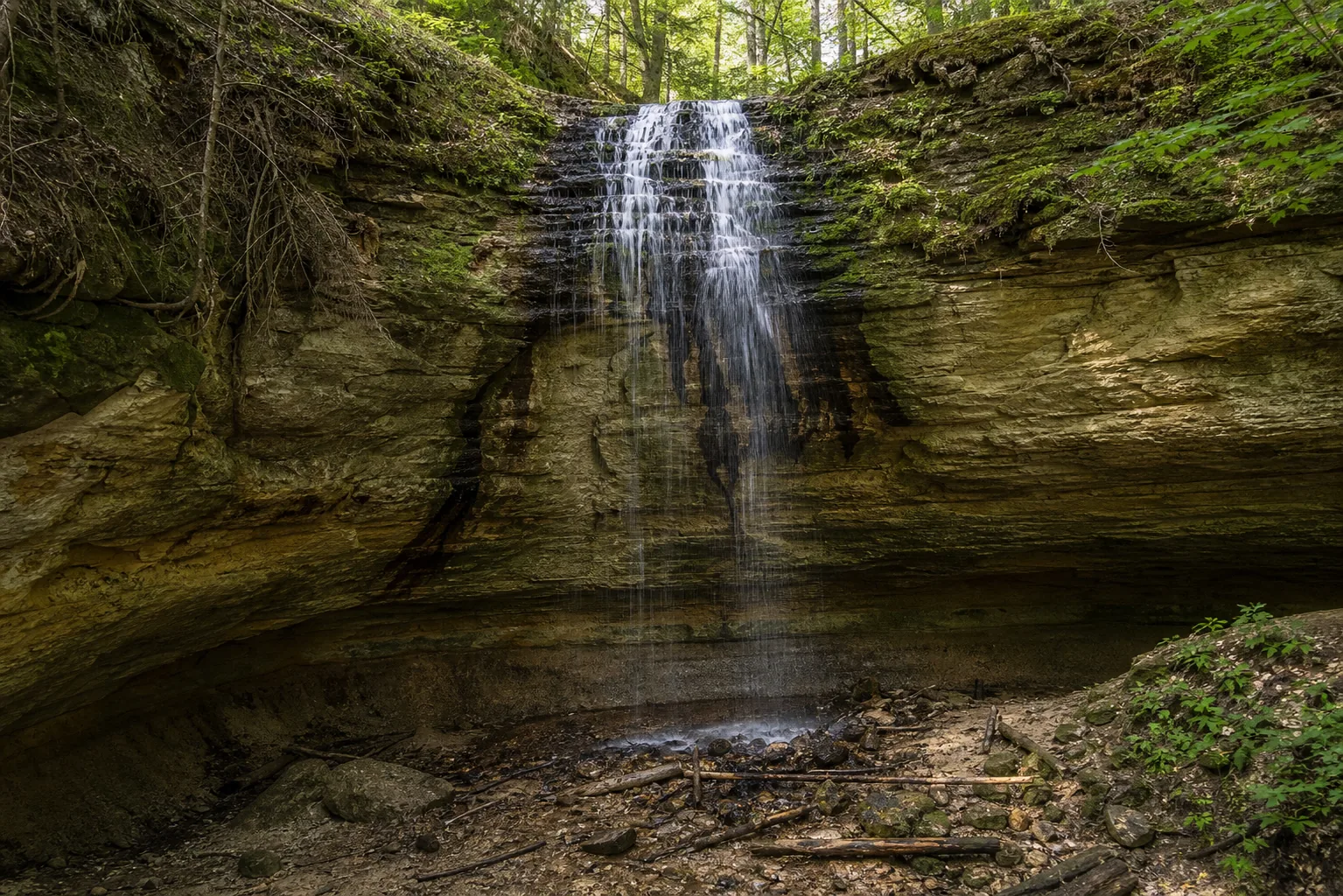
Tannery Falls waterfall and surrounding setting
Munising, MI

Tannery Falls

Tannery Falls is a 40-foot plunge in the city of Munising, Michigan, where Tannery Creek drops over a ledge of Cambrian Munising Formation sandstone into a small amphitheater inside the Pictured Rocks waterfall belt. It is one of the few true backcountry-feeling waterfalls in the Upper Peninsula that you can reach on foot from a downtown sidewalk.

Last verified May 12, 2026 Visited Desk-verified May 2026 6 sources checked
Trail 0.4 mi 1.2 mi extended
Time 15-60 min Easy
Best season May through October; ice column possible Jan through Feb Late Apr through May (snowmelt) and after summer thunderstorms
Parking Free city-park trailhead parking. Lot is small; downtown street parking is the overflow plan in peak summer. City of Munising park trail
Quick answer

Is Tannery Falls worth visiting?

Yes. It is short (about 0.4 miles round trip from a free city park trailhead), free, walkable from downtown Munising, and pairs with Munising Falls and Memorial Falls for an in-town waterfall trio that takes about 60 to 90 minutes on foot. Peak windows are late April through May for spring runoff and late January through mid-February when the curtain forms an ice column.

  • Walkable from downtown Munising
  • Short 0.4 mi out-and-back from the city park
  • Peak flow: late Apr through May
  • Pairs with Memorial and Munising Falls
  • Ice column: late Jan through mid-Feb
  • Free; no Pictured Rocks pass required
Last verified May 12, 2026 Visited Desk-verified May 2026 6 sources checked
Distance 0.4 mi 1.2 mi extended
Round trip 15-60 min Short, well-graded out-and-back from a city park trailhead; some roots and stairs near the viewing area
Difficulty Easy Short, well-graded out-and-back from a city park trailhead; some roots and stairs near the viewing area
Location Munising, MI City of Munising park trail
Parking Free city-park trailhead parking. Lot is small; downtown street parking is the overflow plan in peak summer. City of Munising
Transit No fixed-route transit; walkable from downtown Munising Downtown Munising (Elm Avenue / H-58 corridor) · 2640 ft
Drive 0.5 mi 10 min from downtown
Best season May through October; ice column possible Jan through Feb Late Apr through May (snowmelt) and after summer thunderstorms
Tannery Falls base and water force
Photo guide

Three frames on a 40-foot walkable plunge.

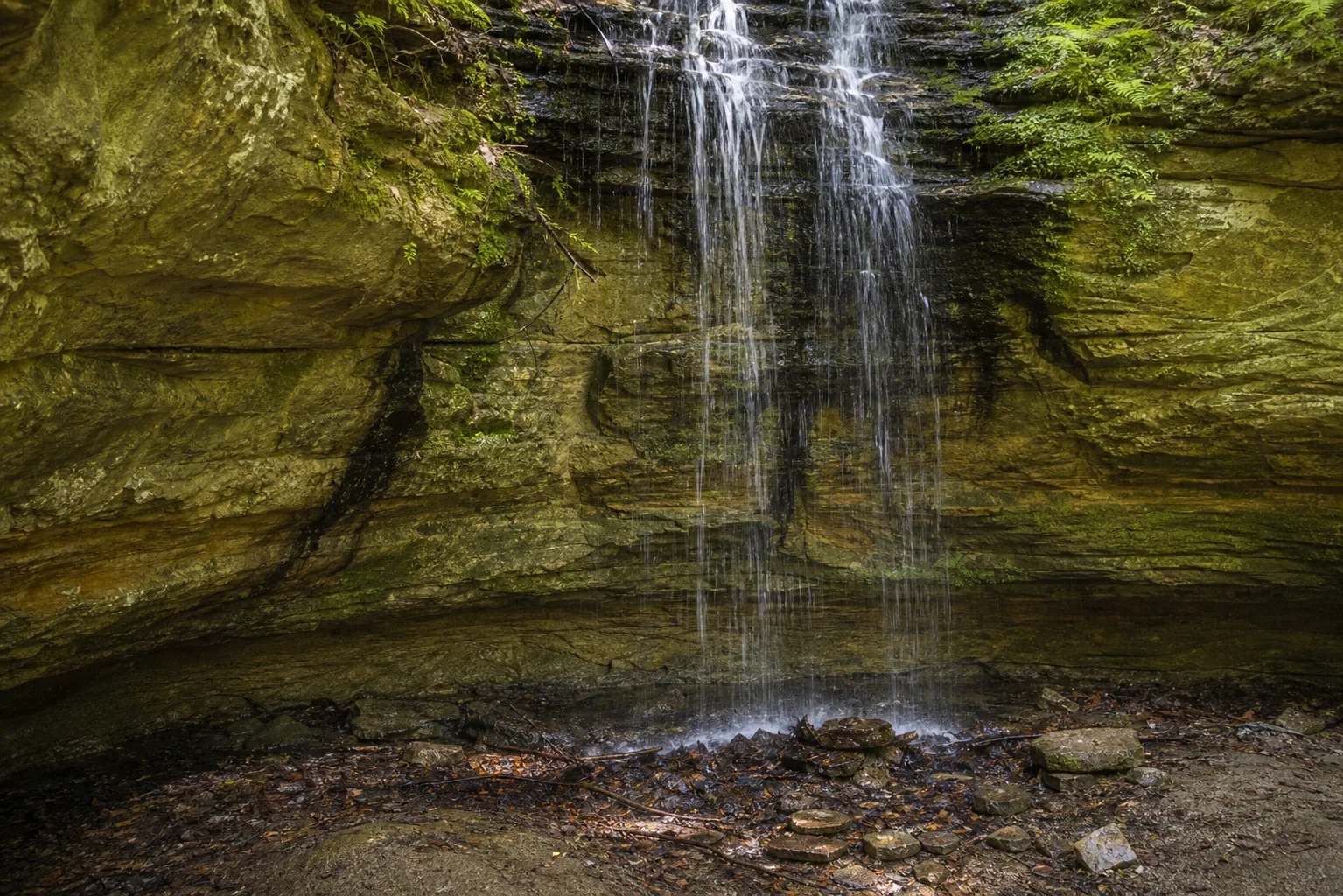
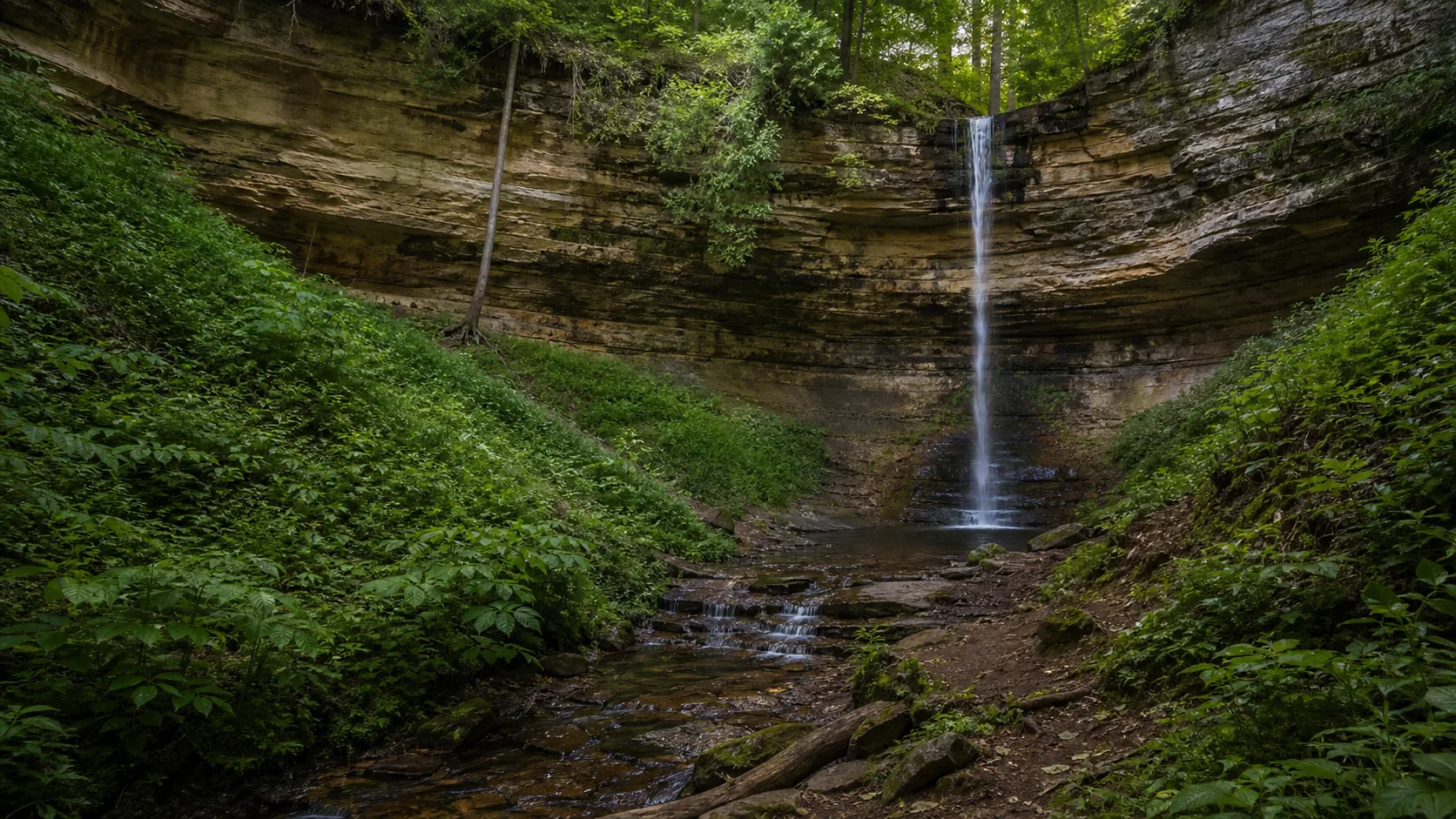
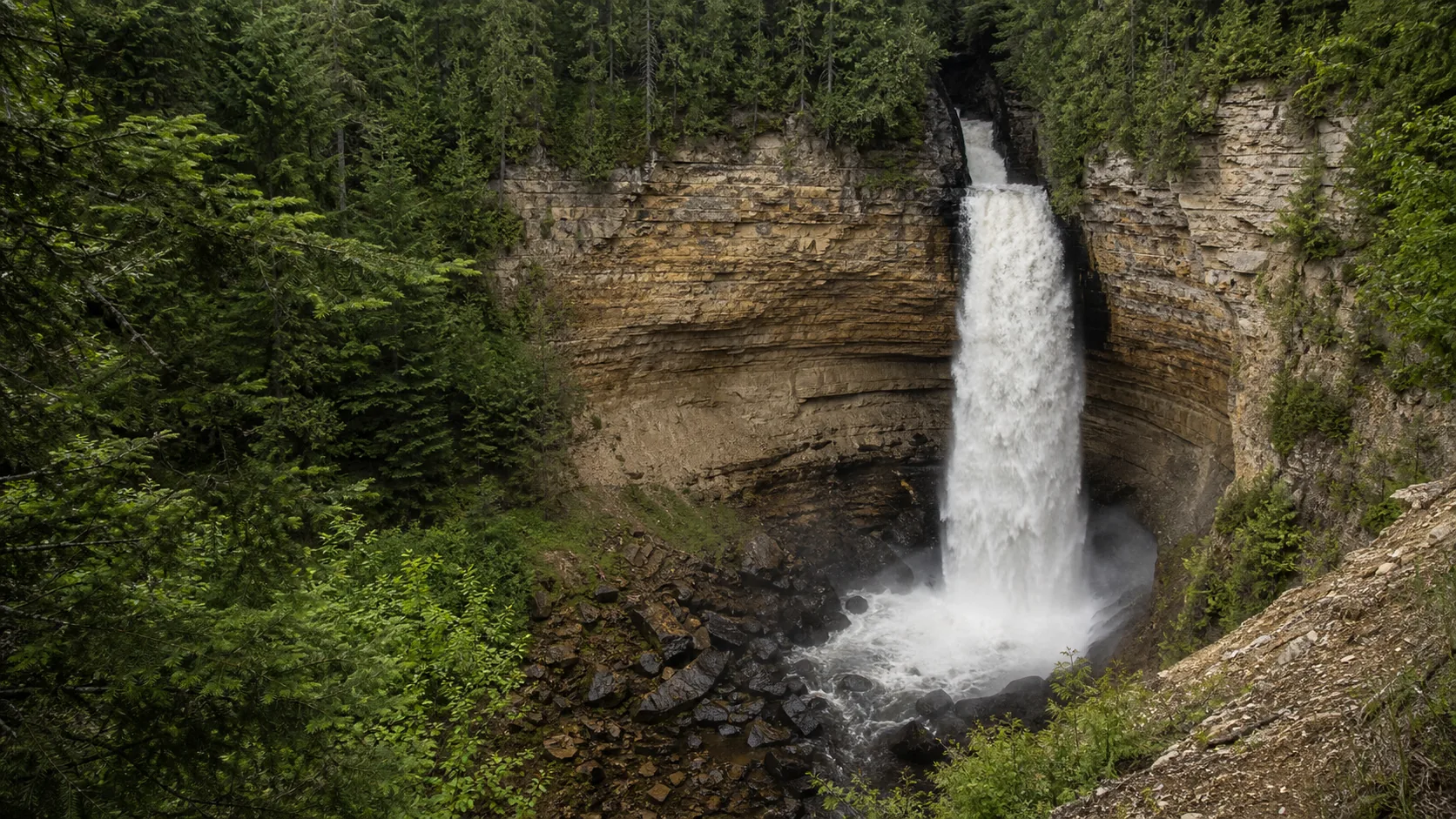
Tannery is the most photographed of the in-town Munising trio because the trail is short and the alcove is tall. The frames here are the front-on composition from the deck, the alcove-undercut detail, and the rim view from the upper trail.

Tannery Falls waterfall and surrounding setting
Tannery Falls, hero composition
Tannery Falls wide setting view
Wide setting view
Tannery Falls base and water force
Base and water force
Tannery Falls water and rock detail
Water and rock detail
01Is Tannery Falls flowing right now?

Tannery Creek does not have a published USGS discharge gauge near the falls, so the live flow chip is hidden. Use recent rain on the MQT forecast as the practical signal.

Tannery Creek is not paired with a USGS gauge. Use the NOAA/NWS Marquette (MQT) forecast for recent rain and the Pictured Rocks NPS conditions feed for upstream snowmelt context.

02How long is the walk?

Short. About 0.4 miles round trip from the city-park trailhead to the viewing platform, 15 to 30 minutes typical. Add Memorial Falls on the parallel creek for a 0.7- to 1.0-mile combined visit.

03How do you get there?

From downtown Munising, head south on the H-58 corridor about a half mile to the Tannery Creek trailhead lot. The lot is small; downtown street parking and a 10-minute walk is the overflow plan in peak summer.

04Is there free parking?

Free city-park trailhead lot. Small (a few cars); arrives full on summer weekends after 10 a.m. Downtown Munising street parking is the alternative, with a 10-minute walk in.

05Does it cost money?

Free. Tannery Falls sits inside the city of Munising, not on National Park Service land, so the Pictured Rocks entrance fee does not apply. No state park pass needed.

06Trail variants

Direct walk to the falls 0.4 mi out-and-back, 15 to 30 min, shortest route from the city park trailhead to the viewing area.
Tannery plus Memorial loop 0.7 to 1.0 mi, 30 to 45 min, Memorial Falls sits on a parallel creek a short connector walk away.
Munising in-town waterfall trio about 1.2 mi total walking, 60 to 90 min, Tannery, Memorial, and Munising Falls all reachable on foot from downtown.
Winter ice column visit 0.4 mi if the trail is broken in, 30 to 60 min, microspikes recommended; snowshoes useful after fresh snow.

Detailed maps and recent reviews: Falls route on AllTrails · Creek route on AllTrails

07Can you swim?

No. The plunge pool is shallow with submerged rock, and the wet sandstone ledges around it are slick year-round. For Lake Superior swimming, Munising Tourist Park (1 mi) and Sand Point Beach (3 mi) are the closest options.

08Are dogs allowed?

Yes, on leash. The trail is short and runs from city streets, so leashes also keep dogs out of the creek and away from the platform edge.

09Is it accessible?

Not accessible. The trail is short but has roots, soft footing, and wooden stairs near the viewing platform. No step-free overlook at the falls itself.

Field notes

Tannery at a glance.

40-foot plunge into a sandstone alcove on Tannery Creek, Cambrian Munising Formation, walkable from downtown Munising, free, year-round. Sourced from the City of Munising tourism page and Pure Michigan.

Height 40 ft USGS 3DEP
Type Plunge (single tier) USGS
County Alger Munising, MI
Managed by City of Munising City of Munising
Water source Tannery Creek USGS
Elevation 778 ft USGS NED
Park area Not listed City of Munising
Hours City park trail; dawn to dusk in practice, winter access varies with snow and ice City of Munising
When to visit

Late April to May for runoff, late January for the ice.

Spring snowmelt runs the falls hardest. Late January through mid-February freezes the alcove into an ice column when the winter holds below freezing for a stretch. Summer flow is steady but lower; fall color in early October.

PEAK FLOW

Peak flowLate Apr through May (snowmelt) and after summer thunderstorms
Ice / low flowLate Jan through mid-Feb
Most crowdedWeekends and midday
Best photosSunrise or weekdays

Live water context

Discharge data -- Tannery Creek does not have a published USGS discharge gauge near the falls, so the live flow chip is hidden. Use recent rain on the MQT forecast as the practical signal.

Why is it called Tannery Falls?

The falls is named for a 19th-century leather tannery that operated near the creek during the Upper Peninsula's first industrial boom, when Munising grew up around sawmills, a charcoal-iron furnace, and small leather works that processed hides for the logging camps and lumber schooners moving across Lake Superior. The tannery itself is long gone; the name on the creek, the trail, and the falls is the visible piece of that industrial era. The falls also carries a secondary, more formal name: Rudy M. Olson Memorial Falls, dedicated to a Munising civic figure, and you will sometimes see it labeled Olson Falls on Lake Superior Circle Tour signage. Both names point at the same 40-foot plunge on Tannery Creek.

What else to do at City of Munising park trail

Tannery Falls is not in a state park or national park. The trailhead is a small city of Munising park lot at the edge of town, and the falls itself sits inside the city limits a few minutes' walk from the downtown grid. That makes it one of the very few Upper Peninsula waterfalls you can visit on foot from a hotel room. The lot fills fast on summer weekends, but the alternative (parking on a downtown side street and walking 10 minutes) is reasonable and often faster than circling for a space.

  • Tannery Creek trail. A short, well-graded 0.4-mile out-and-back from the city-park trailhead to the falls viewing area. Some roots, a few wooden stairs near the platform, otherwise easy footing.
  • Walking distance from downtown. The trailhead sits roughly a half mile from the Elm Avenue / H-58 corridor; about 10 minutes on foot from most downtown lodging and restaurants.
  • Tannery, Memorial, Munising trio. All three Munising in-town falls are reachable on foot. Memorial Falls is the closest pair (parallel creek, short connector); Munising Falls is the third stop, north of downtown.
  • No Pictured Rocks pass needed. Tannery Falls sits inside the city of Munising, not on National Park Service land, so the Pictured Rocks entrance fee does not apply here.

Why it looks this way

Tannery Falls drops over the same Munising Formation sandstone that produces every other waterfall in the Pictured Rocks belt, from Munising Falls a mile north to Miners Falls inside the national lakeshore. The Munising Formation is a Cambrian sandstone laid down roughly 500 million years ago in a shallow tropical sea that covered what is now the Upper Peninsula. It is a soft, friable rock; the creek wears it back about as fast as any caprock-style waterfall in the eastern US, which is why the falls sits in a small amphitheater rather than a sharp ledge. The 40-foot drop is the local relief between the upland sandstone and the lower valley fill where Tannery Creek runs toward the South Bay of Lake Superior.
Field guide deep dive

What a sidewalk walk to a Pictured Rocks waterfall actually looks like.

Cambrian sandstone, the Munising in-town trio, why no Pictured Rocks pass applies, and a 90-minute Munising waterfall day. Skim the headers, read what you need.

How Tannery Falls formed

Tannery Falls is a textbook example of the Pictured Rocks waterfall mechanic. Tannery Creek runs across the upland sandstone, hits a contact with the softer rock below, and the lip retreats upstream into a small amphitheater the way every other waterfall in the Munising belt does. The rock at the lip is the Munising Formation, a Cambrian sandstone laid down roughly 500 million years ago in a shallow tropical sea that covered what is now the Upper Peninsula.

The Munising Formation is famously soft and famously colorful. It is the same sandstone that produces the striped cliffs at Miners Castle a few miles east, the curtain at Munising Falls a mile north, and the dramatic plunge at Miners Falls inside Pictured Rocks National Lakeshore. The 40-foot drop at Tannery is the local relief between the upland surface and the small valley where Tannery Creek runs north toward the South Bay of Lake Superior. The amphitheater behind the curtain is the visible signature of the undercut, exactly the same form you see at Munising Falls; the difference here is scale and setting.

The Munising in-town trio: Tannery, Memorial, and Munising Falls

Munising is unusual because it has three named waterfalls inside the city limits, all reachable on foot. Tannery Falls is the highest of the three at 40 feet. Memorial Falls sits on a parallel creek a short connector walk from the Tannery viewing area; the two are routinely visited together and some local maps treat them as a single “Twin Falls” site. Munising Falls is the third, a 50-foot curtain over the same Munising Formation sandstone, north of downtown and managed by the National Park Service as part of Pictured Rocks National Lakeshore.

The practical day looks like this: park downtown, walk to Tannery and Memorial first (free, city land, no pass), then either walk or drive five minutes to Munising Falls (free to enter, but inside Pictured Rocks boundaries so behavior rules differ). Total walking is roughly 1.2 miles if you do all three on foot. Total visit time is about 60 to 90 minutes. No other Upper Peninsula town has this density of accessible waterfalls.

Walkable from downtown Munising

Tannery Falls is one of a handful of waterfalls in the eastern US where the question is not how far to drive but which sidewalk to follow. The trailhead is a small city-park lot at the edge of town, and the falls itself sits inside the Munising city limits a few minutes' walk from the Elm Avenue / H-58 corridor. From most downtown lodging the walk is about 10 minutes. The trail itself is roughly 0.2 miles each way from the trailhead to the viewing platform, so the total walking distance from a downtown hotel to the base of a 40-foot waterfall is well under a mile.

That changes how visitors plan the stop. You do not need a car day; you do not need a Pictured Rocks pass for this falls; you do not need a backcountry hiking window. A morning coffee in town, a 30-minute walk to the falls, and you are back on the H-58 corridor in time for the Pictured Rocks boat cruise or a drive to Miners Falls. The city-park lot is the limiting factor on busy summer weekends; the workaround is to park on a downtown street and walk in.

A Pictured Rocks waterfall day from Munising

The natural day-trip pattern from Munising is to chain the in-town falls with one or two backcountry stops along the Pictured Rocks corridor. A typical 4 to 5 hour itinerary: start with Tannery and Memorial Falls on foot from downtown (45 minutes), walk or drive to Munising Falls for the 50-foot curtain inside the national lakeshore boundary (30 minutes including the short paved approach), then drive 10 minutes east on H-58 to the Miners Falls trailhead for the largest waterfall on the route (90 minutes for the 1.2-mile round trip plus the overlook).

If you have a fifth stop, drive about 12 miles east toward Au Train and stop at Scott Falls, a 20-foot roadside curtain that is the easiest of the cluster and a good last-light photo. All five waterfalls drop over the same Cambrian sandstone sequence. None of them require a strenuous hike, and none of them cost more than the Pictured Rocks entrance fee at the two NPS-managed stops.

The tannery itself: what was here in the 1880s

Munising's name on the creek is a small piece of Upper Peninsula industrial history. The town grew up in the late 19th century around the same combination of resources that built every UP port: white pine forests on the upland, iron and copper in the hills inland, and Lake Superior shipping out the South Bay. By the 1880s and 1890s Munising had sawmills, a charcoal-iron furnace, and small leather-working operations that processed hides for the logging camps, the lake schooners, and the local market.

The tannery that gave the creek and the falls their name was one of those small operations. Tanning leather in the period meant hemlock-bark vats, hide pits, and a steady supply of clean running water for rinsing and processing; the lower stretch of Tannery Creek met all three requirements. The tannery is gone now (the industry collapsed across the eastern hemlock belt as the bark supply ran out in the early 20th century) and the creek runs through second-growth hardwoods rather than the cutover landscape of the period. The name is the last visible piece of that economy, the same way Mill Creek and Forge Creek run all over the upper Midwest.

Practical photography at Tannery Falls

Tannery Falls is a shaded amphitheater photo rather than a long-distance landscape. The lower viewing platform gives the head-on shot of the 40-foot drop with the sandstone walls visible on either side. A short walk back up the trail opens an angled three-quarter view from the upper side. Both work; neither needs anything more than a standard zoom and a steady hand.

The amphitheater is in shade through most of the day, which is forgiving for shutter speed and contrast. Late morning gives the most even light. Avoid direct midday sun in summer; the contrast between the white water and the dark wet rock walls becomes harder to handle than at exposed falls like Scott Falls. Fall color in the surrounding maple-and-birch hardwoods peaks in the last week of September through the second week of October; spring runoff in late April and May gives the most water but the muddiest trail. Winter is the strongest specialist window: in cold years the curtain forms a partial-to-full ice column from late January through mid-February, audible underneath, and the trail is walkable with microspikes.

Map and route

Half a mile from downtown Munising on the city park trail.

From downtown Munising, head south on the H-58 corridor about a half mile to the Tannery Creek trailhead lot. The lot is small; downtown street parking and a 10-minute walk is the overflow plan in peak summer.

Photography and weddings

East-facing alcove, golden hour through the gap, no permit needed for personal photography.

There are essentially two working positions at Tannery Falls. The lower viewing area from the platform gives the head-on 40-foot plunge shot. A short scramble back up the trail opens an angled three-quarter view from the upper side that includes the sandstone amphitheater. The amphitheater is small and the rock is soft, so do not improvise side angles from the wet ledges around the pool.

The amphitheater is in shade through most of the day, which is forgiving for both highlights and the dark wet sandstone behind the curtain. Late morning gives the most even light. Avoid direct midday sun in summer; the contrast between the white water and the dark rock walls becomes harder to handle than at exposed falls like Scott Falls or Munising Falls.

Personal photography is fine from the public viewing area. Drones are not appropriate over the small amphitheater and are prohibited over adjacent Pictured Rocks National Lakeshore land; check City of Munising rules before any commercial shoot.

Permits

Weddings and engagements

Tannery Falls is too small and too narrow for a ceremony but works for short engagement or elopement portraits when the platform is uncrowded. Late September and early October fall color in the surrounding hardwoods is the strongest window.

Check with the City of Munising for any commercial photography or permitted-use questions. The Pictured Rocks NPS permit system does not apply to Tannery Falls because it sits inside the city.

Keep the setup small, do not block the platform, and have a backup at Scott Falls or Munising Falls for crowds or weather.

Nearby waterfalls

Four Pictured Rocks stops inside thirty minutes.

Tannery pairs naturally with Munising Falls (the same downtown trio), Miners Falls, Scott Falls on M-28, and the Pictured Rocks Cruises departure point. All four sit on the same Cambrian Munising Formation.

Related questions

More questions visitors ask before walking to Tannery.

Trail length, walkability from downtown, free-entry status, dog policy, the Memorial Falls pairing, and disambiguation from the Tannery Falls in Massachusetts. All entries also index in the FAQ schema for AI answer engines.

01How tall is Tannery Falls?

Tannery Falls is a 40-foot single-tier plunge on Tannery Creek in the city of Munising, Michigan. The falls is also recorded as Rudy M. Olson Memorial Falls and is sometimes labeled Olson Falls on Lake Superior Circle Tour signage.

02Where is Tannery Falls?

Tannery Falls is in Munising, Alger County, in Michigan's Upper Peninsula, inside the Pictured Rocks waterfall belt. The trailhead is a small city-park lot a short walk from downtown Munising. It is not on National Park Service land, so no Pictured Rocks entrance fee applies.

03Is Tannery Falls walkable from downtown Munising?

Yes. The trailhead sits roughly a half mile from the Elm Avenue / H-58 downtown corridor, about a 10-minute walk from most lodging. The trail itself is about 0.2 miles each way from the lot to the viewing platform, so the full downtown-to-falls walk is well under a mile.

04Is Tannery Falls free to visit?

Yes. Tannery Falls sits inside the city of Munising, not on National Park Service land, so the Pictured Rocks entrance fee does not apply. The city-park trailhead lot and the trail are free.

05What is the best time to visit Tannery Falls?

Late April through May for the loudest spring runoff, and late January through mid-February when the curtain forms a partial-to-full ice column. Late September through the first half of October is the best fall-color window in the surrounding maple-and-birch hardwoods.

06Is Tannery Falls open in winter?

Yes, the trail is open year-round, but it is not plowed. Microspikes are useful from December through March; snowshoes help after fresh snow. In cold winters the curtain forms an ice column, audible underneath, from late January through mid-February.

07Is Tannery Falls worth visiting?

Yes, especially as part of the Munising in-town trio with Memorial Falls and Munising Falls, or as a quick stop before driving to Miners Falls inside Pictured Rocks National Lakeshore. It is short, free, walkable from downtown, and drops over the same Cambrian sandstone that produces every other Pictured Rocks waterfall.

Sources and data

Where the Tannery Falls guide gets its facts.

Trail and parking from the City of Munising and the Munising Visitors Bureau. Geology from the USGS Geolex Munising Formation entry. Walkable-from-downtown framing cross-checked against the Lake Superior Circle Tour reference.

City of Munising: City of Munising park trail cityofmunising.org
Access, parking, and permit rules: cityofmunising.org
Pictured Rocks National Lakeshore: Geology of the Munising Formation sandstone: Munising bedrock nps.gov
NOAA/NWS Marquette forecast grid MQT/179,66 noaa.gov
USGS National Elevation Dataset 3DEP
Google Maps: embedded map and directions maps.google.com
Google Places: nearby restaurants and hotels places API
Wikipedia: Tannery Falls (Munising, Michigan) en.wikipedia.org
Lake Superior Circle Tour: Olson/Tannery Falls Trail lakesuperiorcircletour.info
City of Munising cityofmunising.org
Pictured Rocks National Lakeshore nps.gov
Wikimedia Commons: Tannery Falls image category commons.wikimedia.org
UP Travel: Tannery Falls listing uptravel.com
Fact checks
Identity audit: height (40 ft), creek (Tannery Creek), city (Munising), and alternate name (Rudy M. Olson Memorial Falls) cross-checked against Wikipedia and the Lake Superior Circle Tour trail description.
Geology audit: Munising Formation sandstone identification matches the Pictured Rocks National Lakeshore geology page and the broader Cambrian sandstone sequence that produces the falls in the Munising belt.
Access audit: Tannery Falls sits inside the city of Munising rather than on NPS land; no Pictured Rocks entrance fee or NPS permit applies to this falls.
Photo audit: AI-original assets are grounded in the local Wikimedia Commons and field-reference image board for Tannery Falls; no Massachusetts Tannery Falls (Savoy) images are used here.
Flow audit: Tannery Creek has no published USGS gauge near the falls, so the live flow chip is intentionally hidden.
Corrections: [email protected]