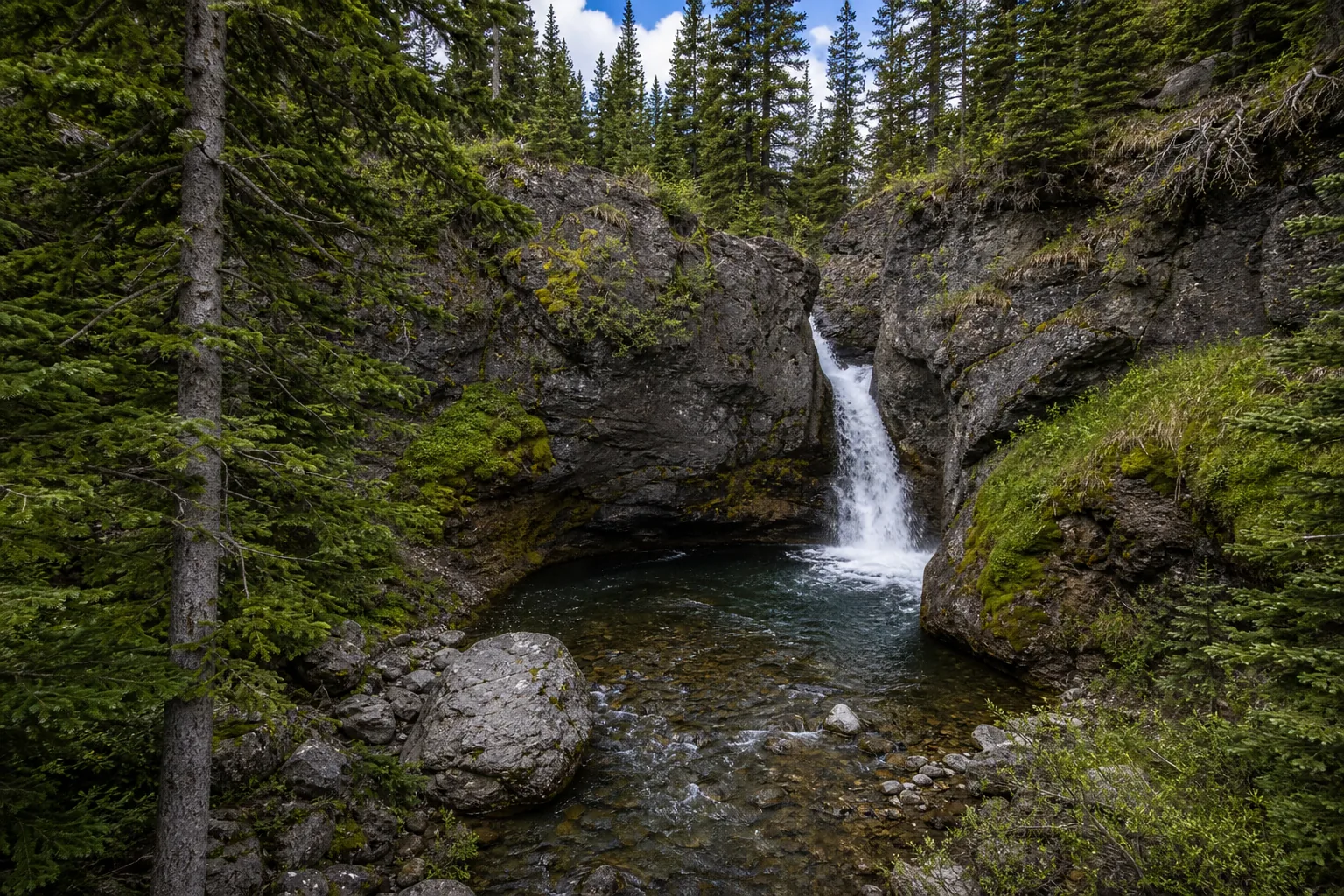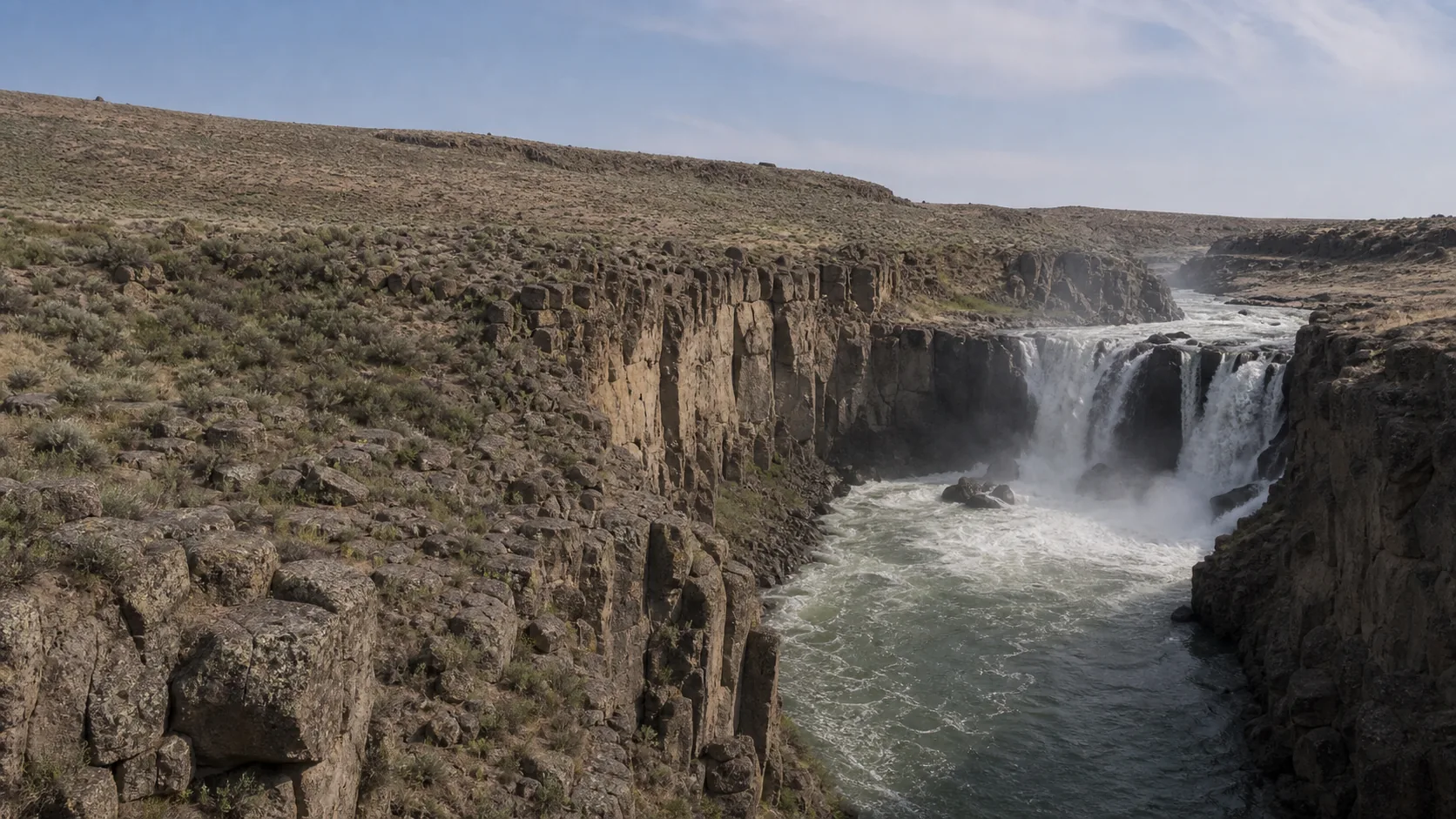
Moose Falls plunging 30 feet over volcanic rock on Crawfish Creek just inside Yellowstone's South Entrance
Teton County, WY

Moose Falls

Moose Falls is a 30-foot plunge on Crawfish Creek just over a mile inside Yellowstone's South Entrance, where the creek drops off a lip of Yellowstone Caldera rhyolite a few yards from the road. The walk from the pullout to the brink is short enough that most visitors miss it on the drive in from Grand Teton, which is exactly why it stays quiet.

Last verified May 12, 2026 Visited Desk-verified May 2026 7 sources checked
Trail 0.1 mi 0.2 mi extended
Time 5-20 min Easy
Best season Late May through early October Late May through June (snowmelt)
Parking Roadside pullout, no fee beyond park entry; the entrance pass covers parking Yellowstone National Park
Quick answer

Is Moose Falls worth visiting?

Yes, if you are already driving the South Entrance corridor between Grand Teton and the Old Faithful side of Yellowstone. The pullout is roadside and the walk to the brink is under a minute, so the time cost is essentially the cost of slowing down. The best window is late May through early October, when the South Entrance Road is open to wheeled vehicles. Yellowstone charges $35 per private vehicle for a 7-day pass; that one fee also covers Lewis Falls 7.6 miles up the same road and the rest of the park.

  • 30-ft plunge on Crawfish Creek
  • Roadside pullout, very short walk
  • Best window: late May to early October
  • Yellowstone fee: $35 per vehicle / 7 days
  • Pair with Lewis Falls up the road
  • South Entrance closes in winter
Last verified May 12, 2026 Visited Desk-verified May 2026 7 sources checked
Distance 0.1 mi 0.2 mi extended
Round trip 5-20 min Essentially roadside; a short, level path from the pullout to the brink and base
Difficulty Easy Essentially roadside; a short, level path from the pullout to the brink and base
Location Teton County, WY Yellowstone National Park
Parking Roadside pullout, no fee beyond park entry; the entrance pass covers parking NPS
Transit No fixed-route transit Private vehicle only; nearest commercial airport is Jackson Hole (JAC) · 0 ft
Drive 58 mi 75 min from downtown
Best season Late May through early October Late May through June (snowmelt)
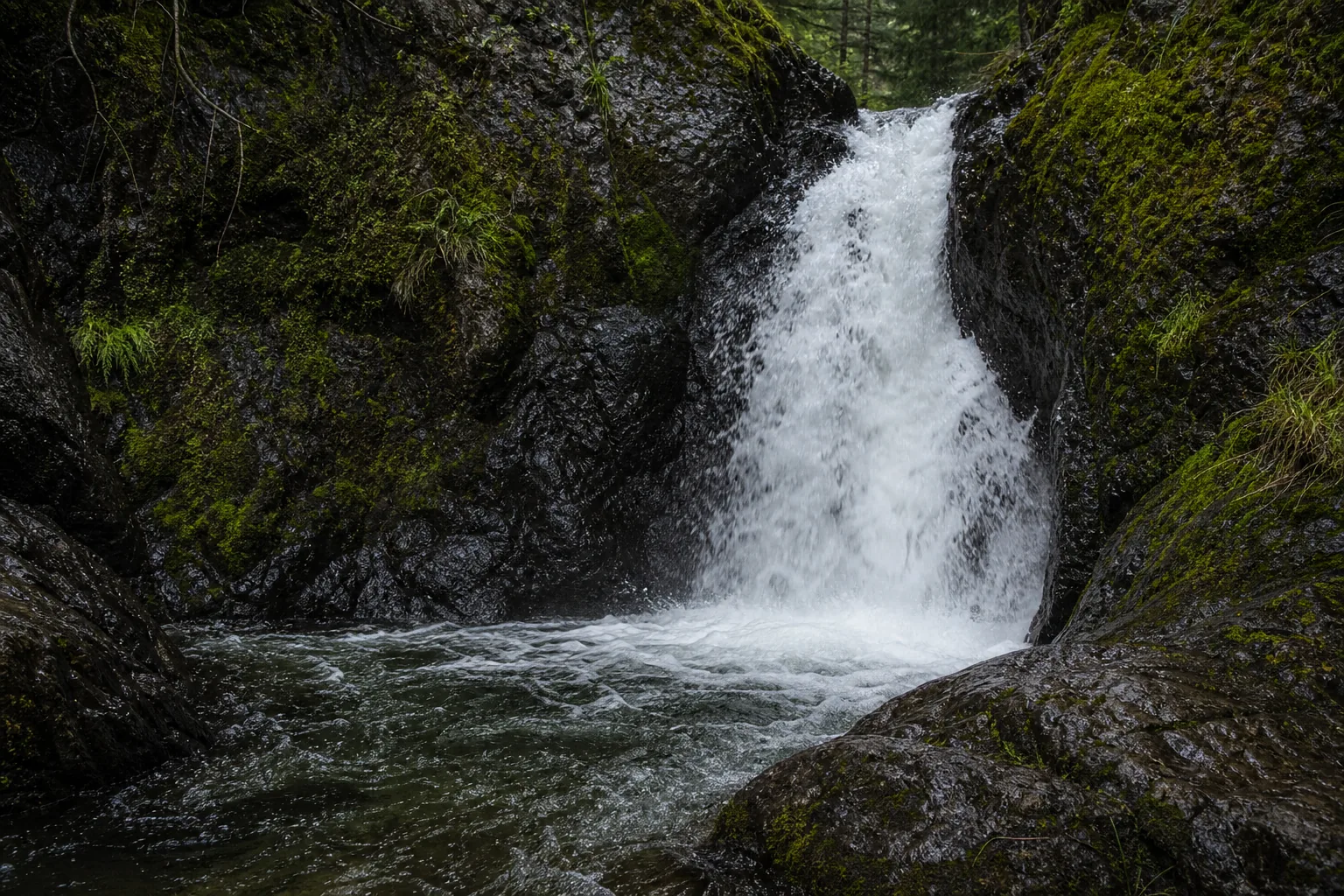
Moose Falls base and plunge pool, looking up at the 30-foot drop
Photo guide

Three composed frames on a 30-foot Yellowstone roadside.

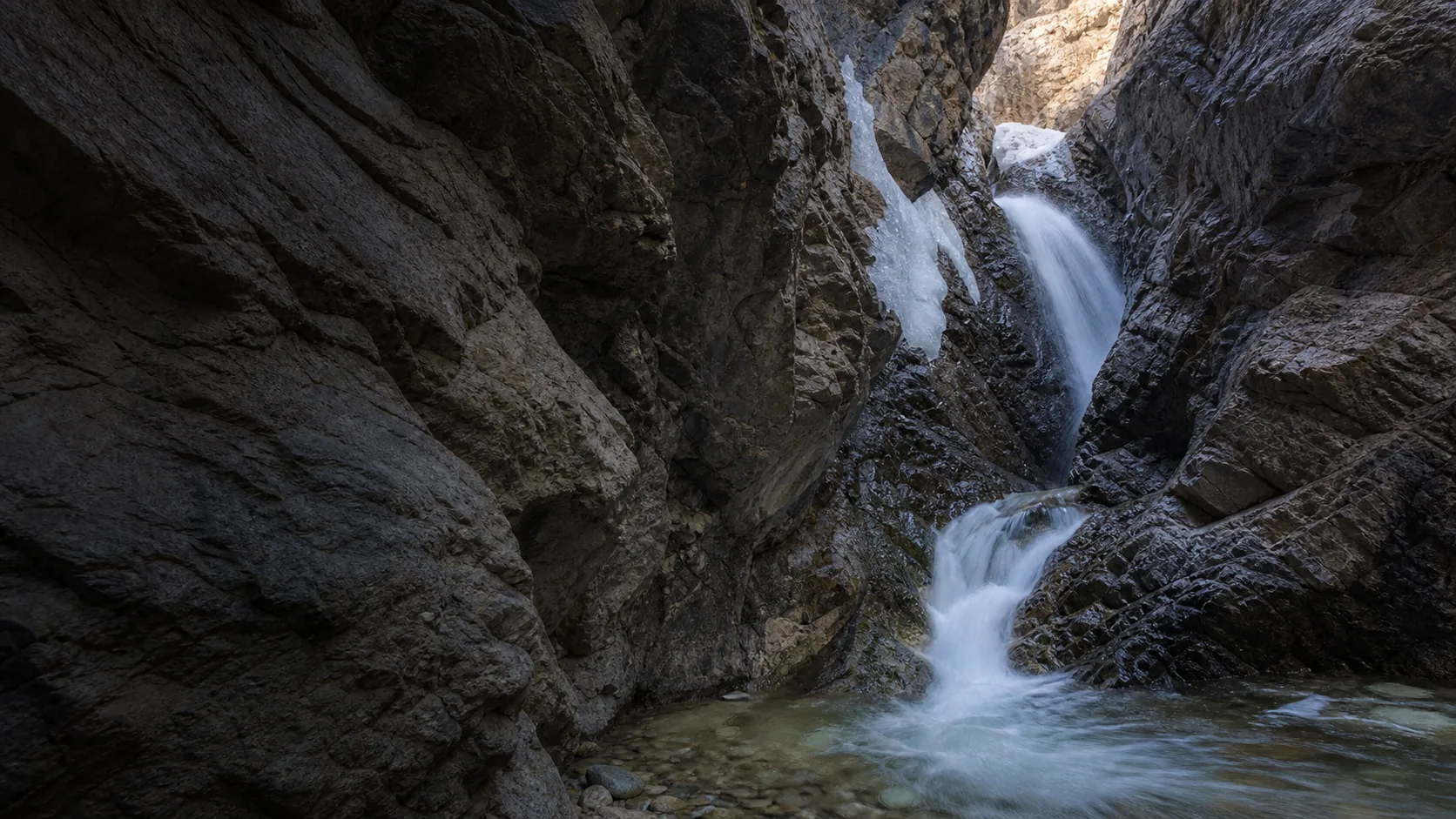
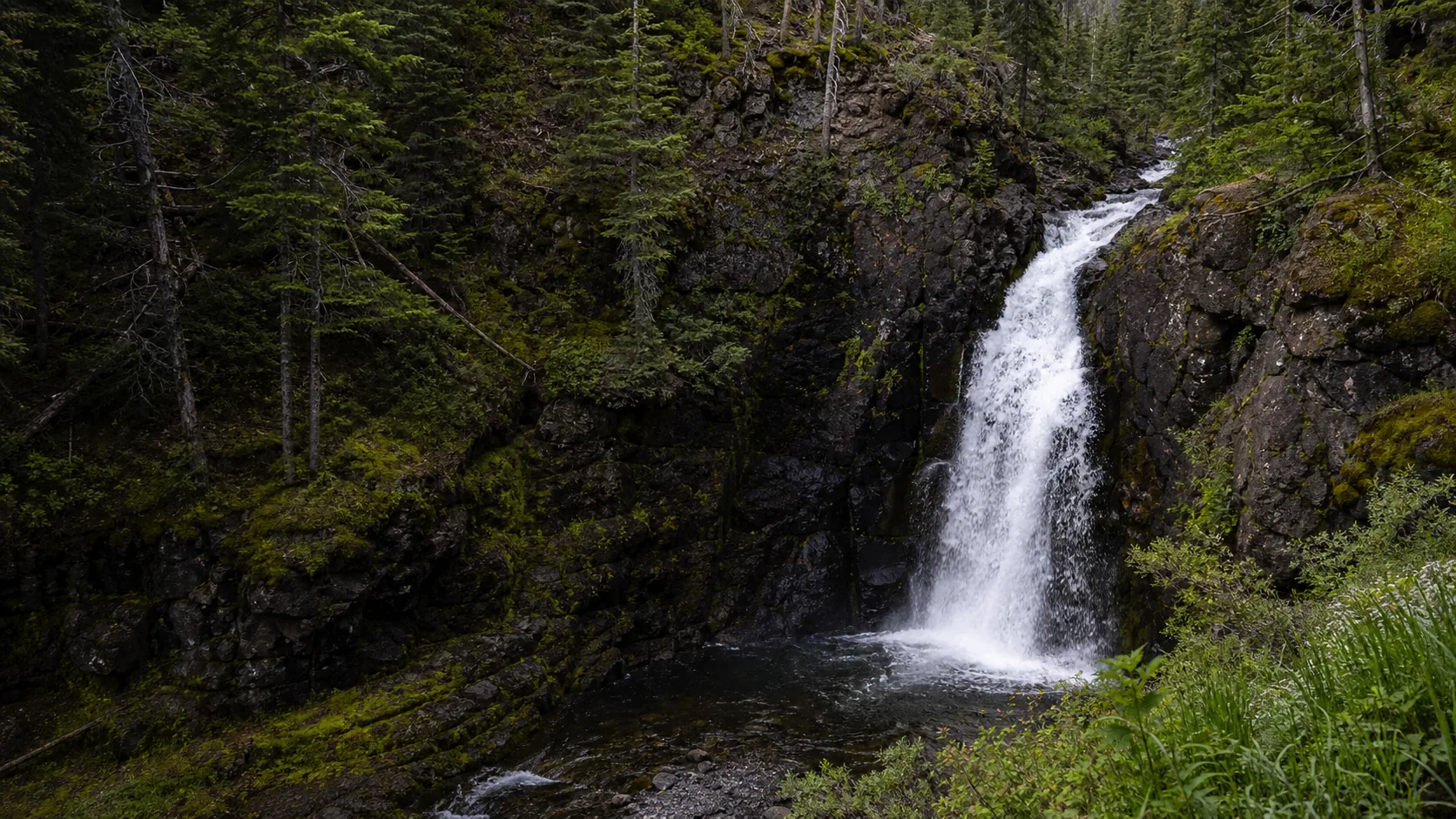
Most visitors miss this one entirely. The frames here show the rhyolite lip from the brink, the curtain from the base, and the lodgepole-framed wide composition from the trail step.

Moose Falls plunging 30 feet over volcanic rock on Crawfish Creek just inside Yellowstone's South Entrance
Moose Falls, hero composition
Wide view of Moose Falls and the surrounding lodgepole pine forest on Crawfish Creek
Wide setting view of Crawfish Creek dropping over the rhyolite lip
Moose Falls plunge pool and base view with whitewater spilling over volcanic ledges
Base and plunge pool, looking up at the 30-foot drop
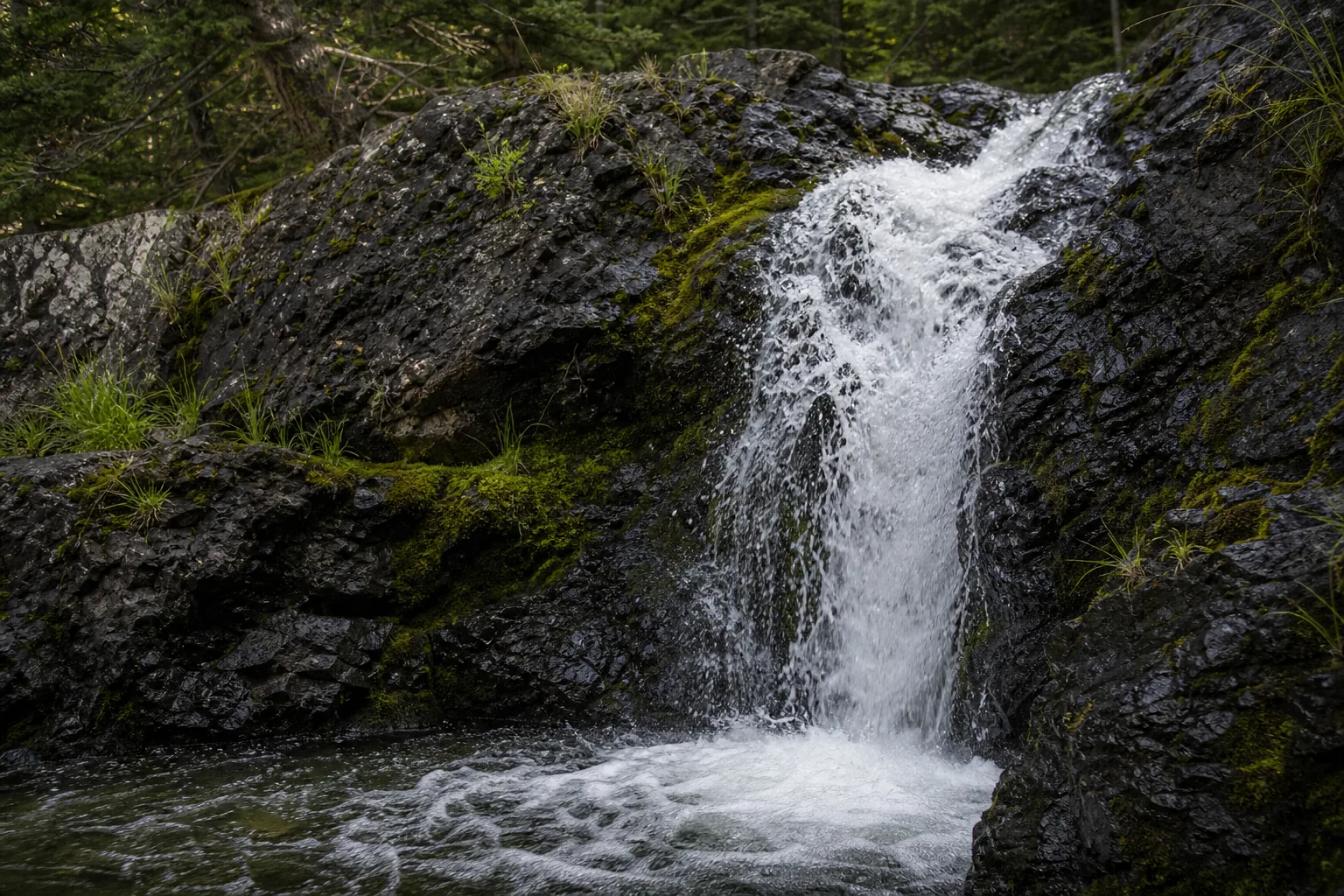
Close-up of water and rhyolite tuff at the lip of Moose Falls
Water-and-rock detail at the lip where the creek meets the volcanic tuff
01Is Moose Falls flowing right now?

This guide does not currently pair Moose Falls with a verified real-time USGS discharge gauge, so the flow chip is intentionally hidden.

Crawfish Creek has no dedicated USGS discharge gauge near the falls. Use the seasonal pattern instead: peak flow lands in late May and June with snowmelt, the creek runs steady through July and August, and the lip thins to a clear single-channel curtain by September.

02How long is the walk?

The walk from the pullout to the brink is roughly 100 feet on a short use-path. A second short scramble drops you to a base view, about 0.1 mile round trip from the car. Most visitors are back to the road in 10 to 15 minutes.

03How do you get there?

From the Yellowstone South Entrance station, drive 1.2 miles north on the South Entrance Road (US-89/191/287). Just after the bridge over Crawfish Creek, look for a small unsigned pullout on the east side of the road. The brink view is a short walk upstream.

04Is there free parking?

Roadside pullout with space for a handful of vehicles. The pullout is included in your Yellowstone entrance pass; there is no separate parking fee. Arrive before mid-morning in July and August or at dusk if you want the spot to yourself.

05Does it cost money?

Yellowstone charges $35 per private vehicle for a 7-day pass, $30 for a motorcycle, and $20 per person on foot or bike. America the Beautiful and senior/access passes are accepted. The $35 vehicle pass also covers Grand Teton if purchased as a joint pass.

06Trail variants

Roadside pullout to brink 0.05 mi, 5 min, park at the small pullout just past the Crawfish Creek bridge and walk a few yards upstream to the top of the drop.
Brink and base loop 0.1 mi out-and-back, 10-15 min, drop down the short use-path to the plunge pool view and back; uneven footing on damp rock.
Moose Falls plus Lewis Falls drive itinerary, 45-60 min, pair with Lewis Falls 7.6 miles north on US-89/191 for two roadside Yellowstone waterfalls in one stop.
South Entrance corridor day drive itinerary, 2-3 hr, Moose Falls, Lewis Falls, Lewis Lake overlook, and Lewis River Canyon on the same stretch of road.

Detailed maps and recent reviews: Falls route on AllTrails · Creek route on AllTrails

07Can you swim?

No. Yellowstone does not allow swimming in any thermal-influenced water, and the plunge pool at Moose Falls sits below upstream thermal seeps. The pool also has submerged volcanic rock and an unprotected lip. Treat it as a look-only stop.

08Are dogs allowed?

No, not at the brink. Yellowstone pet rules allow leashed dogs only within 100 feet of roads, parking areas, and campgrounds. Dogs are prohibited on all trails, off-road, and in the backcountry, which includes the use-path from the Moose Falls pullout down to the falls.

09Is it accessible?

There is no paved or formally accessible viewpoint at Moose Falls. The pullout itself is flat gravel; the brink and base views require walking on uneven natural surface.

Field notes

Moose Falls at a glance.

30-foot plunge over Lava Creek Tuff caprock from the 631,000-year-old Yellowstone Caldera eruption, just inside the South Entrance, free with the $35 NP pass. Sourced from the NPS Yellowstone falls page and the USGS Yellowstone Volcano Observatory.

Height 30 ft USGS 3DEP
Type Plunge (single tier) USGS
Rock Yellowstone Caldera rhyolite (Lava Creek Tuff) USGS Yellowstone Volcano Observatory: Yellowstone Caldera and Lava Creek Tuff
County Teton Teton County, WY
Managed by National Park Service NPS
Water source Crawfish Creek USGS
Elevation 7014 ft USGS NED
Park area 2,219,791 acres NPS
Hours South Entrance open late May through early November; closed in winter except to oversnow travel NPS
When to visit

Late May to early October when the South Entrance is open.

The South Entrance closes in November and reopens in mid-May, when plowing reaches the Crawfish Creek bridge. Crawfish Creek runs strongest in May and June, drops through July, and turns to a trickle by September.

PEAK FLOW

Peak flowLate May through June (snowmelt)
Ice / low flowSouth Entrance closes early November
Most crowdedWeekends and midday
Best photosSunrise or weekdays

Live water context

Discharge data -- This guide does not currently pair Moose Falls with a verified real-time USGS discharge gauge, so the flow chip is intentionally hidden.

Why is it called Moose Falls?

Moose Falls is a descriptive English name, given in 1885 by members of an early military survey of Yellowstone after moose were sighted in the meadows along Crawfish Creek. The naming party did not record an Indigenous name for the falls; the creek itself was named for the small crustaceans found in the warmer water below the drop. Both names are now standard on USGS maps and on NPS signage. If you are searching for it, use Moose Falls Yellowstone or Moose Falls Wyoming to disambiguate from the similarly named Moose Falls in Maine and other small drops elsewhere in North America.

What else to do at Yellowstone National Park

Moose Falls sits inside Yellowstone National Park, 2.2 million acres of plateau, geyser basin, river canyon, and lodgepole forest spread across the corners of Wyoming, Montana, and Idaho. The falls is in the park's South Entrance corridor: a 22-mile stretch of US-89/191/287 that climbs north from the boundary toward West Thumb on Yellowstone Lake. The same corridor passes Lewis Falls (a 30-foot drop on the Lewis River, 7.6 miles north of Moose Falls), the Lewis Lake overlook, and the Lewis River Canyon. Grand Teton National Park is 10 miles south of the South Entrance via the John D. Rockefeller, Jr. Memorial Parkway. If you are coming up from Jackson Hole airport (JAC), you are essentially driving the back-to-back-parks route, and Moose Falls is the first Yellowstone waterfall you can reach.

  • Crawfish Creek lip. The creek crosses a welded ledge of Lava Creek Tuff and drops 30 feet in a clean single plunge. The brink is a few yards from the pullout.
  • South Entrance corridor. Moose Falls sits roughly 1.2 miles north of the park's South Entrance station on the road toward West Thumb and Old Faithful, in lodgepole-pine country at about 7,000 feet.
  • Lewis Falls pairing. Lewis Falls, another 30-foot drop, is 7.6 miles north on the same road, with a footbridge view from the highway and a roadside pullout.
  • Heated creek. Crawfish Creek picks up warmth from thermal seeps upstream, which is why the pool below the falls tends to look mistier than the air temperature alone would suggest. It is not a designated thermal feature and is not a swimming destination.

Why it looks this way

Moose Falls drops off a ledge of welded volcanic tuff laid down by the Yellowstone Caldera's most recent climactic eruption about 631,000 years ago. The cap rock is part of the Lava Creek Tuff, a rhyolitic ash-flow sheet that blanketed thousands of square miles when the caldera collapsed and that now forms much of the high plateau through the southern part of the park. Crawfish Creek runs across the tuff in a shallow channel and finds an erosion-resistant lip where the welded layer is most cohesive; the softer fractured rock immediately downstream wears back faster, leaving the clean 30-foot vertical drop you see today. The same volcanic stratigraphy controls the lip of Lewis Falls a few miles north on the Lewis River.
Field guide deep dive

Everything worth knowing about Moose Falls before you go.

How Moose Falls formed

Moose Falls drops off a welded ledge of the Lava Creek Tuff, a rhyolitic ash-flow sheet erupted from the Yellowstone Caldera about 631,000 years ago. The caldera collapse was the most recent of three climactic eruptions in the Yellowstone hotspot's last 2.1 million years, and the tuff sheet it laid down still blankets much of the southern Yellowstone plateau. Crawfish Creek runs across that tuff in a shallow channel and finds a lip where the welded layer is most cohesive.

The mechanic is straightforward: the cap rock at the lip resists abrasion, the softer fractured rock immediately downstream wears back faster, and the result is a clean vertical drop. The 30-foot height has held within the margin of measurement for as long as the falls has been on US maps, which suggests the lip is structurally stable on a human time scale. The same volcanic stratigraphy controls the rim of Lewis Falls 7.6 miles up the road and the upper edges of the Lewis River Canyon. If you stand at the brink and look down, the dark rock under the green plunge pool is the same Lava Creek Tuff you have been driving across since the South Entrance station.

The shortest trail in Yellowstone

The walk from the pullout to the brink is roughly 100 feet on a packed-dirt use-path. There is no signed trailhead, no boardwalk, no railing, and no formal viewpoint. The pullout is a small gravel turnout on the east side of the South Entrance Road just past the Crawfish Creek bridge, and most cars driving north toward Old Faithful do not slow down enough to notice it.

That is the practical reason Moose Falls stays quieter than the better-known waterfalls in the park. The Lower Falls of the Yellowstone in the Grand Canyon section draws thousands of visitors a day in July and August; Moose Falls draws whoever happens to be paying attention to the right side of the road in the first mile and a half north of the entrance. A second short scramble drops you to a base view on the lower right, where you can read the full 30-foot vertical against the volcanic walls on either side. The total visit is 10 to 15 minutes, with no stairs and no real elevation change.

Lewis Falls and the South Entrance corridor

The South Entrance Road climbs 22 miles from the park boundary to West Thumb on Yellowstone Lake, and the most useful way to use Moose Falls is as the first stop on that drive. Lewis Falls, another 30-foot drop on the Lewis River, is 7.6 miles north and visible from a footbridge view on the highway itself. Together the two waterfalls take maybe 30 to 45 minutes of road time including the walks. They sit on the same volcanic stratigraphy, run on roughly the same snowmelt schedule, and bracket the Lewis Lake overlook and the Lewis River Canyon in between.

If you have a full day, the corridor extends naturally to West Thumb Geyser Basin (a small thermal area on the lake at the north end of the road) and then loops out toward Old Faithful on the Grand Loop. If you are short on time, Moose Falls and Lewis Falls together give you the South Entrance experience in under an hour. They are the lowest-friction way to add Yellowstone waterfalls to a trip that is otherwise built around Grand Teton, which is 10 miles south through the John D. Rockefeller, Jr. Memorial Parkway.

Yellowstone fees, hours, and access windows

Yellowstone charges a single park entry fee that covers all roads and overlooks, including the Moose Falls pullout. A 7-day private-vehicle pass is $35, a motorcycle pass is $30, and an individual on foot or bike is $20. An annual Yellowstone pass is $70. America the Beautiful interagency passes ($80 annual, free for active military and US fourth graders, $80 lifetime senior, free access pass) are honored at the South Entrance station. There is no separate fee for parking at the falls.

The South Entrance Road is the access constraint. NPS opens it to wheeled vehicles in mid-May (typically the second Friday) and closes it to wheeled vehicles in early November (typically the first Sunday of the month). Outside that window, the road is open only to authorized oversnow travel, which means guided snowcoach or snowmobile tours from West Yellowstone, Mammoth, or Flagg Ranch. The falls is technically accessible in deep winter, but as a roadside stop it is a late-May-to-early-November feature. Confirm current road status on the NPS Yellowstone roads page before you drive, especially in shoulder season when snow events can close the road on short notice.

Pets, swimming, and the rules that catch visitors out

Yellowstone's pet rules are stricter than most state parks and they catch a lot of visitors off guard. Leashed dogs are permitted only within 100 feet of roads, parking areas, and campgrounds. They are not allowed on any trail, off-road, in the backcountry, or in thermal areas. The pullout itself qualifies as parking, so a leashed dog is fine there, but the short use-path from the pullout down to the brink is technically a trail and pets are not allowed on it. In practice that means one person waits at the car with the dog while the other walks to the brink.

Swimming is also off the table. Crawfish Creek picks up heat from thermal seeps upstream, which is why the pool below the falls looks unusually misty for the air temperature; the park's general rule against entering thermal-influenced water applies here, and the plunge pool has submerged volcanic rock and an unprotected lip. Drones are prohibited park-wide by NPS regulation, and any commercial photography or filming requires a special-use permit. Personal photography from the pullout and the use-path is fine.

Photography practical at the brink and base

The falls faces roughly west across the creek, so morning light leaves it in shadow and afternoon light catches the curtain head-on. The cleanest window for a brink shot is the second half of the afternoon in summer, when sunlight is on the water but not directly on the camera. Overcast skies are forgiving for both the white water and the dark Lava Creek Tuff behind it. Late September and the first week of October add yellow lodgepole and scattered aspen to the frame along Crawfish Creek; that fall color is the most photographed version of the falls.

From the brink, the foreshortened look down the lip and into the green plunge pool reads cleanest with a wider lens (24 to 35 mm equivalent) and a fast enough shutter to keep the lip sharp. From the base, the full vertical with the rhyolite walls on either side reads well with a moderate normal lens (35 to 50 mm) and either a slow shutter on a tripod for silky water or a faster shutter to freeze the spray. Tripods are allowed in non-blocking positions at the pullout and on the use-path. Drones are not. There is no commercial-shoot space at the falls itself, so plan portrait or video sessions for a different Yellowstone location and treat Moose Falls as a fast personal stop on the way.

Map and route

Half a mile inside the South Entrance, the easiest stop in the park.

From the Yellowstone South Entrance station, drive 1.2 miles north on the South Entrance Road (US-89/191/287). Just after the bridge over Crawfish Creek, look for a small unsigned pullout on the east side of the road. The brink view is a short walk upstream.

Photography and weddings

West-facing curtain, afternoon light, no commercial permit for personal photography in Yellowstone.

There are two working positions at Moose Falls. The brink view from the top of the drop gives you a foreshortened look at the lip and the green plunge pool below. The base view from the short use-path on the right side of the creek gives you the full 30-foot vertical and the rhyolite walls on either side. Both are reachable in under five minutes from the pullout.

The falls faces roughly west across the creek, so afternoon and early-evening light catches the curtain straight on; morning leaves the drop in shadow. Overcast light is forgiving on the bright water against the dark volcanic rock. In late September and the first week of October the lodgepole and scattered aspen pick up yellow, which works well with the warm tone of the tuff.

Casual personal photography is fine. Tripods are allowed in non-blocking positions. Commercial or professional shoots in Yellowstone require an NPS commercial-use permit. Drones are prohibited park-wide.

Permits

Weddings and engagements

Moose Falls is not a practical ceremony location. There is no formal viewing area or staging space, the pullout is small, and Yellowstone restricts group gatherings and any non-personal use that interferes with traffic.

Yellowstone requires a special-use permit for wedding ceremonies anywhere in the park. Moose Falls is generally not a permitted ceremony site; check the NPS Yellowstone special-use permit office before planning anything beyond a quiet elopement photo.

If you want a small portrait stop, keep it under five minutes, stay off the lip, do not block the pullout, and have a backup view in case the spot is occupied.

Nearby waterfalls

Three South Entrance corridor stops on the same Lava Creek Tuff.

Moose pairs naturally with Lewis Falls 7.6 miles north on the same road, the Lewis Lake scenic overlook, and (for a separate day) Grand Teton 10 miles south. All three sit on the same Yellowstone-Caldera-related volcanic stratigraphy.

Related questions

More questions visitors ask before driving to Moose Falls.

Hike length (essentially zero), Yellowstone fee, dog policy, winter closure, and disambiguation from the Moose Falls in Wyoming's Wind River Range. All entries also index in the FAQ schema for AI answer engines.

01Where is Moose Falls?

Moose Falls is on Crawfish Creek inside Yellowstone National Park in Teton County, Wyoming, about 1.2 miles north of the park's South Entrance station on the South Entrance Road (US-89/191/287). It is the first waterfall most visitors encounter on the drive north from Grand Teton.

02How tall is Moose Falls?

Moose Falls is a single 30-foot plunge where Crawfish Creek drops off a ledge of welded volcanic tuff. It is one of the smaller named waterfalls in Yellowstone, but the drop is clean and vertical, and it is the easiest waterfall to reach inside the park.

03Do you have to pay to visit Moose Falls?

Yes. Moose Falls is inside Yellowstone National Park, so the standard park entrance fee applies. A 7-day private-vehicle pass is $35, a motorcycle pass is $30, and an individual on foot or bike is $20. America the Beautiful and senior/access passes are accepted at the South Entrance station.

04What is the best time to visit Moose Falls?

Late May through early October. Flow peaks in late May and June on snowmelt, the creek runs steady through July and August, and the lip thins to a clean single channel by September. Late September and the first week of October add yellow lodgepole and aspen color along Crawfish Creek.

05Is Moose Falls open in winter?

Not by car. The South Entrance Road is closed to wheeled vehicles from early November through mid-May, so during winter the falls is reachable only by guided oversnow coach or snowmobile from West Yellowstone or Flagg Ranch. Most visitors plan around the open-road window from late May through early November.

06Is Moose Falls worth visiting?

Yes, if you are already driving the South Entrance corridor between Grand Teton and the rest of Yellowstone. The visit cost is essentially the few minutes it takes to slow down and walk to the brink. It is not a destination in its own right; it is the easiest waterfall to add to a trip you are already taking.

Sources and data

Where the Moose Falls guide gets its facts.

Road-opening calendar and fee structure from the NPS Yellowstone fees and roads pages. Geology from the USGS Yellowstone Volcano Observatory on the Lava Creek Tuff. Etymology from Wikipedia's entry on the 1885 military survey naming.

NPS: Yellowstone National Park nps.gov
Access, parking, and permit rules: nps.gov
USGS Yellowstone Volcano Observatory: Yellowstone Caldera and Lava Creek Tuff: Teton County bedrock usgs.gov
NOAA / NWS Riverton forecast grid RIW 48,169 noaa.gov
USGS National Elevation Dataset 3DEP
Google Maps: embedded map and directions maps.google.com
Google Places: nearby restaurants and hotels places API
NPS Yellowstone: Fees and Passes nps.gov
NPS Yellowstone: Park Roads and Seasonal Status nps.gov
NPS Yellowstone: Pets nps.gov
Wikipedia: Moose Falls (Wyoming) en.wikipedia.org
World of Waterfalls: Moose Falls, Yellowstone world-of-waterfalls.com
Wikimedia Commons: Moose Falls image category commons.wikimedia.org
Fact checks
Height audit: 30-foot plunge confirmed via Wikipedia, World of Waterfalls, Yellowstone Explored, and the OceanLight Yellowstone photo log; all four describe the drop on Crawfish Creek at the same height.
Geology audit: Yellowstone Caldera / Lava Creek Tuff caprock attribution sourced to the USGS Yellowstone Volcano Observatory; specific microstratigraphy of the lip is not over-claimed because no published outcrop study isolates the Moose Falls ledge.
Access audit: South Entrance Road seasonal closure (early November to mid-May for wheeled vehicles), $35 private-vehicle 7-day pass, and the pets-on-trails prohibition were taken from current NPS Yellowstone pages.
Etymology audit: 1885 naming by members of an early military survey is recorded in the Wikipedia entry; no Indigenous name for the falls is recorded in NPS materials, so this guide does not invent one.
Corrections: [email protected]