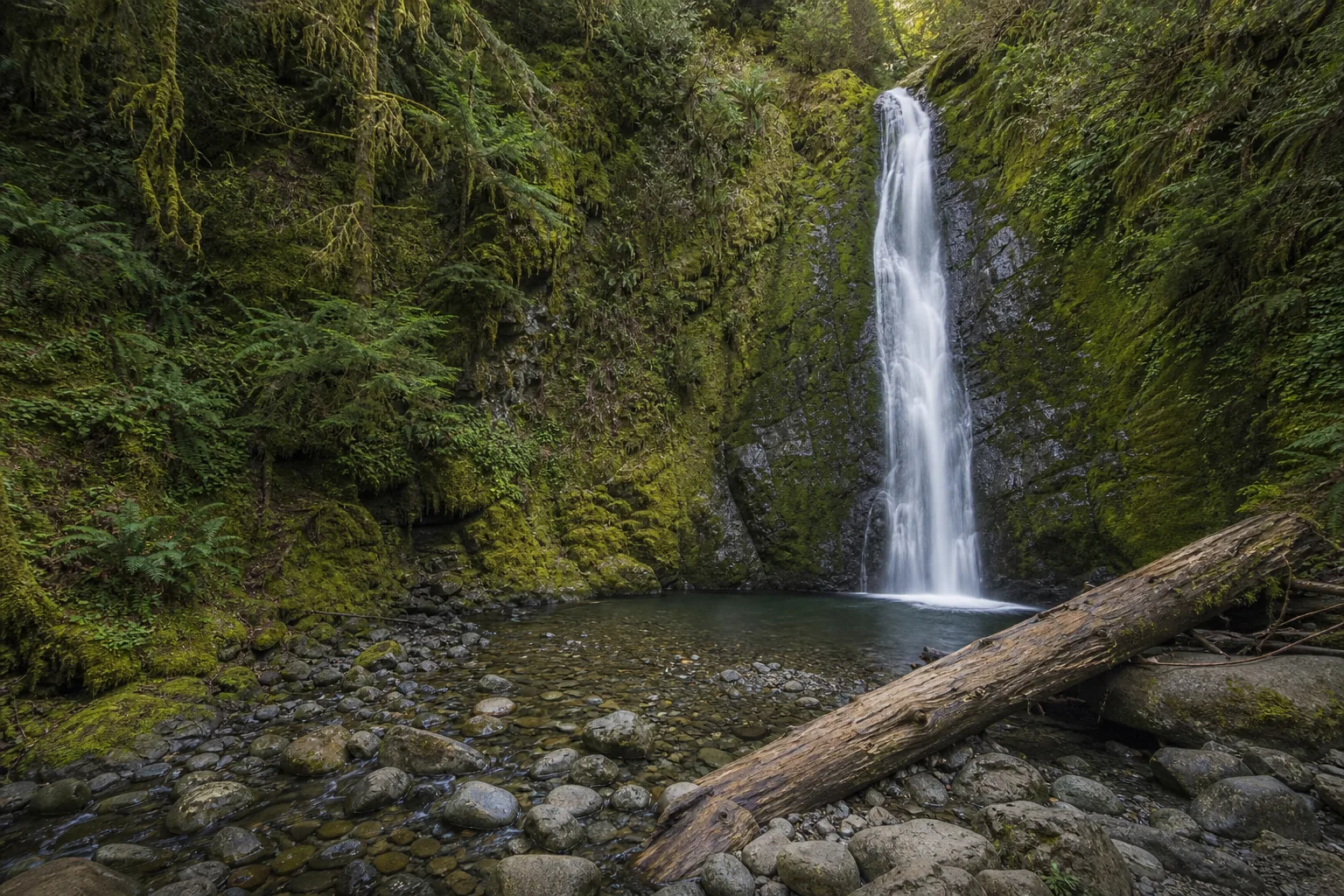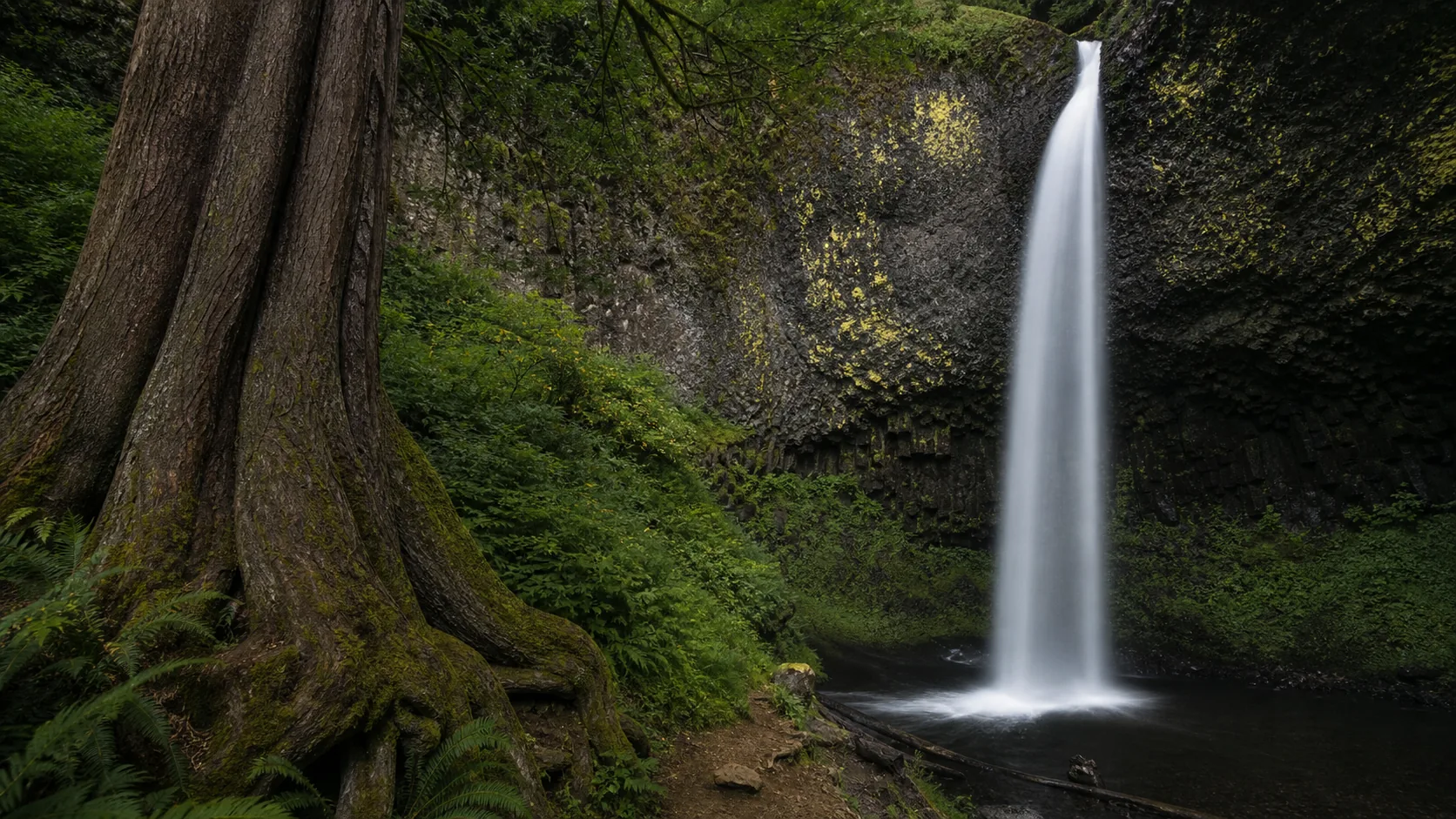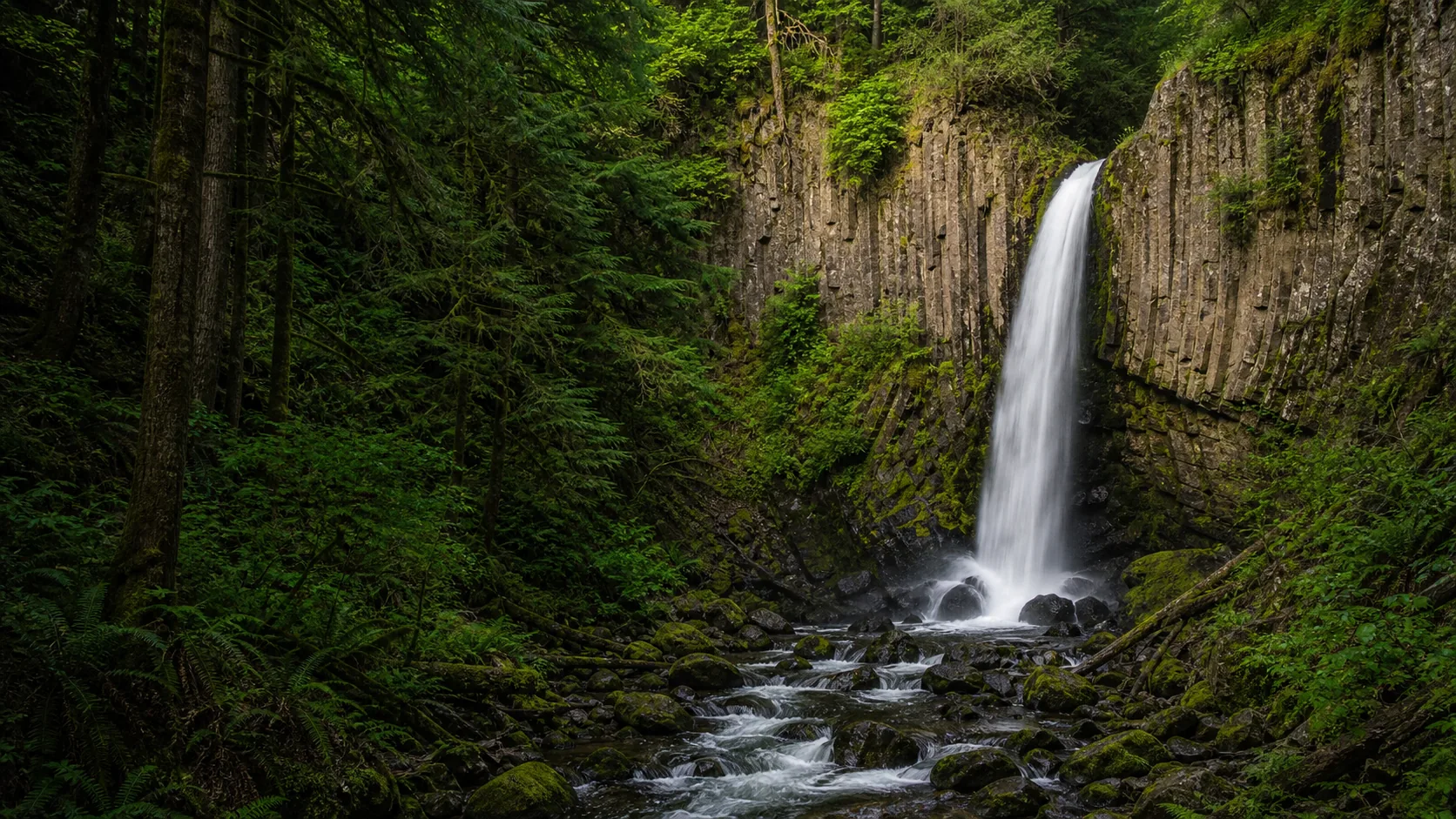
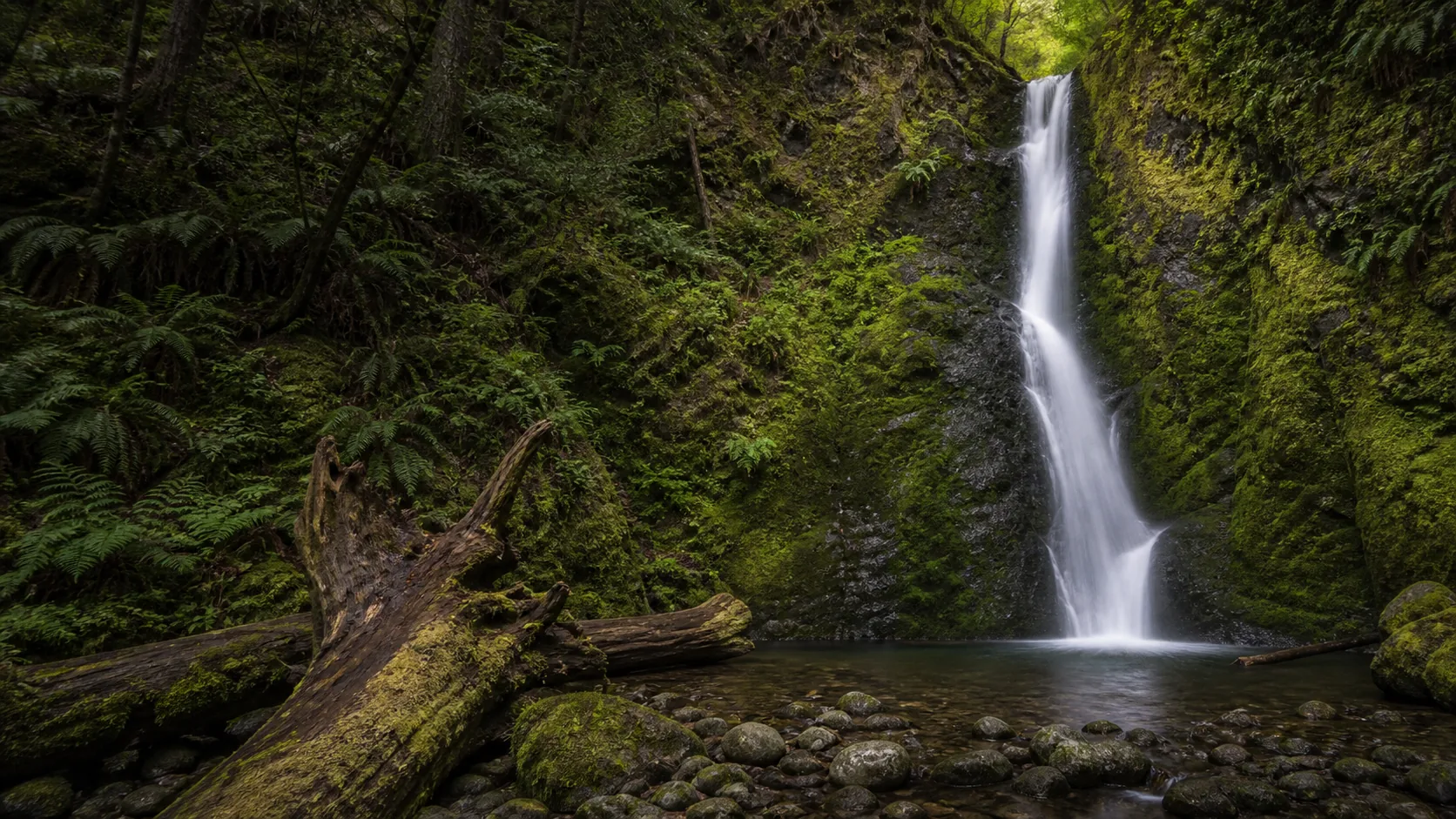
Madison Creek Falls 50-foot horsetail dropping over Crescent Formation basalt in Olympic National Park's Elwha Valley near Port Angeles
Port Angeles, WA

Madison Creek Falls

Madison Creek Falls is a 50-foot horsetail waterfall in the Elwha Valley of Olympic National Park, about 9 miles west of Port Angeles, Washington. A 0.2-mile fully paved, ADA-accessible trail from the Madison Falls Trailhead leads to a wooden viewing porch in a mossy maple-and-cedar grotto, making this one of the most accessible waterfalls in the entire National Park system. Despite the trail sign reading simply Madison Falls, the cascade itself is on Madison Creek a short distance before it joins the Elwha River.

Last verified May 12, 2026 Visited Desk-verified May 2026 8 sources checked
Trail 0.2 mi Round-trip route varies
Time 15-30 min Easy
Best season Year-round; peak in winter rain and spring snowmelt Winter rains & spring snowmelt
Parking Free trailhead lot inside the park; Olympic NP entrance fee is $30 per private vehicle for 7 days (or America the Beautiful pass). Lot fills on summer weekends. Olympic National Park (Elwha entrance)
Quick answer

Is Madison Creek Falls worth visiting?

Yes, especially if you want a no-effort, year-round Olympic National Park waterfall stop that works for strollers, wheelchairs, and tight schedules. The strongest windows are winter rains (November through February) and spring snowmelt (April through early June), when the horsetail runs full and loud; late summer reduces it to a thinner braided strand. Practical realities: Olympic National Park charges a $30 per-vehicle, 7-day entrance fee (or your America the Beautiful pass), the small Madison Falls Trailhead lot fills on summer weekends, the paved trail is roughly 200 feet to the viewing porch, and dogs are not allowed on the trail under standard Olympic NP rules.

  • 0.2 mi paved, ADA-accessible
  • Peak flow: winter rain & spring melt
  • Olympic NP entry fee: $30 / 7 days
  • Small trailhead lot, arrive early summer
  • No dogs on trail (Olympic NP rule)
  • 9 mi west of Port Angeles on US-101
Last verified May 12, 2026 Visited Desk-verified May 2026 8 sources checked
Distance 0.2 mi Loop distance varies
Round trip 15-30 min Fully paved, ADA-accessible, no stairs, no significant grade
Difficulty Easy Fully paved, ADA-accessible, no stairs, no significant grade
Location Port Angeles, WA Olympic National Park (Elwha entrance)
Parking Free trailhead lot inside the park; Olympic NP entrance fee is $30 per private vehicle for 7 days (or America the Beautiful pass). Lot fills on summer weekends. NPS
Transit No fixed-route transit to trailhead Clallam Transit serves Port Angeles; no bus to the Madison Falls Trailhead · 0 ft
Drive 9 mi 15 min from downtown
Best season Year-round; peak in winter rain and spring snowmelt Winter rains & spring snowmelt
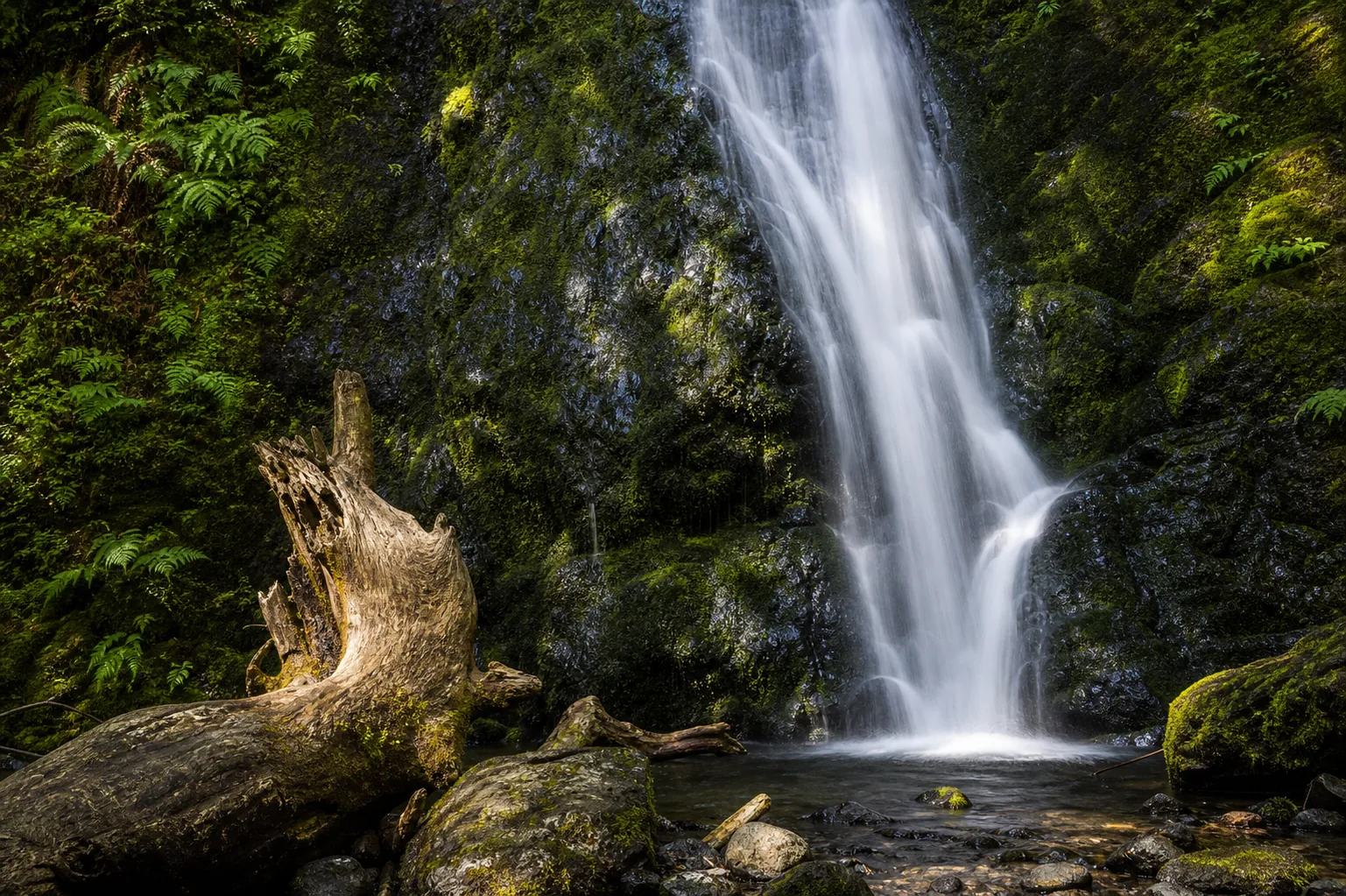
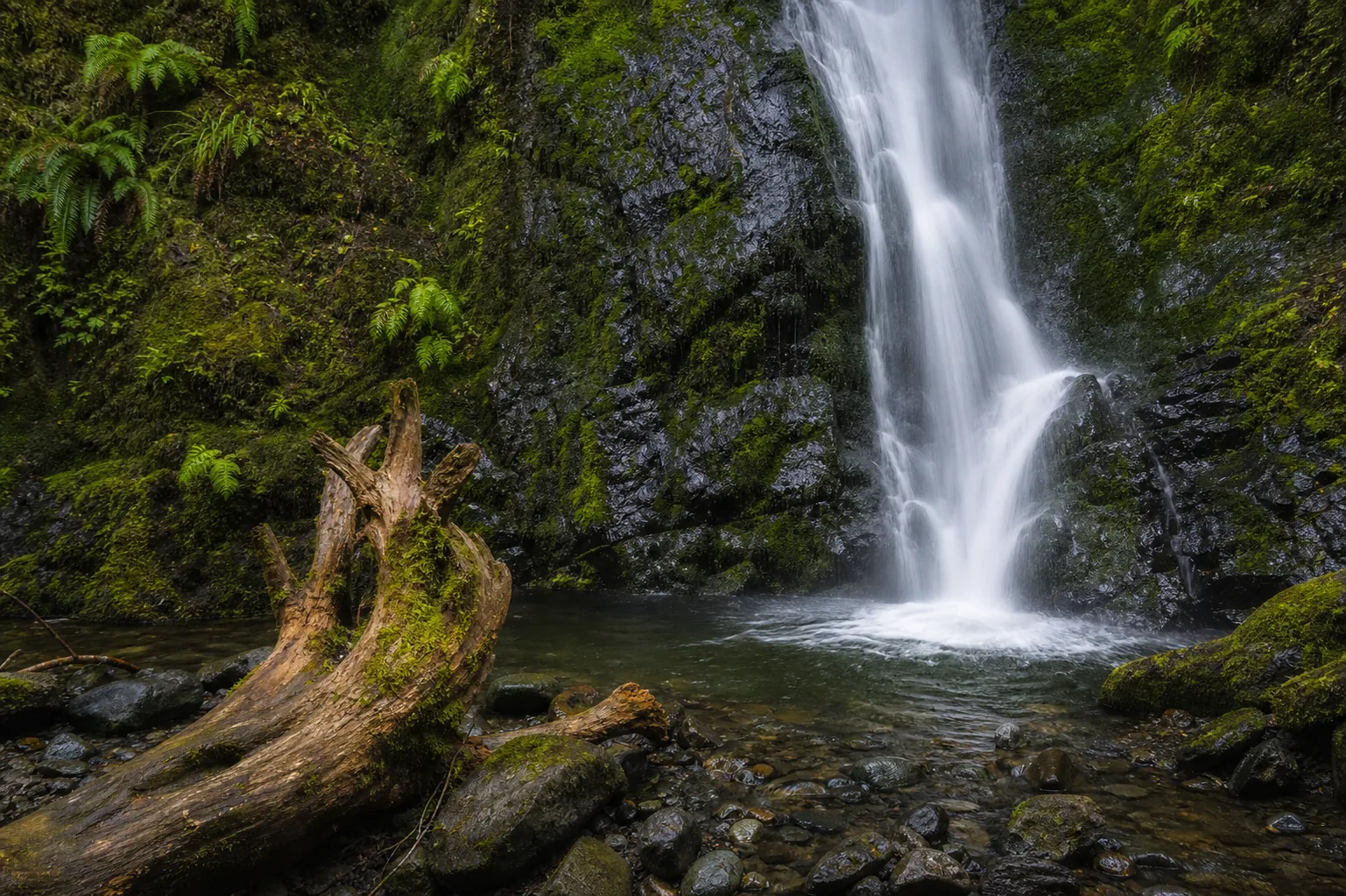
Madison Creek Falls base of the madison creek falls horsetail with mossy basalt step in the elwha valley
Photo guide

One viewpoint, two seasons that change the photo.

Madison Creek Falls is a fixed-viewpoint subject: the wooden porch at the end of the paved trail is the only legal frame. What changes is the water. Winter rain and spring melt fill the horsetail into a full white sheet; late summer thins it into braided strands against the same mossy basalt face.

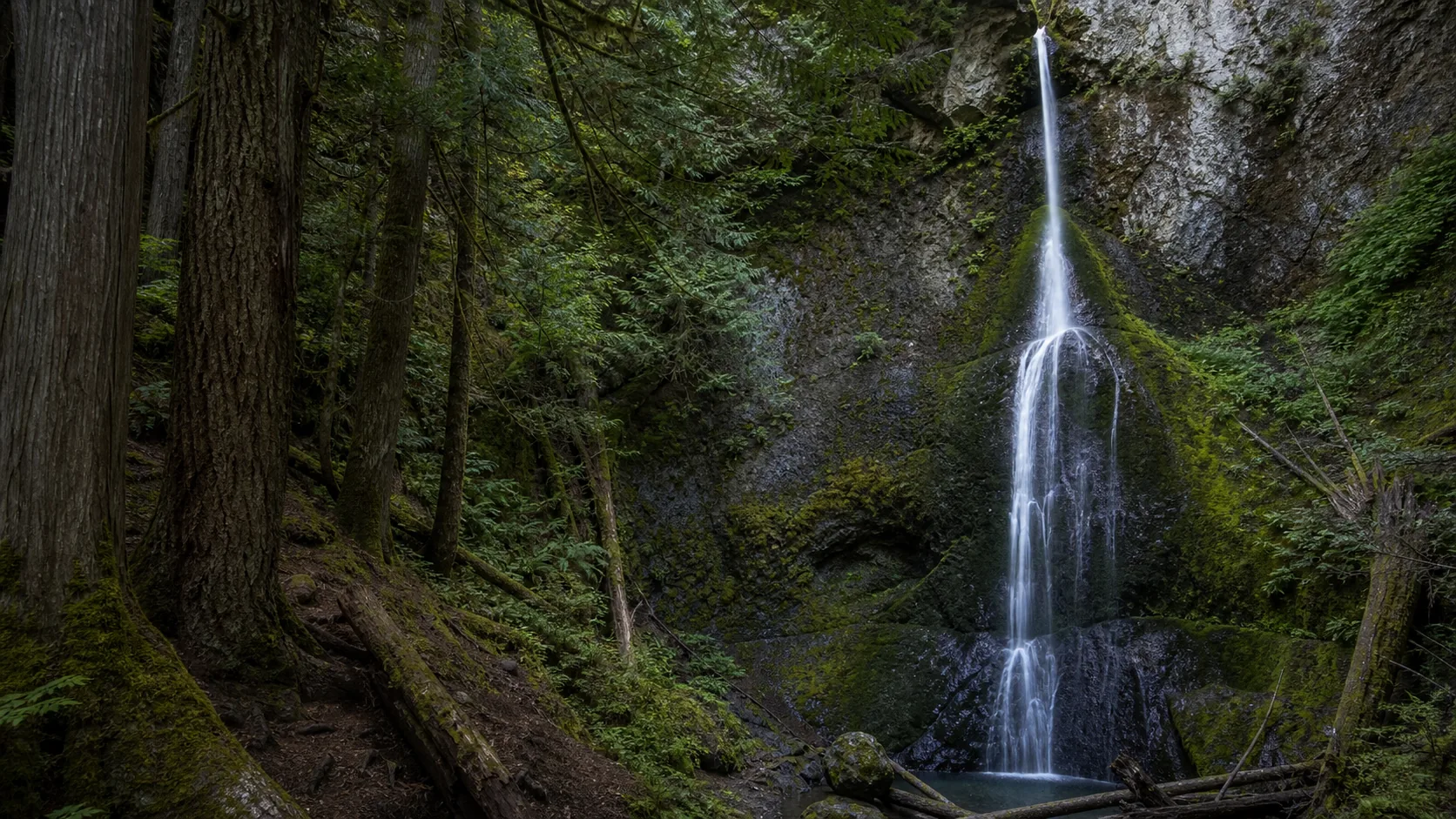
Madison Creek Falls 50-foot horsetail dropping over Crescent Formation basalt in Olympic National Park's Elwha Valley near Port Angeles
Madison Creek Falls, hero composition
Madison Creek Falls 50-foot horsetail over Crescent Formation basalt with surrounding Olympic National Park forest
Madison Creek Falls horsetail from the wooden viewing porch in the maple-and-cedar grotto
Base of Madison Creek Falls with white water hitting mossy Crescent basalt at the foot of the 50-foot horsetail
Base of the Madison Creek Falls horsetail with mossy basalt step in the Elwha Valley
Detail of Madison Creek Falls water threading over textured Crescent basalt and Pacific Northwest moss
Madison Creek Falls water and Crescent Formation basalt detail through the canopy
01Is Madison Creek Falls flowing right now?

This guide does not pair Madison Creek Falls with a real-time USGS discharge gauge because Madison Creek itself is ungauged. The Elwha River gauge nearby is the practical proxy.

Madison Creek does not have its own USGS gauge. The nearest proxy is the Elwha River gauge near McDonald Bridge (12045500) ↗ about 1.2 km away, which tracks the broader watershed's rain and snowmelt response. After a wet Pacific Northwest storm or during the May to early June snowmelt peak, the horsetail runs full and loud; during a late-summer dry spell it thins to a braided strand.

02How long is the walk?

0.2 mile round trip on paved trail, roughly 200 feet from the small lot to the wooden viewing porch. Essentially flat, suitable for wheelchairs, strollers, and walkers. Most visitors spend 15 to 30 minutes here including photos.

03How do you get there?

From Port Angeles: head west on US-101 for about 9 miles, turn south (left) onto Olympic Hot Springs Road at the brown Elwha sign, and continue about 2 miles to the signed Madison Falls Trailhead on your right, immediately after the Olympic National Park entrance station. Driving time from downtown Port Angeles is about 15 minutes.

04Is there free parking?

Small paved lot at the trailhead with roughly 15 to 20 spaces plus a few accessible spots. The lot fills on summer weekends (July and August) and during big-storm winter weekends. Overflow is limited; arrive before 10 a.m. in summer.

05Does it cost money?

Olympic National Park charges a $30 per private vehicle entrance fee covering 7 days, or $25 for motorcycles and $15 per person on foot or bicycle. America the Beautiful annual ($80), senior ($20 annual or $80 lifetime), military, and access passes are accepted. There is no separate parking fee at the trailhead.

06Trail variants

Madison Falls Trail (accessible) 0.2 mi RT paved, 15-30 min, wheelchair- and stroller-accessible to viewing porch.
Madison Falls + Glines Canyon Spillway Overlook 0.2 mi + drive, 60-90 min, see the waterfall plus the former upper Elwha dam site.
Olympic NP three-waterfall day Madison + Marymere + Sol Duc, 4-5 hr trail time, all three covered by the same $30/7-day Olympic NP fee.
Winter accessible stop 0.2 mi RT paved, 15-30 min, low-elevation, road usually open year-round; check NPS alerts.

Detailed maps and recent reviews: Falls route on AllTrails · Creek route on AllTrails

07Can you swim?

No. The base of Madison Creek Falls is not safely accessible from the trail (there is a railing and a steep drop), and Olympic NP does not designate it as a swim area. The Elwha River itself runs cold and pushy year-round; treat it as a look-but-do-not-enter river except at designated put-ins.

08Are dogs allowed?

No. Dogs are not allowed on Olympic National Park trails, including the Madison Falls Trail, per standard Olympic NP regulations (NPS Compendium). Pets are restricted to roads, parking areas, campgrounds, and a small set of pet-allowed beaches; Madison Falls is not one of those. Leashed pets are technically permitted in the paved parking area but cannot proceed onto the trail.

09Is it accessible?

Yes. The full 0.2-mile out-and-back from the lot to the viewing porch is paved, level, and wheelchair-accessible, and the porch itself has space for wheelchairs. Olympic NP specifically lists Madison Falls as a wheelchair-accessible destination, one of the few full-stop accessible waterfalls in the park system.

Field notes

Madison Creek Falls at a glance.

50-foot horsetail on Madison Creek, Crescent Formation basalt, 0.2-mile paved ADA-accessible trail, inside Olympic National Park's Elwha entrance, 9 miles west of Port Angeles. Sourced from the NPS Olympic page, WTA, and USGS geology references.

Height 50 ft USGS 3DEP
Type Horsetail (single tier) USGS
County Clallam Port Angeles, WA
Managed by National Park Service NPS
Water source Madison Creek USGS
Elevation 259 ft USGS NED
Park area 922,651 acres NPS
Hours Open 24 hours; Olympic NP roads are gated at the Elwha entrance but the trailhead itself stays accessible year-round in normal winters NPS
When to visit

Year-round access, two flow peaks.

Olympic Peninsula winter rains (November through February) and spring snowmelt (April through early June) both push Madison Creek to peak flow. Late summer thins the horsetail; fall color through October is the best photo window for the surrounding maples.

PEAK FLOW

Peak flowWinter rains & spring snowmelt
Ice / low flowRare freeze
Most crowdedWeekends and midday
Best photosSunrise or weekdays

Live water context

Discharge data -- Live reading from Elwha River at McDonald Br near Port Angeles (proxy, 1.2 km away) (USGS 12045500) refreshes on the next build. Open the gauge link below for the current cubic-feet-per-second reading.

USGS 12045500 · Elwha River at McDonald Br near Port Angeles (proxy, 1.2 km away)

Why is it called Madison Creek Falls?

Madison Creek and the falls take their name from the Madison family, late-19th-century homesteaders in the Elwha Valley. The NPS plaque at the trailhead actually highlights the adjacent Sweet family homestead, whose open field still sits beside the parking area; the Madison name attaches to the creek itself. The trail sign reads simply Madison Falls, but the official USGS and Wikipedia entry uses Madison Creek Falls; both refer to the same 50-foot horsetail. Do not confuse it with the Madison River and Madison Falls in Yellowstone National Park, a separate waterfall named for President James Madison on the opposite side of the country.

What else to do at Olympic National Park (Elwha entrance)

Madison Creek Falls sits inside Olympic National Park's Elwha entrance, less than a mile from the former Elwha Dam site that was removed in 2012 in what is still the largest dam-removal project in US history. Port Angeles (population about 20,000) is the natural base, with the Olympic National Park Visitor Center about 10 minutes east on Mount Angeles Road. The trailhead is the first major stop after you turn south off US-101 onto Olympic Hot Springs Road, and it pairs naturally with the Glines Canyon Spillway Overlook a few miles further up the valley for visitors who want to see the dam-removal story alongside the waterfall.

  • Madison Falls Trailhead. Small paved lot off Olympic Hot Springs Road, immediately inside Olympic National Park's Elwha entrance. NPS picnic tables and an open meadow (the historic Sweet family homestead site) sit beside the lot.
  • 0.2-mile paved trail. Roughly 200 feet of flat, wheelchair-accessible asphalt through a maple-and-cedar grotto to a wooden viewing porch facing the horsetail. One of the most accessible falls in the entire NPS system.
  • Elwha River corridor. The trailhead sits about 1 mile from the former Elwha Dam removal site (2012), the largest dam removal in US history. Glines Canyon Spillway Overlook is a few miles further up the road.
  • Olympic NP entrance. The $30-per-vehicle / 7-day Olympic National Park fee covers this stop plus Hurricane Ridge, Lake Crescent, Sol Duc, and the Hoh Rain Forest. America the Beautiful annual passes are accepted.
  • Often confused with Marymere. Marymere Falls is a separate 90-foot fall on the south shore of Lake Crescent, about 25 minutes further west; many trip reports mix the two. See the Marymere Falls guide for the longer hike.

Why it looks this way

Madison Creek drops over a step of Crescent Formation basalt, the dark, fine-grained volcanic rock that forms the structural core of the Olympic Peninsula's outer ring. These basalts erupted as submarine pillow lavas and flood-basalt sheets along the early Eocene seafloor roughly 50 million years ago, were later jammed against the continent, and now ring the peninsula in a horseshoe from Hurricane Ridge around to the Pacific coast cliffs. The same Crescent basalt builds the sea stacks at Ruby Beach and Rialto Beach and the cliffs above Lake Crescent a few miles south. Glacial sculpting during the Pleistocene steepened the Elwha Valley walls and left Madison Creek hanging at the lip of a hard basalt step, which is the geometry that produces the horsetail shape today.
Field guide deep dive

What the Madison Creek Falls trail sign doesn't tell you.

Crescent basalt geology, the Elwha dam-removal context, the Madison-Creek-vs-Madison-Falls naming, and the practical Olympic NP day. Skim the headers, read what you need.

How Madison Creek Falls formed

Madison Creek Falls is a horsetail-shaped step in a small Olympic Peninsula tributary, and the rock under it is what makes the shape work. The lip is Crescent Formation basalt, a dark fine-grained volcanic rock that erupted along the early Eocene seafloor roughly 50 million years ago as submarine pillow lavas and flood-basalt sheets. Plate motion later jammed those basalts against the continent and bent them into the horseshoe ring that now forms the structural core of the Olympic Peninsula. The same Crescent basalt builds the sea stacks at Ruby Beach and Rialto Beach on the Pacific coast and the cliffs ringing Lake Crescent a few miles south.

Pleistocene glaciers did the sculpting. The Elwha Valley was carved into its current U-shape by repeated valley-glacier passes through the last ice age, with the most recent retreat finishing about 12,000 years ago. The glacier oversteepened the valley walls and left side tributaries hanging at the edge, which is why so many short Olympic creeks drop in waterfalls into the main valleys instead of joining at grade. Madison Creek sits on exactly this geometry: a small tributary perched at the top of a hard basalt step, dropping about 50 feet onto the bench above the Elwha and joining the river a short distance below.

The horsetail shape (water staying mostly in contact with the rock face on the way down rather than free-falling) is a function of moderate gradient and a relatively low-volume creek. In high flow the contact pattern fattens into a near-sheet; in low flow it breaks into separate strands that trace different fracture lines on the basalt face. The mossy green cushion at the base is a classic Pacific Northwest hanging-tributary biotic community of mosses, ferns, and bigleaf-maple-rooted soils.

The 0.2-mile fully accessible trail

The Madison Falls Trail is one of the most accessible waterfall trails in the entire National Park System. From the small paved trailhead lot it is roughly 200 feet of flat, paved asphalt to a wooden viewing porch facing the horsetail, with no stairs, no significant grade, and only minor camber to shed water. Olympic National Park explicitly lists Madison Falls as a wheelchair-accessible destination. Walkers, strollers, and travelers with mobility limits can all get to the porch under their own power.

The trailhead lot has roughly 15 to 20 spaces, a few of them accessible, plus picnic tables and an interpretive sign for the historic Sweet family homestead, whose open field still sits adjacent to the lot. The trail itself bends past a few large bigleaf maples and western redcedars before arriving at the porch, with a low wooden rail keeping visitors a safe distance from the wet rock below.

The trail's accessibility is also why it works as a sanity-saving stop on bigger Olympic days. If you are en route to Hurricane Ridge, the Hoh Rain Forest, or Sol Duc and you have a member of the group who cannot do a longer hike, Madison Falls is the rare Olympic NP attraction where the entire group can be at a real, full-scale waterfall together in 15 minutes round trip. It also reads well in winter when other Olympic trails are snow-bound: the road into the Elwha entrance is low-elevation and stays open year-round in normal winters.

Madison Creek Falls vs Madison Falls: the same waterfall

The NPS trail sign says Madison Falls. The USGS Geographic Names Information System and Wikipedia entry say Madison Creek Falls. Both are referring to the same 50-foot horsetail on Madison Creek. The longer form is the official feature name; the shorter form is the colloquial and on-park usage. If you are searching directions or recent trip reports, either form works. Locally the trail is the Madison Falls Trail and the trailhead is the Madison Falls Trailhead.

There is a separate and unrelated Madison Falls in Yellowstone National Park on the Madison River, named for President James Madison. The Yellowstone falls is on a much larger river in a completely different geology and is a thousand miles away; do not let the shared name confuse your search results. Within Washington, Madison Creek Falls is the only waterfall using either name.

One more naming clarification worth making explicit: this is not Marymere Falls, which is a separate 90-foot waterfall on Falls Creek above the south shore of Lake Crescent, reached by a 1.8-mile round-trip trail starting near the Storm King Ranger Station. Marymere and Madison are often mixed up because both are short Olympic NP waterfall stops along the same US-101 corridor; the practical difference is that Madison is paved and 0.2 miles, while Marymere involves stairs, a stream crossing, and roughly a mile each way. See the Marymere Falls guide for that hike.

The Elwha dam removal and what it means for this stop

The Madison Falls Trailhead sits about 1 mile from the former Elwha Dam site, removed in 2012 in what is, taken together with the Glines Canyon Dam removal completed in 2014, still the largest dam-removal project in US history. The two dams had blocked salmon and steelhead runs on the Elwha for almost a century. Removal opened more than 70 miles of habitat above the former dam sites and triggered one of the most-watched river-restoration experiments ever attempted in North America.

By the mid-2020s the river had already moved millions of cubic yards of sediment downstream, rebuilt its estuary at the Strait of Juan de Fuca, and seen the return of Chinook, coho, pink salmon, and summer steelhead to reaches that had been salmon-free since 1913. The Lower Elwha Klallam Tribe, whose treaty fishing rights and cultural identity were tied to the river, led much of the long political fight that made removal possible.

None of this is visible from the Madison Falls porch itself: the creek runs in its own small drainage and the river is several hundred feet east through the trees. But the trailhead is the natural first stop on an Elwha-corridor day, and the Glines Canyon Spillway Overlook a few miles further up Olympic Hot Springs Road gives you the visual story (the empty canyon where the upper dam stood, with the river running free through the gap). Pairing Madison Falls with the spillway overlook is the most common way to see both the waterfall and the dam-removal site in 90 minutes.

An Olympic National Park waterfall day

Madison Creek Falls is short enough on its own that most visitors string it together with other Olympic NP waterfalls under the same single $30 / 7-day entrance fee. The classic three-falls Olympic day is:

  • Madison Creek Falls (15 to 30 minutes at the porch on a 0.2-mile paved trail).
  • Marymere Falls on Lake Crescent, about 25 minutes west. A 1.8-mile round-trip trail through old-growth Douglas-fir to a 90-foot fall on Falls Creek. Stairs, modest elevation, generally 60 to 90 minutes.
  • Sol Duc Falls, about 75 minutes west via the Sol Duc Hot Springs Road. A 1.6-mile round-trip to a three-channel fall that drops perpendicular to the river. Roughly 90 minutes, plus the Sol Duc Road approach.

Time the loop east-to-west and you finish at Sol Duc with afternoon light. Time it west-to-east and you finish at Madison Falls in the soft late-day shade that suits the basalt grotto best. The full three-falls day is roughly 4 to 5 hours of trail time plus driving, which leaves room for the Olympic National Park Visitor Center on Mount Angeles Road (10 minutes east of the Madison turnoff) at the start or end.

If you only have a single hour in the Elwha entrance, pair Madison Falls with the Glines Canyon Spillway Overlook instead of trying to add a second hike. The two together give you the waterfall and the dam-removal story in the same valley.

Photography practical for the horsetail and the porch

The wooden viewing porch at the end of the paved trail is the single working viewpoint for Madison Creek Falls. There is no legal way to scramble below or around the falls, and the basalt face above the porch is dangerously slick year-round. The composition is fixed; what you control is exposure, weather, and crop.

The grotto faces roughly south-southwest and sits in deep shade most of the day under a canopy of bigleaf maple and western redcedar. Overcast Olympic Peninsula days are ideal because they keep the white water and the dark wet basalt within a single exposure range. Direct midday sun on the upper lip blows out the highlights and is the one light condition to avoid. The best windows are overcast mornings, the soft gray light typical of late autumn through early spring, and the last hour before sunset when the canopy filters the remaining direct light.

Vertical compositions tend to work better than horizontal because the horsetail is taller than it is wide; a 24mm-equivalent vertical frame typically gets the full drop plus a strip of basalt at the lip and a small foreground of moss and railing. A polarizer cuts wet-rock glare and saturates the green moss; a small travel tripod allows the 1 to 2-second exposures that smooth the horsetail without losing texture. For a long exposure look (5 to 10 seconds), a 6-stop ND filter is the simplest path.

One Olympic-specific rule: drones are prohibited everywhere in Olympic National Park under NPS Director's Order 6.4.4. This is enforced; do not plan a drone shot at Madison Falls. Commercial filming and large group portrait sessions require an NPS Special Use Permit; personal phone and camera photography from the porch is fine without one.

Map and route

15 minutes west of Port Angeles, 1 mile from the former Elwha Dam site.

From Port Angeles: head west on US-101 for about 9 miles, turn south (left) onto Olympic Hot Springs Road at the brown Elwha sign, and continue about 2 miles to the signed Madison Falls Trailhead on your right, immediately after the Olympic National Park entrance station. Driving time from downtown Port Angeles is about 15 minutes.

Photography and weddings

Single fixed viewpoint, no drones (NPS rule), small Special Use Permit for weddings.

Madison Creek Falls is a single, fixed viewpoint shoot: the wooden viewing porch at the end of the paved trail looks directly at the 50-foot horsetail through a frame of bigleaf maple, western redcedar, and Pacific Northwest moss. There is no legal way to scramble below or around the falls; the porch railing is the photograph. Vertical compositions read better than horizontal because the horsetail is taller than it is wide.

The grotto faces roughly south-southwest and stays in deep shade most of the day, which is good news for waterfall photography. Overcast mornings and the gray winter light typical of the Olympic Peninsula give the cleanest exposure across the white water and the dark basalt face. Direct midday sun on the upper lip creates a contrast spread that is hard to recover. Bring a polarizer to cut wet-rock glare and a small travel tripod for the 1- to 2-second exposures that smooth the horsetail without losing texture.

Casual personal photography from the viewing porch does not require a permit. Commercial filming, large-group portrait sessions, and tripods that block the porch in summer all require an NPS Special Use Permit. Drones are prohibited everywhere in Olympic National Park by NPS Director's Order 6.4.4; this is enforced and there is no on-site drone option.

Permits

Weddings and engagements

Madison Creek Falls works for very small elopement-style portraits or post-ceremony pictures because the trail is paved and the porch is wheelchair-accessible, but the porch itself is the only legal viewing space and it is shared with day-use visitors year-round.

Olympic National Park requires a Special Use Permit for any wedding ceremony or commercial photography session, regardless of group size. Application lead time is typically 4 to 8 weeks; fees start around $100 and scale with group size.

If you want the Elwha corridor for portraits without crowding Madison Falls, the picnic area at the trailhead and the open Sweet homestead meadow are better fits for a small group than the porch itself.

Nearby waterfalls

Three Olympic National Park waterfalls in one day.

Madison Creek Falls pairs naturally with Marymere Falls on Lake Crescent (about 25 minutes west) and Sol Duc Falls (about 75 minutes west). All three sit inside the same $30 / 7-day Olympic NP entrance fee.

Related questions

More questions visitors ask before visiting Madison Creek Falls.

Accessibility, fee, hike length, dogs, swimming, and the worth-visiting question. The full set is indexed in the FAQ schema for AI answer engines.

01How tall is Madison Creek Falls?

Madison Creek Falls is approximately 50 feet tall and drops in a horsetail shape over Crescent Formation basalt. Some sources round to 60 feet (NPS) or describe it as 40 to 50 feet; the USGS and Washington Trails Association figure is 50 feet.

02Where is Madison Creek Falls?

Madison Creek Falls is in Olympic National Park's Elwha Valley, about 9 miles west of Port Angeles, Washington (Clallam County). From US-101 turn south on Olympic Hot Springs Road and continue about 2 miles past the park entrance station to the signed Madison Falls Trailhead.

03Is Madison Creek Falls worth visiting?

Yes if you are already inside or passing through Olympic National Park's Elwha entrance; on its own the $30 entrance fee is harder to justify for a 0.2-mile stop. Most visitors pair it with Marymere Falls, Sol Duc Falls, Hurricane Ridge, or the Glines Canyon Spillway Overlook for a full Olympic day.

Sources and data

Where the Madison Creek Falls guide gets its facts.

Trail and accessibility specs from NPS Olympic and WTA. Geology from USGS Crescent Formation references. Dam-removal context from the NPS Elwha River Restoration record. Cross-checked with Wikipedia, Wikidata, and AllTrails for trail length and condition reports.

USGS Streamflow: 12045500 Elwha River at McDonald Br near Port Angeles (proxy, 1.2 km away) waterdata.usgs.gov
NPS: Olympic National Park (Elwha entrance) nps.gov
Access, parking, and permit rules: nps.gov
USGS Geologic Map of the Olympic Peninsula: Crescent Formation basalt: Port Angeles bedrock mrdata.usgs.gov
NOAA / NWS Seattle forecast grid SEW 89,97 (Elwha Valley) noaa.gov
USGS National Elevation Dataset 3DEP
Wikidata: Q6728199 (Madison Creek Falls) wikidata.org
Google Maps: embedded map and directions maps.google.com
Google Places: nearby restaurants and hotels places API
NPS Olympic National Park: See Madison Falls nps.gov
NPS Olympic National Park: Madison Falls Trailhead nps.gov
NPS Olympic National Park: Elwha River Restoration nps.gov
Washington Trails Association: Madison Falls hike wta.org
AllTrails: Madison Falls Trail alltrails.com
Olympic Peninsula Waterfall Trail (Visit Olympic Peninsula) olympicpeninsula.org
Wikipedia: Madison Creek Falls en.wikipedia.org
Wikimedia Commons: Madison Creek Falls image category commons.wikimedia.org
Fact checks
Entrance fee audit: Olympic National Park entrance fee is $30 per private vehicle for 7 days, $25 per motorcycle, $15 per person on foot/bike, as published on the NPS Olympic fees page; America the Beautiful, senior, military, and access passes are accepted. The Madison Falls Trailhead lies inside the park's Elwha entrance.
Accessibility audit: trail length (0.2 mi round trip), paved surface, and wheelchair accessibility are sourced to the NPS "See Madison Falls" page and the NPS Madison Falls Trailhead page, with WTA cross-confirmation. No stairs and no significant grade.
Dog policy audit: Olympic National Park's pet regulations restrict dogs from park trails including the Madison Falls Trail. Pets are permitted only on roads, paved areas, campgrounds, and a small set of designated pet-allowed beaches. This is a stricter rule than many state parks and many visitors do not expect it.
Naming audit: NPS uses Madison Falls on the trail sign; USGS, Wikipedia, and Washington Trails Association use Madison Creek Falls. Both refer to the same 50-foot horsetail on Madison Creek, distinct from Madison Falls on the Madison River in Yellowstone National Park.
Corrections: [email protected]