Long Creek Falls waterfall and surrounding setting
Blue Ridge, GA

Long Creek Falls

Long Creek Falls is a 25-foot two-tier cascade in the Chattahoochee-Oconee National Forest, hidden at the point where the Appalachian Trail and the Benton MacKaye Trail split apart in Fannin County, Georgia. The approach is a 2-mile out-and-back from the Three Forks parking pull-offs on Forest Service Road 58, walking the white-blazed A.T. north through hardwood forest before a short blue-blazed spur drops to the falls. It is the rare North Georgia waterfall hike that doubles as a literal piece of the Appalachian Trail.

Last verified May 12, 2026 Visited 12 sources checked
Trail 1.9 mi 4.4 mi extended
Time 55-150 min Easy
Best season Mar-May for spring flow, Oct-Nov for forest color Mar-May
Parking Free roadside trailhead parking; Forest Service Road 58 can be rough after rain Chattahoochee-Oconee National Forest
Quick answer

Is Long Creek Falls worth visiting today?

Yes, in the right window. The cascade runs strongest from March through May and again after autumn rain, with a second visit-quality peak in October when the hardwood canopy turns. Three Forks parking is currently free on Forest Service Road 58; budget a $5 USFS day-use pass if you extend the trip to a fee site like Anna Ruby Falls the same day, and treat the gravel road as the slow part of the drive rather than the trail.

  • 2 mile out-and-back from Three Forks parking
  • On the Appalachian Trail / Benton MacKaye Trail junction
  • 25-foot two-tier cascade on Long Creek
  • Free roadside parking on Forest Service Road 58
  • Dog-friendly on leash
  • Best Mar-May for flow, October for color
Last verified May 12, 2026 Visited 12 sources checked
Distance 1.9 mi 4.4 mi extended
Round trip 55-150 min Short out-and-back with roots, rocks, and a rough forest-road approach
Difficulty Easy Short out-and-back with roots, rocks, and a rough forest-road approach
Location Blue Ridge, GA Chattahoochee-Oconee National Forest
Parking Free roadside trailhead parking; Forest Service Road 58 can be rough after rain USFS
Transit No public transit Three Forks Trailhead · 0 ft
Drive 21 mi 55 min from downtown
Best season Mar-May for spring flow, Oct-Nov for forest color Mar-May
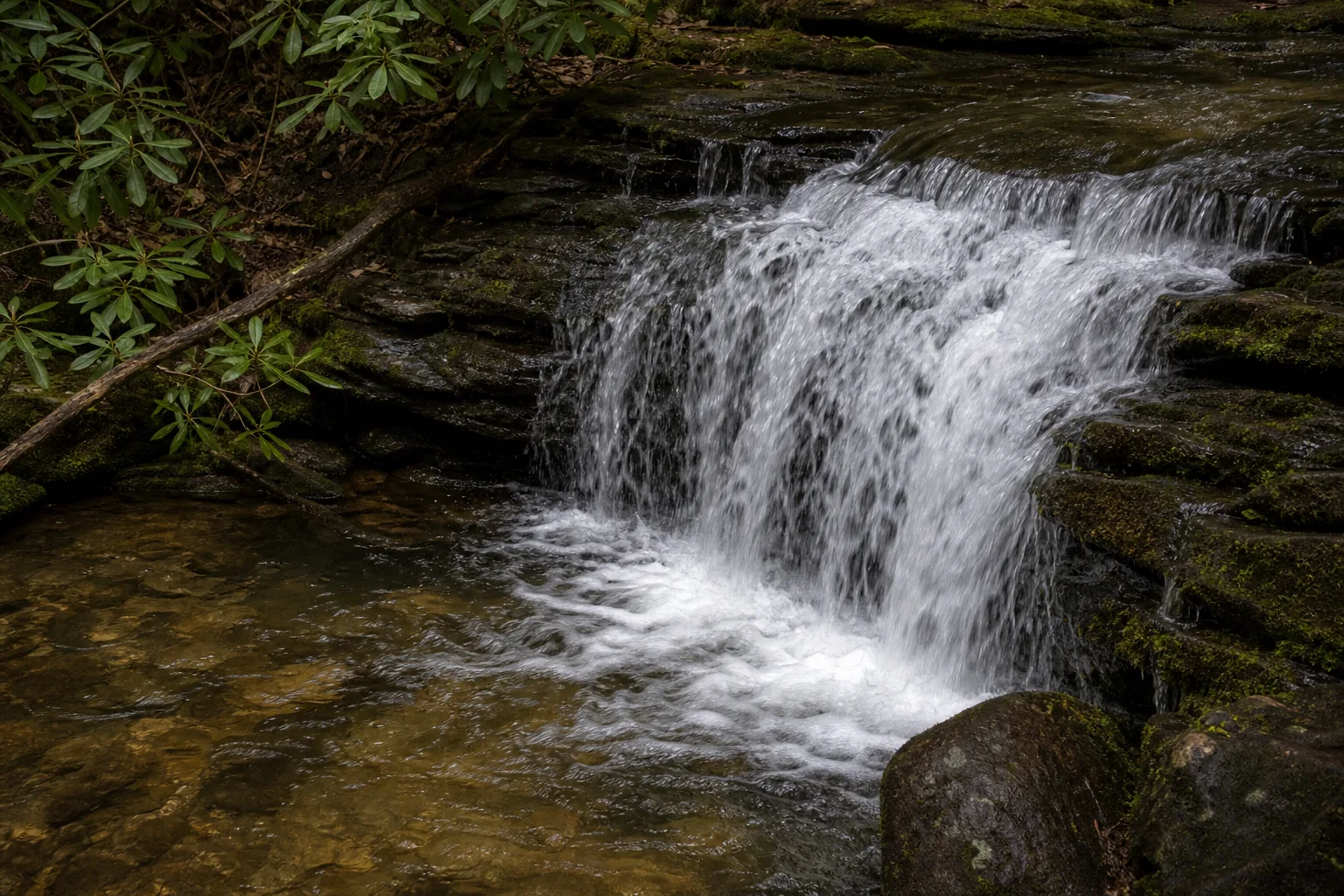
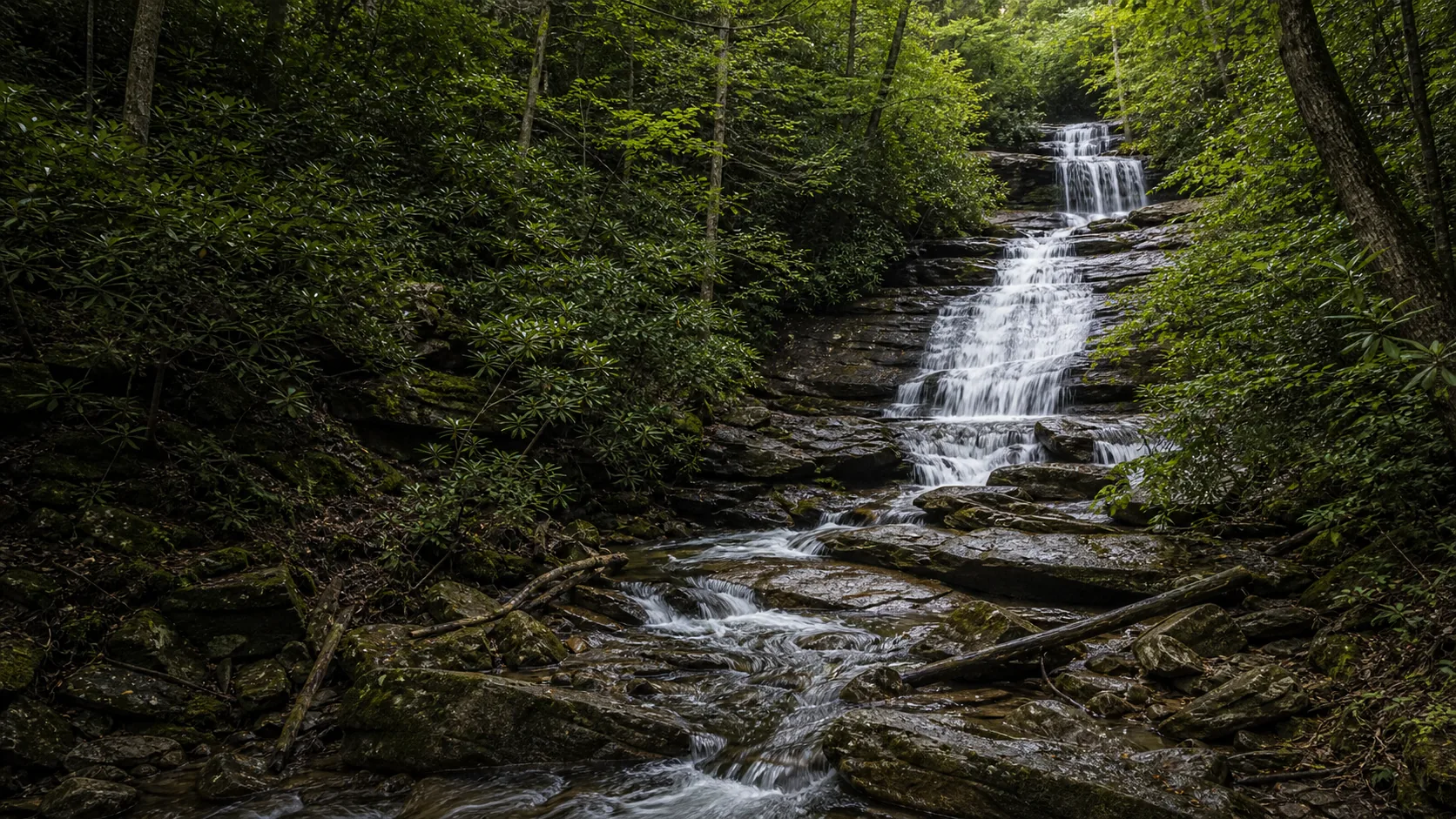
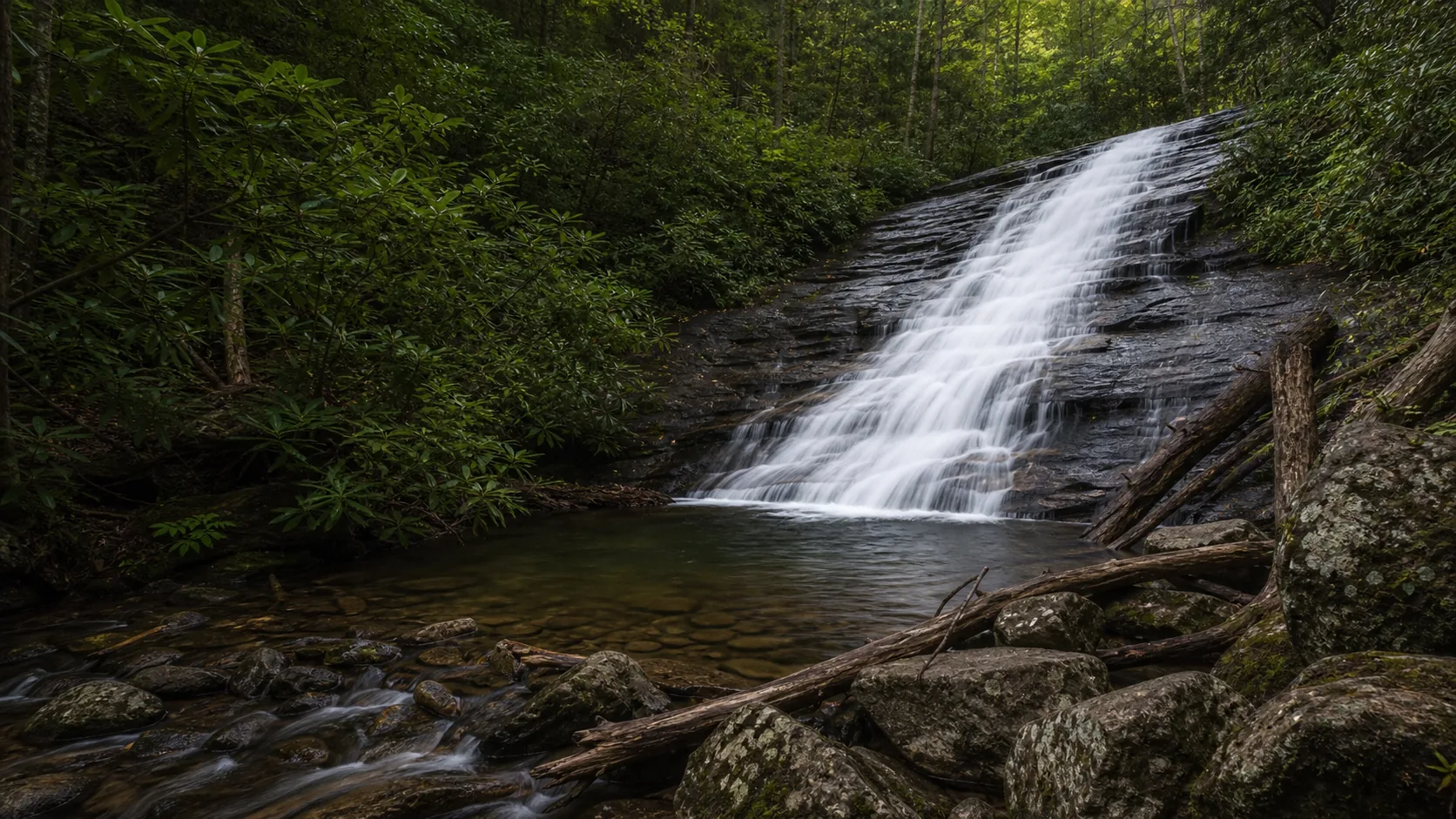
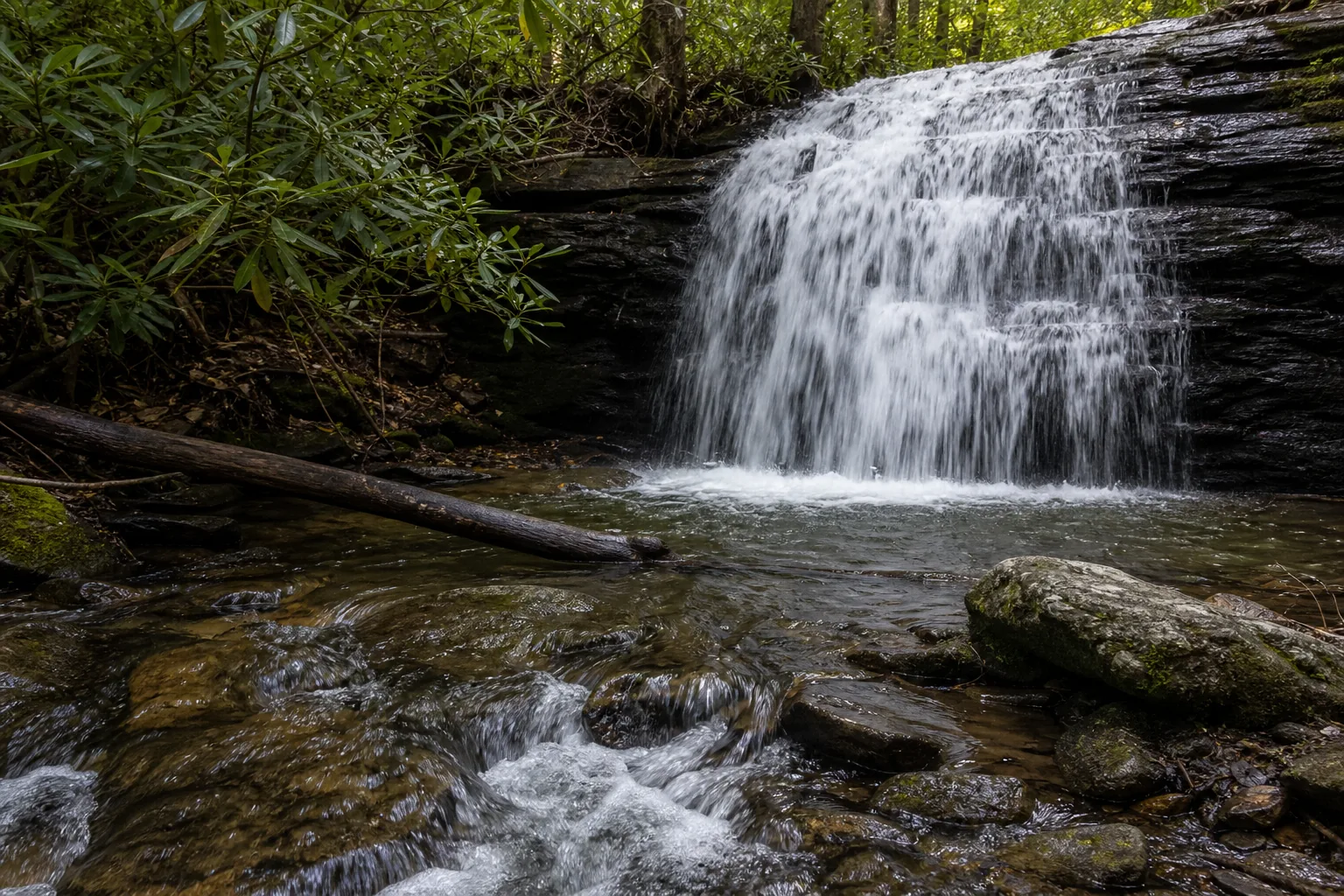
Long Creek Falls lower tier breaking across the gneiss ledge into the shallow plunge pool.
Photo guide

Three frames on a 25-foot Blue Ridge cascade.

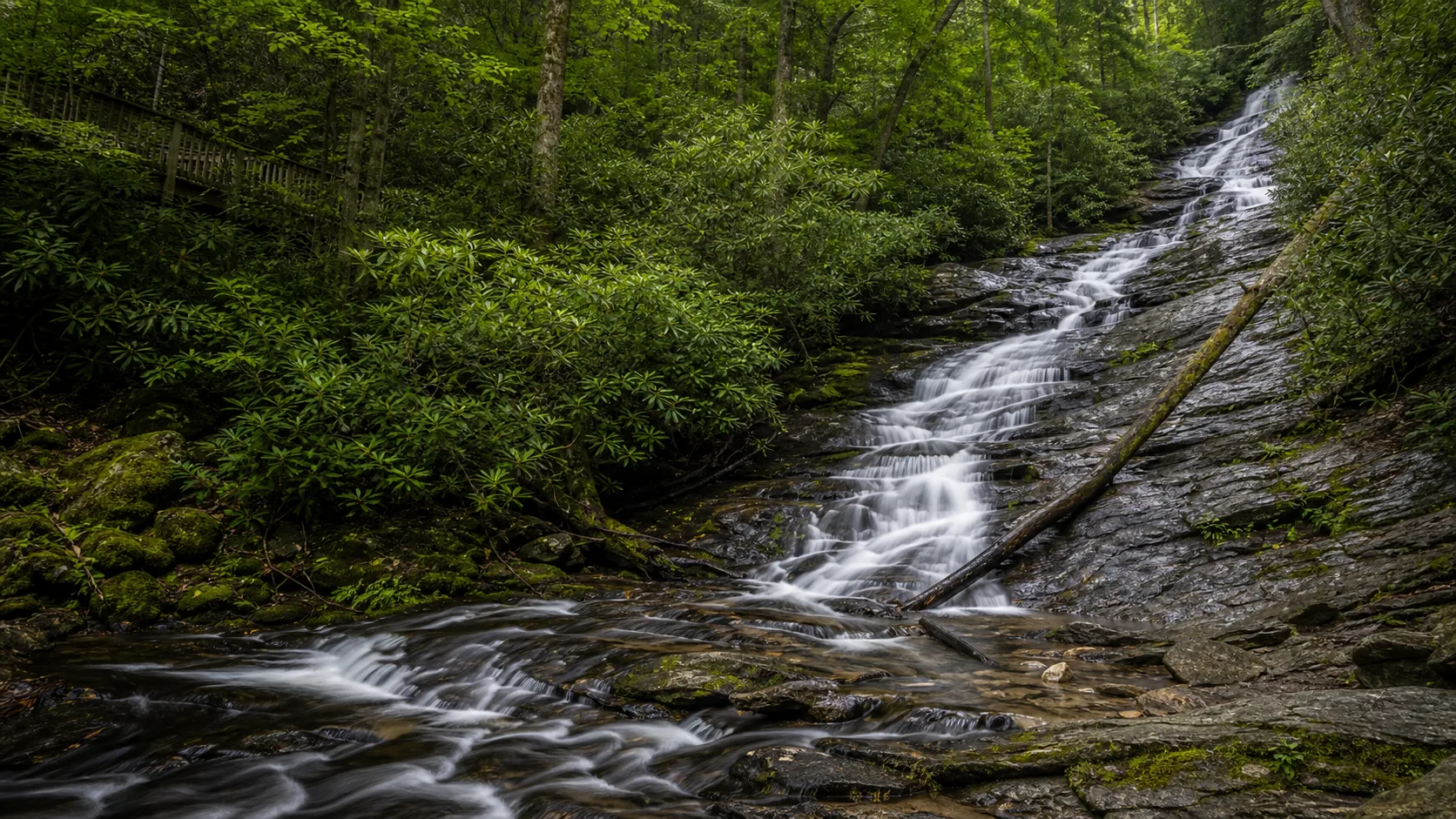
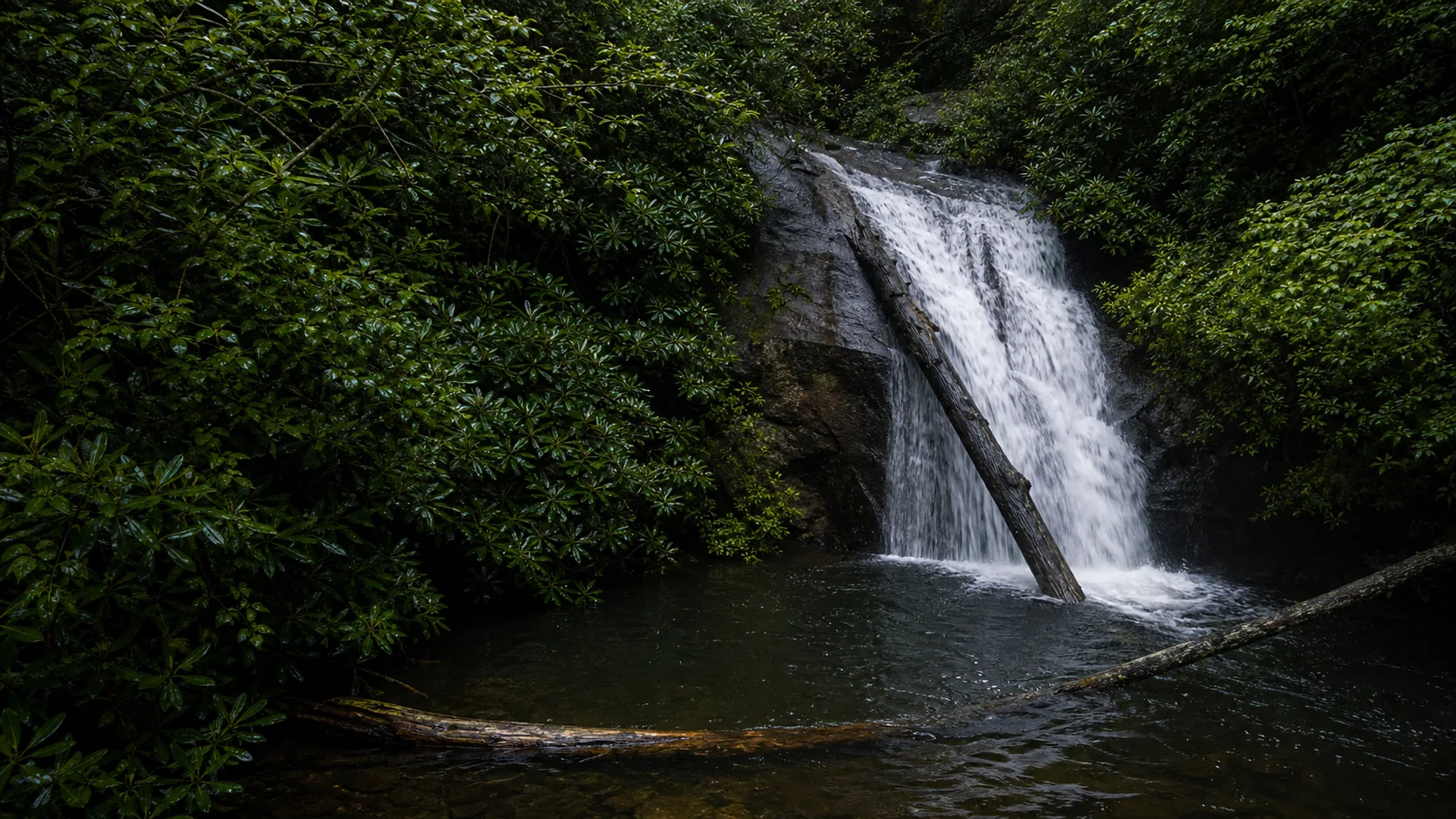
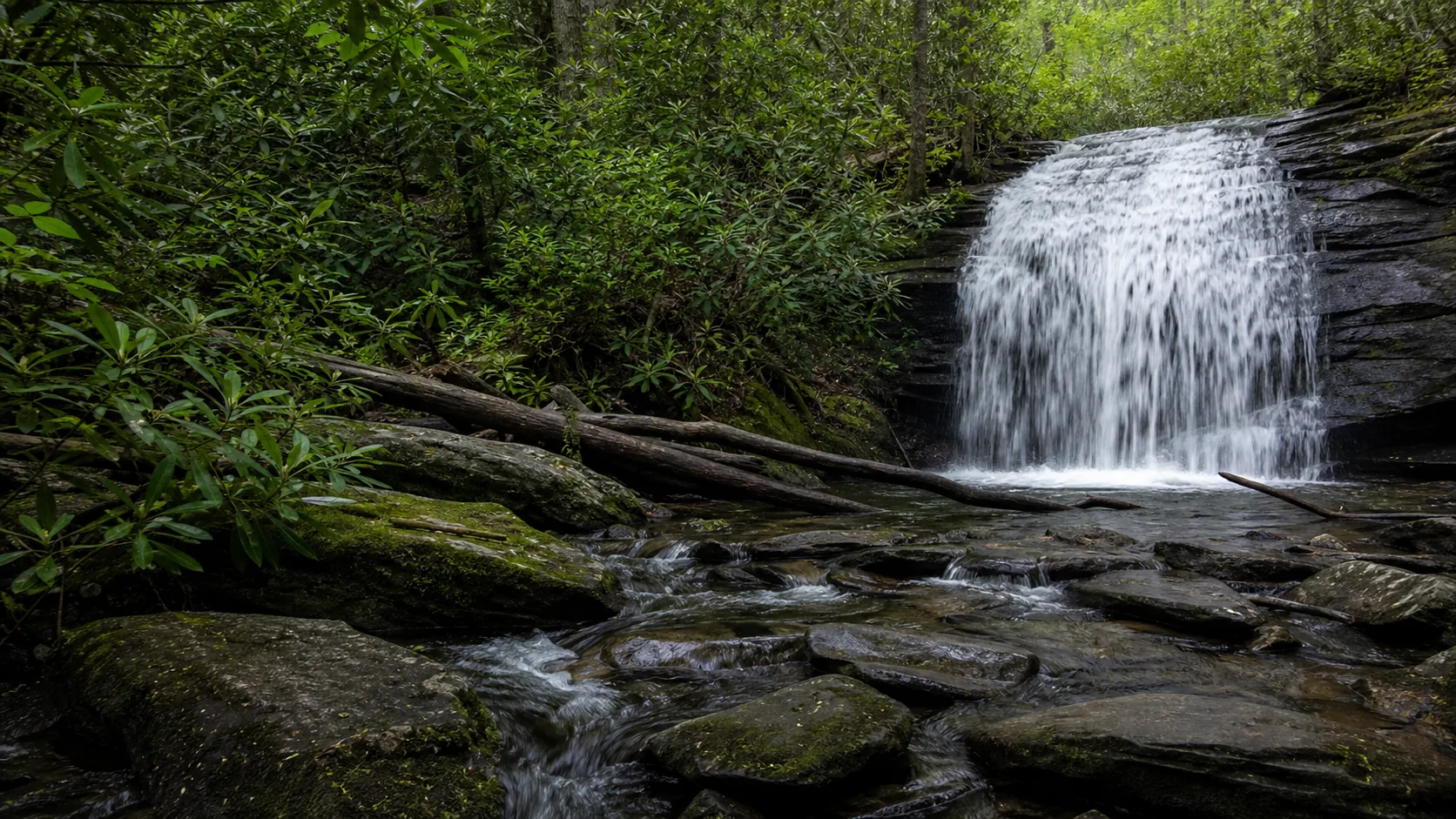
The signature is the wide fan from the trail-end overlook. Supporting frames are the upper-lip detail and the hemlock-rhododendron corridor on the approach.

Long Creek Falls waterfall and surrounding setting
Long Creek Falls, hero composition
Long Creek Falls 25-foot two-tier cascade from the base of the spur trail in Chattahoochee-Oconee National Forest
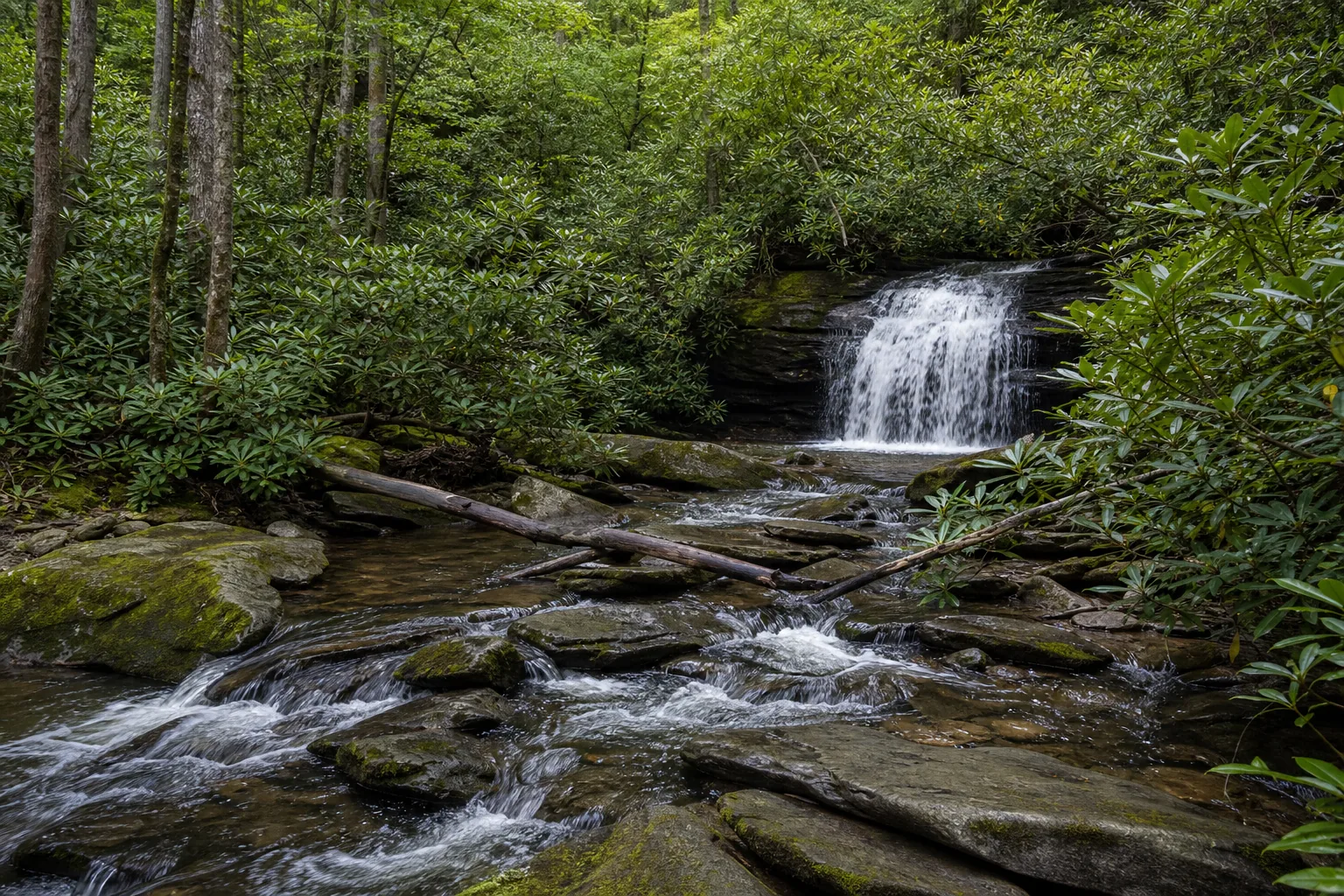
Both tiers in the hemlock and rhododendron corridor, from the base flat at the end of the blue-blaze spur.
Lower tier of Long Creek Falls fanning across a gneiss ledge into the shallow plunge pool
Lower tier breaking across the gneiss ledge into the shallow plunge pool.
Detail of Long Creek Falls showing the two-tier step over Blue Ridge gneiss
Detail of the two-tier mechanic where Long Creek steps over two resistant gneiss bands.
01Is Long Creek Falls flowing right now?

No paired real-time USGS discharge gauge is currently published for Long Creek itself. For trip planning, the seven-day rainfall total in Fannin County and the recent AllTrails or Reddit r/GeorgiaCampAndHike trail reports are more useful than any distant river gauge. The cascade visibly thickens within 12 to 24 hours of a half-inch rain and thins quickly during the late-summer dry spell.

02How long is the walk?

Plan on a 2-mile out-and-back from Three Forks (the Appalachian Trail Conservancy lists 1.8 mi, AllTrails 1.9 mi). The walk uses the white-blazed A.T. north for about 0.8 mile, then a signed blue-blaze spur left for 0.1 mile to the falls. Most hikers finish the round trip in 50 to 70 minutes; photographers and families should budget 90 minutes to two hours. Elevation gain is about 337 feet.

03How do you get there?

From Blue Ridge, drive south on Aska Road and connect to Forest Service Road 58 via Doublehead Gap Road; from Atlanta, take GA-400 north to GA-52 east, then Doublehead Gap Road to FS 58. Three Forks parking is at the point where the A.T. crosses FS 58. From the lot, walk north on the A.T. (white blaze) for about 0.8 mile to the signed Long Creek Falls junction; the blue-blaze spur drops left a short 0.1 mile to the base. FS 58 is gravel for the last several miles and washboards rough after heavy rain.

04Is there free parking?

Three Forks is a roadside trailhead, not a developed lot. Parking is currently free in the pull-offs where the A.T. crosses FS 58. Space is limited; arrive before 9 a.m. on spring and fall weekends. A separate Three Forks lot off FS 42 (Springer Mountain side) is an alternate access if FS 58 is gated.

05Does it cost money?

Three Forks itself is free. The wider Chattahoochee-Oconee National Forest charges a $5 USFS day-use pass at developed fee sites like Anna Ruby Falls; budget the $5 only if you stack a fee site into the same day. America the Beautiful interagency passes are honored.

06Trail variants

Three Forks to Long Creek Falls 1.8-1.9 mi round trip, 50-60 min, Appalachian Trail plus short blue-blaze spur.
Three Forks loop 4.4 mi, 2-2.5 hr, uses Appalachian and Benton MacKaye trails.

Detailed maps and recent reviews: Falls route on AllTrails · Creek route on AllTrails

07Can you swim?

Not a real swimming hole. The plunge pool is shallow, the gneiss is slick when wet, and there is no lifeguard or developed swim area. Treat it as a wading-and-photo stop in calm low-flow conditions only. Better local swim options are Helton Creek Falls's lower pool and the Toccoa River downstream.

08Are dogs allowed?

Yes, on leash. The A.T. requires dogs on a six-foot leash, and the BMT corridor follows the same rule. Bring water (the creek is shaded and clean above the falls, but treat anything you drink), and yield to thru-hikers, especially in March and April.

09Is it accessible?

No. The route is natural-surface trail with roots, rocks, two minor wet-foot crossings on Stover and Long Creek (bridged in most years), and a 337-foot rolling climb. The gravel FS 58 approach also rules out most low-clearance accessible vans.

Field notes

Long Creek at a glance.

25-foot two-tier cascade on Long Creek, Blue Ridge gneiss and schist, USFS Chattahoochee-Oconee National Forest, Toccoa Ranger District, free at Three Forks. Sourced from USFS and the Appalachian Trail Conservancy.

Height 25 ft USGS 3DEP
Type Cascade USGS
Rock Neoproterozoic metasedimentary rock Georgia Geological Survey: Blue Ridge metamorphic terrane
County Fannin Blue Ridge, GA
Managed by USDA Forest Service USFS
Water source Long Creek USGS
Elevation 2590 ft USGS NED
Park area 866,468 acres USFS
Hours Open daily; forest road access can vary by conditions USFS
When to visit

March-May for runoff, October for hardwood color.

Spring runs the falls hardest. October paints the corridor with hickory yellow and maple red. Summer is fine but the hemlocks shade the falls into low contrast.

PEAK FLOW

Peak flowMar-May
Ice / low flowrare
Most crowdedWeekends and midday
Best photosSunrise or weekdays

Live water context

Discharge data -- No paired real-time USGS discharge gauge is currently published for Long Creek itself. For trip planning, the seven-day rainfall total in Fannin County and the recent AllTrails or Reddit r/GeorgiaCampAndHike trail reports are more useful than any distant river gauge. The cascade visibly thickens within 12 to 24 hours of a half-inch rain and thins quickly during the late-summer dry spell.

Why is it called Long Creek Falls?

Long Creek Falls takes its name from Long Creek, the stream that drains the north slope of Rich Mountain and joins Stover and Chester creeks at the Three Forks confluence. The long descriptor is a 19th-century settler usage common across southern Appalachia for any creek that ran a notably long distance before meeting another stream, with Fannin County records using the name by the late 1800s. Do not confuse it with the better-known Long Creek Falls in Oconee County, South Carolina, a 50-foot drop on a different Long Creek near the Chattooga River; the Georgia falls is shorter, two-tiered, and on the Appalachian Trail itself.

What else to do at Chattahoochee-Oconee National Forest

Long Creek Falls sits in the Toccoa Ranger District of the Chattahoochee-Oconee National Forest, about 21 miles southeast of downtown Blue Ridge and 12 miles north of Ellijay as the crow flies. The access point is Three Forks, the named junction where Stover Creek, Long Creek, and Chester Creek meet and where the Appalachian Trail, the Benton MacKaye Trail, and the Duncan Ridge Trail all converge before climbing toward Springer Mountain. Blue Ridge is the practical base town (lodging, food, the Toccoa River) with Ellijay and Dahlonega as alternatives if you are coming up from Atlanta on GA-400.

  • Three Forks confluence. Stover Creek, Long Creek, and Chester Creek braid together at the trailhead, named on USFS maps and the Appalachian Trail Conservancy entry.
  • Appalachian Trail (white blaze). The walk to the falls uses a popular section of the A.T. about 5 miles north of Springer Mountain, the southern terminus.
  • Benton MacKaye Trail (white diamond). The A.T. and the BMT share the corridor north from Three Forks, then separate at the Long Creek Falls spur, making this a literal junction point of two long trails.
  • Duncan Ridge Trail. The third trail at Three Forks links to the BMT and gives stronger hikers a 4.4-mile loop option.
  • Toccoa Ranger District (Chattahoochee-Oconee NF). Day use is generally free at Three Forks; nearby developed sites (Anna Ruby Falls, DeSoto Falls) carry a USFS $5 day-use pass.

Why it looks this way

Long Creek Falls drops through the Blue Ridge geologic province, a thick sequence of Neoproterozoic metasedimentary rock (mostly biotite gneiss and quartz-mica schist) that was folded and metamorphosed during the Appalachian orogenies more than 250 million years ago. The two-tier shape is the visible result of two slightly more resistant bands of gneiss in the rock face: water steps over the upper ledge, picks up speed, then breaks again across a second ledge before sliding into the plunge pool. Because the underlying rock fractures into broad sloping sheets rather than the flat horizontal caps you see in Midwestern limestone falls, Long Creek fans across the rock face rather than plunging cleanly. The pool at the base is small and shallow, scoured into a softer joint in the gneiss rather than into a deep stream-cut bowl.
Field guide deep dive

What the AllTrails listing leaves out.

How the two-tier cascade actually formed, what Three Forks means historically, the practical 2-mile walk, and a North Georgia waterfall day that pairs Long Creek with DeSoto, Anna Ruby, and Helton Creek. Skim the headers; read what you need.

How Long Creek Falls formed

Long Creek Falls is a step cascade in Blue Ridge metamorphic rock, and the two-tier shape is not a coincidence. The Appalachian Mountains here are built from Neoproterozoic and early Paleozoic sediments that were buried, heated, and recrystallized during a sequence of mountain-building events (the Grenville, Taconic, Acadian, and Alleghenian orogenies) over a roughly 700-million-year span. What is left at the surface today is mostly biotite gneiss, quartz-mica schist, and metasandstone, all foliated by that long pressure history.

Long Creek meets that rock at an angle. Two slightly more resistant gneiss bands cross the streambed within about 25 vertical feet of each other; the creek steps over the upper band, picks up speed across a short bench of fractured schist, then breaks again over the lower band. Because the gneiss fractures into broad sloping sheets along its foliation, the water fans across the rock face instead of free-falling. That is also why the plunge pool is small and shallow: there is no soft caprock-undercut mechanism like the one that excavates deep amphitheaters under Midwestern limestone falls. Instead, Long Creek is slowly grinding the gneiss down a millimeter at a time, in line with the geologic clock of the southern Appalachians.

Three Forks and the A.T. / BMT junction

The hike's identity is wrapped up in Three Forks, the named confluence of Stover Creek, Long Creek, and Chester Creek that sits within a quarter mile of the trailhead. It is also the point where the Appalachian Trail (white blaze) and the Benton MacKaye Trail (white diamond) share corridor north from Springer Mountain, then split apart at the spur to Long Creek Falls. The A.T. continues north toward Hawk Mountain Shelter and ultimately Mount Katahdin in Maine, 2,194 miles away; the BMT veers west toward the Cohutta Wilderness on a quieter 300-mile arc to the Great Smokies.

For day hikers, the practical takeaway is that you are walking a literal piece of the Appalachian Trail, just five miles north of the southern terminus at Springer Mountain. In March and April you will share the path with northbound thru-hikers, many of them in their first week on trail. Yield to packs heavier than yours, step off-trail on the downhill side, and skip the question about whether they are actually doing the whole thing.

The 2-mile walk from Three Forks parking

From the Three Forks pull-offs on Forest Service Road 58, the walk is short and the navigation is simple. Cross the gate and follow the white-blazed Appalachian Trail north (uphill, gently) through a rhododendron and hemlock corridor along Long Creek. The grade is steady but never steep; AllTrails records about 337 feet of elevation gain over the 1.9 mile round trip, which most hikers do not feel.

At roughly 0.8 mile, a signed junction marks the blue-blazed spur left to Long Creek Falls. The spur drops about 100 feet over 0.1 mile to a small flat at the base of the lower tier; this is the working photo position. The two tiers stack vertically in the frame, with a shallow plunge pool collecting briefly before the creek slips into the next bend. Two minor stream crossings on Stover and Long Creek along the route are usually bridged with log spans; expect a wet-foot crossing in big-rain weeks. Add the optional 4.4-mile Three Forks loop on the return (A.T. north, BMT south) if you want a half-day rather than an hour.

A North Georgia waterfall day

Long Creek Falls is short enough that it works well as the anchor of a multi-stop waterfall day. Three sensible pairings, all within a reasonable drive of Blue Ridge:

  • DeSoto Falls: about an hour southeast in Lumpkin County, with an upper and a lower drop on Frogtown Creek and a more developed USFS site. Pairs well as a paved-trail counterpoint to the natural-surface walk at Long Creek.
  • Anna Ruby Falls: an hour and 15 minutes east near Helen, where two creeks drop side by side off the same cliff into the head of Smith Creek. The $5 USFS day-use pass applies here.
  • Helton Creek Falls: about an hour east in Union County, a short forest-road approach to two cascades on Helton Creek with a real swimmable lower pool when temperatures and flow agree.

For a full day, the practical loop is Long Creek in the morning (cool air, fewer hikers), DeSoto or Helton Creek at midday, and Anna Ruby in the late afternoon when the east-facing curtain is still lit. Add the Helen tubing run on the Chattahoochee or a stop at Dukes Creek Falls in Smithgall Woods if you want one more.

Blue Ridge, GA as the base town

Most Long Creek Falls visitors base out of Blue Ridge, Fannin County's small mountain town about 21 miles north of the trailhead. The drive in is the slow part: pavement on Aska Road and Doublehead Gap Road, then gravel on Forest Service Road 58 for the final approach. Plan on 55 to 65 minutes from a downtown Blue Ridge cabin even though the mileage looks shorter.

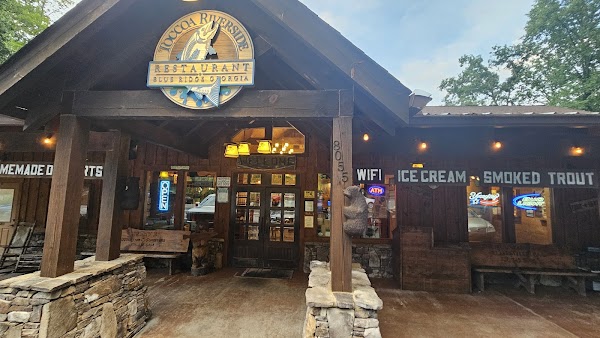
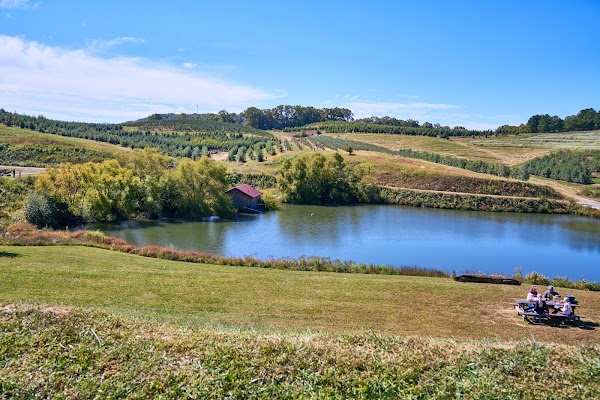
Blue Ridge itself is a working tourism economy built around the Blue Ridge Scenic Railway, the Toccoa River, and a Main Street of restaurants, outfitters, and short-term rentals. The local food anchor for waterfall day-trippers is Mercier Orchards, an 1940s family-run orchard with hard cider, fried pies, and a peak fall apple harvest that overlaps with the October waterfall window; Harvest on Main is the sit-down dinner option, and the Toccoa Riverside Restaurant on Aska Road is the closest real meal to the trailhead. Ellijay, 20 minutes south, is the alternate base if Blue Ridge cabins are booked, especially in October.

Photography practical

The Long Creek Falls light window is short but workable. The corridor faces roughly south-southeast through a dense hardwood and hemlock canopy, so direct sun rarely hits the cascade for more than an hour at midday. For most of the year, overcast or lightly drizzling days are the easiest light: even tones, no blown highlights, saturated greens. Morning is better than afternoon because filtered light comes through the trees from the left side of the falls and gives the two-tier rock face dimension.

Three working positions: the flat at the base of the lower tier (the signature stacked-tier frame), about 20 feet up the spur for an isolated upper-tier shot through rhododendron, and from the creek-level rocks downstream of the pool for a leading-line frame with the cascade as the vanishing point. A polarizer helps with leaf glare on wet rhododendron; a tripod is worth carrying for one- to two-second exposures that smooth the fan. Skip wide zooms longer than about 50mm equivalent; the corridor is too tight to use the long end. Drone flight here is restricted by both USFS rules and the wider A.T. corridor policy; do not plan on aerials.

Map and route

Two-mile out-and-back from Three Forks parking.

From Blue Ridge, drive south on Aska Road and connect to Forest Service Road 58 via Doublehead Gap Road; from Atlanta, take GA-400 north to GA-52 east, then Doublehead Gap Road to FS 58. Three Forks parking is at the point where the A.T. crosses FS 58. From the lot, walk north on the A.T. (white blaze) for about 0.8 mile to the signed Long Creek Falls junction; the blue-blaze spur drops left a short 0.1 mile to the base. FS 58 is gravel for the last several miles and washboards rough after heavy rain.

Photography and weddings

East-facing fan, late-morning light, no permit needed for personal photography in the NF.

The signature Long Creek Falls frame is from the small flat at the base of the lower tier, where the two-tier cascade stacks vertically in the lens and rhododendron and hemlock close in tight around the rock face. A second working position is about 20 feet up the spur trail, where you can isolate the upper drop through the trees. The shaded plunge pool below the lower tier is the third frame, especially after rain when it briefly fills.

Overcast and lightly drizzling days are easiest because the hardwood canopy is dark and direct sun blows out the white cascade. The corridor faces roughly south-southeast, so morning light filters through the trees from the left side of the falls and is the cleanest moving-water light of the day. Long exposures of one to two seconds smooth the fan; faster than 1/60 freezes the two separate steps.

Personal photography from the public spur trail does not require a permit. Commercial productions, large workshops, and drone flights require USDA Forest Service authorization through the Toccoa Ranger District; drone flights are also restricted in the wider Appalachian Trail corridor.

Permits

Weddings and engagements

This is a natural-surface backcountry trail in a national forest, not a developed wedding venue. It can work for very small elopement or engagement sessions, but it is not a fit for a full ceremony.

For any organized group or ceremony, file a special-use authorization with the Toccoa Ranger District in advance.

Keep parties small (typically 6 or fewer including the officiant and photographer) and do not block the A.T. or BMT corridor; thru-hikers and dayhikers share the same single-track.

Nearby waterfalls

Five North Georgia waterfalls inside an hour drive.

Long Creek pairs naturally with DeSoto, Anna Ruby, Helton Creek, Dukes Creek, and Blue Hole. All sit on the same Blue Ridge metamorphic terrane and all open from the same Helen and Blue Ridge base towns.

Related questions

More questions visitors ask before driving to Long Creek.

Trail length, the AT and BMT junction, dog policy, fee status, and disambiguation from the Long Creek Falls in Oconee County South Carolina. All entries also index in the FAQ schema for AI answer engines.

01Where is Long Creek Falls?

Long Creek Falls is in Fannin County, Georgia, inside the Chattahoochee-Oconee National Forest, about 21 miles southeast of downtown Blue Ridge. The trailhead is the Three Forks parking pull-offs on Forest Service Road 58, off Doublehead Gap Road.

02How tall is Long Creek Falls?

25 feet. The Appalachian Trail Conservancy and Wikidata both list the named drop at 25 feet, in two distinct tiers. Some cabin-rental and tourism sites describe the broader cascade complex as 35 to 50 feet by including the upstream and downstream chutes; the photographed named falls is the shorter two-tier drop.

03When is the best time to visit Long Creek Falls?

March through May is best for flow, with the cascade thickening within 24 hours of any half-inch rain. October is the second-best window for hardwood color through the corridor; flow then depends on recent rain. Weekday mornings before 10 a.m. are the quietest, especially during the March-April A.T. thru-hiker wave.

04Is Long Creek Falls worth visiting?

Yes, if you accept that the falls itself is compact rather than huge. The payoff is the combination: a 25-foot two-tier cascade in a tight hemlock-and-rhododendron corridor, reached on a 2-mile walk that is literally a piece of the Appalachian Trail, at the junction where the A.T. and the Benton MacKaye Trail split. That mix is rare in Georgia and worth the gravel drive on FS 58.

Sources and data

Where the Long Creek guide gets its facts.

Trail and forest-road conditions from the USFS Chattahoochee-Oconee Toccoa Ranger District. AT and BMT junction context from the Appalachian Trail Conservancy and the Benton MacKaye Trail Association. Geology from the Georgia Geological Survey on the Blue Ridge province.

USFS: Chattahoochee-Oconee National Forest fs.usda.gov
Access, parking, and permit rules: fs.usda.gov
Georgia Geological Survey: Blue Ridge metamorphic terrane: Blue Ridge bedrock epd.georgia.gov
NOAA / NWS Peachtree City forecast grid FFC 55,128 noaa.gov
USGS National Elevation Dataset 3DEP
Wikidata: Q6672477 (Long Creek Falls) wikidata.org
Google Maps: embedded map and directions maps.google.com
Google Places: nearby restaurants and hotels places API
USDA Forest Service: Chattahoochee-Oconee National Forest (Toccoa Ranger District) fs.usda.gov
Appalachian Trail Conservancy: Three Forks to Long Creek Falls appalachiantrail.org
AllTrails: Long Creek Falls via Appalachian and Benton MacKaye Trail alltrails.com
Visit Blue Ridge: Long Creek Falls (Blue Ridge Mountains, GA) blueridgemountains.com
Benton MacKaye Trail Association: Hikes with Waterfalls bmta.org
Wikipedia: Long Creek Falls (Georgia) en.wikipedia.org
Wikidata: Long Creek Falls (Q6672477) wikidata.org
Atlanta Trails: Hiking the Appalachian Trail at Three Forks to Long Creek Falls atlantatrails.com
Fact checks
Distance cross-check: Appalachian Trail Conservancy lists 1.8 mi round trip; AllTrails and Atlanta Trails list 1.9 mi; rounded to 2 mi in tourism listings. Editorial uses the 2-mile out-and-back framing with the ATC and AllTrails figures cited.
Height cross-check: ATC and Wikidata list the named drop at 25 ft in two tiers; a small number of cabin-rental sites describe a broader 35-50 ft cascade complex. Editorial uses 25 ft and notes the discrepancy.
Junction cross-check: Visit Blue Ridge, the Benton MacKaye Trail Association, and the USFS Toccoa Ranger District all confirm Three Forks as the junction of the Appalachian Trail, Benton MacKaye Trail, and Duncan Ridge Trail.
Fee cross-check: USDA Forest Service confirms Three Forks itself has no posted day-use fee; the $5 USFS day-use pass applies at developed Chattahoochee-Oconee fee sites such as Anna Ruby Falls. Editorial only references the $5 fee in that context.
Corrections: [email protected]