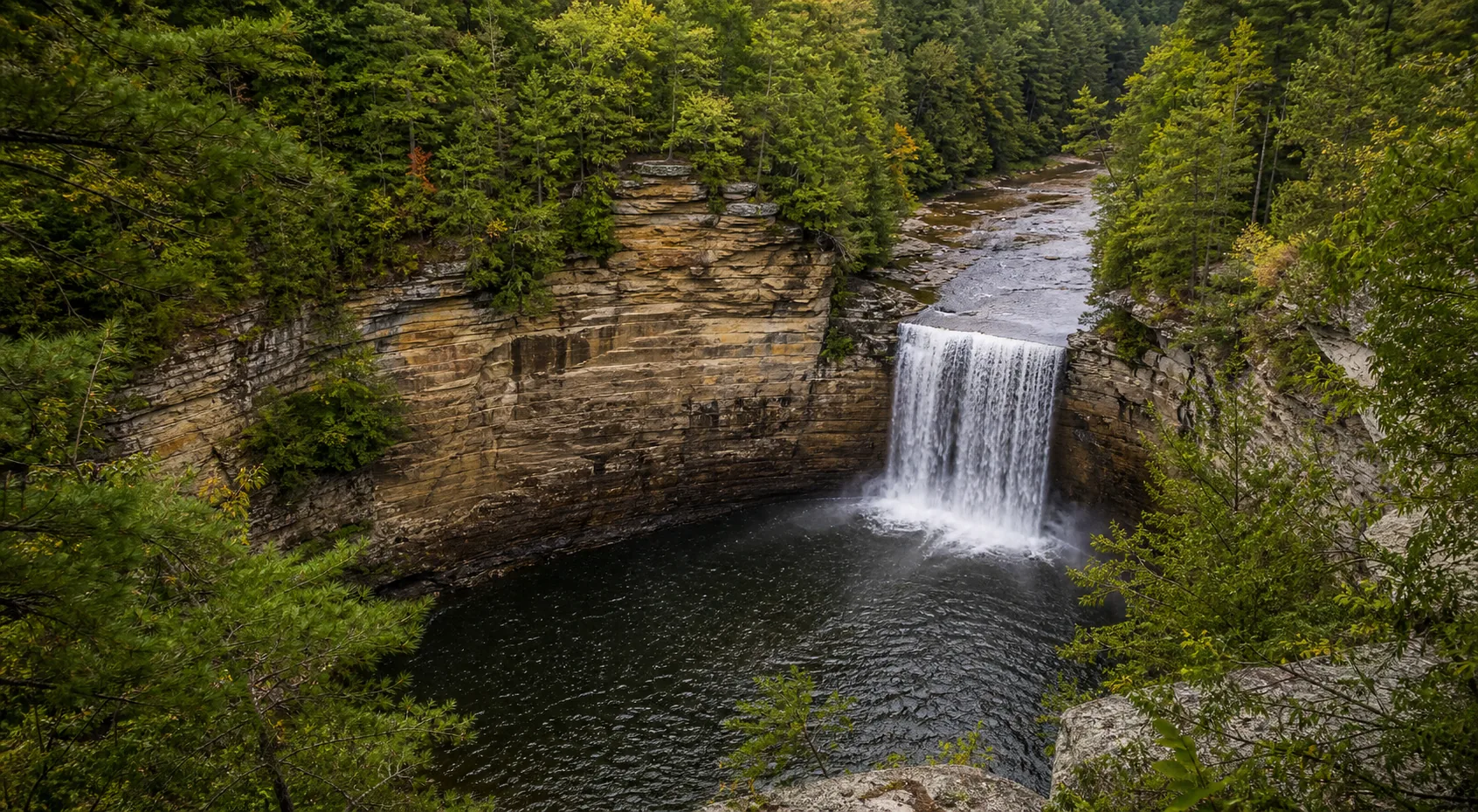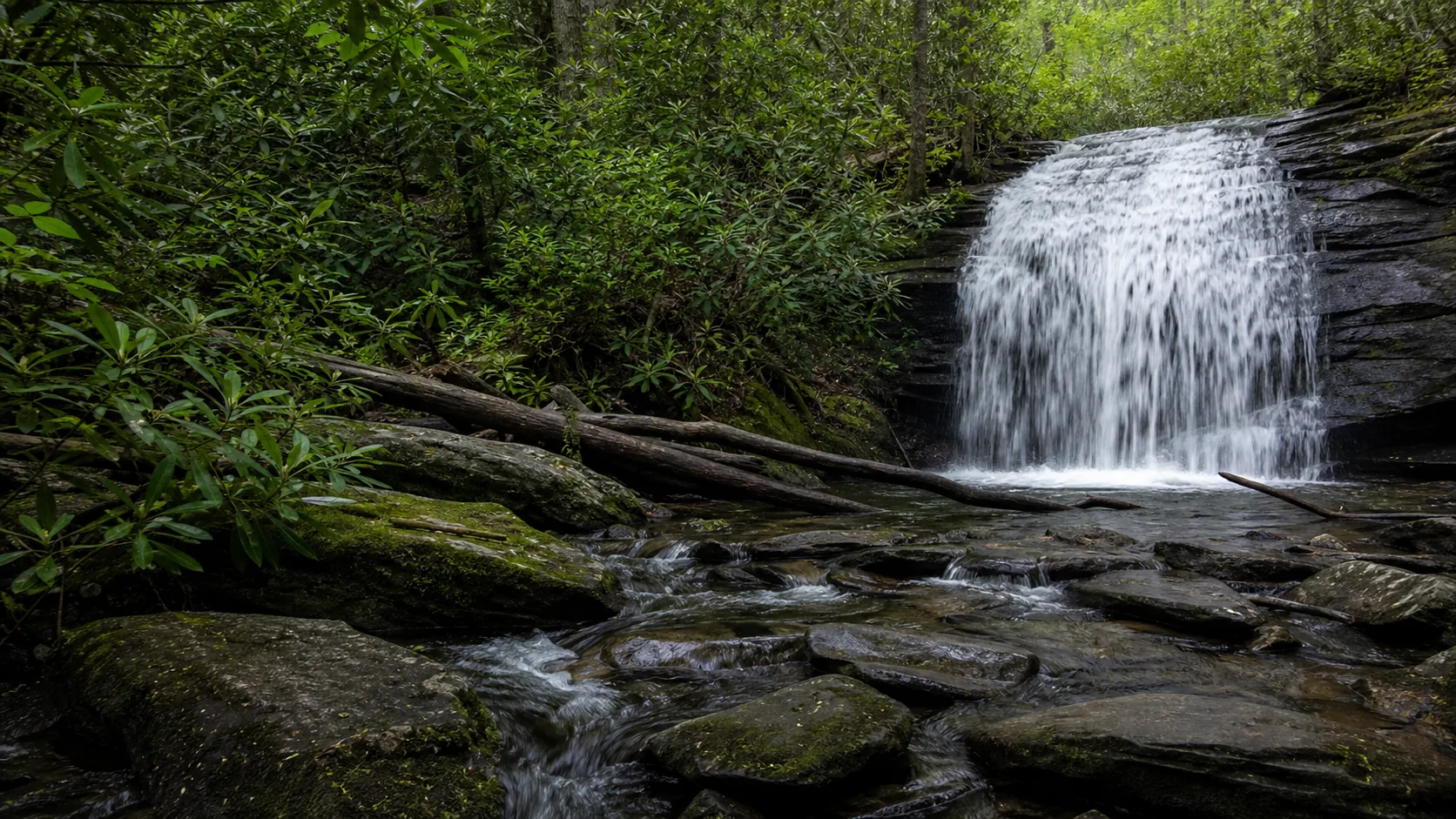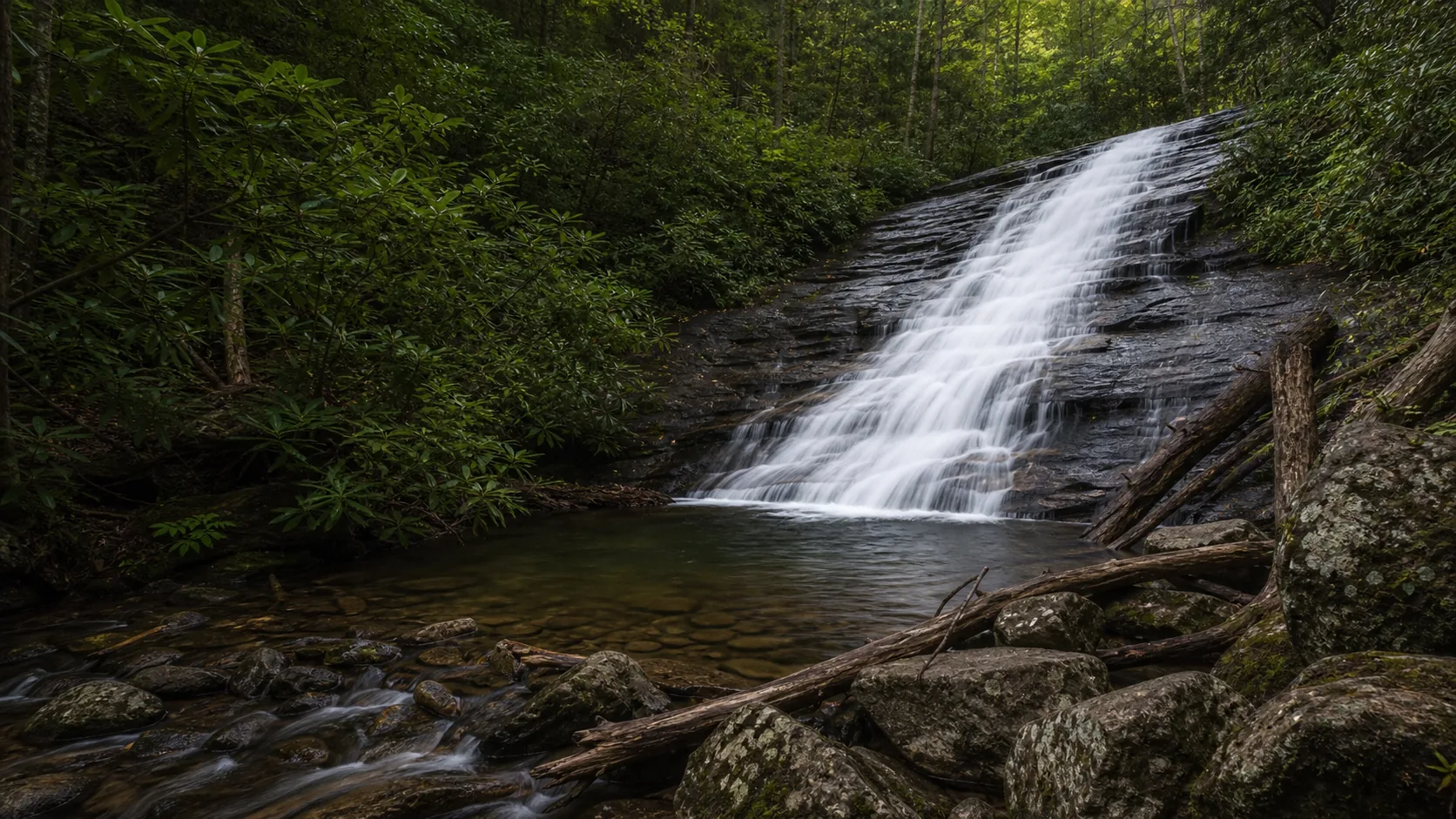
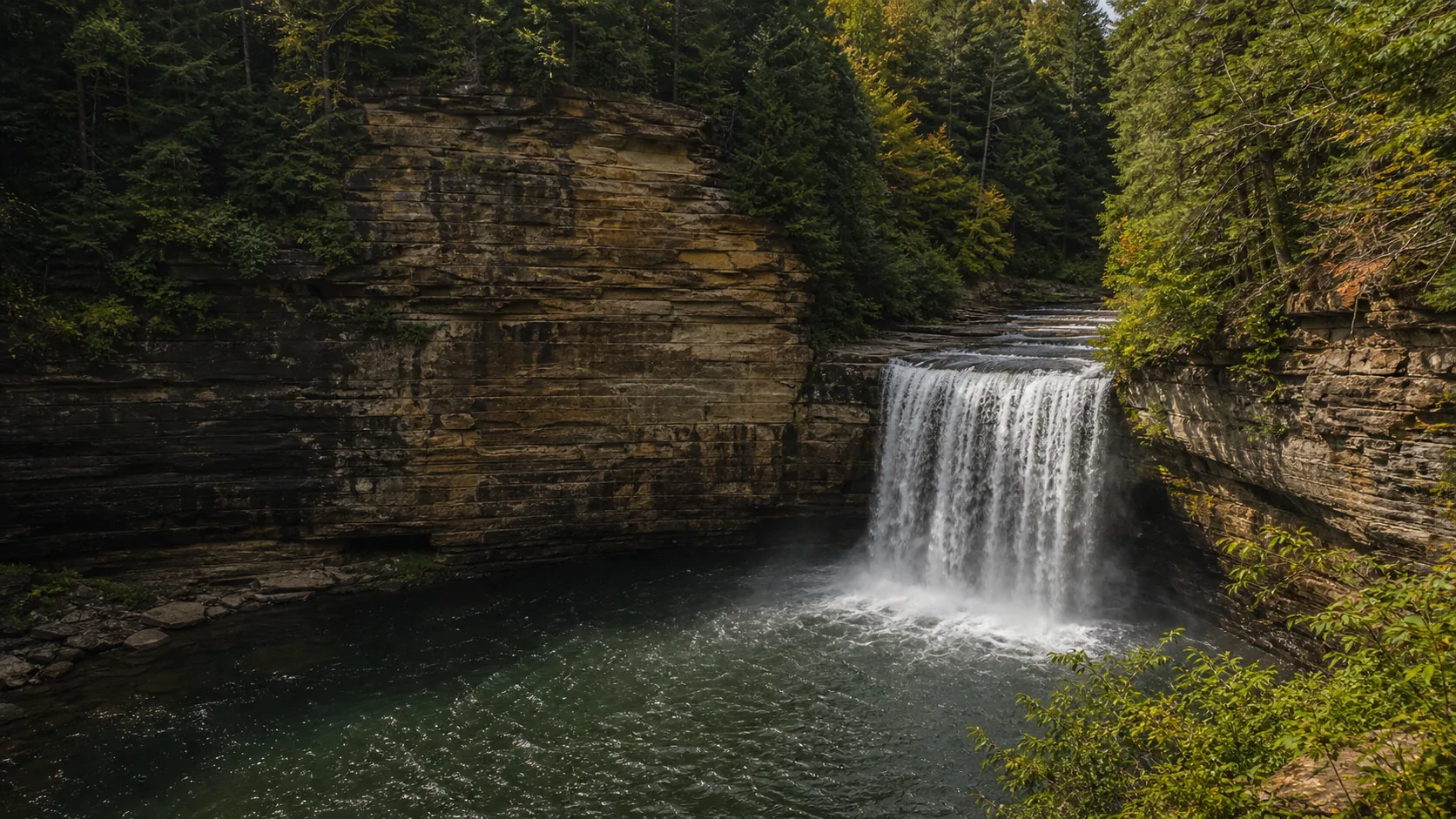
Cane Creek Falls plunging 85 feet from the Cumberland Plateau caprock into Cane Creek Gorge
Spencer, TN

Cane Creek Falls

Cane Creek Falls is an 85-foot plunge inside Fall Creek Falls State Park on the Cumberland Plateau of Middle Tennessee, where Cane Creek leaves the plateau caprock and drops into Cane Creek Gorge a short paved walk from the park Nature Center. It is the largest-by-volume waterfall in the park and the one most visitors pair with the much taller Fall Creek Falls (256 feet) on the same loop. The state park is free to enter, the main overlook is family-friendly, and the descent to the base is a separate, much harder trip.

Last verified May 12, 2026 Visited Desk-verified May 2026 7 sources checked
Trail 0.4 mi 4.5 mi extended
Time 15-180 min Easy at overlook, strenuous to base
Best season Mar-May for peak flow; Oct for fall color; after rain year-round March through May
Parking Free Nature Center lot. No state park entry fee. Spaces fill on summer and fall-color weekends; arrive before 10am or after 3pm. Fall Creek Falls State Park
Quick answer

Is Cane Creek Falls worth visiting?

Yes. The two best windows are March through May for the heaviest spring flow and the first two weeks of October for fall color in the gorge. The state park is free, parking at the Nature Center is free, and the main Cane Creek Falls overlook is a short paved walk from the lot with railings and a stroller-friendly grade. The descent to the base on the Cable Trail is a separate, very strenuous trip that should be skipped when the rock is wet.

  • 85-foot plunge near the Nature Center
  • Best windows: Mar-May and Oct
  • Free state park entry and free parking
  • Short paved overlook from the lot
  • Cable Trail to base is strenuous; skip if wet
  • Pairs with Fall Creek Falls (256 ft) on the loop
Last verified May 12, 2026 Visited Desk-verified May 2026 7 sources checked
Distance 0.4 mi 4.5 mi extended
Round trip 15-180 min Paved overlook is short and family-friendly; the Cable Trail descent to the base is rated very strenuous with a fixed cable for hand support
Difficulty Easy at overlook, strenuous to base Paved overlook is short and family-friendly; the Cable Trail descent to the base is rated very strenuous with a fixed cable for hand support
Location Spencer, TN Fall Creek Falls State Park
Parking Free Nature Center lot. No state park entry fee. Spaces fill on summer and fall-color weekends; arrive before 10am or after 3pm. TN State Parks
Transit No fixed-route transit Park is rural; drive from Nashville, Chattanooga, or Knoxville · 0 ft
Drive 14 mi 25 min from downtown
Best season Mar-May for peak flow; Oct for fall color; after rain year-round March through May
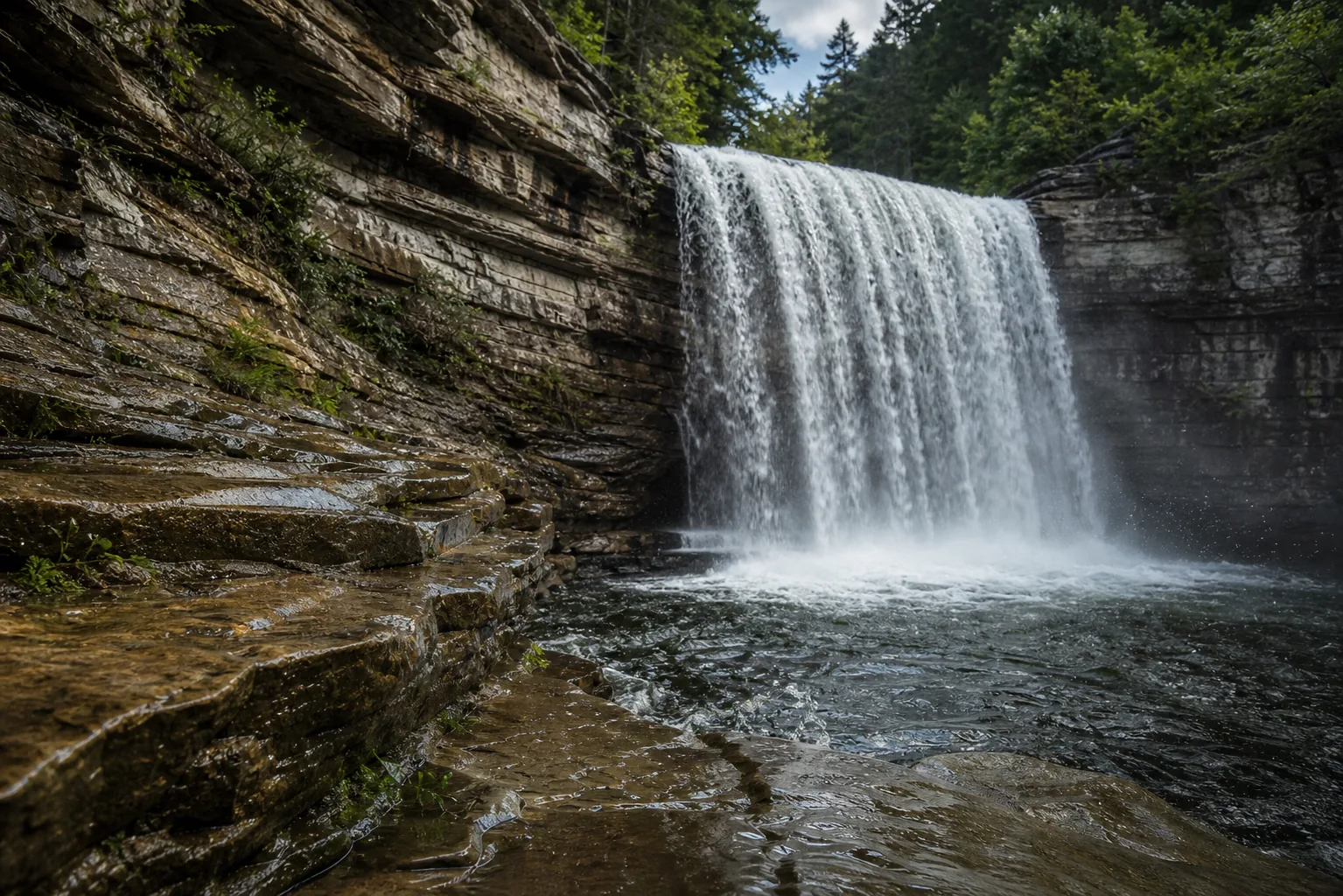
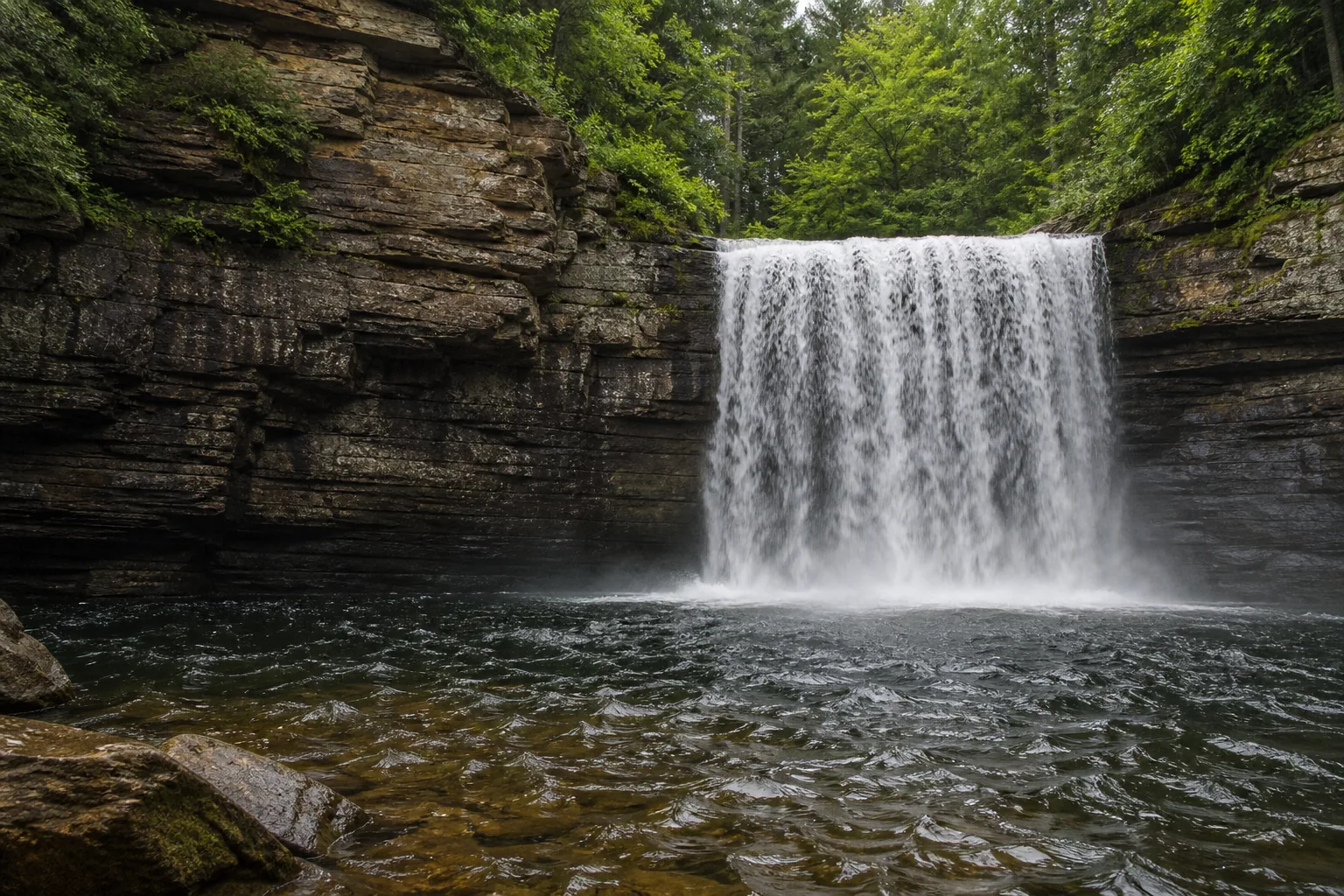
Cane Creek Falls plunge column and base pool, the same view reached by the strenuous cable trail
Photo guide

Three working angles on an 85-foot Cumberland Plateau plunge.

The Nature Center overlook gives the standard cross-gorge frame. The suspension bridge looks upstream at Cane Creek Cascade. The base view from the Cable Trail is the bottom-up shot, but only when the rock is dry.

Cane Creek Falls plunging 85 feet from the Cumberland Plateau caprock into Cane Creek Gorge
Cane Creek Falls, hero composition
Cane Creek Falls wide view from the Nature Center overlook with the Cumberland Plateau caprock rim visible
Wide gorge view from the Nature Center overlook with the 85-foot plunge anchoring the canyon wall
Cane Creek Falls plunge column hitting the base pool inside Cane Creek Gorge
Plunge column and base pool, the same view reached by the strenuous Cable Trail
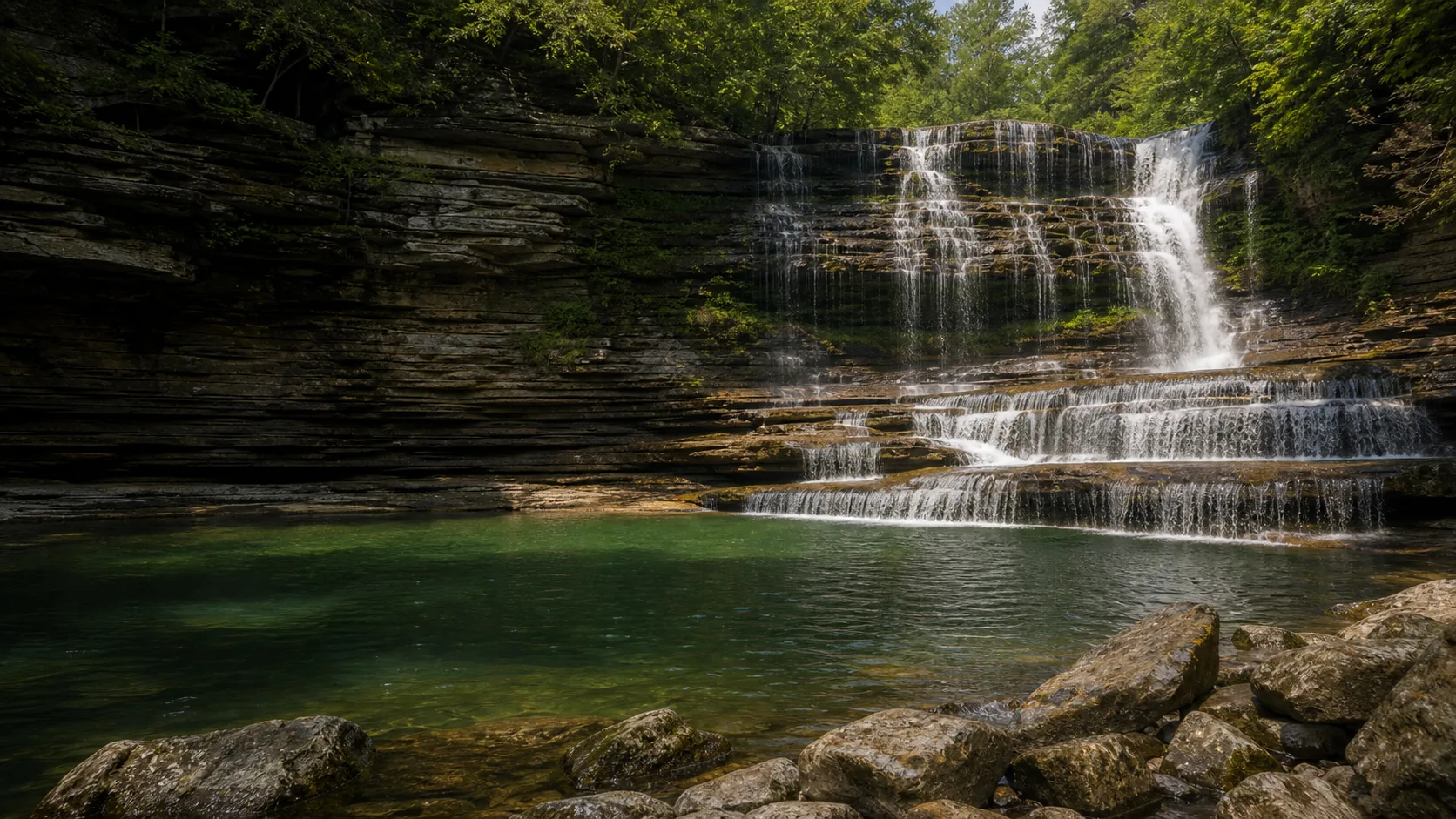
Cane Creek Falls caprock lip and sandstone wall in Fall Creek Falls State Park
Caprock lip and sandstone wall where the falls leaves the plateau edge
01Is Cane Creek Falls flowing right now?

This guide does not pair Cane Creek Falls with a verified real-time USGS discharge gauge, so the flow chip is intentionally hidden.

Cane Creek does not have a paired live USGS gauge at the falls. Use recent rainfall and the Tennessee State Parks alerts page as the practical flow check before driving.

02How long is the walk?

The Cane Creek Falls main overlook is a short paved walk (about 0.2 mile) from the Nature Center parking lot. The Cable Trail descent to the base is roughly 0.3 mile one way but is rated very strenuous because of the fixed cable section.

03How do you get there?

Drive to the Fall Creek Falls State Park Nature Center near 2009 Village Camp Road, Spencer, TN 38585. From Nashville: I-24 east, exit at TN-111 north, then TN-30 east into the park, about 2 hours total. From Chattanooga: TN-111 north, then TN-30 east, about 90 minutes.

04Is there free parking?

Free parking at the Nature Center lot serves the Cane Creek Falls overlook, the suspension bridge, and the Cable Trail. Spaces fill on summer and fall-color weekends; arrive before 10am or after 3pm, or use the overflow lot at the park visitor center.

05Does it cost money?

Free. There is no entry fee for Fall Creek Falls State Park and no parking fee at the Nature Center lot. Camping, cabins, the inn, and special-use permits do have fees.

06Trail variants

Nature Center overlook 0.4 mi out-and-back, 15-30 min, paved path from Nature Center parking; stroller-friendly to the main overlook deck.
Suspension Bridge loop 0.6 mi loop, 30-45 min, crosses Cane Creek above the falls on the swinging suspension bridge; views of Cane Creek Cascade upstream.
Cable Trail to base of Cane Creek Falls 0.6 mi out-and-back, 45-90 min, very strenuous; fixed steel cable for hand support; closed in wet, icy, or unsafe conditions.
Gorge Overlook loop with Fall Creek Falls 4.5 mi loop, 2.5-3.5 hr, pairs Cane Creek Falls, Rockhouse Falls, Cane Creek Gorge Overlook, and the Fall Creek Falls overlook.

Detailed maps and recent reviews: Falls route on AllTrails · Creek route on AllTrails

07Can you swim?

No. Swimming is not permitted at the base of Cane Creek Falls or in Cane Creek Cascade upstream. The plunge pool has produced fatal drownings; park rangers have repeatedly flagged deceptive surface currents and submerged hydraulics. Use the Fall Creek Lake swim area for swimming inside the park.

08Are dogs allowed?

Yes, on a 6-foot leash, throughout Fall Creek Falls State Park trails and overlooks. Carry water for your dog in summer; the plateau gets hot, and there is no safe creek access from the overlook.

09Is it accessible?

The Nature Center building and the main paved Cane Creek Falls overlook are wheelchair accessible. The suspension bridge has stairs and gaps that limit wheelchair use. The Cable Trail is not accessible.

Field notes

Cane Creek Falls at a glance.

85-foot plunge over Pennsylvanian sandstone caprock, inside Fall Creek Falls State Park, managed by Tennessee State Parks, free to enter, free parking at the Nature Center.

Height 85 ft USGS 3DEP
Type Plunge (single tier) USGS
Rock Pennsylvanian sandstone caprock over weaker Pennington shale and Mississippian limestone Tennessee Geological Survey: Cumberland Plateau Pennsylvanian sandstone and stratigraphy
County Van Buren Spencer, TN
Managed by Tennessee State Parks TN State Parks
Water source Cane Creek USGS
Elevation 1673 ft USGS NED
Park area 26,000 acres TN State Parks
Hours Park gates 7am to 10pm; the Nature Center area and the Cane Creek Falls overlook are typically accessible during daylight TN State Parks
When to visit

Two windows that justify the drive.

March through May for spring runoff. The first two weeks of October for fall color in the gorge. Summer is greener but lower-flow; winter is quiet but the Cable Trail closes when the rock is wet or icy.

PEAK FLOW

Peak flowMarch through May
Ice / low flowHard freeze rare; partial ice possible Jan-Feb
Most crowdedWeekends and midday
Best photosSunrise or weekdays

Live water context

Discharge data -- This guide does not pair Cane Creek Falls with a verified real-time USGS discharge gauge, so the flow chip is intentionally hidden.

Why is it called Cane Creek Falls?

Cane Creek Falls takes its name from Cane Creek, the plateau stream that feeds it. The creek was named for the dense stands of native river cane (Arundinaria gigantea), a true bamboo, that once lined the gorge bottom and the creek's lower banks. Cane was a useful native plant for the Cherokee and earlier Indigenous communities in the region. The falls inherited the creek's name; the same naming pattern produces Cane Creek Cascade upstream and Cane Creek Gorge as the canyon that holds both.

What else to do at Fall Creek Falls State Park

Fall Creek Falls State Park is the largest state park in Tennessee, covering more than 26,000 acres of Cumberland Plateau forest, plateau-edge waterfalls, and gorge country roughly halfway between Nashville and Chattanooga, with Spencer as the base town. Cane Creek Falls is one of five waterfalls inside the park; the others are Cane Creek Cascade (a quiet 45-foot ledge upstream of the falls), Rockhouse Falls (an 85-foot plunge on Rockhouse Creek visible from the same overlook complex), Piney Falls (95 feet, in a quieter side gorge), and Fall Creek Falls itself, a 256-foot plunge that is one of the tallest east of the Mississippi. Most visitors start at the Fall Creek Falls Nature Center, which sits a few minutes' walk from the Cane Creek Falls overlook.

  • Fall Creek Falls Nature Center. Anchor building for the Cane Creek Falls overlook, with exhibits, restrooms, free parking, and the trailhead for the suspension bridge and Cable Trail.
  • Cane Creek Falls overlook deck. Paved approach from the Nature Center lot, railed view of the 85-foot plunge into Cane Creek Gorge, stroller-friendly.
  • Suspension bridge over Cane Creek. Swinging bridge above Cane Creek Cascade, connecting the Nature Center side of the gorge to the rim trails on the far bank.
  • Cable Trail to the base. A short, very strenuous descent with a fixed steel cable for hand support; the only on-foot route to the base pool of Cane Creek Falls.
  • Five-falls itinerary. Cane Creek Falls, Cane Creek Cascade, Rockhouse Falls, Piney Falls, and the 256-foot Fall Creek Falls itself, all reachable from a single park visit.

Why it looks this way

Cane Creek Falls is a Cumberland Plateau caprock waterfall. The lip is a hard band of Pennsylvanian-age sandstone, the same resistant sandstone that armors the plateau rim across Middle Tennessee. The wall behind the falls and the floor of Cane Creek Gorge expose weaker Pennington Formation shales and Mississippian-age limestones underneath. The creek erodes the softer rock faster than the cap, the sandstone overhangs, slabs fail, and the lip retreats upstream a small amount each century. The same mechanic produces Fall Creek Falls a short distance away, and the same caprock geology produces Cummins Falls and the other plateau-edge waterfalls of the Cumberland.
Field guide deep dive

What the Nature Center overlook does not put in a placard.

The 85-foot plunge, the Cumberland Plateau caprock that produces it, the five-falls layout of the largest state park in Tennessee, the two Cane Creek Falls you should not confuse, and the honest read on the base trail.

How Cane Creek Falls formed

Cane Creek Falls is a Cumberland Plateau caprock waterfall, which is the same engineering pattern that produces most of the famous waterfalls in Middle Tennessee. The plateau is a broad, flat-topped highland armored by a hard cap of Pennsylvanian-age sandstone. Underneath sit weaker rocks: the shales of the Pennington Formation and the older Mississippian-age limestones of the Bangor and Monteagle units. Plateau streams like Cane Creek run on top of the sandstone until they reach the rim. There, they leave the cap, drop into softer rock, and start cutting a gorge.

The mechanic at the lip is straightforward. The creek erodes the soft shale and limestone behind and under the sandstone faster than the cap itself. The sandstone overhangs, develops fractures, and eventually a slab fails and falls into the plunge pool. Each failure shifts the lip a few feet upstream and deepens the bowl behind the curtain. Over thousands of years the same process built Cane Creek Gorge: a horseshoe of cliff with Cane Creek Falls on one wall, Rockhouse Falls on a tributary, and the broader gorge that Fall Creek itself eventually drops into.

Cane Creek Falls is the largest by volume of the five waterfalls in Fall Creek Falls State Park, even though the much taller Fall Creek Falls (256 feet) gets the brochure cover. The volume difference comes from the drainage area: Cane Creek collects a larger watershed before it reaches its lip than Fall Creek does before reaching its own.

The five waterfalls of Fall Creek Falls State Park

Fall Creek Falls State Park is the largest state park in Tennessee, with more than 26,000 acres of plateau forest, plateau-edge gorges, and the small mid-park Fall Creek Lake. Five named waterfalls sit inside the park, and four of them are reachable from a single afternoon centered on the Nature Center.

Cane Creek Falls is the 85-foot plunge described on this page, the closest waterfall to the Nature Center. Cane Creek Cascade is a quieter 45-foot ledge a short distance upstream of the falls, viewable from the suspension bridge. Rockhouse Falls is a separate 85-foot plunge on Rockhouse Creek that drops into the same gorge as Cane Creek Falls and is visible from the same overlook complex; the two falls share a meeting point at the gorge floor just below their respective base pools. Piney Falls is a 95-foot plunge in a quieter side gorge of the park, reached on a longer hike. Fall Creek Falls itself is the 256-foot plunge on Fall Creek a couple of miles south by road, with its own paved overlook and a separate descent route.

If you have one half day, drive to the Nature Center, walk to the Cane Creek Falls overlook, cross the suspension bridge to read Cane Creek Cascade and the Rockhouse Falls view, then drive south to the Fall Creek Falls overlook. That itinerary covers four of the five park waterfalls without any major hiking and works for families and most mobility levels.

The Nature Center overlook vs the Cable Trail to the base

Cane Creek Falls is one of the easiest 85-foot waterfalls in Tennessee to read from above and one of the harder ones to reach from below. That split matters when planning your visit.

The Nature Center overlook is a short paved walk from the free Nature Center parking lot. It is railed, stroller-friendly to the deck, and gives the standard cross-gorge view of the plunge. Total time from the car to the overlook is about 5 minutes. This is the visit most people make.

The Cable Trail to the base of Cane Creek Falls is a different trip. It is short on the map (about 0.3 mile one way) but rated very strenuous by Tennessee State Parks. The crux is a steep section of bare sandstone where a fixed steel cable is bolted into the rock for hand support; you hold the cable and lower yourself down with care. The trail descends roughly 200 feet into the gorge in that short distance. At the bottom you reach the base pool of the falls, looking up at the column. The return is the same route in reverse, mostly hands-and-feet climbing on the cable section.

The Cable Trail is closed in wet, icy, or unsafe conditions, and it should not be attempted with small children, in trail runners with worn tread, or with anything bulky in your hands. The base pool itself is dangerous (more on that below); the trip is about the view from the bottom, not the swim.

The two Cane Creek Falls in Tennessee, and how to tell them apart

There are two named Cane Creek Falls in Tennessee, and visitors confuse them often enough that disambiguation belongs on the page.

This guide covers Cane Creek Falls in Fall Creek Falls State Park, Van Buren County, the 85-foot plunge near the Nature Center. It is the larger and far more famous of the two, sits on the Cumberland Plateau in Middle Tennessee, and is the one you reach by driving to Spencer and entering the state park.

The other Cane Creek Falls is a smaller waterfall in the Cumberland Mountain State Park area of Cumberland County, Tennessee, on a different Cane Creek (creek names are recycled across the state). It is much smaller, locally known but not a destination, and not the subject of this page.

There are also unrelated waterfalls named Cane Creek Falls in Georgia (on the grounds of Camp Glisson near Dahlonega) and in North Carolina near Highlands. If you are searching from out of state, append "Tennessee" or "Fall Creek Falls State Park" to your query, and use the map pin near 35.6623, -85.3510 to confirm.

The Cumberland Plateau waterfall cluster

Cane Creek Falls sits inside one of the densest waterfall clusters in the eastern United States. The Cumberland Plateau in Middle Tennessee is a flat highland with deep, narrow gorges cut into its rim by hundreds of streams, and most of those gorges hold a named waterfall or three. The cluster is the reason a long weekend can pack in five to ten major falls without driving more than two hours total.

The natural pairings are: Cane Creek Falls (this page) with the other four falls inside Fall Creek Falls State Park; Cummins Falls at Cummins Falls State Park about 90 minutes north, a 75-foot waterfall with a famous gorge pool (and its own permit and weather-closure rules); Burgess Falls between them at Burgess Falls State Park, a four-waterfall sequence on the Falling Water River; and Piney Falls Natural Area south of Fall Creek Falls, which holds its own plateau-edge waterfalls separate from the Piney Falls inside the state park.

All of these falls share the same caprock-undercut geology described above. They look like cousins because they are: a hard sandstone lip, a softer rock behind, a deep gorge below, and a long-running retreat upstream.

Swimming at Cane Creek Falls and Cane Creek Cascade

The honest read on swimming at Cane Creek Falls is that you should not. The base pool of the 85-foot plunge has produced fatal drownings, and Tennessee State Parks rangers have repeatedly flagged deceptive currents in both Cane Creek Falls and Cane Creek Cascade upstream. The danger pattern is the one that produces most waterfall drownings: surface water looks calm, but the plunging column creates a recirculating hydraulic at the bottom that traps swimmers against submerged rock, and water temperature at the base of a plateau gorge can drop quickly even in summer. The pools also vary in depth, with hidden boulders that have caused diving and slip injuries.

Swimming is not permitted at the base of Cane Creek Falls or in Cane Creek Cascade. The Cable Trail leads to the gorge floor for the view, not for water access. If you want to swim inside Fall Creek Falls State Park, the designated swim area is at Fall Creek Lake, the small mid-park lake near the inn and group lodge, where the bottom is sandy, depths are posted, and seasonal lifeguarding has been provided in past summers. For wading or rock-hopping, the small unnamed feeder creeks along the park's day-use trails are safer than any pool inside the gorge.

Map and route

Two hours east of Nashville, 90 minutes north of Chattanooga.

Drive to the Fall Creek Falls State Park Nature Center near 2009 Village Camp Road, Spencer, TN 38585. From Nashville: I-24 east, exit at TN-111 north, then TN-30 east into the park, about 2 hours total. From Chattanooga: TN-111 north, then TN-30 east, about 90 minutes.

Photography and weddings

Good light, safer footing, fewer surprises.

There are three working positions for Cane Creek Falls. The Nature Center overlook is the standard frame, putting the 85-foot column against the sandstone wall with the lip visible at the top. The suspension bridge view looks upstream toward Cane Creek Cascade, which is the better cascade-and-pool shot. The base-of-falls view from the Cable Trail is the dramatic bottom-up frame, but it requires the strenuous descent and is unsafe in wet or icy conditions.

The gorge faces broadly south, so midday light tends to flatten and overexpose the cliff face. Soft overcast light, the hour after sunrise, or the hour before sunset gives the cleanest waterfall photos. Late October light is especially clean because the sun stays lower and the gorge fills with yellow and red leaves.

Personal photography from the overlooks does not require a permit. Drone flight inside a Tennessee state park requires a written permit from the park manager; casual hobby drone use is prohibited.

Permits

Weddings and engagements

Cane Creek Falls and the nearby overlooks see small wedding parties and elopement portrait sessions in spring and fall. The Nature Center area can accommodate short ceremonies with a park special-use permit.

Tennessee State Parks special-use permits for weddings start near $100 and scale with group size. Apply through the Fall Creek Falls park office in advance.

The overlook is a public deck with foot traffic; weekday mornings are the calmest window. Keep the setup small and have a weather backup at the Nature Center or the inn on the lake.

Nearby waterfalls

Cumberland Plateau waterfall cluster.

Cane Creek Falls pairs naturally with the other four falls in the same state park, and with the broader Cumberland Plateau waterfall belt that runs from Cummins Falls south through Burgess Falls and into Fall Creek Falls itself.

Related questions

More questions visitors ask about Cane Creek Falls.

Disambiguation, dogs, swimming, hike length, and the difference between Cane Creek Falls and Fall Creek Falls. The full set is indexed in the FAQ schema for AI answer engines.

01Where is Cane Creek Falls?

Cane Creek Falls is inside Fall Creek Falls State Park in Van Buren County, Tennessee, near Spencer, on the Cumberland Plateau roughly halfway between Nashville and Chattanooga. The main overlook is a short paved walk from the Fall Creek Falls Nature Center.

02How tall is Cane Creek Falls?

Cane Creek Falls is an 85-foot plunge waterfall on Cane Creek. It is the largest by volume of the five waterfalls inside Fall Creek Falls State Park, though it is shorter than the park's namesake Fall Creek Falls (256 feet).

03Is Cane Creek Falls free?

Yes. Fall Creek Falls State Park has no entry fee and parking at the Nature Center lot is free. Camping, cabins, the park inn, and special-use permits (like wedding permits) carry separate fees.

04What is the difference between Cane Creek Falls and Fall Creek Falls?

Cane Creek Falls is the 85-foot plunge on Cane Creek near the Nature Center; it is the largest by volume in the park. Fall Creek Falls is the 256-foot plunge on Fall Creek a couple of miles south by road; it is one of the tallest waterfalls east of the Mississippi. Both sit inside the same state park (Fall Creek Falls State Park) and many visitors see both on the same day.

05Is Cane Creek Falls worth visiting?

Yes, especially in March through May for peak flow and the first two weeks of October for fall color in the gorge. The state park is free, the main overlook is a short paved walk, and you can pair Cane Creek Falls with Rockhouse Falls, Cane Creek Cascade, and the much taller Fall Creek Falls on the same visit.

Sources and data

Where the Cane Creek Falls guide gets its facts.

Tennessee State Parks Fall Creek Falls page. USGS for watershed context. Tennessee Geological Survey for Cumberland Plateau caprock geology. Wikipedia and Wikidata for height and confluence facts. Third-party guides for overlook viewpoint documentation.

TN State Parks: Fall Creek Falls State Park tnstateparks.com
Access, parking, and permit rules: tnstateparks.com
Tennessee Geological Survey: Cumberland Plateau Pennsylvanian sandstone and stratigraphy: Spencer bedrock tn.gov
NOAA / NWS Nashville (OHX) forecast grid 103,38 noaa.gov
USGS National Elevation Dataset 3DEP
Google Maps: embedded map and directions maps.google.com
Google Places: nearby restaurants and hotels places API
Tennessee State Parks: Fall Creek Falls State Park tnstateparks.com
Wikipedia: Cane Creek Falls (Tennessee) en.wikipedia.org
Wikimedia Commons: Cane Creek Falls image category commons.wikimedia.org
AllTrails: Cane Creek Falls and Suspension Bridge alltrails.com
Tennessee Trails Association: plateau trails reference tennesseetrails.org
World of Waterfalls: Cane Creek Falls, Rockhouse Falls, and Fall Creek Falls world-of-waterfalls.com
Waterfall Picture Guide: Cane Creek Falls in Fall Creek Falls State Park waterfall-picture-guide.com
Fact checks
Height audit: the 85-foot plunge figure for Cane Creek Falls is sourced to Wikipedia and corroborated by World of Waterfalls and Waterfall Picture Guide; the figure also matches the height given in Tennessee State Parks materials for the Cane Creek Falls overlook.
Free-access audit: Tennessee State Parks does not charge an entry fee at Fall Creek Falls State Park and parking at the Nature Center is free; camping, cabins, inn rooms, and special-use permits remain paid items.
Swim-safety audit: swim language is conservative and grounded in repeated Tennessee State Parks safety notices for the Cane Creek Falls and Cane Creek Cascade pools, including drownings recorded at the base of Cane Creek Falls.
Disambiguation audit: this page covers Cane Creek Falls in Fall Creek Falls State Park, Van Buren County; the much smaller Cane Creek Falls in the Cumberland Mountain State Park area of Cumberland County is a separate waterfall and is explicitly flagged in the long-form essay and the identity disambiguation list.
Corrections: [email protected]