North Carolina waterfalls

North Carolina waterfalls: four guides in the Pisgah and Chimney Rock orbit.

Practical guides to four North Carolina waterfalls inside the Pisgah Ranger District, Chimney Rock State Park, and the Toecane corridor north of Asheville. Verified trail length, fees, swim rules, and seasonal-access notes against USFS, NC State Parks, and Chimney Rock sources.

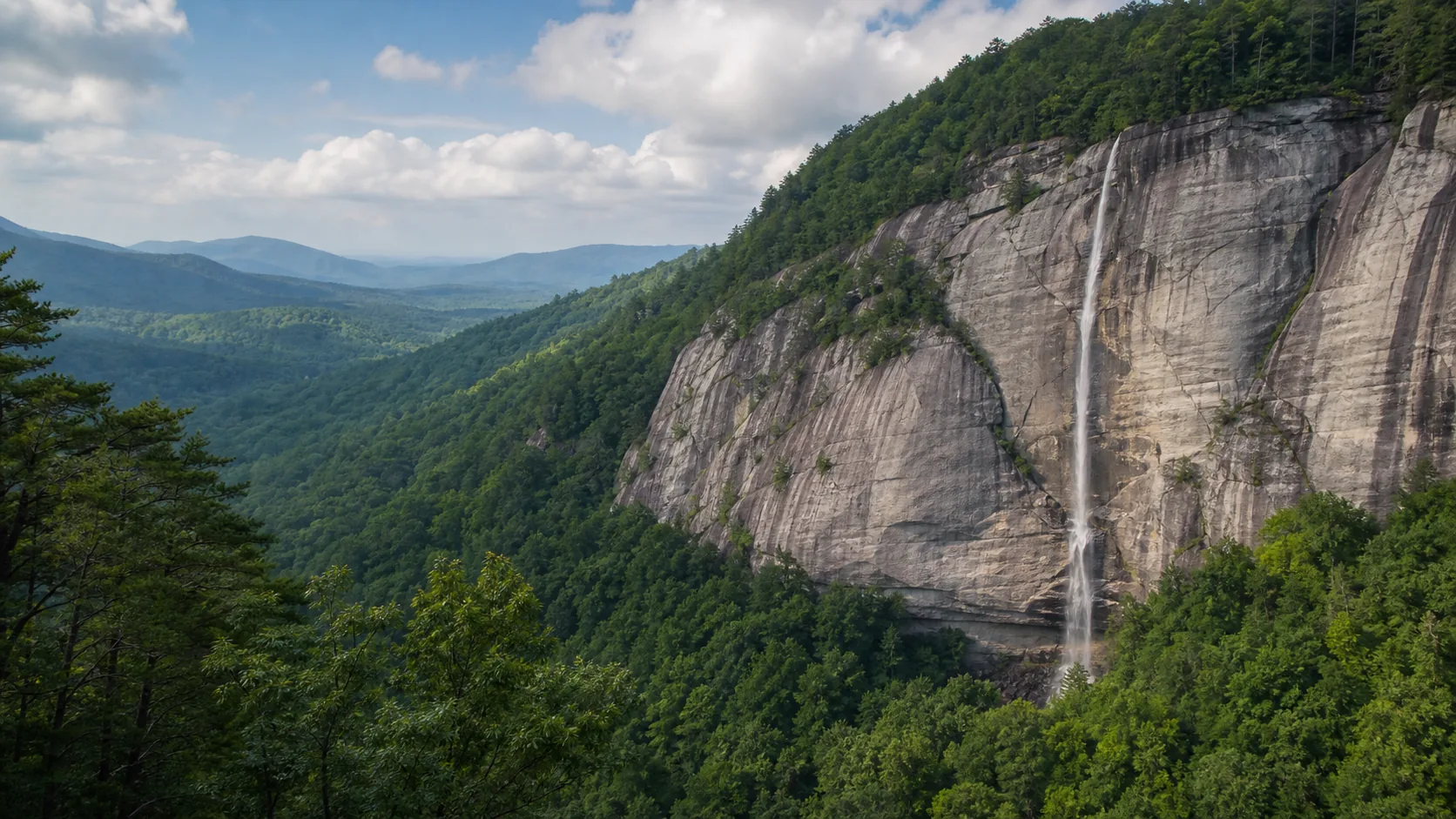
North Carolina is one of the highest-volume waterfall states in the country, and almost all of the headline drops cluster inside a single mountain crescent on the western side of the state. Transylvania County alone bills itself the Land of Waterfalls and registers more than 250 named falls inside its borders, the densest waterfall county in the Southeast. Pisgah National Forest, which wraps Brevard on three sides, holds the biggest concentration of those falls along the US 276 and NC 215 corridors, and DuPont State Recreational Forest just south of Brevard adds Triple Falls, High Falls, and Hooker Falls on the Little River drainage. East of that cluster, Chimney Rock State Park guards the Hickory Nut Gorge, where Falls Creek drops 404 feet down a near-vertical Henderson Gneiss wall.

The geology behind the cluster is the southern Blue Ridge Province, a thick package of Mesoproterozoic gneiss and schist roughly 1.1 billion years old that was folded and re-cooked during the Appalachian orogeny. The Brevard Fault Zone, a major strike-slip lineament that runs through Transylvania County, repeatedly fractures that crystalline basement rock and gives the streams the vertical joints and step-faulted ledges that produce a waterfall every few miles. The same rock package extends north through the Linville Gorge Wilderness on the Blue Ridge Parkway and east into the Hickory Nut Gorge, which is why Linville Falls, Crabtree Falls, and Hickory Nut Falls all share the same general structural setup.

This hub indexes the four North Carolina waterfall guides published on Waterfalls Guide so far. All four sit in the Pisgah and Chimney Rock orbit within about 90 minutes of Asheville, and three of them are short enough to combine into a single Pisgah waterfall day. Each guide carries verified trail length, parking fees, swim rules, and seasonal-access notes cross-checked against the US Forest Service Pisgah Ranger District, Chimney Rock State Park, and NC State Parks.

Three picks if you can only do one stop.

When to visit North Carolina.

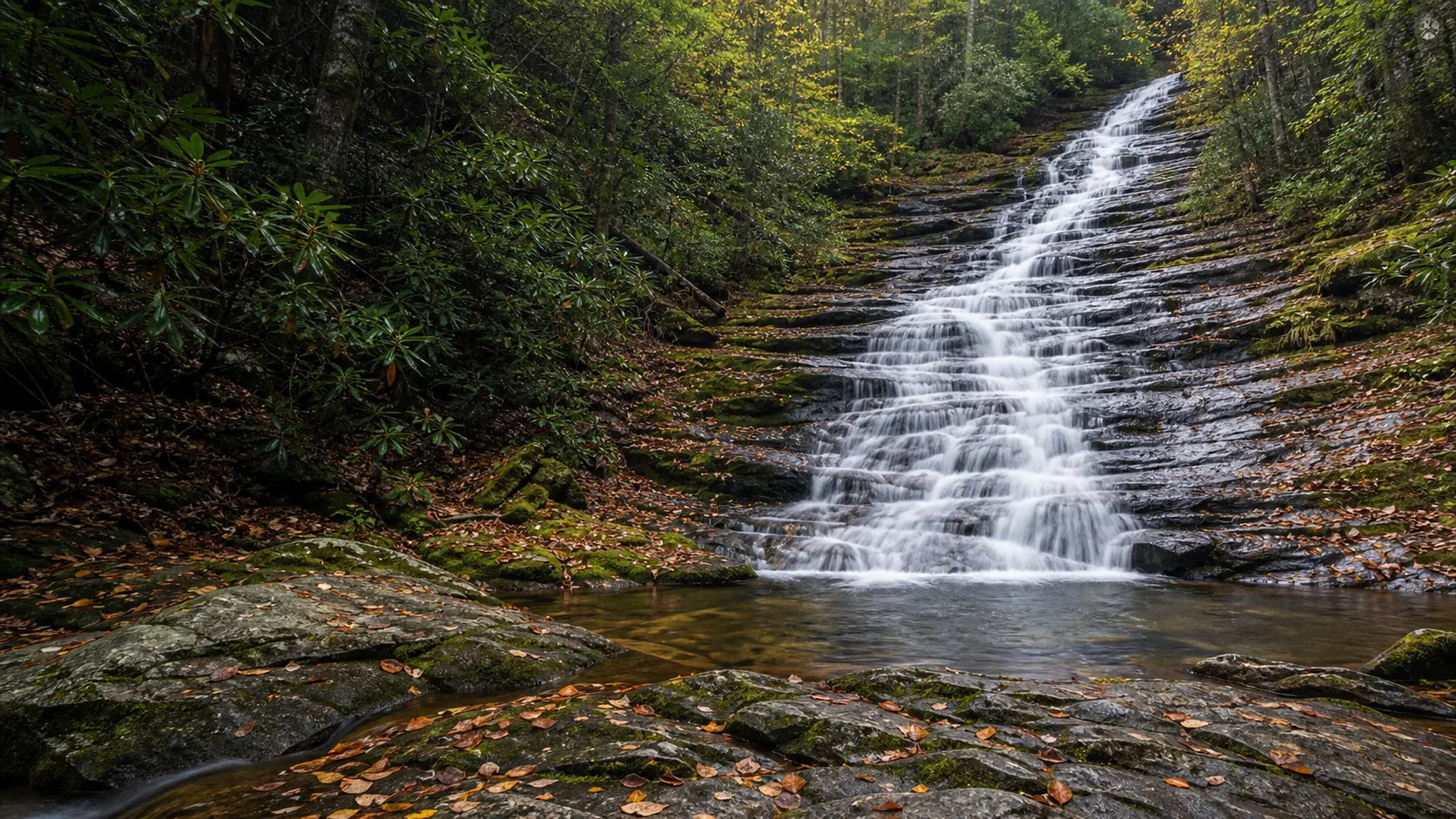
North Carolina waterfalls run on two clocks that visitors plan around: March through May for the loudest spring flow, when winter rain and Blue Ridge snowmelt push every chute and ledge into a full curtain, and October for the killer fall-color window, when hardwood color fills the gorges and flow holds up after the first cold-front rains. Most photographers and trip-planners treat the third week of October as the peak for the Pisgah and Hickory Nut Gorge corridor, with the Blue Ridge Parkway corridor at higher elevations turning a week or two earlier.

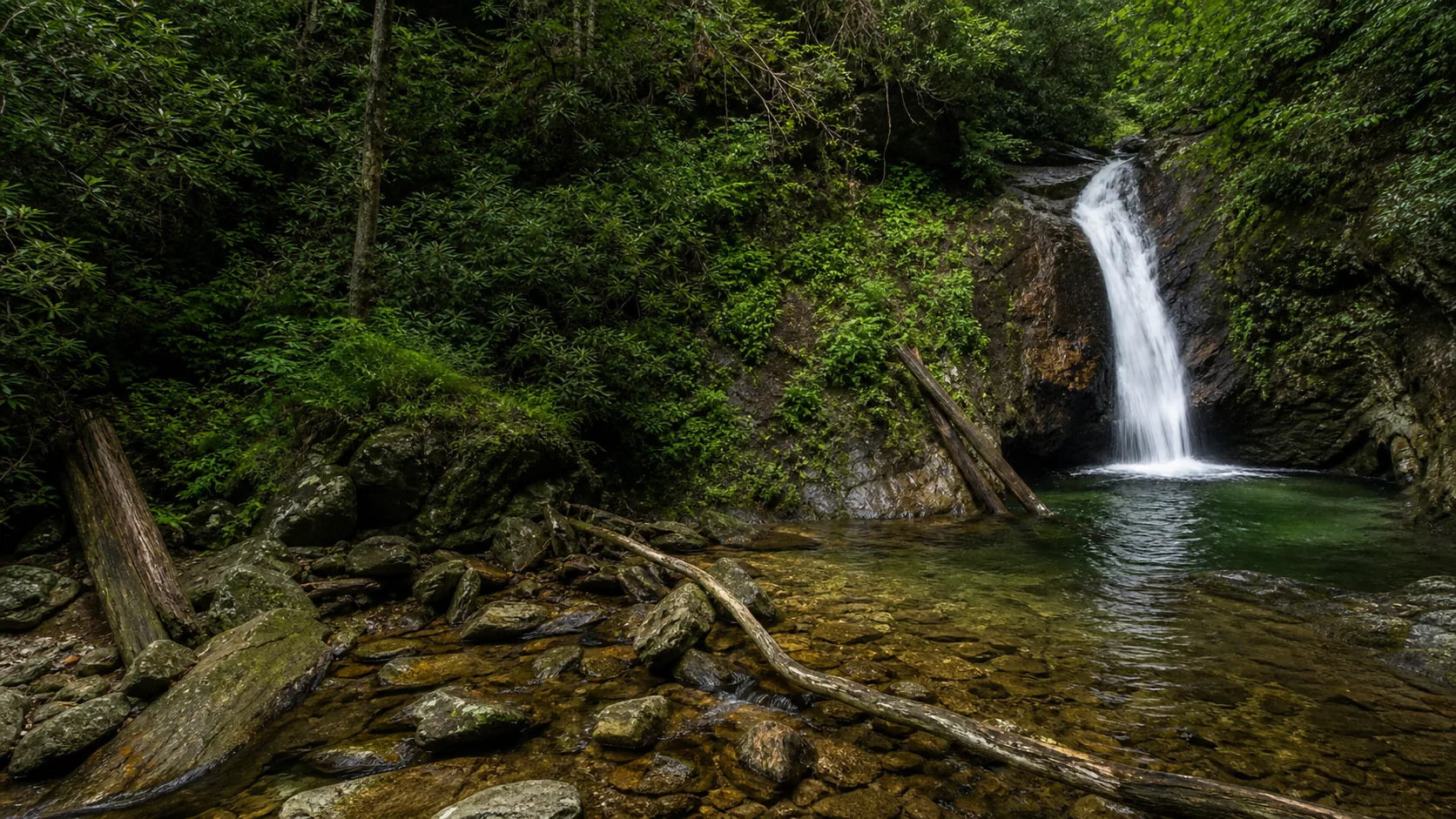
Two access constraints worth planning around. Pisgah's Forest Road 140 (the access spur for Courthouse Falls) is unmaintained gravel and is regularly impassable to low-clearance vehicles after snow or heavy rain, typically late December through February. Sliding Rock only has lifeguards and the $5 fee structure from Memorial Day through Labor Day; outside that window the slide is open but unstaffed, the water runs 50 to 60 degrees, and most visitors stop at the viewing deck rather than going in. Chimney Rock State Park stays open year-round but closes during ice events and reduces hours in winter; verify on chimneyrockpark.com before driving up.

By region.

Pisgah Ranger District

Pisgah National Forest's Pisgah Ranger District holds the headline cluster on the US 276 and NC 215 corridors out of Brevard. Looking Glass Falls, Moore Cove Falls, and Twin Falls sit on the same US 276 spine as Sliding Rock; Courthouse Falls is the standout on the NC 215 spur. Most visitors stack two or three of these into a single Pisgah waterfall day rather than treating any one as a standalone trip. Brevard is the practical base for the cluster.

Hickory Nut Gorge and Chimney Rock

Chimney Rock State Park guards the Hickory Nut Gorge corridor along US 64/74A east of Asheville, where Falls Creek drops 404 feet down a near-vertical Henderson Gneiss wall directly above the Rocky Broad River and Lake Lure. The geology here is the same Blue Ridge crystalline basement as Pisgah but exposed as a single tall cliff rather than the closed amphitheaters of the Pisgah corridor.

Blue Ridge Parkway corridor and Yancey County

North of Asheville the Blue Ridge Parkway corridor runs past Crabtree Falls, Linville Falls, and the Linville Gorge Wilderness along the gneiss-and-quartzite spine of the southern Blue Ridge. Roaring Fork Falls sits on the Toecane Ranger District side of Pisgah National Forest north of Marion, a 100-foot stairstep cascade reached by a quiet half-mile walk that gets a fraction of the foot traffic of the Pisgah cluster.

Questions visitors ask about North Carolina waterfalls.

Where is the Land of Waterfalls in North Carolina?

The Land of Waterfalls is the tourism branding for Transylvania County in western North Carolina, anchored by the town of Brevard. The county registers more than 250 named waterfalls inside its borders, the densest waterfall county in the Southeast, and most of them sit inside Pisgah National Forest and DuPont State Recreational Forest. Brevard is about 35 minutes south of Asheville on US 64 and is the practical base for any Pisgah waterfall trip.

How many waterfalls are in Pisgah National Forest?

Pisgah National Forest covers about 512,000 acres across western North Carolina and holds well over 100 named waterfalls across its three ranger districts. The Pisgah Ranger District around Brevard is the densest concentration, with Looking Glass Falls, Sliding Rock, Moore Cove, Twin Falls, and Courthouse Falls all within roughly 30 minutes of one another on US 276 and NC 215. The Toecane Ranger District north of Marion and Burnsville adds Roaring Fork Falls, Crabtree Falls, and the Mount Mitchell area; the Grandfather District covers Linville Falls and the Wilson Creek corridor.

Are North Carolina waterfalls free to visit?

Most are free. Pisgah National Forest does not charge a general entry fee, so Courthouse Falls, Looking Glass Falls, and most of the US 276 and NC 215 waterfalls are free at the trailhead. Sliding Rock charges $5 per person from Memorial Day through Labor Day when lifeguards are on duty and is free during the unstaffed off-season. Hickory Nut Falls sits inside Chimney Rock State Park, which charges a paid admission that covers parking and trail access. DuPont State Recreational Forest is free at the trailheads.

When is the best time for fall color at North Carolina waterfalls?

The third week of October is the standard peak for the Pisgah Ranger District and the Hickory Nut Gorge, with the Blue Ridge Parkway corridor at higher elevations turning roughly a week earlier. October also holds the second-best flow window of the year (after spring runoff) because the first cold-front rains tend to refill the streams before the leaves drop. Expect crowded trailhead lots from the second through fourth weekends of October; weekday visits and a pre-9 a.m. start are the standard workaround at Courthouse Falls, Sliding Rock, and Chimney Rock.

Can you swim at North Carolina waterfalls?

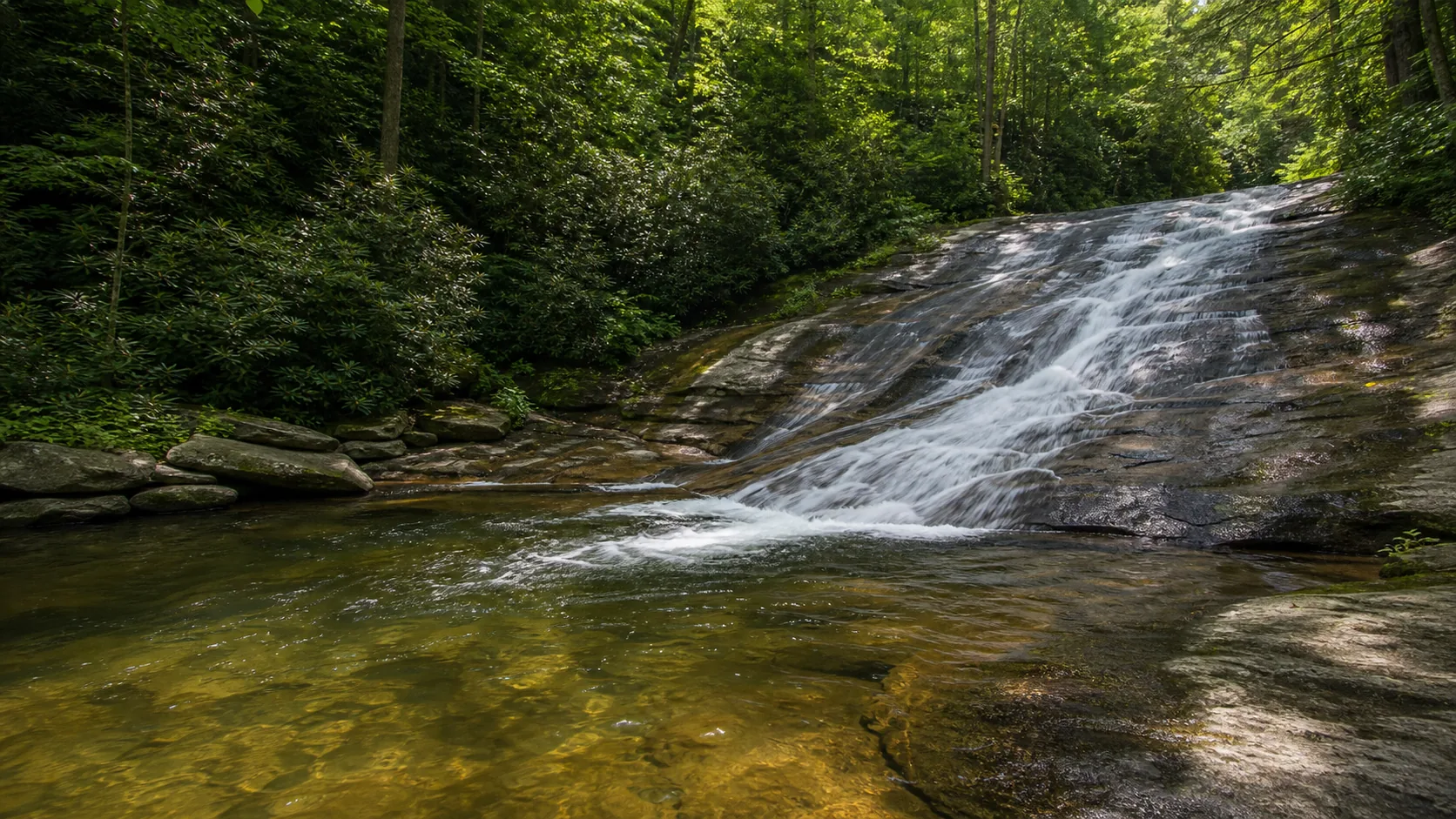
Some, but not most of the headline guides on this hub. Sliding Rock is a designated swim area with lifeguards on duty Memorial Day through Labor Day and an 8 to 10 foot pool at the base; you must know how to swim to slide. Courthouse Falls has a deep, cold plunge pool where swimming is informally tolerated by visitors who respect the hydraulic at the base; the Forest Service does not maintain it as a swimming area. Swimming is prohibited at Hickory Nut Falls because of rockfall hazard from the 404-foot cliff. For real swimming in the region, Lake Lure (next to Chimney Rock), the Davidson River swimming holes in Pisgah, and the Little River pools in DuPont are the standard alternatives.

Which North Carolina waterfalls are wheelchair accessible?

Accessibility is limited across the cluster, but a few options exist. Looking Glass Falls on US 276 in Pisgah is a roadside viewpoint with a paved overlook and is the most accessible waterfall in the Pisgah Ranger District. Sliding Rock has a paved upper viewing deck that watches the entire slide from the rim; steps drop to the base and are not accessible. Hooker Falls in DuPont State Recreational Forest has a relatively flat, hard-packed approach. Courthouse Falls, Hickory Nut Falls, and Roaring Fork Falls all involve rooted or rocky trail sections and are not wheelchair accessible.

How far is DuPont State Forest from Pisgah National Forest?

DuPont State Recreational Forest sits about 30 minutes south of Brevard on US 276 and NC 280, a short drive from the Pisgah Ranger District trailheads. Most visitors split a long weekend between the two: a Pisgah waterfall day on US 276 and NC 215 (Sliding Rock, Looking Glass, Moore Cove, Courthouse), and a DuPont waterfall day on the Little River (Hooker Falls, Triple Falls, High Falls). Waterfalls Guide does not yet publish DuPont guides; until they land, the NC State Forests DuPont page and the High Falls trail map at the Hooker Falls trailhead are the standard references.

All 4 North Carolina guides.

Courthouse Falls waterfall guide
Transylvania County, North Carolina

Courthouse Falls

Plan Courthouse Falls in Transylvania County, North Carolina: 0.8 mi route details, parking and directions, best time to visit, safety notes, and 4 waterfall photos.

45 ft0.8 mi4 photos
Hickory Nut Falls waterfall guide
Chimney Rock, North Carolina

Hickory Nut Falls

Plan Hickory Nut Falls near Chimney Rock, North Carolina: 1.4 mi route details, parking and directions, best time to visit, safety notes, and 4 waterfall photos.

404 ft1.4 mi4 photos
Roaring Fork Falls waterfall guide
Yancey County, North Carolina

Roaring Fork Falls

Plan Roaring Fork Falls in Yancey County, North Carolina: 0.6 mi route details, parking and directions, best time to visit, safety notes, and 8 waterfall photos.

100 ft0.6 mi8 photos
Sliding Rock waterfall guide
Transylvania County, North Carolina

Sliding Rock

Plan Sliding Rock in Transylvania County, North Carolina: 0.1 mi route details, parking and directions, best time to visit, safety notes, and 8 waterfall photos.

height not listed0.1 mi8 photos