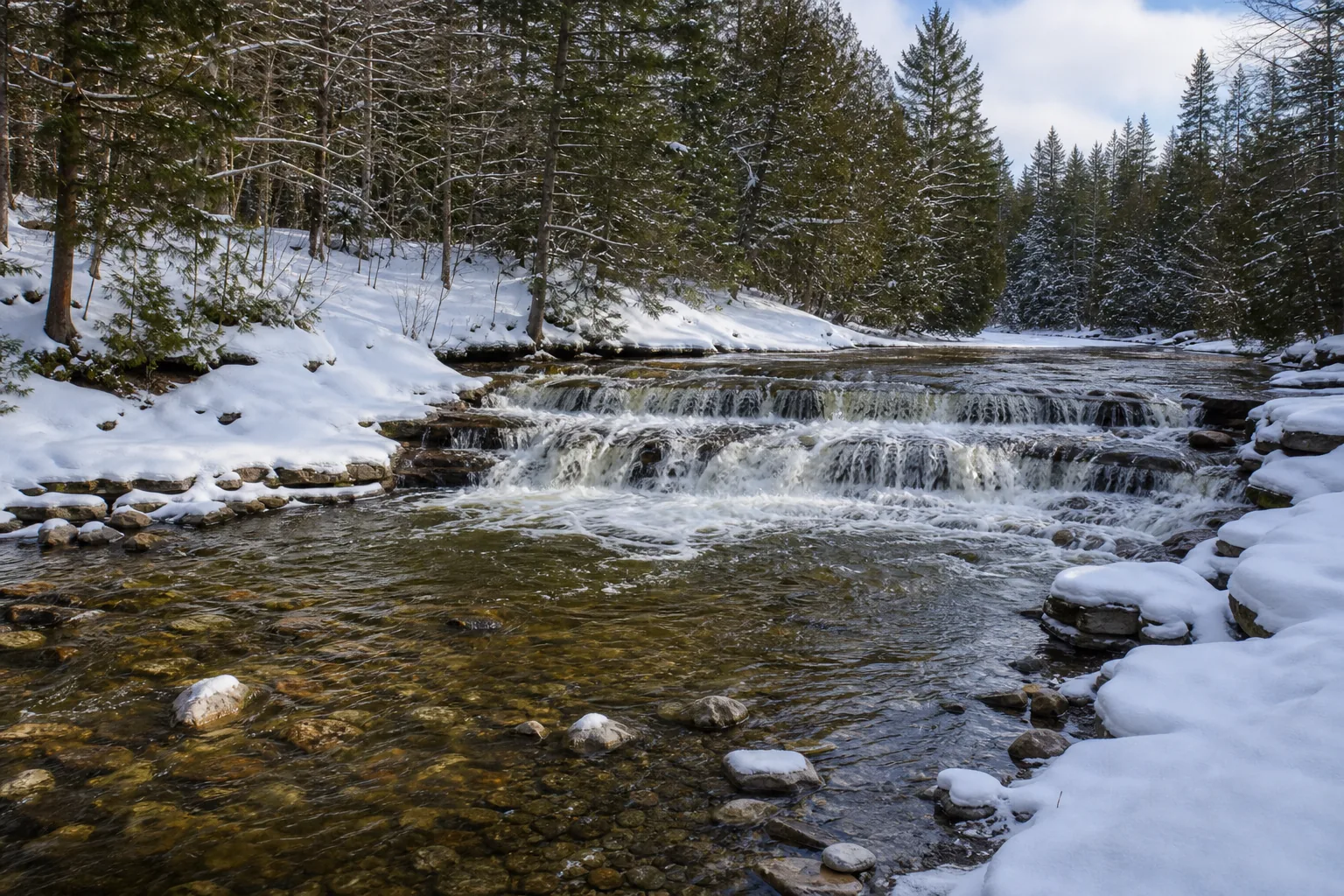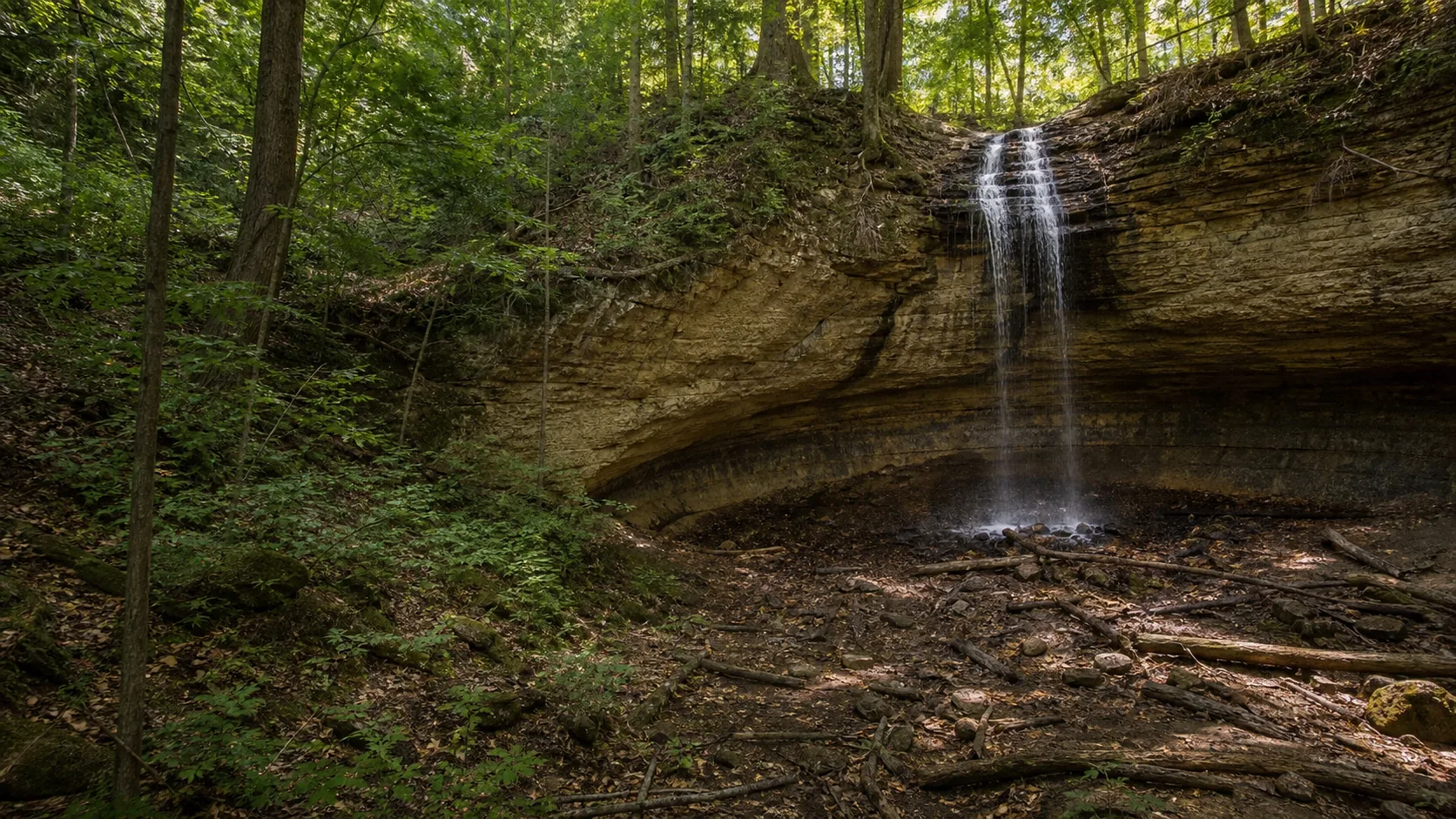
Ocqueoc Falls multi-tier limestone cascade on the Ocqueoc River in northern Michigan's Lower Peninsula
Ocqueoc Township, MI

Ocqueoc Falls

Ocqueoc Falls is the largest waterfall in Michigan's Lower Peninsula and the only fully ADA-accessible waterfall in the state, with a paved path and boardwalk that put a wheelchair user at the water with the falls directly in front of them. The drop is short (about five feet of stepped limestone) and the volume is generous, which is why the pools at the base are the closest thing northeast Michigan has to a family swim hole tied to a named waterfall.

Last verified May 12, 2026 Visited Desk-verified May 2026 8 sources checked
Trail 0.3 mi 6.3 mi extended
Time 15-180 min Easy
Best season Year-round; summer for swimming, late April-May for high flow Late April-May (snowmelt)
Parking Free paved lot at the trailhead; Michigan Recreation Passport required on the vehicle ($13 resident, $14 non-resident annually, or $9 daily non-resident) Ocqueoc Falls Bicentennial Pathway, Mackinaw State Forest
Quick answer

Is Ocqueoc Falls worth visiting?

Yes, especially if you want a Lower Peninsula waterfall that works for visitors with mobility needs, families with strollers, or anyone planning a summer swim stop. The site is free, day-use, and open year-round. You will need a Michigan Recreation Passport on your vehicle to use the lot ($13 annual for residents, $14 annual for non-residents, or $9 daily for non-residents). Best windows: late April through May for the heaviest flow, mid-June through August for swimming, and early October for color along the Bicentennial Pathway loops.

  • ADA-accessible boardwalk to the falls and pool
  • Free entry; Recreation Passport required to park
  • Family swim hole in summer
  • Largest waterfall in the Lower Peninsula
  • 6.3-mile Bicentennial Pathway loop on site
  • 11 miles west of Rogers City off M-68
Last verified May 12, 2026 Visited Desk-verified May 2026 8 sources checked
Distance 0.3 mi 6.3 mi extended
Round trip 15-180 min Boardwalk and paved accessible loop at the falls; longer hiking loops are flat to gently rolling forest two-track and singletrack.
Difficulty Easy Boardwalk and paved accessible loop at the falls; longer hiking loops are flat to gently rolling forest two-track and singletrack.
Location Ocqueoc Township, MI Ocqueoc Falls Bicentennial Pathway, Mackinaw State Forest
Parking Free paved lot at the trailhead; Michigan Recreation Passport required on the vehicle ($13 resident, $14 non-resident annually, or $9 daily non-resident) Michigan DNR
Transit No fixed-route transit Drive only; nearest town is Rogers City · 0 ft
Drive 11 mi 17 min from downtown
Best season Year-round; summer for swimming, late April-May for high flow Late April-May (snowmelt)
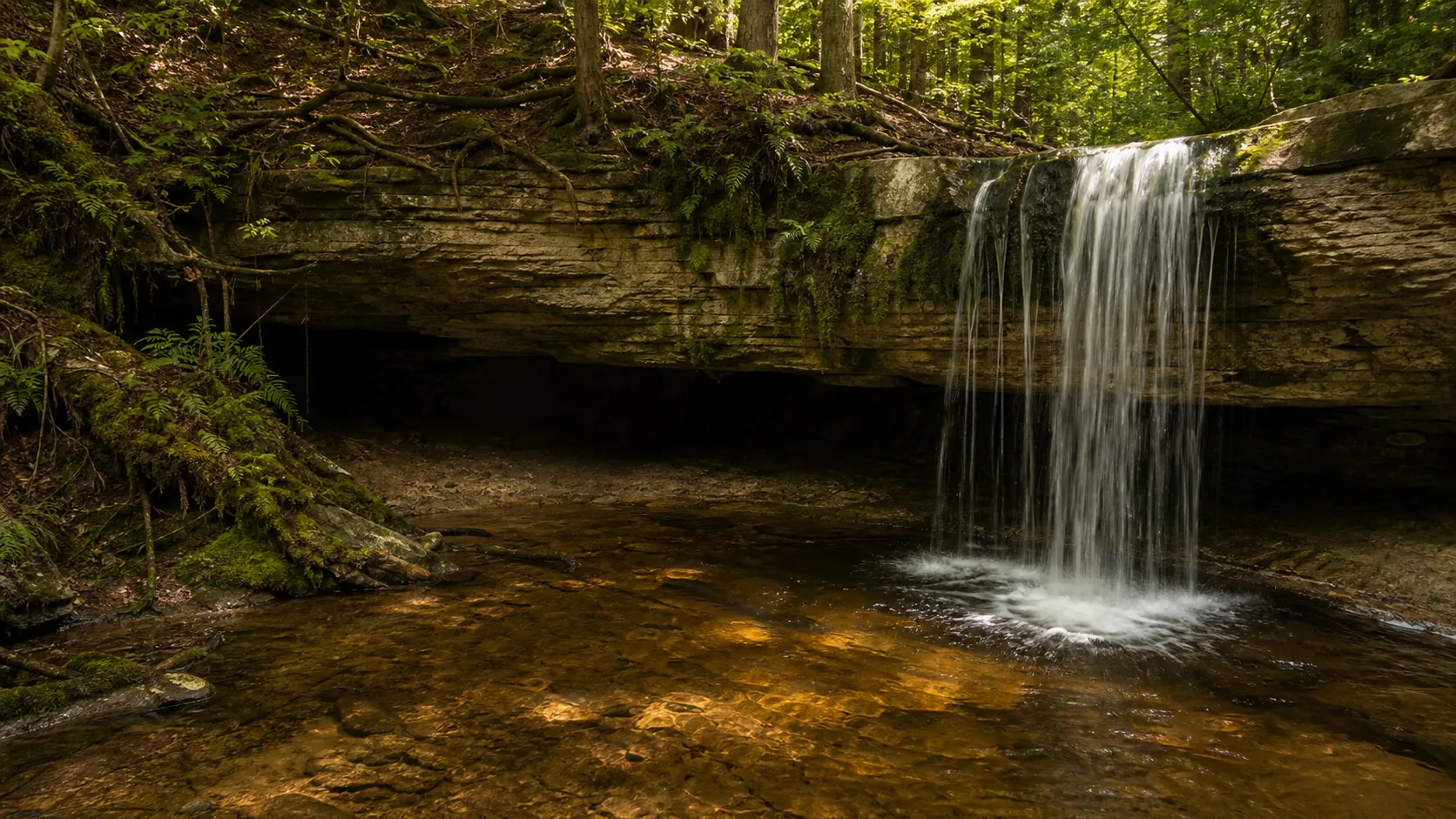
Ocqueoc Falls base of the falls where the tannin-stained ocqueoc river fans across stepped limestone ledges into the swim pool
Photo guide

Three angles of the Lower Peninsula's largest waterfall.

Wide head-on from the boardwalk, base-and-pool from the lower overlook, and stepped-ledge detail from the rocks downstream. Use the captions to pick the shot you want before walking to the spot.

Ocqueoc Falls multi-tier limestone cascade on the Ocqueoc River in northern Michigan's Lower Peninsula
Ocqueoc Falls, hero composition
Ocqueoc Falls wide setting view showing the multi-tier limestone cascade and surrounding hardwood forest along the Ocqueoc River
Wide setting view of the Ocqueoc River cascade and surrounding northern hardwood forest
Base of Ocqueoc Falls where the Ocqueoc River fans across limestone ledges into the shallow swim pool
Base of the falls where the tannin-stained Ocqueoc River fans across stepped limestone ledges into the swim pool
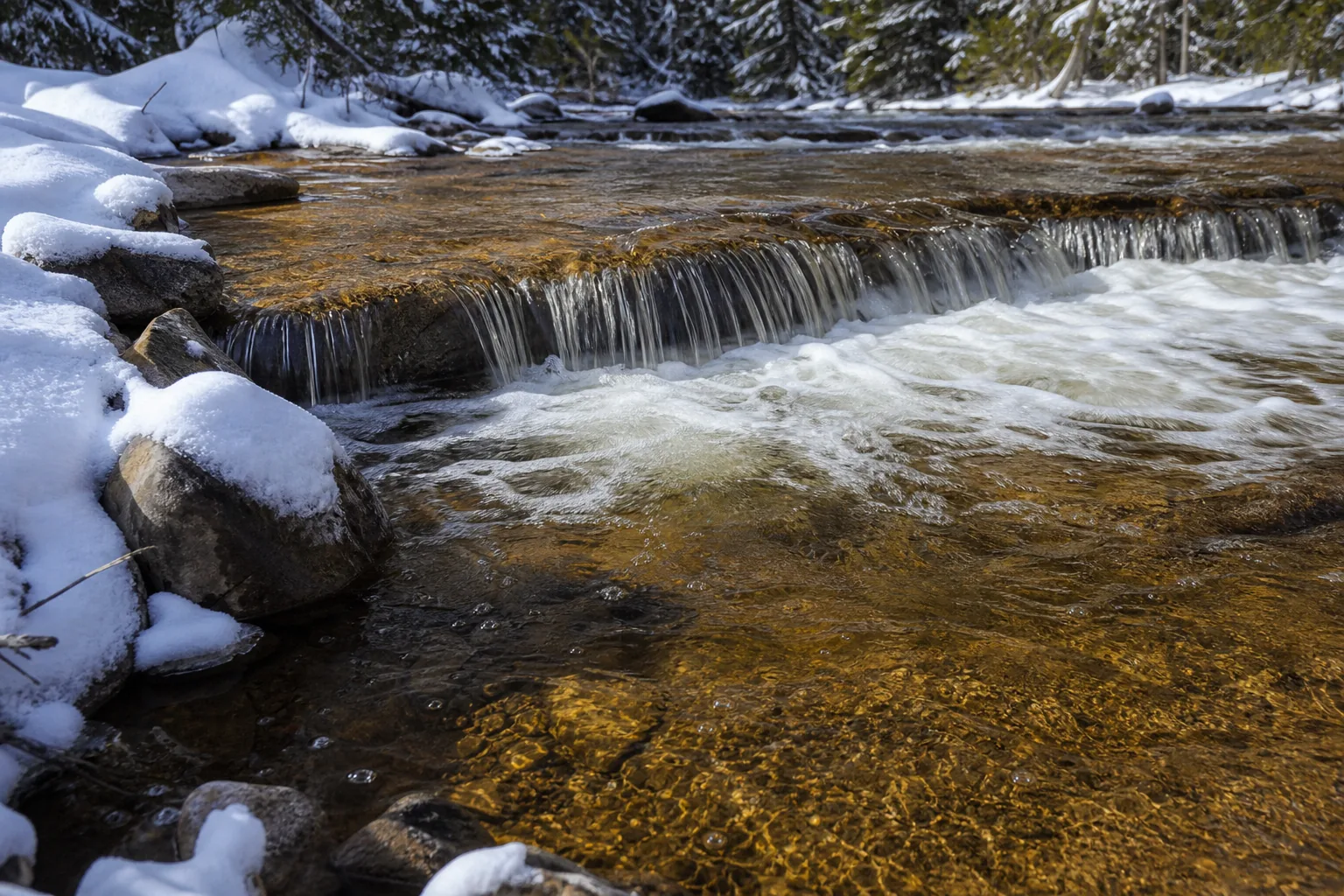
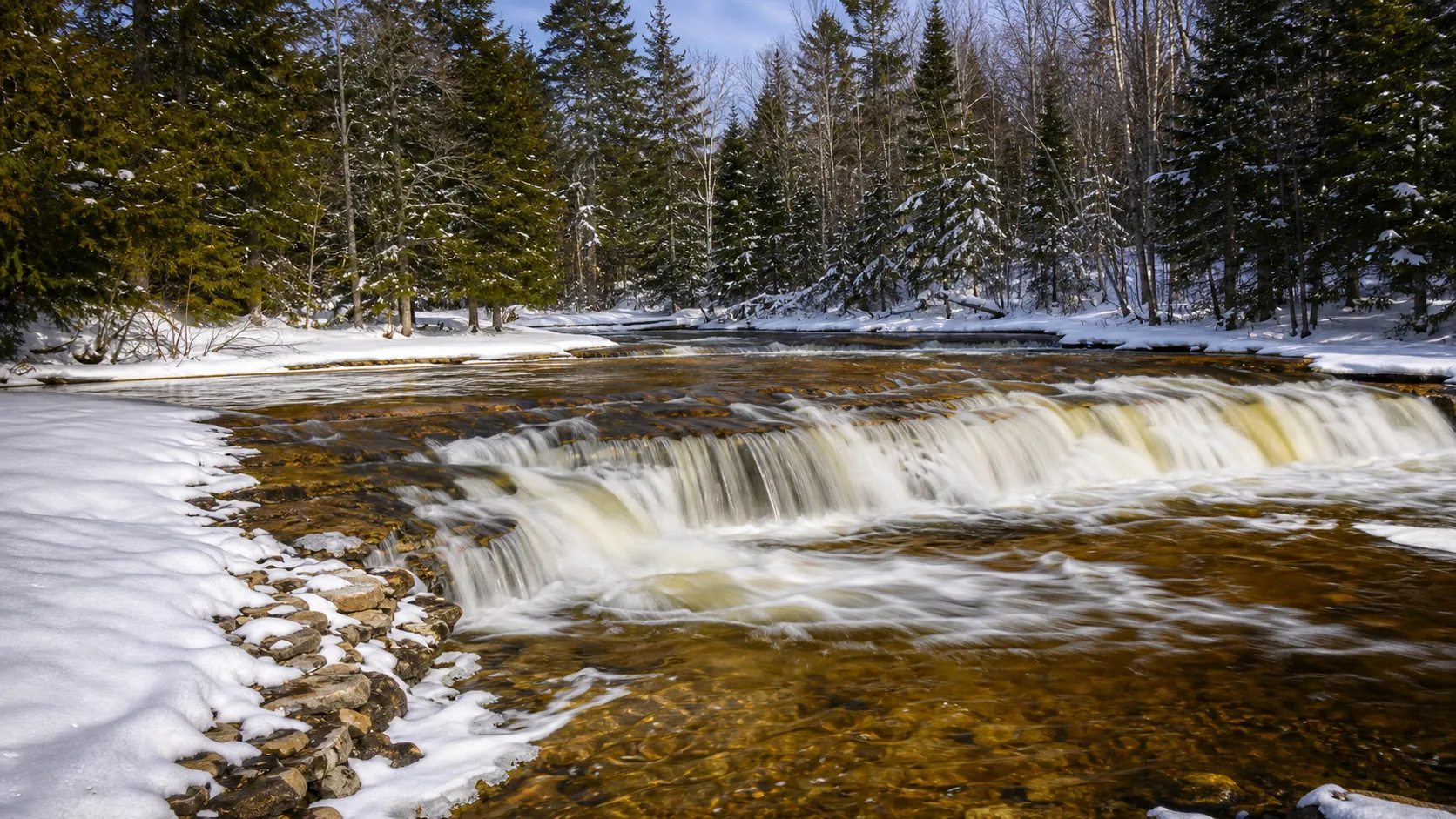
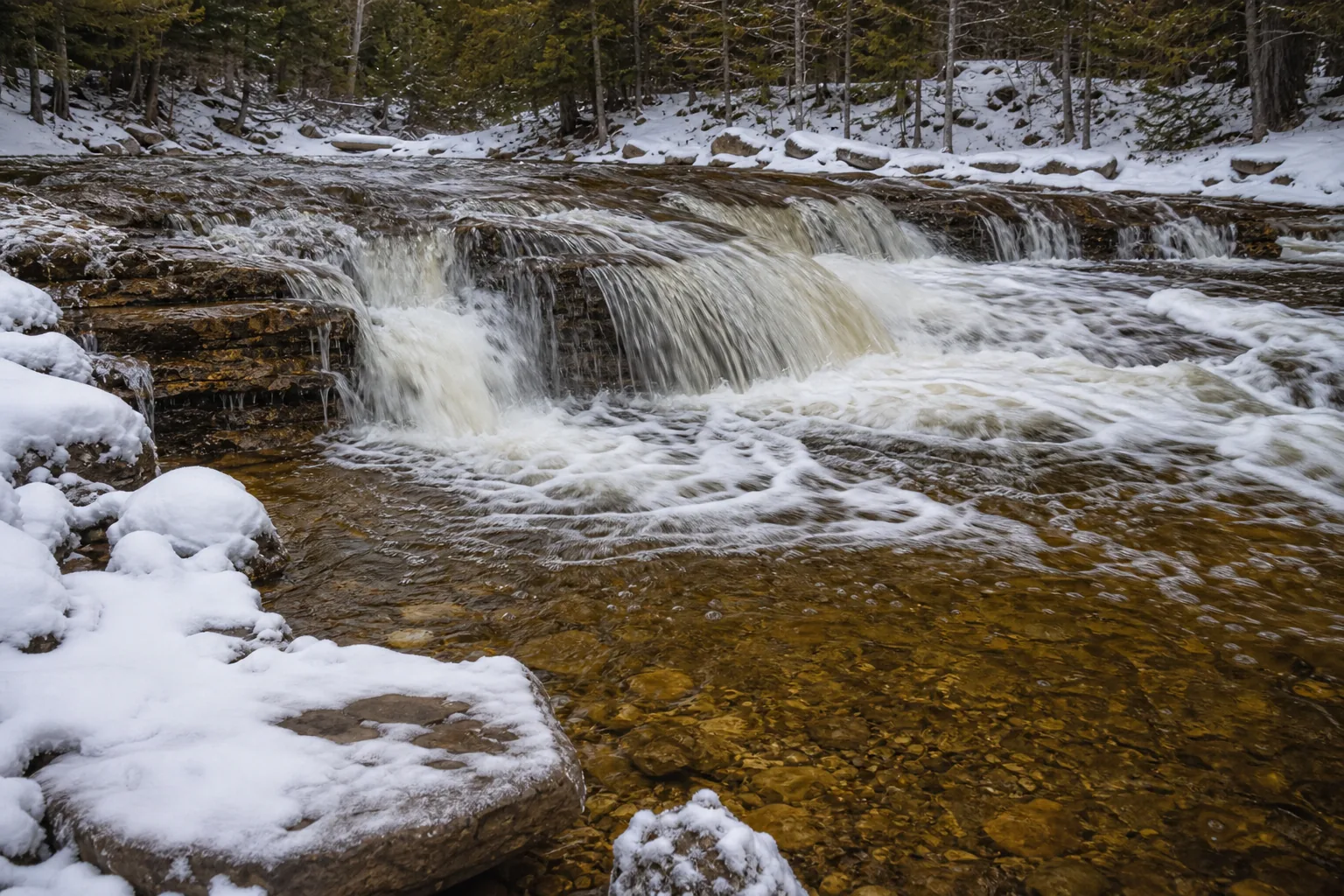
Close water and limestone-ledge detail at Ocqueoc Falls showing the stepped cascade
Water and limestone detail showing the stepped ledges that give Ocqueoc Falls its multi-tier character
01Is Ocqueoc Falls flowing right now?

Ocqueoc River discharge is read at the USGS Ocqueoc River near Ocqueoc gauge (04127800), about a mile downstream from the falls. The river drains a forested watershed with extensive wetland storage, which means flow is relatively steady year-round compared to flashier creeks in the same region; the loudest readings come in late April and May after snowmelt.

02How long is the walk?

From the parking lot to the upper boardwalk viewing platform is about 200 feet on a paved path. The full accessible loop with the pool-level overlook is roughly 0.3 miles. Add the 2.8, 4.9, or 6.3-mile Bicentennial Pathway loops if you want a proper hike from the same trailhead.

03How do you get there?

From Rogers City: drive about 11 miles west on M-68. Turn south on Ocqueoc Falls Highway and the signed paved lot is on the right within a quarter mile. From Cheboygan: about 35 miles east on M-68. From Mackinaw City: about 50 miles southeast via I-75 to M-68. The lot is signed from M-68 and shows up on standard mapping apps as Ocqueoc Falls or Ocqueoc Falls State Forest Campground.

04Is there free parking?

Free paved lot with marked accessible spaces. A Michigan Recreation Passport is required on your vehicle ($13 annual for residents at vehicle-registration renewal, $14 annual for non-residents, or $9 daily for non-residents). Lot fills on summer weekend afternoons; aim for a morning arrival on July and August Saturdays.

05Does it cost money?

No entry fee. The only required cost is the Michigan Recreation Passport on your vehicle to use the parking lot (annual or daily). Camping at the adjacent state forest campground is a small per-night fee, paid to the DNR.

06Trail variants

Accessible falls loop 0.3 mi paved + boardwalk, 15-30 min, wheelchair and stroller accessible to the falls and pool overlook.
2.8-mile pathway loop 2.8 mi, 60-90 min, shortest forest loop on the Bicentennial Pathway.
5-mile pathway loop 4.9 mi, 2 hr, the loop most visitors mean when they say the 'six-mile loop'.
Full 6.3-mile loop 6.3 mi, 2.5-3 hr, longest of the four nested loops; cross-country ski in winter.

Detailed maps and recent reviews: Falls route on AllTrails · Creek route on AllTrails

07Can you swim?

Yes. Swimming is allowed in the pools at the base of the falls and in the calmer river stretch downstream. The water is cold, dark with tannins from upstream wetlands, and shallow over slippery limestone; supervise children, wear water shoes, and avoid the main flow line during spring runoff.

08Are dogs allowed?

Yes, on a leash. Dogs are welcome on the boardwalk, in the day-use area, and on all four loops of the Bicentennial Pathway. Pick up after your dog and keep it out of the swim pool when other families are using it.

09Is it accessible?

Fully accessible to the falls. A paved path from the lot reaches the upper viewing platform; a boardwalk spur drops to a pool-level overlook. Accessible parking spots, an accessible restroom, accessible picnic tables, and changing rooms are at the trailhead. Ocqueoc is the only ADA-accessible waterfall in Michigan and one of very few in the United States that lets a wheelchair user be at the water with the waterfall directly in front of them.

Field notes

Ocqueoc at a glance.

Five-foot multi-tier cascade on the Ocqueoc River, Mackinaw State Forest, Presque Isle County, managed by the Michigan DNR, free to enter, day-use only, Recreation Passport required to park. Sourced from Michigan DNR, Pure Michigan, and the Ocqueoc Township parks page.

Height 5 ft USGS 3DEP
Type Multi-tier cascade (limestone shelves) USGS
Rock Ordovician/Silurian limestone (Lower Peninsula carbonate sequence) Michigan Geological Survey: Bedrock Geology of the Lower Peninsula (Ordovician/Silurian carbonate sequence)
County Presque Isle Ocqueoc Township, MI
Managed by Michigan Department of Natural Resources Michigan DNR
Water source Ocqueoc River USGS
Elevation 725 ft USGS NED
Park area Not listed Michigan DNR
Hours Open 24 hours, year-round; day-use only Michigan DNR
When to visit

Three windows that justify the trip.

Late April through May for the loudest spring runoff. Mid-June through August for the family swim pool. Early October for color along the Bicentennial Pathway loops. Winter is quiet and partially frozen; the lot is not plowed.

PEAK FLOW

Peak flowLate April-May (snowmelt)
Ice / low flowJanuary-February
Most crowdedWeekends and midday
Best photosSunrise or weekdays

Live water context

Discharge data -- Live reading from Ocqueoc River near Ocqueoc, MI (USGS 04127800) refreshes on the next build. Open the gauge link below for the current cubic-feet-per-second reading.

USGS 04127800 · Ocqueoc River near Ocqueoc, MI

Why is it called Ocqueoc Falls?

Ocqueoc comes from the Anishinaabe languages spoken by the Odawa and Ojibwe communities of the northern Great Lakes, and it is usually translated as crooked water or sacred crooked water. The reference is to the Ocqueoc River itself, which bends sharply through Presque Isle County on its way to Lake Huron and gives the falls, the township, the river, and the surrounding trail system their shared name. The Anishinaabek presence in this region long predates the surveys and tourism literature that adopted the Anglicized spelling, and the river name is one of the most direct surviving traces of that on a modern Michigan map.

What else to do at Ocqueoc Falls Bicentennial Pathway, Mackinaw State Forest

Ocqueoc Falls sits inside Mackinaw State Forest about 11 miles west of Rogers City, on the south side of M-68 along Ocqueoc Falls Highway. The day-use area pairs a free paved lot, accessible restroom, picnic area, and changing rooms with a short paved path and boardwalk straight to the falls. From the same lot, the Ocqueoc Falls Bicentennial Pathway heads north into the forest as four nested loops of 2.8, 3.5, 4.9, and 6.3 miles, used for hiking and mountain biking in summer and groomed for cross-country skiing in winter. A small DNR rustic campground sits a short walk upstream from the falls.

  • Accessible boardwalk. Paved path from the lot to an upper viewing platform, with a boardwalk spur dropping to a pool-level overlook. Both can be reached without stairs.
  • Ocqueoc Falls Bicentennial Pathway. Four nested loops (2.8, 3.5, 4.9, 6.3 mi) through northern hardwood and white pine forest, used for hiking, mountain biking, and Nordic skiing.
  • Day-use area. Picnic tables, accessible restroom, changing rooms, and grills above the falls; popular with families on summer weekends.
  • Ocqueoc Falls State Forest Campground. 13 rustic sites a short walk upstream of the falls, first-come first-served, vault toilets, no hookups.
  • Swim access. Pools at the base of the falls and a calmer stretch just downstream where the Ocqueoc River widens; cold water and tannin stain are normal.

Why it looks this way

Ocqueoc Falls is a low, multi-tier cascade over flat-lying Ordovician and Silurian carbonates (limestone and dolostone) that underlie this part of Michigan's Lower Peninsula. The rock here was laid down on the floor of a warm tropical sea roughly 440 to 470 million years ago when what is now Michigan sat near the equator, and it tilts gently into the center of the Michigan Basin. The Lower Peninsula has very few waterfalls because the landscape is otherwise blanketed by soft glacial drift; Ocqueoc exists because the Ocqueoc River cut down through the drift far enough to reach the bedrock and step across exposed limestone ledges before continuing on to Lake Huron.
Field guide deep dive

What you cannot tell from a Pure Michigan listing.

Limestone geology, the meaning of Ocqueoc, the realities of swimming a cold tannic pool, the 6.3-mile pathway loop, and why this is the one Michigan waterfall that meaningfully changes the access conversation. Skim the headers, read what you need.

How Ocqueoc Falls formed on the Lower Peninsula

Ocqueoc Falls is the kind of cascade that needs a moment of explanation, because most Michigan waterfall lists are dominated by the Upper Peninsula. The Lower Peninsula has almost no named waterfalls. The reason is geological: under almost all of the Lower Peninsula, the bedrock dips gently into the center of the Michigan Basin, and on top of that bedrock sits a thick, soft blanket of glacial drift left behind by the last ice sheets roughly 12,000 years ago. Rivers cut shallow valleys in that drift, but they rarely reach the rock beneath, and where they do not reach rock, they cannot form a waterfall.

Ocqueoc is the exception. The Ocqueoc River cut down through the drift in Presque Isle County far enough to expose flat-lying Ordovician and Silurian limestone and dolostone, deposited roughly 440 to 470 million years ago when this part of North America sat near the equator under a warm tropical sea. Those carbonates form a series of shallow ledges where the river crosses them, and the river fans out across the steps in a low, broad, five-foot multi-tier cascade rather than a single drop. That is the geometry you see from the boardwalk: not a plunge, but a staircase. It is also why the volume of water visible at any given moment is more impressive than the height number suggests. The Ocqueoc continues a few more miles to Lake Huron, carrying tannin-stained water that gives the pools at the base of the falls their dark cola color.

The accessibility story (why this falls matters)

Almost every waterfall page on the internet uses the word accessible loosely. Ocqueoc Falls is one of the rare cases where the word means what it sounds like. The day-use area has accessible parking, an accessible restroom, accessible picnic tables, and changing rooms, all on level pavement. A short paved path from the lot leads to an upper viewing platform with no stairs. From there, a boardwalk spur drops to a pool-level overlook that places a wheelchair user, a stroller, or a visitor with limited mobility directly at the water, with the cascade in front of them rather than viewed from above.

That is uncommon nationally and effectively unique in Michigan. The state's other notable waterfalls (Tahquamenon, Bond Falls, Munising Falls, Miners Falls) all involve either stairs, soft trail, or a step-up from a paved overlook to actually see the water. Ocqueoc is the one site in Michigan where the accessibility goes all the way to the falls, and that is the reason the site frequently gets described as the only universally accessible waterfall in the United States, a claim that originated with the Michigan DNR and has been picked up by Pure Michigan and the local tourism literature. A few other sites contest the absolute superlative, but the practical point stands: this is one of the very few places nationally where the access conversation is real rather than rhetorical, and it is the only one in Michigan.

The 6.3-mile Bicentennial Pathway and the rest of the site

The boardwalk is the headline, but the trail system around it is the reason a lot of return visitors keep coming back. The Ocqueoc Falls Bicentennial Pathway was built in 1976 for the United States bicentennial and is laid out as four nested loops sharing a common trailhead: 2.8, 3.5, 4.9, and 6.3 miles. The shortest loop stays close to the river; the longer loops swing north through northern hardwoods and red and white pine, with short steep pitches into a couple of small creek drainages and a few wider sandy stretches. The 4.9-mile loop is the version most visitors mean when they refer to the six-mile loop; the difference between that and the full 6.3 is a small outer extension.

The pathway is open to hiking and mountain biking in summer and is groomed by volunteers as a cross-country ski route in winter. The Michigan Trail Maps entry has the current loop map, and the trailhead kiosk has the same map printed. Combined with the short accessible loop at the falls, the site supports both a 15-minute boardwalk stop and a half-day hike from the same lot, which is unusual for a Lower Peninsula waterfall. The adjacent Ocqueoc Falls State Forest Campground (13 rustic sites, vault toilets, no hookups) is a few hundred yards upstream and is one of the more popular state forest campgrounds in northeast Michigan, especially on summer weekends.

The Anishinaabe name and the cultural setting

The name Ocqueoc comes from the Anishinaabe languages spoken by the Odawa and Ojibwe communities of the northern Great Lakes, and is usually translated as crooked water (and in some sources sacred crooked water). The reference is to the Ocqueoc River, which bends sharply through Presque Isle County before reaching Lake Huron. The river name predates the township, the road, and the campground by a long span; it is one of the older surviving Anishinaabe-language references on a modern Michigan map.

The broader region around the falls is part of the historical homeland of the Anishinaabek, and the Little Traverse Bay Bands of Odawa Indians, the Sault Ste. Marie Tribe of Chippewa Indians, and other Anishinaabe nations all have ongoing cultural ties to the rivers and the Lake Huron shoreline north of Rogers City. The tourism literature does not always make the cultural framing explicit, and the falls is not a designated cultural site in the way that some Anishinaabe heritage locations farther north and west are, but the name on the boardwalk sign is itself the most direct surviving marker of that earlier presence on this stretch of river. Visitors are not asked to do anything specific because of that history; the simple recognition is that the river was named, in Anishinaabemowin, well before the day-use lot was paved.

Swimming a Lower Peninsula waterfall (the cold-water reality)

One of the unusual things about Ocqueoc Falls is that swimming is explicitly permitted. Most waterfall pages on the internet (and most pages on this site) have to say no in the swim box because of liability, depth, hydraulics, or land-manager rules. Ocqueoc says yes. The pools at the base of the cascade are shallow, the limestone ledges flatten out into a calmer stretch a short distance downstream, and the Michigan DNR has accepted swimming as part of the day-use profile for decades. The boardwalk drops you to the water on one side; the rocks step you down on the other.

The realities are worth knowing in advance. The water is cold even in August because the Ocqueoc River drains a shaded, wetland-heavy upper watershed and never picks up much summer heat. The water is also tannin-stained, the color of weak iced tea, because of the wetlands; that is normal and is not a water-quality flag. The limestone is slippery when wet; water shoes are not optional. The main flow line is not safe during late-April through May spring runoff when the upper ledges are submerged. The accessible boardwalk lets non-swimmers be at the water with the swimmers in front of them, which is part of why the site reads well for multi-generational and mixed-ability families. If you want a warmer Lake Huron swim afterwards, Hoeft State Park (about 15 miles east) and Forty Mile Point Lighthouse beach (about 13 miles east) are the two closest sand-beach options on the Sunrise Coast.

Photography and the day-trip framing from Rogers City

The practical photography position list is short because the falls is short. The upper boardwalk is the head-on wide frame and the one that shows the multi-tier character clearly. The pool-level overlook is the water-in-foreground frame and the only one where you can read the dark tannin color of the pool against the white step of the lowest ledge. The rocks downstream on the river-right bank give an angled side-on frame when the river is low enough to walk out onto them safely (do not try this in spring). The falls faces roughly southwest, so the cleanest light is mid-afternoon through golden hour; midday flattens the ledges because the limestone is light-toned and the white water blows out. October mid-mornings give the best color frame because the surrounding hardwoods turn gold and the river darkens with leaf litter.

From Rogers City the falls is an 11-mile drive west on M-68, signed clearly from the highway. From Cheboygan it is about 35 miles east on M-68. From Mackinaw City it is roughly 50 miles southeast via I-75 and M-68. The lot, the boardwalk, and the campground are all part of the same site and share one entry. The standard half-day plan is: 30 to 45 minutes at the falls and boardwalk; 60 to 90 minutes on the shortest pathway loop; a Lake Huron beach stop at Hoeft or Forty Mile Point on the way back to your base. For visitors used to the Upper Peninsula's tall single-drop falls (compare Munising Falls or Miners Falls, both in the UP), Ocqueoc reads as a different category of waterfall: shorter, broader, more accessible, and tied to a swim pool rather than a viewing platform. That is the whole point of the stop, and it is why this is the Lower Peninsula waterfall worth driving for.

Map and route

Eleven miles west of Rogers City off M-68.

From Rogers City: drive about 11 miles west on M-68. Turn south on Ocqueoc Falls Highway and the signed paved lot is on the right within a quarter mile. From Cheboygan: about 35 miles east on M-68. From Mackinaw City: about 50 miles southeast via I-75 to M-68. The lot is signed from M-68 and shows up on standard mapping apps as Ocqueoc Falls or Ocqueoc Falls State Forest Campground.

Photography and weddings

Southwest-facing cascade, three working positions, no permit for personal photography.

Most useful frames at Ocqueoc are wide because the falls is broad and low rather than tall. Plan around the upper boardwalk for a clean head-on view across the stepped ledges, the pool-level overlook for a water-in-foreground frame, and the rocks downstream for an angled side-on shot when the river is low enough to wade.

The falls faces roughly southwest, so late-afternoon and golden-hour light wash directly across the limestone ledges and the water lines. Overcast days are friendlier to the tannin color in the pools and prevent the white water from blowing out against the darker forest behind. October mid-mornings give the best color frame because the surrounding hardwoods turn yellow and orange.

Personal photography from the public boardwalk and day-use area does not require a permit. Commercial productions, drone flights, large-group portrait sessions, and tripod setups that block the boardwalk should be cleared with the Michigan DNR first.

Permits

Weddings and engagements

Ocqueoc is a low-key option for small ceremonies and portraits because the day-use area is free, the boardwalk and pool overlook are step-free, and the surrounding forest is photogenic in October.

Michigan DNR does not currently require a wedding permit for casual ceremonies at most state forest day-use sites, but groups large enough to displace other visitors should call the local DNR field office ahead of time. Confirm before booking vendors.

Plan around peak summer-weekend crowds and have a backup location for high water in spring; the boardwalk is open year-round but the lot is not winter-maintained.

Related questions

More questions visitors ask before driving to Ocqueoc Falls.

Accessibility, swim, height, dogs, hours, season, and worth-visiting. The full set is also indexed in the FAQ schema for AI answer engines.

01Where is Ocqueoc Falls?

Ocqueoc Falls is in Mackinaw State Forest in Presque Isle County, about 11 miles west of Rogers City off M-68. From Cheboygan it is about 35 miles east on M-68; from Mackinaw City it is roughly 50 miles southeast via I-75 and M-68. The signed paved lot is on Ocqueoc Falls Highway just south of M-68.

02Is Ocqueoc Falls free to visit?

Yes, there is no entry fee. The parking lot requires a Michigan Recreation Passport on your vehicle ($13 annual for Michigan residents at vehicle-registration renewal, $14 annual for non-residents, or $9 daily for non-residents). The boardwalk, picnic area, and accessible restroom are free to use.

03How tall is Ocqueoc Falls?

Ocqueoc Falls is roughly 5 feet tall as a multi-tier cascade, with the water fanning across several stepped limestone ledges rather than dropping in one plunge. It is the largest waterfall in Michigan's Lower Peninsula by volume and breadth, even though Upper Peninsula falls such as Tahquamenon are taller.

04What is the best time to visit Ocqueoc Falls?

Late April through May for the loudest spring runoff, mid-June through August for the family swim pool, and early October for fall color on the Bicentennial Pathway loops. The boardwalk is accessible year-round, but the parking lot is not winter-maintained and the falls only partially freezes.

05Is Ocqueoc Falls worth visiting?

Yes, especially for visitors with mobility needs, families with strollers or young kids, and anyone planning a Lower Peninsula or Sunrise Coast road trip. The combination of a fully ADA-accessible boardwalk, a permitted swim pool, and a 6.3-mile trail system at the same trailhead is uncommon nationally and unique in Michigan.

Sources and data

Where the Ocqueoc Falls guide gets its facts.

Geology from the Michigan Geological Survey and USGS Lower Peninsula bedrock maps. Park rules, accessibility, and hours from the Michigan DNR. Site profile and Bicentennial Pathway loops from Pure Michigan and the Michigan Trail Maps Bicentennial Pathway entry. Etymology cross-referenced with Odawa and Ojibwe language sources.

USGS Streamflow: 04127800 Ocqueoc River near Ocqueoc, MI waterdata.usgs.gov
Michigan DNR: Ocqueoc Falls Bicentennial Pathway, Mackinaw State Forest michigan.gov
Access, parking, and permit rules: michigan.gov
Michigan Geological Survey: Bedrock Geology of the Lower Peninsula (Ordovician/Silurian carbonate sequence): Ocqueoc Township bedrock michigan.gov
NOAA / NWS Gaylord (APX) forecast grid 78,80 noaa.gov
USGS National Elevation Dataset 3DEP
Google Maps: embedded map and directions maps.google.com
Google Places: nearby restaurants and hotels places API
Michigan DNR: Ocqueoc Falls State Forest Campground michigan.gov
Pure Michigan: Ocqueoc michigan.org
US-23 Heritage Route: Ocqueoc Falls Scenic Site us23heritageroute.org
Michigan Trail Maps: Ocqueoc Falls Bicentennial Pathway michigantrailmaps.com
AllTrails: Ocqueoc Falls alltrails.com
Wikipedia: Ocqueoc Falls en.wikipedia.org
Wikimedia Commons: Ocqueoc Falls commons.wikimedia.org
Michigan Recreation Passport policy michigan.gov
Fact checks
Superlative audit: 'largest waterfall in Michigan's Lower Peninsula' is sourced to Pure Michigan, US-23 Heritage Route, Visit Alpena, and the Ocqueoc Township parks page. The 'only ADA-accessible waterfall in Michigan' and the 'only universally accessible falls in the United States' language is sourced to the Michigan DNR, US-23 Heritage Route, and the Ocqueoc Township parks page. The page presents the United States superlative as a widely-repeated claim originating with the Michigan DNR.
Height audit: 5-foot multi-tier cascade is consistent with the AllTrails 16 ft elevation gain across the 0.3-mile loop and with Pure Michigan and Wikipedia descriptions of a low, broad cascade rather than a tall plunge.
Trail audit: four nested Bicentennial Pathway loops at 2.8, 3.5, 4.9, and 6.3 miles plus a short universally accessible loop is sourced to the Michigan Trail Maps entry; cross-referenced with the Pure Michigan 'approximately six miles' summary.
Swim audit: swimming is explicitly permitted in the Michigan DNR site profile and in Tripadvisor, Visit Alpena, and miroadtrip references; cold-water and slippery-limestone cautions added editorially.
Access fee audit: Michigan Recreation Passport requirement and 2026 rates ($13 resident annual, $14 non-resident annual, $9 non-resident daily) sourced to the Michigan DNR Recreation Passport page.
Etymology audit: 'crooked water' translation of Ocqueoc from Anishinaabemowin (Odawa/Ojibwe) is consistent across regional reference sources; sacred-crooked-water gloss noted as a secondary translation.
Corrections: [email protected]