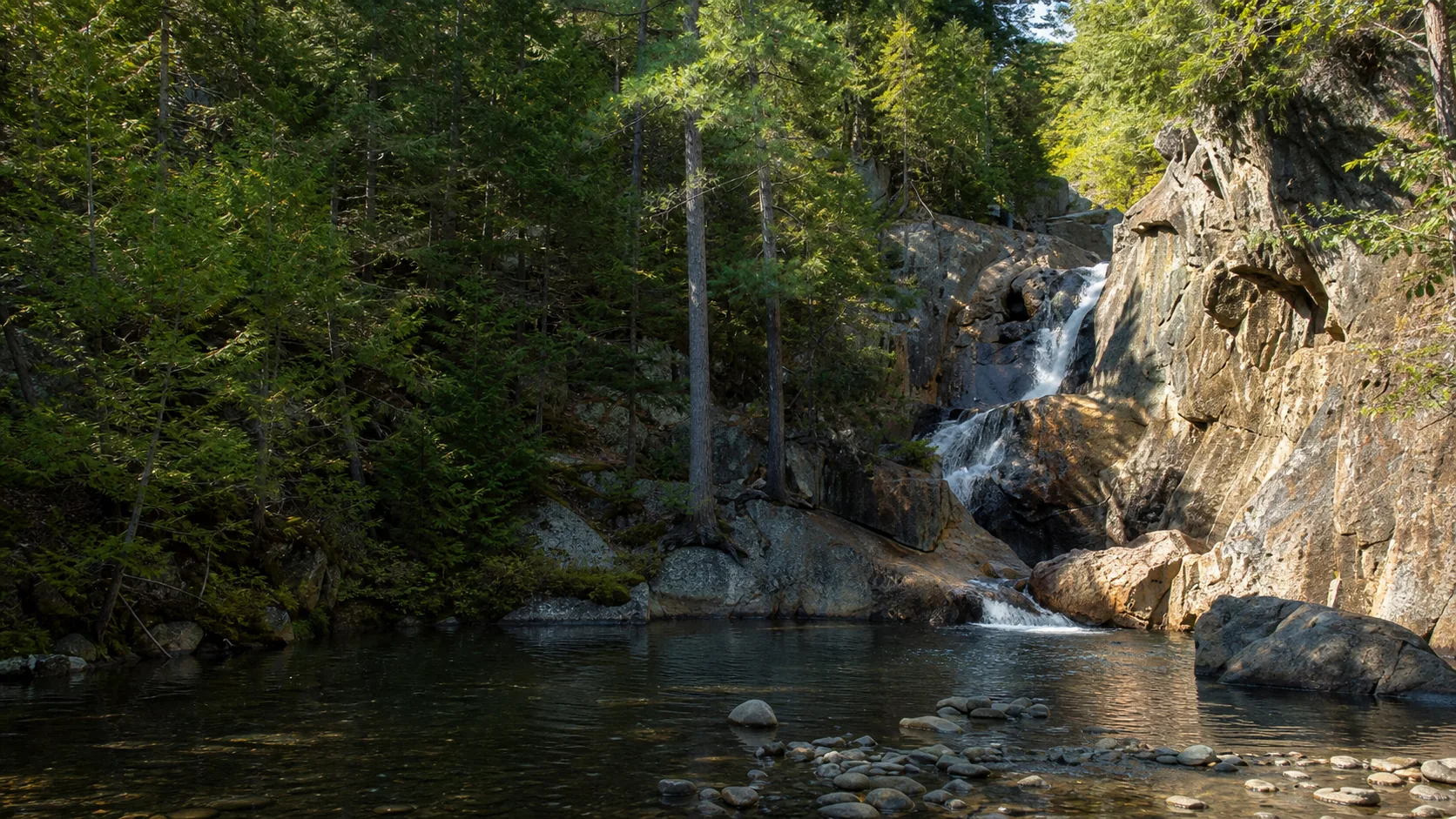
Smalls Falls four-tier cascade dropping through the Sandy Stream gorge in Township E, Maine
Township E, ME

Smalls Falls

Smalls Falls is a 54-foot, four-tier cascade in a narrow bedrock gorge on the Sandy Stream, a headwater of the Sandy River. It is a Maine Bureau of Parks and Lands roadside picnic area on Route 4 between Madrid and Rangeley, which means you park, walk maybe a minute, and you are already standing over the first plunge pool. The pools are deep enough, clear enough, and legal enough that the gorge is one of the most popular summer swimming spots in western Maine.

Last verified May 12, 2026 Visited Desk-verified May 2026 7 sources checked
Trail 0.5 mi 0.8 mi extended
Time 20-90 min Easy
Best season Late May through early October; peak swimming July through August Apr-May snowmelt
Parking Free Maine BPL rest-area lot off Route 4 with picnic tables, charcoal grills, and vault toilets; the lot can fill on summer weekends and holiday afternoons Smalls Falls Picnic Area (Maine Bureau of Parks and Lands)
Quick answer

Is Smalls Falls worth visiting today?

Yes, especially on a warm July or August afternoon when the lower pool is jammed with families and the upper tiers are running clean and cold. The walk from the car to the first overlook is under a minute, the climb to the top of the gorge is under fifteen, and the lower pool is one of the few Maine swimming holes where swimming is openly welcomed by the land manager rather than tolerated. The trip is also worth it in late April through May for the loudest snowmelt flow, and in early October for foliage running through the gorge.

  • 54-foot four-tier cascade on the Sandy Stream
  • Free Route 4 rest area, gated mid-May to mid-October
  • Legal swimming in the gorge pools
  • Live USGS gauge 01047200 on this page
  • Short gorge-rim path, about 0.5 mi out-and-back
  • Best swimming: July and August afternoons
Last verified May 12, 2026 Visited Desk-verified May 2026 7 sources checked
Distance 0.5 mi 0.8 mi extended
Round trip 20-90 min About 32 feet of elevation gain on a short worn path along the gorge rim; uneven footing and unprotected drops next to the cascades
Difficulty Easy About 32 feet of elevation gain on a short worn path along the gorge rim; uneven footing and unprotected drops next to the cascades
Location Township E, ME Smalls Falls Picnic Area (Maine Bureau of Parks and Lands)
Parking Free Maine BPL rest-area lot off Route 4 with picnic tables, charcoal grills, and vault toilets; the lot can fill on summer weekends and holiday afternoons Maine BPL
Transit No fixed-route transit Drive Route 4; the rest area pulls off directly from the highway · 0 ft
Drive 12 mi 18 min from downtown
Best season Late May through early October; peak swimming July through August Apr-May snowmelt
Smalls Falls lower plunge pool where the bottom tier lands; the local swimming hole
Photo guide

Four working positions on a four-tier gorge.

The footbridge for the bottom-tier head-on, the lower pool for the looking-up-the-gorge frame, the mid-gorge ledge for the stacked-tier shot, and the top of the gorge for the looking-down-the-throat frame. Use the captions to pick angles before you commit to wet rock.

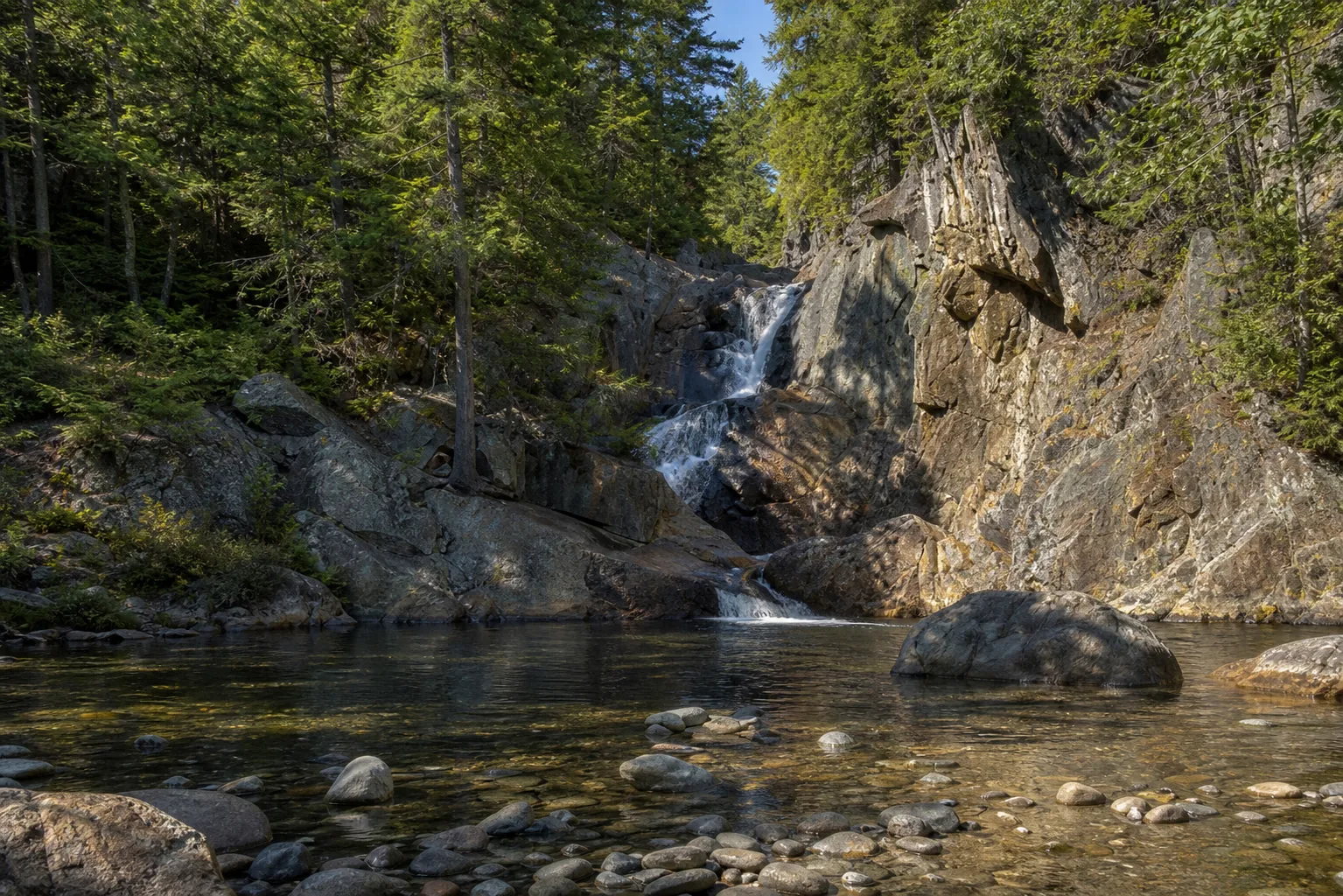
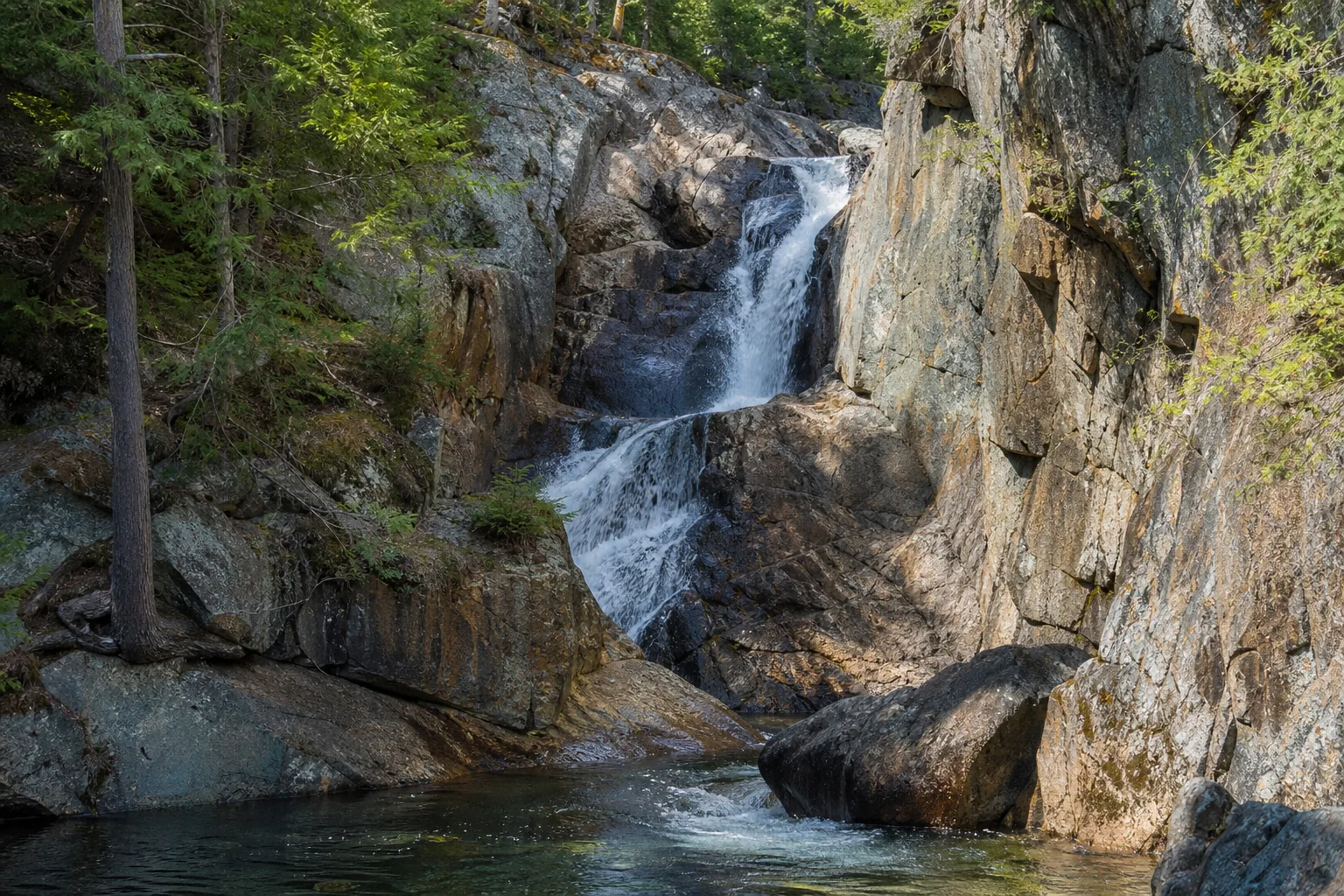
Smalls Falls four-tier cascade dropping through the Sandy Stream gorge in Township E, Maine
Smalls Falls, hero composition
Wide view of the Smalls Falls gorge with multiple cascading tiers and rust-colored bedrock walls
Wide view down the Sandy Stream gorge with the upper tiers visible from the footbridge
Lower Smalls Falls plunge pool with clear deep water at the base of the cascade
Lower plunge pool where the bottom tier lands; the local swimming hole
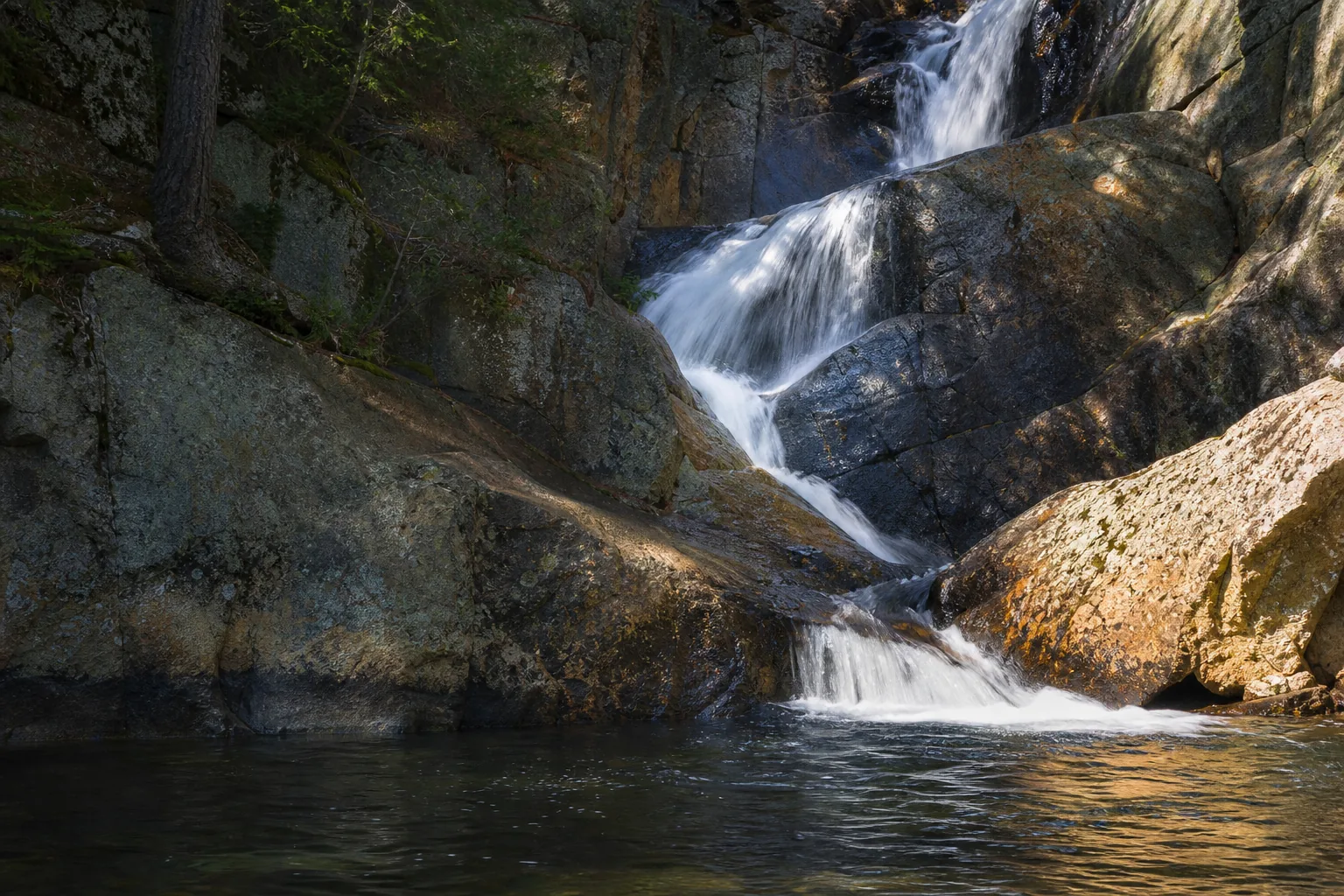
Close detail of Smalls Falls water sliding across iron-stained metamorphic bedrock with quartz veining
Water and rock detail showing the iron-stained schist and quartz veins through the gorge wall
01Is Smalls Falls flowing right now?

Live data: USGS gauge 01047200 on the Sandy River ↗, period of record 1996 to present, 6,309 daily readings. The 30-year daily-discharge median is 31 cfs; the 75th percentile is 64 cfs; the 90th percentile is 148 cfs; the maximum recorded reading is 3,680 cfs.

02How long is the walk?

Five minutes from the lot to the footbridge. The full gorge rim path is about 0.5 miles out-and-back with roughly 32 feet of elevation gain. A longer Chandler Mill add-on is about 0.8 miles total if the upper path is dry and the stream is low enough to scramble at the top.

03How do you get there?

From Rangeley, drive about 12 miles south on Route 4. From Phillips and Madrid, the rest area is about 6 miles north on the same highway. The Smalls Falls Picnic Area pulls off Route 4 on the west side; the lot is paved and signed.

04Is there free parking?

Free paved Maine BPL lot at the rest area. Holds roughly 30 cars and overflows onto the highway shoulder on summer weekends. Get there before 11 a.m. in July and August for a spot.

05Does it cost money?

Free. No entrance fee, no day-use pass, no parking fee. Picnic tables, grills, and vault toilets are part of the rest area at no charge.

06Trail variants

Lower falls and first pool 200 ft from the rest area, 5-10 min, step out of the car, cross the footbridge, and you are looking down into the first plunge pool.
Full four-tier gorge walk 0.5 mi out-and-back, 30-45 min, follows the worn path on the south side of the gorge past all four drops.
Upstream Chandler Mill loop add-on 0.8 mi total, 60-90 min, continue up the Sandy Stream above the top tier toward Chandler Mill Brook for quieter pools.
Swimming-day visit stay at the lower two pools, 2-4 hr, bring towels, water shoes, and a picnic; the lower pool is the most popular swimming hole.

Detailed maps and recent reviews: Falls route on AllTrails · Creek route on AllTrails

07Can you swim?

Yes. The gorge pools are one of western Maine's most popular swimming holes and swimming is openly welcomed. The lower plunge pool is deep and locals do jump from the rocks, but there is no lifeguard, depths change with water level, and serious injuries have happened. Treat it as backcountry swimming.

08Are dogs allowed?

Dogs are allowed on a leash in the picnic area and along the rim path. Keep them away from the cliff edges and out of the pools when families are swimming.

09Is it accessible?

The picnic area, vault toilets, and the first footbridge overlook are reachable on a short paved-to-packed-gravel route from the lot. The gorge rim path itself is uneven dirt with roots and rock steps and is not wheelchair accessible.

Field notes

Smalls Falls at a glance.

54-foot four-tier cascade on the Sandy Stream, managed by the Maine Bureau of Parks and Lands as a free rest area on Route 4, gated mid-May through mid-October, with a live USGS gauge on this page. Sourced from the BPL rest-area listings, USGS NWIS gauge 01047200, and the New England Waterfalls field guide.

Height 54 ft USGS 3DEP
Type Four-tier cascade USGS
Rock Metamorphic bedrock of the Central Maine Belt (Silurian schist and phyllite, intruded by Devonian granite during the Acadian orogeny) Maine Geological Survey: bedrock geology of the Central Maine Belt and the Acadian orogeny
County Franklin Township E, ME
Managed by Maine Bureau of Parks and Lands Maine BPL
Water source Sandy River / Sandy Stream USGS
Elevation 1168 ft USGS NED
Park area Not listed Maine BPL
Hours Daylight-hours roadside access; the rest area is gated seasonally, typically open mid-May through mid-October Maine BPL
When to visit

Three windows that justify the drive.

Late April through May for the loudest snowmelt and the highest readings on the Sandy River gauge. July and August for swimming in the lower pool. Early October for foliage running through the gorge with manageable flow. The live gauge on the right tells you which one you are walking into today.

PEAK FLOW

Peak flowApr-May snowmelt
Ice / low flowLate Dec-Mar
Most crowdedWeekends and midday
Best photosSunrise or weekdays

Live water context

Discharge data -- Live reading from Sandy River near Mercer, Maine (USGS 01047200) refreshes on the next build. Open the gauge link below for the current cubic-feet-per-second reading.

USGS 01047200 · Sandy River near Mercer, Maine

Why is it called Smalls Falls?

Smalls Falls takes its name from the Smalls family, early settlers in the Madrid and Township E area of western Maine in the 1800s. The waterfall has been called Smalls Falls in print since at least the late nineteenth century, when the name appears in regional gazetteers describing the Sandy River and its headwaters. The stream itself is the upper Sandy River, sometimes labeled the Sandy Stream above the confluence with Chandler Mill Brook, and the gorge is a tributary feature rather than a separate watershed.

The waterfall should not be confused with Small Falls on the Cathance River in Topsham, a different and much smaller drop in coastal Maine, or with similarly named waterfalls in other states. When searching, use Smalls Falls Maine or Smalls Falls Rangeley to keep the results clean.

What else to do at Smalls Falls Picnic Area (Maine Bureau of Parks and Lands)

Smalls Falls Picnic Area is a Maine Bureau of Parks and Lands roadside rest stop on Route 4 between Madrid and Rangeley, which is the practical access point for the falls. There is no entrance booth, no day-use fee, no formal trailhead sign other than the rest-area marker. The lot is paved, there are picnic tables, charcoal grills, and vault toilets, and a wooden footbridge crosses the Sandy Stream just below the lowest tier. From the bridge a worn path climbs the south side of the gorge past all four drops. Maine BPL gates the rest area in winter; the practical season is mid-May through mid-October, which lines up almost exactly with safe swimming weather anyway.

  • Smalls Falls footbridge. Wooden pedestrian bridge across the Sandy Stream at the base of the lowest tier, with the most-photographed view of the falls and the easiest place to read the water level at a glance.
  • Four cascading tiers. The total drop is about 54 feet split across four distinct ledges. The bottom tier feeds the main swimming hole; the upper tiers each have their own narrower pool.
  • Sandy Stream gorge rim path. A short worn path on the south side of the gorge climbs about 32 feet of elevation past all four tiers. Roots, rock steps, and unprotected drops near the edges.
  • Picnic area amenities. Picnic tables, charcoal grills, and vault toilets at the upper rest-area lot. No water spigot and no trash service; pack out everything you bring in.
  • Route 4 scenic corridor. The rest area sits along the Rangeley Lakes Scenic Byway between Madrid and Rangeley, which is the practical reason most travelers stop here rather than driving out specifically for the falls.

Why it looks this way

Smalls Falls sits in the Central Maine Belt, a Silurian-age sequence of metamorphic schist and phyllite that was folded, fractured, and intruded by Devonian granites during the Acadian orogeny roughly 380 to 410 million years ago. The Sandy Stream found a weakness in that bedrock, probably a fracture zone or a softer phyllite band, and the four-tier gorge is the slot the stream has cut into it. Glacial sculpting during the last continental ice sheet, about 12,000 to 20,000 years ago, scraped the upland clean and steepened the headwater slope, which is what gives the gorge its short and concentrated tier-after-tier geometry rather than a single big plunge.
Field guide deep dive

What you cannot tell from a Route 4 pull-off sign.

Maine bedrock, the live Sandy River gauge, the four-tier geometry, why the swimming hole is legal, and how the rest-area season actually works. Skim the headers, read what you need.

How Smalls Falls formed

The bedrock under Smalls Falls is part of the Central Maine Belt, a Silurian-age sequence of metamorphic schist and phyllite roughly 420 to 440 million years old. During the Acadian orogeny about 380 to 410 million years ago, the rocks of the proto-Maine continental margin were folded, fractured, and intruded by Devonian granites; that is what gives western Maine its current grain of long northeast-trending ridges separated by softer valleys.

The Sandy Stream found a weakness in that bedrock, probably a fracture zone or a softer phyllite band running cross-grain to the ridges, and the gorge at Smalls Falls is the slot the stream has cut into the harder rock on either side. Glacial sculpting during the most recent continental ice sheet, about 12,000 to 20,000 years ago, scraped the upland clean and steepened the headwater slope. That is why the falls reads as four short tiers in quick succession rather than one big plunge: the stream is dropping through a steep stretch of resistant rock with no single dominant ledge, so the energy gets distributed across four shorter falls instead of one tall one.

Reading the live Sandy River gauge

USGS gauge 01047200 has been recording daily discharge on the Sandy River since 1996 (6,309 daily readings as of this writing). The 30-year daily-flow median is 31 cfs, the 75th percentile is 64 cfs, the 90th percentile is 148 cfs, and the maximum recorded reading is 3,680 cfs after a regional flood event. April and May routinely run above the 75th percentile, with isolated snowmelt days clearing 500 cfs. By August the same gauge often reads in the low 20s and the four tiers thin into separate ribbons across the lip of each ledge.

The visual transitions that matter at Smalls Falls: below about 25 cfs the lower pool turns warm and the upper tiers go quiet. From 30 to 80 cfs is the brochure-quality clean-tiered cascade and the best swimming window. From 80 to 150 cfs the falls is loud, the lower pool churns, and the gorge edges read as wet rock. Above 180 cfs the swimming pools wash out and the rim path is unsafe; above 500 cfs you should not be in the gorge at all.

Four tiers in a 54-foot drop

The total height at Smalls Falls is about 54 feet across four distinct tiers, though local guidebooks and whitewater records sometimes count five or six smaller drops depending on whether they include the shoulder ledges at the top. The bottom tier is the tallest single drop and is the one that feeds the main swimming pool below the footbridge. Above it, three shorter ledges step the stream up the gorge, each with its own narrower plunge pool between drops.

The gorge itself is narrow, slot-like, and stained the deep iron-red and ochre color of weathered phyllite, which is the visual signature of Smalls Falls and the reason most photos here lean toward warm earth tones rather than the cool gray-and-green of a typical Maine waterfall. The American Whitewater entry on the upper Sandy River describes the stretch as Maine's premier park-and-huck waterfall run, with the headwaters of the Sandy dropping a cumulative 65 feet in a tenth of a mile when you include the upstream ledges above the rest area.

The summer swimming hole

Smalls Falls is one of a small number of Maine waterfalls where swimming is not just tolerated but openly welcomed by the land manager. The lower plunge pool below the bottom tier is the main swimming hole; it is clear, cold, and on a summer afternoon it is full of families, teenagers, and weekenders down from the lakes. The upper tier pools are smaller, quieter, and the place to retreat to when the lower pool gets jammed on a holiday weekend.

Locals jump from the rocks above the lower pool and have for generations. The pool is deep enough for that in normal flow, but depth changes with the gauge reading, rocks shift, and there are no lifeguards. Maine has logged serious injuries and deaths at Smalls Falls over the decades, all of them tied to jumps gone wrong or attempts to swim in high water. The honest version of the answer is: yes, swimming is legal and welcomed; no, jumping is not officially endorsed; everyone who gets in does so at their own risk.

If the gauge is reading above 150 cfs, the safer Maine swimming options nearby are Rangeley Lake State Park (lake beach with a lifeguard in season) about 20 minutes north, or the slower Sandy River pools downstream of Madrid where the gorge geometry stops compressing the current.

A Route 4 day trip in the Rangeley region

Smalls Falls is the easiest waterfall stop on the Rangeley Lakes Scenic Byway, the Route 4 corridor that runs north from Phillips through Madrid and into the Rangeley lakes country. A practical day plan that uses the rest area as the anchor: start at Smalls Falls in the morning (footbridge, gorge rim path, photo set in the soft light); drive 5 minutes further north to Chandler Mill Stream Falls for a quieter smaller cascade; continue 25 minutes north into Rangeley for lunch on Main Street; then double back about 30 minutes south and west to Angel Falls outside Houghton for the afternoon's headline 90-foot horsetail.

If the day is hot, flip the order: do Angel Falls in the cooler morning when the slot is in shadow, then end at Smalls Falls in the late afternoon when the lower pool is in sun and you can swim before the drive home. Either way, the rest area is a working roadside facility, not a destination park; treat it as a stop, not the whole day.

How the Maine BPL rest area actually works

The Smalls Falls Picnic Area is managed by the Maine Bureau of Parks and Lands as a roadside rest area, which is a different animal from a state park. There is no entrance booth, no day-use fee, no day-of permit, and no official trailhead with kiosks; you pull off Route 4 into a paved lot, use the vault toilets if you need to, eat at the picnic tables, walk down to the footbridge, and decide how far up the gorge you want to go.

BPL gates the rest area in winter. The practical open season is mid-May through mid-October, which lines up almost exactly with the safe swimming weather anyway. Outside that window Route 4 is plowed, but the lot is closed and the gorge path is unmaintained; the edges are ice-glazed by mid-November and frozen solid by January. There is no trash service inside the rest area, which is BPL policy across most of its sites; pack out everything you pack in. The lot holds roughly 30 cars and overflows onto the Route 4 shoulder on July and August weekend afternoons, so getting there before 11 a.m. in peak season is the simplest way to find a spot.

The closest comparable Maine and New Hampshire roadside cascades worth pairing with this one in trip planning are Arethusa Falls in Crawford Notch (about 2.5 hours west across the New Hampshire line; a 200-foot single drop rather than a tiered gorge) and Diana's Baths in Bartlett, New Hampshire (about 2.5 hours west; a White Mountains swimming-hole cascade with a similar legal-swimming, easy-access profile to Smalls Falls).

Map and route

Twelve miles south of Rangeley on Route 4.

From Rangeley, drive about 12 miles south on Route 4. From Phillips and Madrid, the rest area is about 6 miles north on the same highway. The Smalls Falls Picnic Area pulls off Route 4 on the west side; the lot is paved and signed.

Photography and weddings

West-northwest-facing gorge, four working positions, no drones over the swimming hole.

The working positions at Smalls Falls are the footbridge (bottom-tier head-on), the lower pool (looking up the gorge), the mid-gorge ledge between tiers two and three (the classic stacked-tier frame), and the top of the gorge looking down the throat. The gorge is narrow and shaded, so the light is workable most of the day in summer.

The gorge faces roughly west-northwest, which means morning is soft and shadowed, midday is the brightest the gorge ever gets, and late afternoon backlights the falling water through the trees on the far rim. Overcast days are the most forgiving because the bedrock walls keep their iron-stained color without blowing out the white water.

Casual personal photography from the path and the footbridge does not require a permit. Drone use is restricted at Maine BPL rest areas and is a bad idea over a swimming hole; commercial shoots, large group portrait sessions, and any setup that blocks the path or the bridge should be cleared with Maine BPL first.

Permits

Weddings and engagements

Smalls Falls is occasionally used for engagement portraits because the lower pool and the footbridge frame well, but it is a busy public rest area and not a ceremony venue.

Maine BPL does not run a formal wedding permit system for this rest area. Coordinate any organized session directly with the regional BPL office and avoid summer weekend afternoons when the parking lot and the gorge are full.

Keep the setup small, do not stage props in the water or block the footbridge, and have a backup spot at Rangeley Lake State Park if the rest area is jammed.

Related questions

More questions visitors ask before driving to Smalls Falls.

Height, hike length, swimming, dogs, directions, fees, and worth-visiting. The full set is also indexed in the FAQ schema for AI answer engines.

01How tall is Smalls Falls?

Smalls Falls drops about 54 feet across four distinct tiers in a narrow bedrock gorge on the Sandy Stream. The lowest tier is the tallest single drop and feeds the main swimming pool; the upper three tiers are shorter ledges with their own smaller pools between them.

02Where is Smalls Falls?

Smalls Falls is in Township E, Franklin County, western Maine, on the Sandy Stream just above its confluence with Chandler Mill Brook. The access point is the Smalls Falls Picnic Area, a Maine Bureau of Parks and Lands rest area on Route 4 between Madrid and Rangeley.

03How do you get to Smalls Falls?

Drive Route 4 in western Maine. From Rangeley, the rest area is about 12 miles south. From Phillips and Madrid, it is about 6 miles north. The Smalls Falls Picnic Area pulls off the west side of Route 4 and is signed; park in the paved lot, then walk down to the footbridge.

04Is Smalls Falls worth visiting?

Yes. Few Maine waterfalls combine a 54-foot four-tier drop, a one-minute walk from the car, a clean public swimming hole, a free roadside rest area, and a live USGS gauge so you can check the flow before driving. The trip is strongest in July and August for swimming, in late April through May for snowmelt volume, and in early October for foliage running through the gorge.

Sources and data

Where the Smalls Falls guide gets its facts.

Live discharge from USGS NWIS gauge 01047200 on the Sandy River. Rest-area and access details from the Maine Bureau of Parks and Lands. Tier count, height, and gorge geometry cross-checked against the New England Waterfalls field guide and the Rangeley Lakes Heritage Trust. Bedrock framing from the Maine Geological Survey description of the Central Maine Belt.

USGS Streamflow: 01047200 Sandy River near Mercer, Maine waterdata.usgs.gov
Maine BPL: Smalls Falls Picnic Area (Maine Bureau of Parks and Lands) maine.gov
Access, parking, and permit rules: maine.gov
Maine Geological Survey: bedrock geology of the Central Maine Belt and the Acadian orogeny: Township E bedrock maine.gov
NOAA/NWS forecast grid GYX/54,111 noaa.gov
USGS National Elevation Dataset 3DEP
Google Maps: embedded map and directions maps.google.com
Google Places: nearby restaurants and hotels places API
Maine Bureau of Parks and Lands: rest areas and public reserved lands maine.gov
USGS National Water Information System: Sandy River gauge 01047200 waterdata.usgs.gov
Rangeley Lakes Heritage Trust: Smalls Falls rlht.org
New England Waterfalls: Smalls Falls newenglandwaterfalls.com
Wikimedia Commons: Smalls Falls images commons.wikimedia.org
NOAA/NWS forecast grid weather.gov
AllTrails: Smalls Falls alltrails.com
Fact checks
Height and tier audit: the 54-foot total drop across four tiers is corroborated by the Wikipedia entry, the New England Waterfalls field guide, the Natural Resources Council of Maine explore-Maine map entry, and the Rangeley-Maine.com trail listing.
Flow audit: 30-year daily-discharge values come from USGS NWIS gauge 01047200 (Sandy River) covering 1996 to present, 6,309 daily readings; median 30.8 cfs, 75th percentile 64.4 cfs, 90th percentile 148 cfs, maximum 3,680 cfs.
Access audit: free Maine BPL rest area on Route 4, gated seasonally; no day-use fee or parking fee. Confirmed against the BPL rest-area listings and the Rangeley Lakes Heritage Trust page.
Swimming audit: legal swimming at the gorge pools is consistent with the Tripadvisor description, the seeswim.com listing, and the NRCM Explore Maine entry; the page also flags real-world injury history and the no-lifeguard reality.
Corrections: [email protected]