 Waterfalls Guide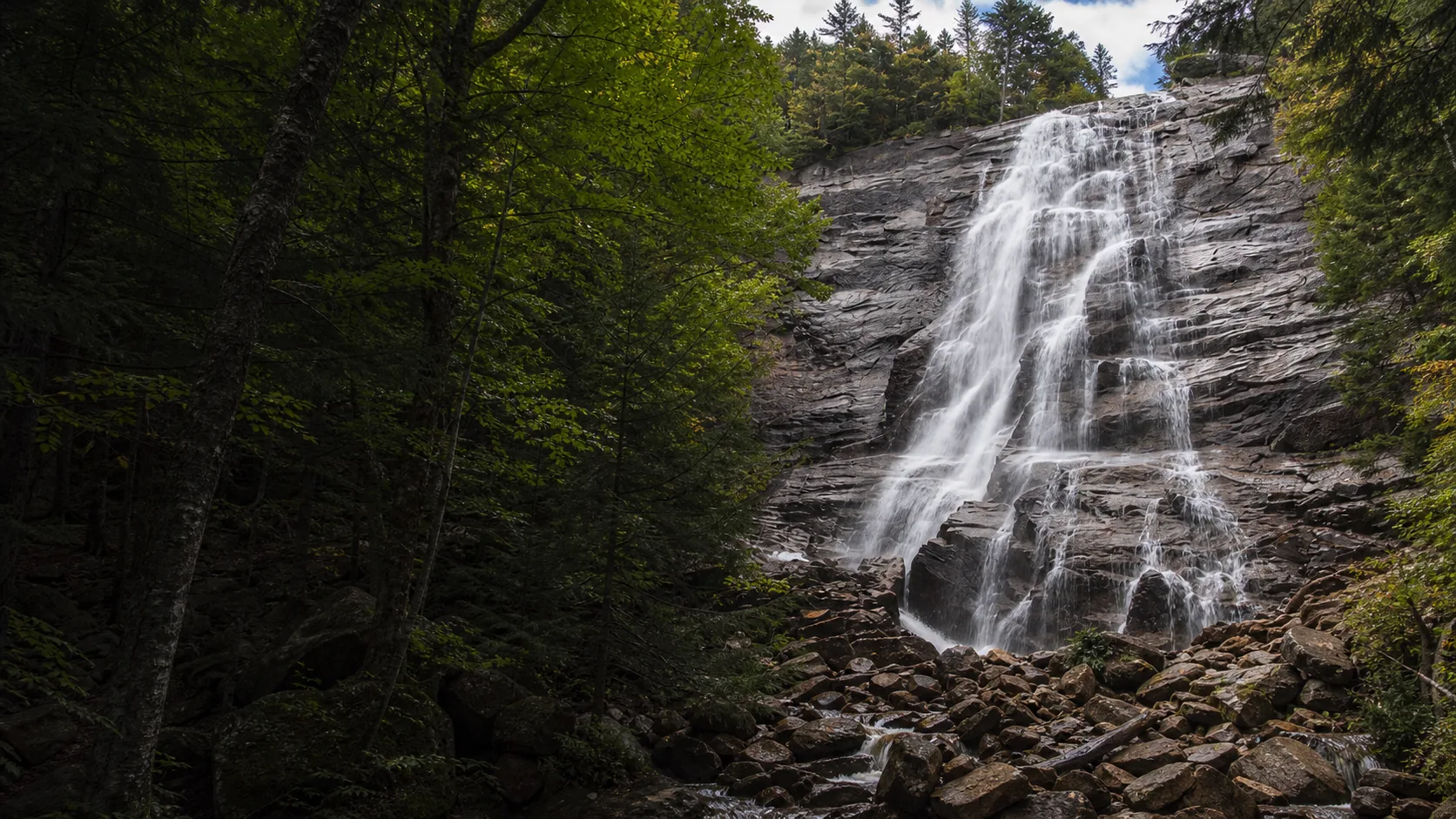
Harts Location, New Hampshire
Arethusa Falls
Plan Arethusa Falls near Harts Location, New Hampshire: 2.6 mi route details, parking and directions, best time to visit, safety notes, and 8 waterfall photos.
140 ft2.6 mi8 photos
Two published New Hampshire waterfall guides in the White Mountain National Forest and Crawford Notch State Park. Arethusa for the climb, Diana's Baths for the family swim. Verified trail length, parking, fees, and seasonal access against USFS, NH State Parks, and NH Geological Survey sources.
Almost every New Hampshire waterfall search ends in the same orbit: a North Conway hotel room, a Bartlett rental cabin, or a White Mountains trip planned around US-302 through Crawford Notch. The state's headline cascades cluster inside the White Mountain National Forest, an 800,000-acre federal forest that covers most of north-central New Hampshire, and inside the state parks that interrupt it. The Mt. Washington Valley, with North Conway at its south end and Crawford Notch at its north, is the regional spine.
The geology underneath the cluster is the Conway Granite of the White Mountain Magma Series, a coarse pink-to-buff intrusive rock emplaced into the older bedrock of New England roughly 180 to 165 million years ago during Jurassic-age volcanic activity. The same magma series built the ring-dike complexes that today form Mount Washington and the Presidential Range, the Ossipee Mountains to the south, and the Crawford Notch cliffs. Pleistocene continental ice overrode the entire region until about 12,000 years ago, leaving overdeepened main valleys with hanging tributaries that now drain off the cliffs as waterfalls. Both falls published here read off that same playbook on the same rock.
Waterfalls Guide currently publishes two New Hampshire trips: Arethusa Falls in Crawford Notch State Park, a 140-foot horsetail reached by a 2.6-mile climb with about 900 feet of elevation gain, and Diana's Baths in Bartlett, a staircase of sculpted granite pools on a flat 0.6-mile gravel walk. The two pair naturally into a single Mt. Washington Valley waterfall day: Arethusa for the climb, Diana's Baths for the swim or the fall-color stroll. The broader New Hampshire waterfall universe (Glen Ellis, Sabbaday, Lower Falls Scenic Area, Avalanche Falls, Beecher Cascades, and the Kancamagus Highway falls) is on the roadmap but not yet covered in full; the USFS White Mountain National Forest and NH State Parks pages remain the standard references until those guides land.
A 140-foot horsetail on Bemis Brook over Conway Granite in Crawford Notch State Park, reached by a 2.6-mile out-and-back with about 900 feet of climb from a free trailhead lot off US-302. The most popular waterfall hike in the White Mountains south of Franconia Notch.
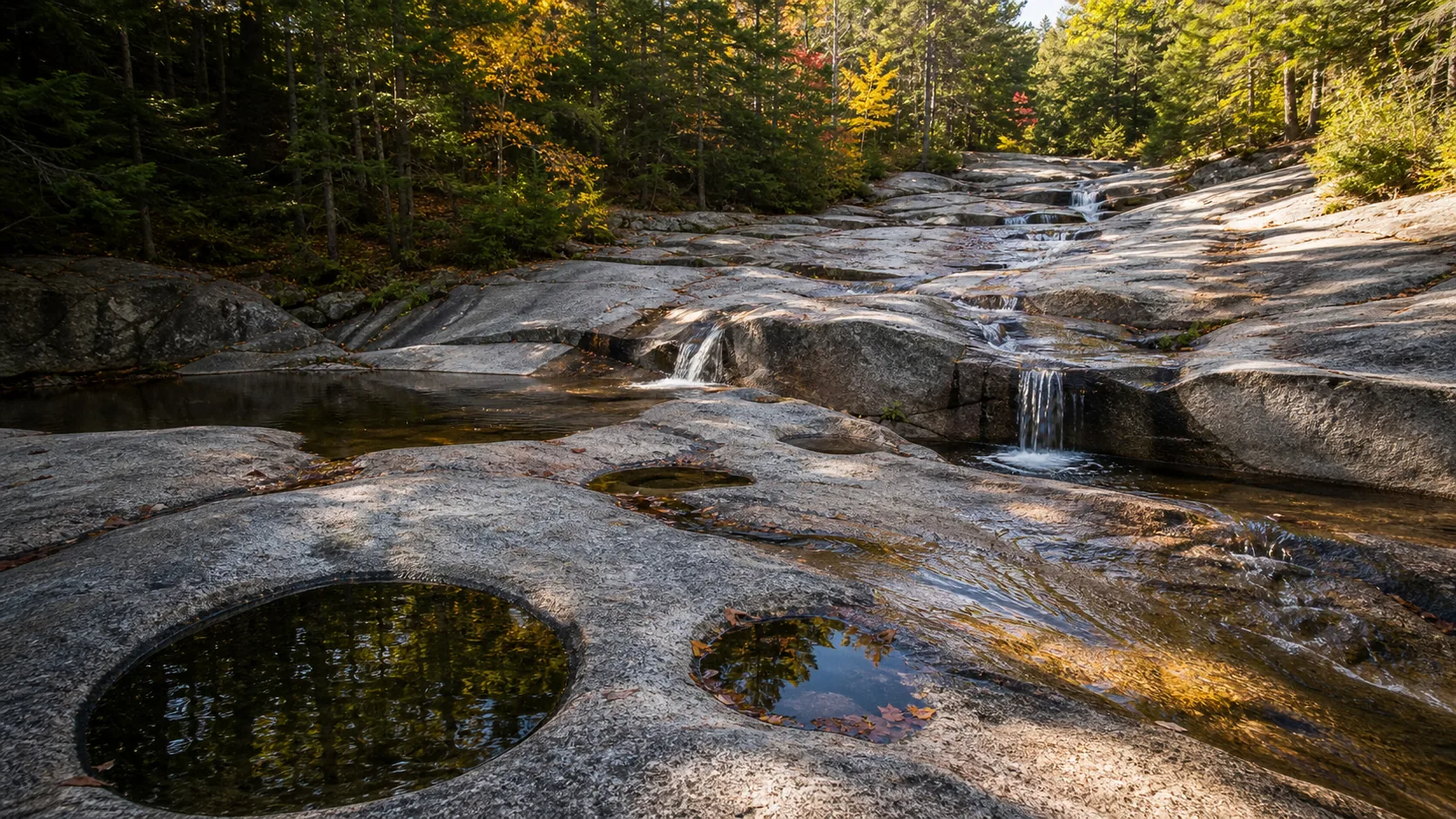
A staircase of sculpted granite pools and low cascades on Lucy Brook in the White Mountain National Forest, reached by a flat 0.6-mile gravel path from a $5 USFS lot on West Side Road in Bartlett. The single best family swim hole in the Mt. Washington Valley from mid-June through August.
New Hampshire waterfalls run on two big windows. The first is the spring snowmelt window, roughly late April through mid-May, when Mount Washington and Presidential Range snow drains hard through Bemis Brook, Lucy Brook, and every smaller tributary in the White Mountains. Arethusa reads as a full white sheet rather than a thin horsetail in this stretch, and the lower pools at Diana's Baths run loudest. The trade-off is muddy trails, cold water (the Diana's Baths pools are still too cold to swim), and snow lingering on the upper Arethusa Falls Trail into early May in heavier winters.
The second is the fall foliage window, the third week of September into the first two weeks of October. The Mt. Washington Valley is one of the best-known fall-color destinations in the eastern United States, and the hardwood color in the Crawford Notch corridor and along Lucy Brook fills the gorges against the pink Conway Granite. The Diana's Baths gravel path becomes a yellow-birch and sugar-maple tunnel; Arethusa pairs the same color with a real climb. Plan around two practical constraints in this window: the Diana's Baths USFS lot fills by 8 to 9 a.m. on Columbus Day weekend, and the Arethusa Falls trailhead lot off US-302 fills shortly after on any October foliage Saturday.
Summer (late June through August) is the family-swim window at Diana's Baths, with water in the low 60s F and lower pools shallow enough for kids; Arethusa is climbable but the falls thins to a horsetail rather than a sheet. Winter (January through March) requires microspikes or full traction on both trails. The Arethusa Falls Trail freezes solid, becomes a sustained icy grade in its upper half, and the falls itself forms a multi-pitch ice climb rated WI3 to WI4 by the Mountain Project community. Diana's Baths is workable in winter with microspikes or snowshoes but the pools rim-freeze and the USFS lot is unplowed.
Crawford Notch State Park is a 5,950-acre state park strung along US-302 between Bartlett and the village of Crawford Notch, with the Bemis Brook drainage holding Arethusa Falls. The natural Crawford Notch waterfall day adds two drive-up roadside falls a few minutes north of the Arethusa trailhead: Silver Cascade and Flume Cascade, both 250-foot multi-tier ribbons visible from the US-302 shoulder. Waterfalls Guide does not yet publish full guides to the roadside falls; the NH State Parks Crawford Notch page is the standard reference. Beecher Cascades, a stacked multi-tier above the notch village, is on the same drive.
The Mt. Washington Valley is the regional tourism anchor, with North Conway at the south end and Bartlett four miles north on US-302. Diana's Baths sits on West Side Road on the Bartlett side, the closest big-name waterfall to the valley restaurants and lodging. Cathedral Ledge, Echo Lake State Park, and the Saco River swim holes round out the casual day-use options inside a 10-minute drive of the Diana's Baths trailhead. Most visitors base out of North Conway for the lodging density and treat both Arethusa and Diana's Baths as day trips from the same hotel.
The honest answer is that the title is disputed. Arethusa Falls in Crawford Notch State Park is most commonly cited as the tallest single-drop waterfall in New Hampshire and is the figure used by the NH State Parks listing and most modern guidebooks. The height itself is contested: Visit New Hampshire and Visit White Mountains list 160 feet, the Wikipedia article and current signage list 140 feet, and a 2017 Woodlands and Waters field write-up estimated about 176 feet. Waterfalls Guide treats 140 ft as the conservative authoritative number. Other candidates including Wilkinson Falls and Beecher Cascades contest the ranking by total drop, but Beecher is multi-tier rather than a single fall and Wilkinson is harder to access. Arethusa wins on uninterrupted single-drop height; it loses on volume to Glen Ellis Falls in Pinkham Notch.
The White Mountains hold dozens of named waterfalls across the White Mountain National Forest and several state parks. The two Waterfalls Guide currently publishes in full, Arethusa Falls in Crawford Notch and Diana's Baths in Bartlett, are the headline cluster on the US-302 and West Side Road corridor in the Mt. Washington Valley. Other well-known White Mountain falls include Glen Ellis Falls and Crystal Cascade in Pinkham Notch on NH-16, Sabbaday Falls and the Lower Falls Scenic Area on the Kancamagus Highway (NH-112), Avalanche Falls inside the Flume Gorge at Franconia Notch State Park, and Beecher Cascades north of the Arethusa trailhead in Crawford Notch. The USFS White Mountain National Forest page is the standard reference for falls not yet published here.
Two windows. Late April through mid-May is the snowmelt peak, when Bemis Brook and Lucy Brook drain hard off the Presidential Range and Arethusa reads as a full white sheet rather than a thin horsetail. The third week of September into the first two weeks of October is the fall foliage window, when the Mt. Washington Valley hardwood color fills the Crawford Notch corridor and the Lucy Brook canopy. Summer (late June through August) is the swim window at Diana's Baths with pool water in the low 60s F. Winter trips require microspikes or full traction on both trails, and the Arethusa Falls trailhead lot is unplowed.
Most are free. Crawford Notch State Park charges no entry fee for the Arethusa Falls Trailhead, and most White Mountain National Forest waterfalls are free at the trailhead. Diana's Baths is the practical exception: the USFS day-use lot on West Side Road charges $5 per vehicle (cash or America the Beautiful interagency pass). The Flume Gorge at Franconia Notch State Park, where Avalanche Falls sits, charges a paid admission. Several New Hampshire state-park sites also charge a per-person day-use fee in summer; check the NH State Parks page before you go.
Some, but not most. Diana's Baths on Lucy Brook is the most famous family swim hole in the Mt. Washington Valley: the lower pools are knee- to thigh-deep with a waist- to shoulder-deep tub at the foot of the upper cascade. Water stays cold (roughly 60 to 65 F in midsummer) and there are no lifeguards. Arethusa Falls has no real swimming hole; the plunge pool is shallow, the granite is slick, and wading is informally tolerated only on hot days. For warm-water swimming with lifeguards the standard alternatives are Echo Lake State Park near North Conway, the Saco River pools below Bartlett, and Jackson Falls on the Wildcat Brook side.
The southern White Mountains run on the Conway Granite of the White Mountain Magma Series, a pink-to-buff intrusive rock emplaced into the older New England bedrock roughly 180 to 165 million years ago during Jurassic-age volcanic activity. The same magma series built the ring-dike complexes that today form Mount Washington and the Presidential Range, the Ossipee Mountains to the south, and the Crawford Notch cliffs that hold Arethusa Falls. Pleistocene continental ice overrode the region until about 12,000 years ago and overdeepened the main valleys, leaving hanging tributaries like Bemis Brook to drop off the cliffs as waterfalls. At Diana's Baths, the same granite is the canvas for plunge-pool potholes: small cobbles spun in tight circular grinds at the base of each cascade wear the rock into the bathtub-shaped depressions that name the falls.
Yes, with traction. Both Arethusa Falls and Diana's Baths stay open in winter, but the Arethusa Falls Trail freezes hard from late December through March and the steeper second half becomes a sustained icy grade that requires microspikes or full traction (trekking poles help, and snowshoes are sometimes needed after fresh snow). The falls itself forms a multi-pitch ice climb rated WI3 to WI4 and is one of the more popular intermediate ice routes in New England. Diana's Baths is workable with microspikes or snowshoes on the flat gravel path; Lucy Brook runs partly under ice and the pools rim-freeze without fully sealing. Both trailhead lots are unplowed; park in the US-302 pullout for Arethusa and use the West Side Road lot at Diana's Baths if it has been cleared.
Plan Arethusa Falls near Harts Location, New Hampshire: 2.6 mi route details, parking and directions, best time to visit, safety notes, and 8 waterfall photos.
Plan Diana's Baths near Bartlett, New Hampshire: 1.2 mi route details, parking and directions, best time to visit, safety notes, and 8 waterfall photos.