 Waterfalls Guide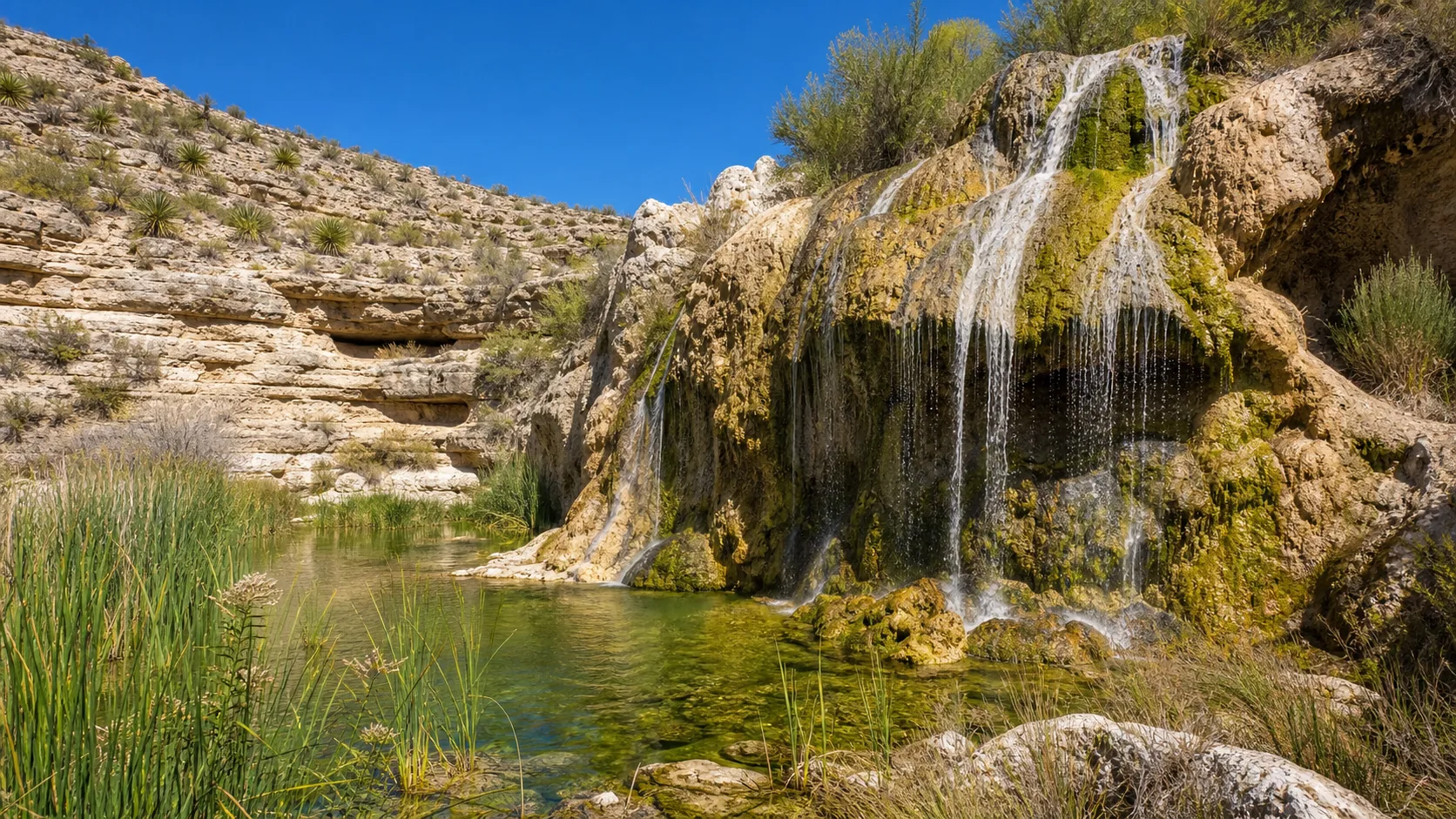
Carlsbad, New Mexico
Sitting Bull Falls
Plan Sitting Bull Falls near Carlsbad, New Mexico: 0.2 mi route details, parking and directions, best time to visit, safety notes, and 8 waterfall photos.
150 ft0.2 mi8 photos
One verified guide to the most reliable waterfall in the Chihuahuan Desert. Year-round spring flow over Permian limestone, $5 gate fee, 9-to-4 hours, and the Carlsbad triangle that puts the caverns and the falls on the same two-day loop.
New Mexico is a desert state, and that fact controls every waterfall question that gets typed into a search bar from inside its borders. The Chihuahuan Desert covers the southern third of the state at around 15 inches of annual rainfall, the high plateau north of Albuquerque is dry sage and pinyon-juniper, and even the wetter ranges (the Sangre de Cristos around Taos, the Jemez above the Rio Grande, the Sacramentos east of Alamogordo) hold their water mostly as snowpack and seasonal runoff. The result is a state where named waterfalls are scattered and most of them are seasonal: Jemez Falls on the East Fork of the Jemez River, Soda Dam on the same drainage, Frijoles Falls inside Bandelier National Monument, Capulin Spring in the Sandias, Nambe Falls on Pueblo of Nambe land near Santa Fe. None of those have been published as verified Waterfalls Guide entries yet, and several of them are dry by August in a normal year.
The one New Mexico waterfall we have walked end to end is the anomaly that proves the rule. Sitting Bull Falls is a 150-foot multi-tier travertine cascade in Lincoln National Forest, hidden in a Chihuahuan Desert canyon roughly 42 miles southwest of Carlsbad. It runs year-round because the discharge is not surface runoff but spring-fed groundwater emerging from the Capitan Reef, the same Permian fossil reef that hosts the chambers of Carlsbad Caverns National Park about 50 miles east. Calcium-rich water hits open air, degasses carbon dioxide, precipitates calcium carbonate, and over geologic time has built tiered rimstone dams of pale travertine that step down the canyon wall. The face is, slowly, still growing.
This hub indexes the New Mexico waterfall guide published on Waterfalls Guide so far. It covers one region (Lincoln National Forest / Guadalupe Ranger District) and pairs cleanly with the most popular itinerary in southern New Mexico: a two-day Carlsbad loop that puts the caverns, the falls, and Guadalupe Mountains National Park inside a single trip. The operational details matter here in a way they do not at most state waterfalls because the Forest Service runs Sitting Bull as a tightly gated day-use site, and the access road is long enough that getting the hours wrong is a real cost.
Unlike snowmelt-driven waterfalls farther north, Sitting Bull Falls does not have a discharge peak you have to chase. The springs run year-round and the flow holds steady across seasons; the constraint is not the water, it is the daytime heat and the gate hours. The two easiest windows are March through May and October through November, when daytime temperatures in the canyon are comfortable, the desert understory is greenest in spring, and the light on the pale travertine is workable at any time of day.
Summer (June through August) is the popular swimming window precisely because the spring-fed pool is cold; arrive at the 9 a.m. gate opening to beat both the heat and the parking competition. The Forest Service can close the site during posted flash-flood, fire, or water-quality events, especially during the July through August monsoon when afternoon thunderstorms push debris flow through the canyon below the recreation area. Winter is uncrowded and the canyon stays mild compared with the rest of the state; freezes are rare but possible, and the same 9-to-4 gate hours hold every day of the year. Always confirm the gate is open before driving out from Carlsbad; the last 8 miles into Forest Road 276 are remote with no services and limited cell coverage.
The southern unit of Lincoln National Forest covers the New Mexico side of the Guadalupe Mountains, the range that crosses the Texas border to form Guadalupe Mountains National Park and that hosts the Permian Capitan Reef limestone of Carlsbad Caverns. Sitting Bull Falls is the only major waterfall in the district and one of the very few perennial-flow waterfalls anywhere in the Chihuahuan Desert. The Guadalupe Ranger District also manages dispersed camping outside the gated recreation area and the trail system around the canyon, including Overlook Trail #215 and the longer desert routes.
The standard southern New Mexico trip is a two-day loop anchored on Carlsbad, with Carlsbad Caverns National Park about 75 minutes east of the falls and Guadalupe Mountains National Park about 90 minutes south. A typical plan is caverns on day one (half-day cave tour and natural-entrance walk), Sitting Bull Falls plus the Living Desert Zoo and Gardens State Park on day two, ordered by gate times: the falls first because the entrance station closes at 3:30 p.m., then Living Desert in the late afternoon. Guadalupe Mountains works as a separate longer trip if you want a real backcountry day.
Not many, by waterfall-state standards. The state has a handful of named falls scattered across the Jemez Mountains, the Sangre de Cristos, the Sandias, the Sacramento Mountains, and the Guadalupes, including Jemez Falls, Soda Dam, Frijoles Falls inside Bandelier National Monument, Capulin Spring in the Sandias, and Nambe Falls on Pueblo of Nambe land. Most are seasonal, several are dry by late summer in a normal year, and several sit on tribal land with separate access rules. Waterfalls Guide currently publishes one verified New Mexico guide (Sitting Bull Falls) and is expanding coverage as additional falls are field-checked.
The tallest named waterfall most often cited is Nambe Falls on Pueblo of Nambe land near Santa Fe, with a published height around 100 feet, accessed through tribal recreation fees that vary by season. Sitting Bull Falls in Lincoln National Forest is the tallest waterfall in southern New Mexico at 150 feet across a multi-tier travertine face, and the only one in the Chihuahuan Desert with year-round flow. Waterfalls Guide has not yet published a verified Nambe Falls guide; we publish Sitting Bull because it is the one we have walked end to end.
Yes, but the list is short. Sitting Bull Falls is the most reliable because it is spring-fed from groundwater stored in the Permian Capitan Reef rather than surface runoff, which is why it holds steady through the dry Chihuahuan Desert summer when the surrounding arroyos are bone dry. A few other springs in the state produce small perennial drops, but most named New Mexico waterfalls (Jemez, Soda Dam, Frijoles, Capulin) run hard with spring snowmelt and thin or disappear by August. If you want a guaranteed waterfall in any month of the year, Sitting Bull is the answer.
The U.S. Forest Service entrance gate at the Sitting Bull Falls Recreation Area opens at 9 a.m. and closes at 4 p.m. daily, with last entry at 3:30 p.m. so the parking lot can clear before closing. The hours hold year-round, the site is day-use only with no overnight camping inside the gated area, and the fee is $5 per vehicle. Plan the drive from Carlsbad (about 60 minutes including the last 8 miles on Forest Road 276) around those gate hours; arriving at 4 p.m. means you do not get in.
$5 per vehicle, paid at the Forest Service entrance gate. The fee is a USFS day-use charge, not a true park entrance, and interagency passes are accepted in lieu of the daily fee, including the America the Beautiful pass, the Senior Pass, the Access Pass, and the Military Pass. No reservation is required. The fee covers parking inside the gated recreation area and the picnic facilities, but does not cover any guided service; there are no guided tours of the falls itself.
Yes. Swimming and wading are allowed in the main spring-fed pool below the cascade when the recreation area is open, and the cold water in summer is the reason a large share of visitors come. There is no lifeguard, the bottom is uneven travertine and limestone with submerged rocks, and the Forest Service can close the pool during posted flash-flood, fire, or water-quality events. Water shoes are strongly recommended; do not climb on the fragile travertine terraces above the pool, where the calcium-carbonate crust is fragile and biologically active.
The two sites pair naturally as a two-day southern New Mexico loop because they sit on the same Permian Capitan Reef limestone and are about 75 minutes apart by road. Carlsbad Caverns National Park is the show cave; Sitting Bull Falls is the surface expression of the same fossil-reef geology, where calcium-rich groundwater emerges into the canyon and precipitates travertine. A typical plan is caverns on day one and Sitting Bull on day two, with the Living Desert Zoo and Gardens State Park in Carlsbad filling the late afternoon and Guadalupe Mountains National Park reserved for a longer trip about 90 minutes south of the falls.
Plan Sitting Bull Falls near Carlsbad, New Mexico: 0.2 mi route details, parking and directions, best time to visit, safety notes, and 8 waterfall photos.