 Waterfalls Guide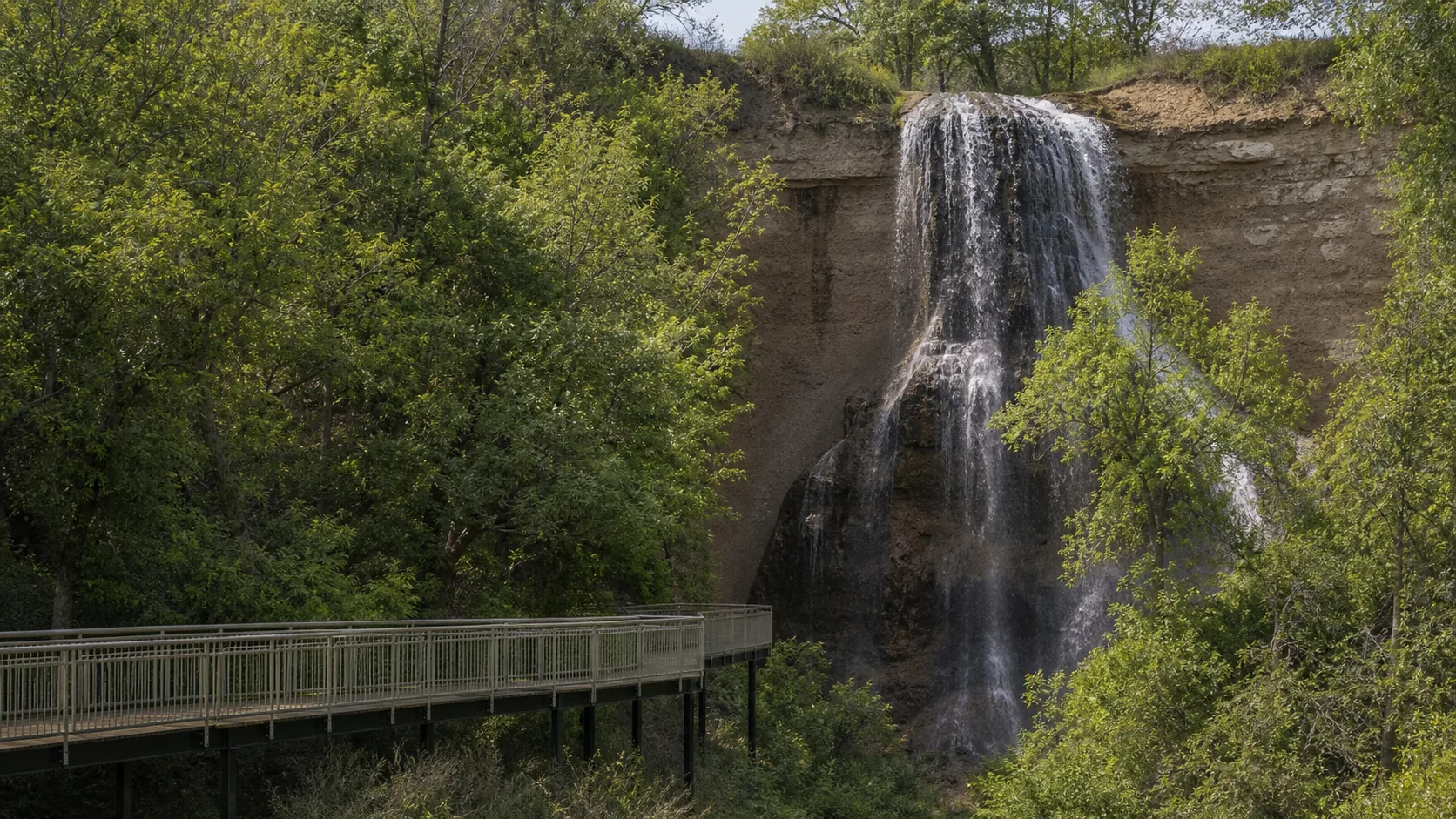
Cherry County, Nebraska
Smith Falls
Plan Smith Falls in Cherry County, Nebraska: 0.8 mi route details, parking and directions, best time to visit, safety notes, and 8 waterfall photos.
63 ft0.8 mi8 photos
One verified guide to the tallest waterfall in Nebraska. A 63-foot spring-fed plunge over Niobrara Formation chalk, fed by the Ogallala aquifer, and the Cherry County tubing scene it sits inside.
Nebraska is a prairie state, and that fact controls every honest waterfall question that gets typed into a search bar from inside its borders. The land between the Missouri River and the Wyoming line is the eastern edge of the Great Plains, planed flat by glacial outwash and the slow, low-gradient meandering of rivers like the Platte, the Republican, and the Niobrara. There are very few caprock-undercut ledges of the kind that produce a Minnehaha in Minneapolis or a St. Anthony on the Mississippi. What Nebraska does have, hidden under most of the state, is one of the largest aquifers in the world. Smith Falls is what happens when that aquifer hits an edge.
Waterfalls Guide currently publishes Smith Falls in full. It is the only Nebraska waterfall we have walked end to end and the one most likely to be on a visitor's short list: a 63-foot spring-fed plunge inside Smith Falls State Park, 17 miles east of Valentine in Cherry County, set inside the Niobrara National Scenic River corridor. It is the tallest waterfall in the state, and the gap between first and second is large enough that the question is essentially settled. The water itself is groundwater from the Ogallala Group, the High Plains aquifer that underlies most of Nebraska and parts of seven other states, daylighting along the contact with the Niobrara Formation chalk and falling 63 feet into a shallow alcove the spring has carved over thousands of years.
The broader list of named Nebraska falls is short and mostly small. Fort Falls inside Fort Niobrara National Wildlife Refuge, Stairstep Falls, Berry Falls, and Norden Chute share the same Niobrara canyon and the same spring-fed mechanic at smaller scale. Toadstool Geologic Park in the Pine Ridge country holds small intermittent drops over badlands clay. The Sandhills hide a handful of unnamed spring cascades. Devil's Nest in Knox County has small seasonal falls. None of those have been published as verified Waterfalls Guide entries yet, and several only run after wet spring stretches. This hub is built around the single anchor that does run year-round, and around the summer tubing scene that brings most visitors within driving distance of it anyway.
Unlike snowmelt-driven waterfalls farther north, Smith Falls does not have a discharge peak you have to chase. The spring is fed by Ogallala groundwater and the flow holds steady across seasons at roughly 52 degrees Fahrenheit; the constraint is not the water, it is the seasonal park gate and the summer crowd. The two easiest windows are late May through mid-June and September through early October, when the entry gate is staffed, the Niobrara canyon is comfortable, and the tubing concessions have not yet hit peak volume.
Summer (late June through August) is the busy window because the broader regional draw is the Niobrara River itself rather than the falls. The Niobrara National Scenic River, designated by Congress in 1991, is a 76-mile reach of shallow, warm-bottomed, slow water that most of Nebraska treats as the state's flagship summer destination. Outfitters in Valentine run shuttle vans and rent tubes, canoes, and kayaks daily from Memorial Day to Labor Day, and Smith Falls is one of the standard put-in and take-out points on the upper reach. If the parking lot is full when you arrive on a July weekend, the reason is tubing, not the falls. Arrive before 10 a.m. on summer Saturdays if you want a calm photo.
Fall (September through October) is the underrated window. The tubing volume thins out after Labor Day, the gate is typically still staffed through early October, the canyon turns yellow in the burr-oak draws, and weekday mornings on the boardwalk are quiet. Winter (December through February) is uncrowded but the main entrance gate is typically closed; access becomes a walk-in from Highway 12 with an extra mile of road walking each way. Because the source is aquifer storage at 52 degrees year-round, the falls rarely freezes solid in any meaningful way. Expect heavy ice fringes and a bearded rime crust on the moss and chalk rather than a frozen column. Confirm the gate status with Nebraska Game and Parks before driving out from Valentine; the canyon is remote with no services on the last few miles of Smith Falls Road.
The 76-mile Niobrara National Scenic River corridor between Valentine and the Highway 137 bridge holds essentially every named waterfall in Nebraska. Smith Falls is the tallest and the only one with a developed park around it. The other Niobrara-canyon falls (Fort Falls inside Fort Niobrara National Wildlife Refuge, Stairstep Falls, Berry Falls, and Norden Chute) are all spring-fed for the same Ogallala reason and all in the 20- to 50-foot range; none have published Waterfalls Guide entries yet. The canyon sits at the convergence of six ecosystems, which is why Congress designated the National Scenic River unit in 1991 and why University of Nebraska researchers have spent decades studying it as an ecological crossroad. Cherry County is the largest county in Nebraska by area and one of the least densely populated; Valentine, population around 2,600, is the only practical base town.
The standard Cherry County summer trip is a one- or two-day Niobrara float anchored on Valentine. Outfitters including Sunny Brook Camp, Little Outlaw, and Graham Canoe Outfitters run shuttle vans and rent tubes, canoes, and kayaks for trips that range from a 3-mile float (Cornell Bridge to Smith Falls, about 2 hours) to a 12-mile float (Sunny Brook to the Berry Bridge, about 6 hours). Expect to pay roughly $20 to $35 per person for a half-day trip with shuttle, more for longer trips and for canoes. Smith Falls is one of the most popular put-in or take-out points on the upper reach, which is why the park parking lot fills before noon on summer Saturdays. The falls itself is a 10-minute side trip from the boat ramp. If you have one day and want both, do the falls first thing in the morning and put on the river by 11 a.m.
Not many, by waterfall-state standards. Nebraska is a prairie state and the geography does not produce the caprock-undercut ledges that make for cascades elsewhere. The state has a handful of named falls, almost all of them clustered along a single 76-mile reach of the Niobrara River in Cherry County, including Smith Falls, Fort Falls inside Fort Niobrara National Wildlife Refuge, Stairstep Falls, Berry Falls, and Norden Chute. Most are spring-fed from the Ogallala aquifer and most are in the 20- to 50-foot range. A few small intermittent drops exist at Toadstool Geologic Park in the Pine Ridge, at Devil's Nest in Knox County, and at scattered Sandhills springs. Waterfalls Guide currently publishes one verified Nebraska guide (Smith Falls) and is expanding coverage as additional falls are field-checked.
Smith Falls is the tallest waterfall in Nebraska at 63 feet, inside Smith Falls State Park about 17 miles east of Valentine in Cherry County. Wikipedia, the National Park Service Niobrara unit page, Nebraska Game and Parks, and Visit Nebraska all list the surveyed height at 63 feet. Some sources round up to almost 70 feet, but 63 is the figure on the park sign and on the official state-parks page. The next-tallest Nebraska waterfalls are all on the same stretch of the Niobrara River and most are in the 20- to 50-foot range, so the gap between first and second is large enough that the question is essentially settled.
Yes. Smith Falls and the other Niobrara-canyon falls are spring-fed from groundwater stored in the Ogallala aquifer, not from surface runoff or snowmelt, which is why they run at essentially the same volume in August that they run in May. The water emerges as a perched spring along the contact between the Ogallala sands above and the Niobrara Formation chalk below, at roughly 52 degrees Fahrenheit year-round. Because the source is aquifer storage rather than precipitation, the falls survives the dry High Plains summer when surface creeks across the state are at their lowest. The constraint at Smith Falls is the seasonal park gate, not the water itself.
Nebraska state parks charge a daily vehicle permit of $8 for residents and $11 for non-residents, with a $35 resident annual permit that covers every Nebraska state park. The permit is required at Smith Falls State Park year-round when the gate is staffed, sold at the entrance, online through the Nebraska Game and Parks system, and at any other Nebraska state park. There is no separate per-person hike fee. Tubing rental and shuttle through private Valentine outfitters is a separate cost, typically $20 to $35 per person for a half-day trip on the Niobrara River.
Smith Falls State Park day use runs 6 a.m. to 10 p.m. when the gate is staffed. The full park experience, including vehicle access to the day-use lot near the trailhead and to the campground, is typically available from mid-May through Labor Day weekend, with reduced shoulder-season access in spring and fall. Outside that window the entrance road may be gated and walk-in access from Highway 12 is the only option; the falls itself is still reachable on foot but you add roughly a mile of road walking each way. Confirm the current gate window with Nebraska Game and Parks before driving.
Standing under the falls itself is informally tolerated on hot summer days, but the plunge pool is shallow, the chalk shelf is slick with algae, and the platform is narrow. The Niobrara River itself is the legal swim and tube zone and the actual draw for most summer visitors; the park has a small river beach at the campground end, and the river runs at a comfortable summer temperature because it picks up Ogallala spring water along the canyon. Outside the gated park, do not swim or wade above the lip of the falls; the chalk shelf there is fragile and slippery.
The two are essentially the same trip for most visitors. The 76-mile Niobrara National Scenic River, designated by Congress in 1991, is the broader summer destination, and Smith Falls State Park is one of the standard put-in or take-out points on the upper reach. A typical day plan is to arrive at Smith Falls early in the morning, walk the boardwalk and photograph the falls in the soft canyon light, then drive back into Valentine for a half-day tubing rental and shuttle. Outfitters will drop you upstream and pick you up at the Smith Falls boat ramp, which puts the falls walk and the float trip on the same $8 state-park permit.
Plan Smith Falls in Cherry County, Nebraska: 0.8 mi route details, parking and directions, best time to visit, safety notes, and 8 waterfall photos.