 Waterfalls Guide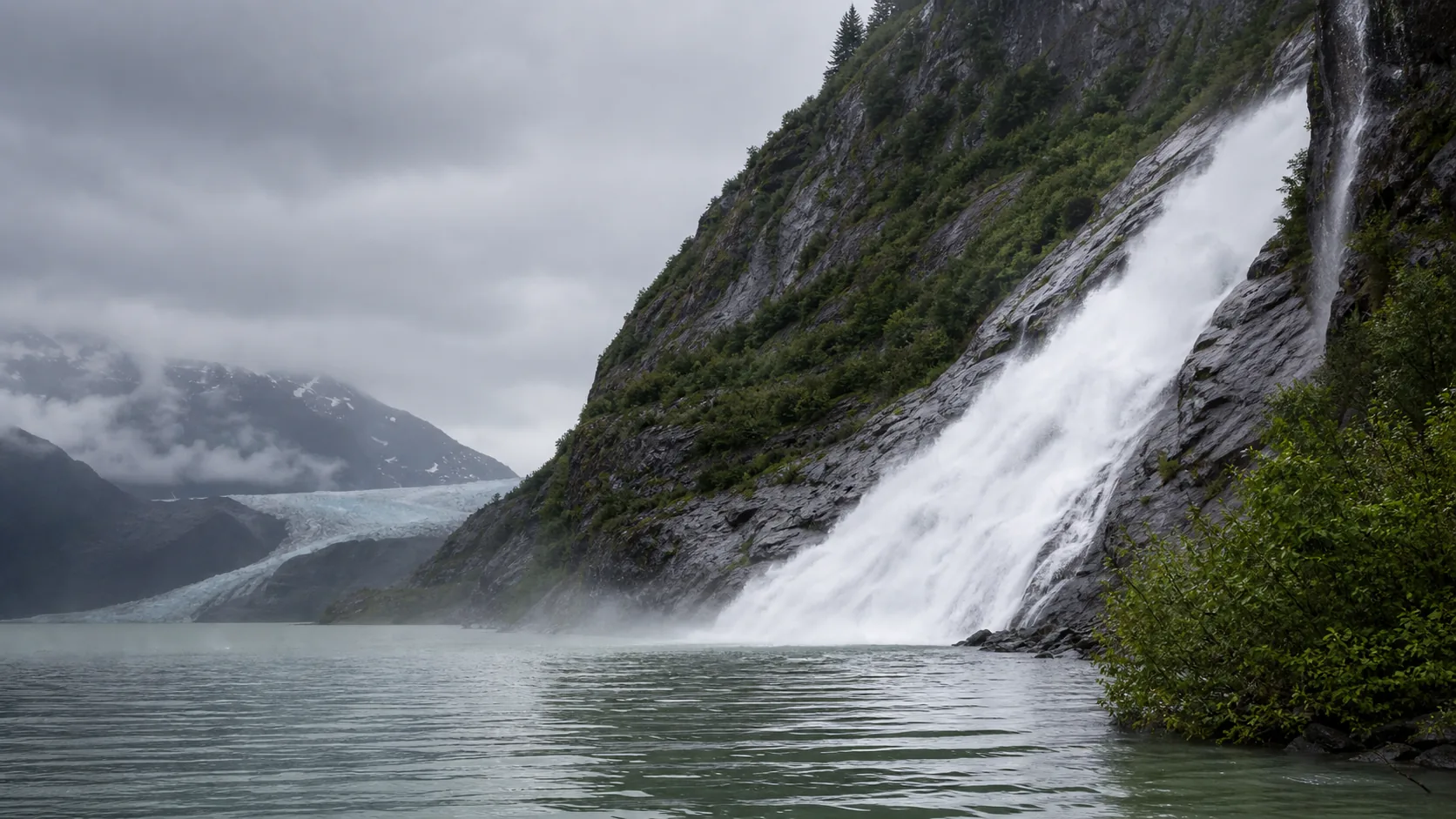
Juneau, Alaska
Nugget Falls
Plan Nugget Falls near Juneau, Alaska: 2 mi route details, parking and directions, best time to visit, safety notes, and 10 waterfall photos.
377 ft2 mi10 photos
Alaska has more waterfalls than most U.S. states combined, and almost none of them are easy to publish well. The one we do publish, Nugget Falls, is the 377-foot two-tier plunge directly beside the Mendenhall Glacier near Juneau, reached on a flat one-mile lake-edge trail.
Alaska almost certainly has more waterfalls than any other U.S. state. The state holds 16.7 million acres of Tongass National Forest alone (the largest national forest in the country), the entire Coast Mountains rainforest belt from Ketchikan north to Skagway, a temperate maritime climate that delivers 60 to 200 inches of precipitation a year along the southeast panhandle, and roughly 27,000 glaciers feeding meltwater into hanging valleys above tidewater. The Northwest Waterfall Survey has cataloged thousands of named Alaska drops; many thousands more are unnamed. By raw count it is not a close contest.
The problem is publishing them. Most Alaska waterfalls fail at least one of the practical tests this site holds every guide to: a maintained trailhead, a legal access route, a verifiable trail length, a reliable live flow proxy, and a managing agency we can quote. The headline names visitors search for, Horsetail Falls and Bridal Veil Falls in Keystone Canyon outside Valdez, the cascades streaming off the Worthington Glacier on the Richardson Highway, the waterfalls inside Wrangell-St. Elias National Park and Preserve (13.2 million acres, the largest U.S. national park), Punchbowl Falls and the long list of Tongass drops along the Inside Passage cruise route, and the unnamed plunges around McCarthy and Kennecott, are all real, photographed routinely, and almost all of them lack the maintained-access plus live-data combination we need to publish a complete guide. Our coverage will grow. As of May 2026 it is one fall, deliberately chosen.
That fall is Nugget Falls: a 377-foot two-tier plunge on Nugget Creek that drops directly into Mendenhall Lake inside the Mendenhall Glacier Recreation Area, a 5,815-acre unit of Tongass National Forest about 13 miles north of downtown Juneau. The trail is a flat 1.0 mile each way of hard-packed gravel and short paved sections from the Mendenhall Glacier Visitor Center. There is a U.S. Forest Service $5 day-use fee in summer (May 1 to September 30), federal Interagency and America the Beautiful passes cover it, and the live USGS gauge on the Mendenhall River near Auke Bay (15052500, 30-year daily-discharge median 424 cfs, historical maximum 21,900 cfs from a 2024 glacial outburst flood) is a reliable proxy for falls volume. It is the rare Alaska waterfall with verifiable trail length, a maintained surface, an active managing agency, and a live discharge gauge in one package.
The other thing worth saying up front: the Mendenhall Glacier itself has retreated about two miles from where it stood in the 1950s, when its ice face was at the present-day Visitor Center overlook. The glacier is still the headline reason most cruise passengers visit, but the falls is the part of the view that has stayed put. As the ice has receded into the distance, Nugget Falls has become the closer, louder, and more reliably full-frame photographic subject for the area. This hub is built around that one trip.
Late June through early August is the loudest window for Nugget Falls and most southeast Alaska waterfalls fed by snow and glacial melt. Warm afternoons on the Juneau Icefield melt the ice surface fast enough to push the Mendenhall River gauge near Auke Bay (USGS 15052500) regularly above 2,000 cfs, which is when the falls reads as a thick column with audible roar from the lakeshore trail. The 30-year daily median at that gauge is 424 cfs and the 90th-percentile reading is 3,540 cfs, so July readings between roughly 1,500 and 3,500 cfs are the brochure window.
Mid-May through mid-June is the shoulder before peak cruise season. The Visitor Center is open, the day-use fee is collected, the trail is maintained, and the falls is running on early snowmelt at lower but still photogenic volume. Wildflower bloom on the trail and bear activity along Steep Creek both start in this window. Late August through late September is the second shoulder: glacial melt eases, the falls reads more delicate, fall color comes into the alders and devil's club along the trail, and crowds thin noticeably as the cruise season winds down at the end of September.
October through April is technically off-season. The Visitor Center closes for the winter, the day-use fee program ends, the trail is unmaintained, the Capital Transit shuttle stops running the Glacier Express loop, and access depends on snow cover, lake ice, and short-notice Forest Service alerts. Partial ice forms on the falls in cold stretches but a fully formed ice column is not a reliable annual event. Winter visits are possible but require self-sufficient planning, traction devices, and a willingness to turn around for short-notice conditions. The same general window applies to most southeast Alaska waterfalls; interior and Arctic waterfalls follow a separate, harder calendar.
The Mendenhall Glacier Recreation Area is a 5,815-acre unit of Tongass National Forest about 13 miles north of downtown Juneau and 5 miles from Juneau International Airport. The Mendenhall Glacier Visitor Center, which opened in 1962 as the first National Forest Service visitor center in the country, anchors the area; the Nugget Falls Trail, the paved Photo Point loop, the Trail of Time interpretive loop, the East Glacier Loop, and the Steep Creek salmon viewing platform all start within a few minutes' walk of each other. A $5 day-use fee per adult applies between May 1 and September 30, federal Interagency, America the Beautiful, Senior, and Access passes cover the fee, and the lot fills before 10 a.m. on cruise ship days. This is the published cluster.
Almost certainly more than any other U.S. state. Alaska holds the 16.7-million-acre Tongass National Forest (the largest in the country), the 13.2-million-acre Wrangell-St. Elias National Park and Preserve (the largest U.S. national park), roughly 27,000 glaciers, and a temperate maritime climate across the southeast panhandle that delivers 60 to 200 inches of precipitation a year. The Northwest Waterfall Survey has cataloged thousands of named Alaska drops and many thousands more are unnamed. Waterfalls Guide currently publishes one full Alaska guide (Nugget Falls in Juneau), deliberately, because most Alaska waterfalls lack the maintained-trail-plus-live-data combination we publish a complete guide around.
There is no single household-name Alaska waterfall in the way that Niagara, Yosemite, or Multnomah serve their states. The most photographed Alaska waterfalls are probably Nugget Falls at the Mendenhall Glacier near Juneau (377 feet, beside one of the most visited glaciers in the country), Horsetail Falls and Bridal Veil Falls in Keystone Canyon outside Valdez on the Richardson Highway, and the cascades draining off the Worthington Glacier farther north on the same road. Nugget Falls is the only one of those with a full Waterfalls Guide guide as of May 2026.
From any of the four Juneau cruise piers downtown, the Mendenhall Glacier Visitor Center is about 13 miles north and 25 minutes by road. The cheapest legal options are the Juneau Capital Transit Route 3 city bus to the DeHart's stop on Mendenhall Loop Road, plus the seasonal Glacier Express shuttle the last few miles to the Visitor Center, or one of the blue line tour buses that depart on a fixed schedule directly from the cruise pier area. From the Visitor Center, the Nugget Falls Trail is a flat 1.0 mile each way of hard-packed gravel and short paved sections to the base of the falls. Most cruise visitors complete the full round trip from ship to falls and back in about 3 to 4 hours.
Yes, in summer. The U.S. Forest Service charges a $5 day-use fee per adult at the Mendenhall Glacier Visitor Center between May 1 and September 30. Children under 16 are free, and federal Interagency, America the Beautiful, Senior, and Access passes cover the fee. Outside those dates the trail is technically open and free but the Visitor Center is closed, the trail is unmaintained, and the Capital Transit Glacier Express shuttle is not running. The fee covers the recreation area, not the falls trail specifically; there is no separate trail fee.
Yes. The Nugget Falls Trail runs along the south shore of Mendenhall Lake for the full mile, with the glacier across the water for the entire walk. The combined falls-plus-glacier composite (377 feet of waterfall on one side, blue glacial ice on the far shore, and floating icebergs in the lake between them) is the photograph most visitors actually take home from Juneau. The Mendenhall Glacier has retreated about two miles from where it stood in the 1950s, so the ice face is now noticeably farther from the Visitor Center deck than the postcards from 30 years ago show; Nugget Falls, by contrast, has held its line, which is part of why the falls has become the more reliable photographic subject.
Most Alaska waterfalls fail at least one of the practical tests we hold every full guide to: a maintained trailhead, a legal access route, a verifiable trail length, a reliable live flow proxy (typically a USGS discharge gauge), and an active managing agency we can quote for hours, fees, and short-notice closures. Roadside drops like Horsetail Falls and Bridal Veil Falls in Keystone Canyon are real and accessible but have no trail and no flow gauge. Backcountry falls inside Wrangell-St. Elias and Tongass require a floatplane, a multi-day permit trip, or a guided ice hike, and the access conditions change too often to publish a date-stamped complete guide. As of May 2026 we publish Nugget Falls, where the maintained-access-plus-live-data combination is in place; coverage will grow over time.
Many. Tongass National Forest covers 16.7 million acres across the southeast Alaska panhandle, the largest national forest in the U.S. by acreage, and holds thousands of waterfalls draining the Coast Mountains rainforest into salt water. Punchbowl Falls and the long list of cliff-and-tidewater drops along the Inside Passage cruise route, the falls inside Misty Fjords National Monument south of Ketchikan, and the cascades draining into the Stikine River near Wrangell are all within Tongass. Most are best seen from the water on a guided boat or floatplane tour rather than from a maintained trail, which is why Nugget Falls (the rare Tongass fall with a flat, maintained, signed trail from a developed Visitor Center) is currently the only one we publish in full.
Plan Nugget Falls near Juneau, Alaska: 2 mi route details, parking and directions, best time to visit, safety notes, and 10 waterfall photos.