 Waterfalls Guide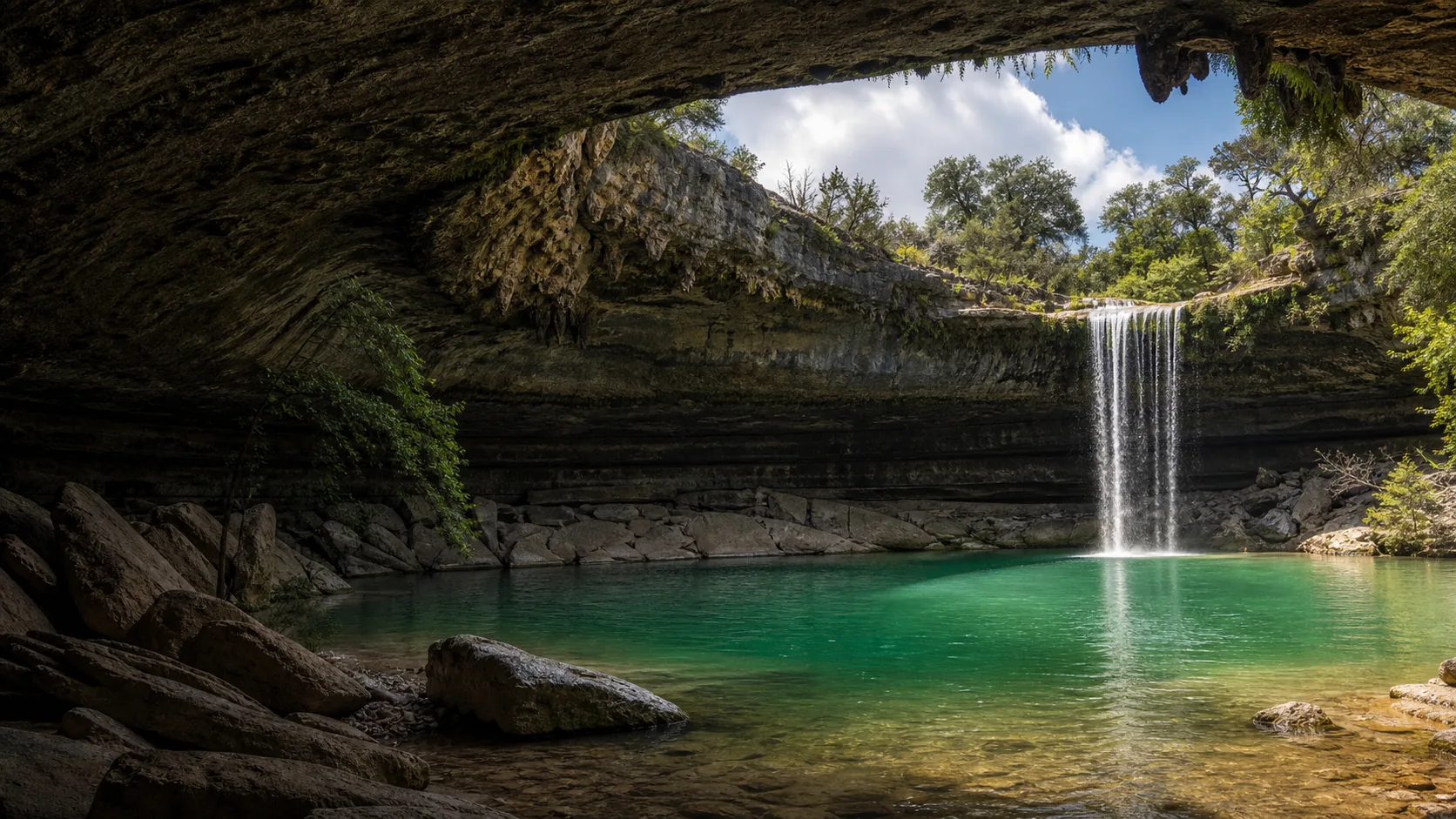
Travis County, Texas
Hamilton Pool Preserve
Plan Hamilton Pool Preserve in Travis County, Texas: 0.5 mi route details, parking and directions, best time to visit, safety notes, and 8 waterfall photos.
50 ft0.5 mi8 photos
Yes, Texas has waterfalls. Most of them sit in the Hill Country's Edwards-limestone canyons west of Austin, where Hamilton Pool Preserve is the headline: a 50-foot drop into a collapsed-grotto pool that you can only visit with a Travis County reservation.
Texas surprises most first-time visitors with the answer: yes, the state has waterfalls, but the geography is concentrated and the rules are stricter than almost anywhere else in the country. Almost every Texas waterfall worth driving to sits in one of two regions. The Hill Country west of Austin and San Antonio holds the largest cluster, where Cretaceous Edwards limestone caps the Edwards Plateau and Hill Country creeks drop off the rim into spring-fed canyons. The second region is far West Texas, where the Big Bend country and the Davis Mountains hold a handful of remote drops; Capote Falls is the tallest waterfall in the state at about 175 feet, but it sits on private ranch land and is essentially unvisitable.
Waterfalls Guide currently publishes Hamilton Pool Preserve in full. It is the most photographed Texas waterfall and the one most likely to be on a visitor's short list: a 50-foot drop off an undercut limestone overhang into a jade-green pool inside a collapsed grotto, on Hamilton Creek about 23 miles west of Austin in Travis County. The thing the brochures bury is the access model. Hamilton Pool runs on a mandatory $15 online reservation plus $15 per-vehicle on-arrival fee, with two timed slots per day, and swimming is decided each morning based on bacteria sampling and rockfall conditions. Without a reservation you will be turned away at Hamilton Pool Road.
The broader Hill Country swim-hole circuit (Pedernales Falls State Park, Westcave Outdoor Discovery Center, Krause Springs, Jacob's Well Natural Area, Gorman Falls at Colorado Bend) shares the same Edwards Plateau caprock geology as Hamilton Pool but does not yet have published guides on this site. Those sites are on the roadmap; for now, the Texas Parks & Wildlife state-park pages and each private preserve's reservation portal remain the canonical references.
Spring and early summer (April through June) after a wet stretch produce the strongest flow on Hill Country creeks. Hamilton Creek and the Pedernales both run loudest in this window, and Hamilton Pool reads as a full curtain rather than a slow trickle. The trade-off is that heavy rain often triggers a bacteria closure on the swim side of the pool; the trail itself stays open.
Summer (June through September) is the only stretch of the year warm enough to want the cold, spring-fed Hill Country pools. Hamilton Pool sits in the low 60s Fahrenheit most of the year, which is bracing in April but a relief in August. Summer is also the hardest reservation window: weekend morning slots at Hamilton Pool often sell out within minutes of opening, and the Hill Country sun pushes mid-afternoon hikes above 100°F regularly in July and August. Carry more water than you think you need.
Fall (October through early November) is the best combination of comfortable air temperatures, lighter reservation pressure, and a still-running waterfall. Remnant tropical storms from the Gulf can produce sudden surges in flow and the occasional bacteria closure, but a dry fall stretch is the most reliable window for a swim day with manageable crowds.
Winter (December through February) is mild by national standards. Brief freezes can ice the trail steps, but the falls itself rarely freezes in any meaningful way; ice-column photography is not a Texas thing. The upside is that Hamilton Pool only requires reservations on weekends and Travis County holidays in this window, which is the easiest time of year to walk on an available slot.
Almost every published and roadmapped Texas waterfall sits on the same Cretaceous Edwards limestone sequence that armors the Edwards Plateau west of Austin and San Antonio. A hard cap of dense limestone overlies softer, more soluble interior layers, and Hill Country creeks (Hamilton Creek, the Pedernales River, Cypress Creek, Cibolo Creek, the Frio) cut down into that contact. Hamilton Pool is the published headline. The broader regional context includes Pedernales Falls State Park (tiered drops on the Pedernales River about 35 minutes north), Westcave Outdoor Discovery Center (a guided-tour-only collapsed grotto across the Pedernales from Hamilton Pool), Krause Springs (a private spring-fed swim hole in Spicewood about 25 minutes away), and Jacob's Well Natural Area (a 12-foot karst spring near Wimberley with reservation-required swim access in summer). None of those four have published guides on this site yet; treat this cluster as one Hill Country swim-hole circuit on one shared geology, with Hamilton Pool as the currently published anchor.
Yes. Texas has fewer waterfalls than wetter parts of the country, but they exist, concentrated in two regions. The Hill Country west of Austin and San Antonio holds the largest cluster, including Hamilton Pool Preserve, Pedernales Falls State Park, Gorman Falls at Colorado Bend State Park, and the Westcave grotto. West Texas holds a smaller, more remote group, including Cattail Falls in Big Bend National Park and Capote Falls in Presidio County. Capote Falls is the tallest in the state at about 175 feet but sits on private ranch land and is essentially unvisitable.
Hamilton Pool Preserve in Travis County, about 23 miles west of Austin. The 50-foot waterfall drops off an undercut Edwards limestone overhang into a jade-green pool inside a collapsed grotto on Hamilton Creek. It is the most photographed Hill Country waterfall and the one most visitors are picturing when they search for Texas waterfalls. Access is gated by a Travis County reservation system: $15 per vehicle online, plus $15 per vehicle paid on arrival, with two timed slots per day.
Yes. Reservations through the Travis County Parks portal are required every day from March through October, and on weekends and Travis County holidays from November through February. There is no walk-up gate during reservation periods. Reservations cost $15 per vehicle online (one car, up to eight people), are non-refundable, and slots can sell out within minutes of opening for summer weekend mornings. On arrival you also pay $15 per vehicle at the entrance booth. Full details and current pricing live on the Hamilton Pool Preserve guide.
Not always. Swimming is determined each morning by Travis County Parks staff based on bacteria sampling and rockfall conditions. The pool is closed to swimming any time E. coli counts exceed the state safety threshold for primary contact recreation, which happens often after rain. A reservation does not guarantee swim access. The trail and beach typically stay open under most closures, so you can still hike in and photograph the grotto on a no-swim day. Call the preserve information line at 512-854-2581 the morning of your visit for the live status.
Capote Falls in Presidio County, in far West Texas, is the tallest waterfall in the state at about 175 feet. It sits on private ranch land with no public access and is not realistically visitable for most travelers. Among visitable Texas waterfalls, Gorman Falls at Colorado Bend State Park in the Hill Country is the tallest at about 60 to 70 feet (the published height varies by source), and Hamilton Pool's drop is about 50 feet over Hamilton Creek. Waterfalls Guide does not yet publish full Gorman or Capote guides; the Texas Parks & Wildlife state-park page is the current reference for Gorman.
A collapsed grotto is a half-cave open to the sky, produced when the roof of a partly hollowed-out limestone chamber drops out and leaves the chamber open. The mechanic is specific: a hard cap of limestone overlies softer, more soluble interior layers; weakly acidic groundwater hollows out the interior faster than the surface erodes; and once the underground cavity outgrows the structural strength of its roof, the dome collapses. The downstream half of the cap drops into the canyon while the upstream half stays cantilevered out over the pool. Hamilton Pool's Cretaceous Edwards limestone is a textbook example, and Westcave Outdoor Discovery Center across the Pedernales is the same mechanic on a smaller scale. Truly collapsed grottos like this are rare globally.
Spring and early summer (April through June) after a wet stretch produce the strongest flow on Hill Country creeks. Summer (June through September) is the only window warm enough to want the cold, spring-fed pools comfortably, but it is also the hardest reservation window and the hottest hiking. Fall (October through early November) is the best combination of comfortable temperatures, easier reservations, and still-running falls. Winter is mild but offers no real ice-column photography, and the falls slow to a trickle in dry stretches.
Plan Hamilton Pool Preserve in Travis County, Texas: 0.5 mi route details, parking and directions, best time to visit, safety notes, and 8 waterfall photos.