 Waterfalls Guide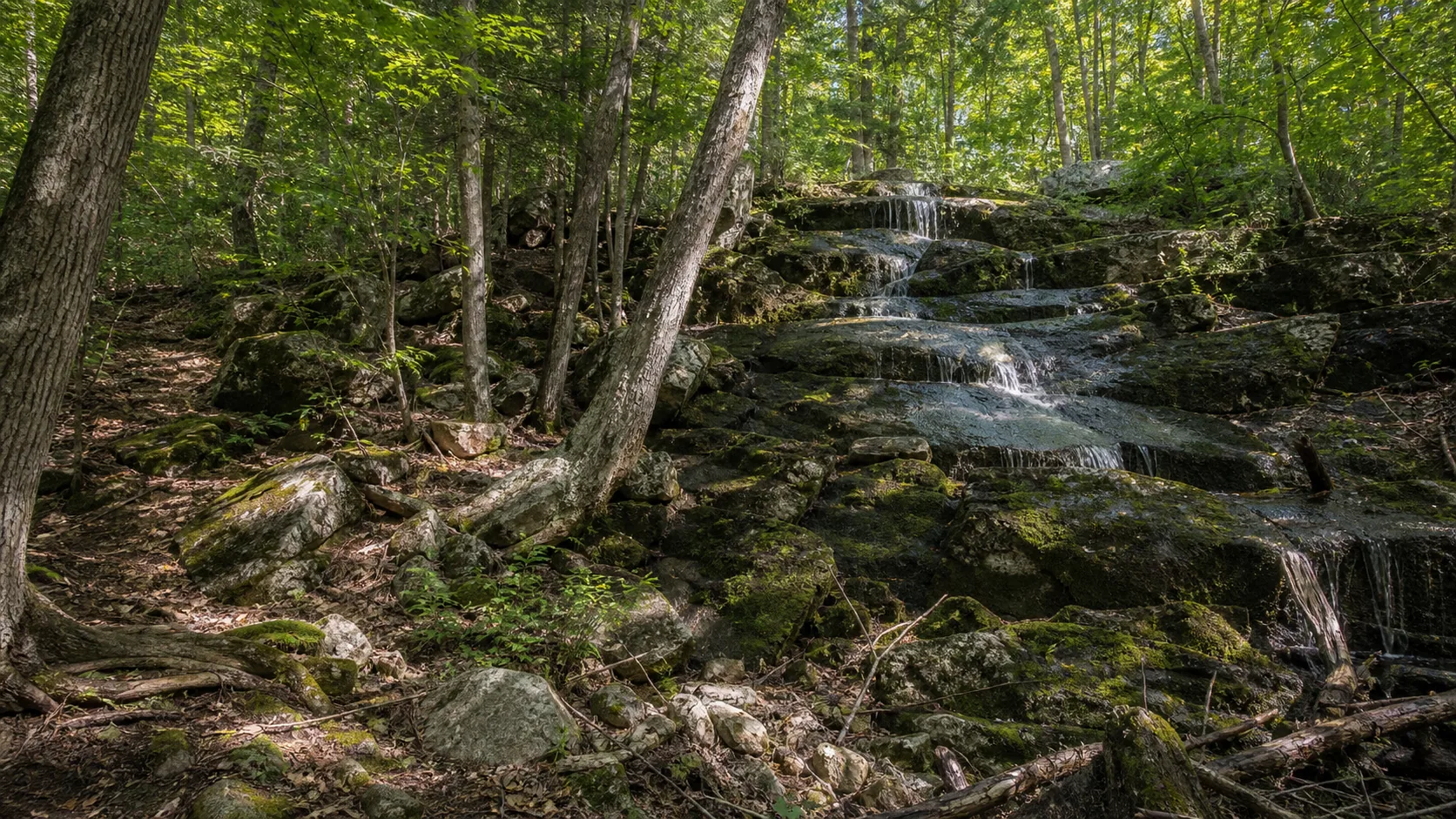
Royalston, Massachusetts
Spirit Falls
Plan Spirit Falls near Royalston, Massachusetts: 0.6 mi route details, parking and directions, best time to visit, safety notes, and 4 waterfall photos.
50 ft0.6 mi4 photos
Massachusetts is not a headline waterfall state. It is a state with a respectable network of small, free, hemlock-shaded cascades on Acadian metamorphic bedrock, anchored in the North Quabbin hills and stewarded largely by The Trustees of Reservations.
Set the bar honestly. Massachusetts is not a headline waterfall state in the way Vermont, New Hampshire, or upstate New York are. The rivers are short, the gradient is gentle, and most of the surface water in the state drains slowly through old glacial valleys rather than off ledges. What Massachusetts does have is a respectable scatter of small cascades in the western hills and the North Quabbin, almost all of them on free public land, and a single statewide conservation organization that holds many of the best ones.
Waterfalls Guide currently publishes one Massachusetts trip in full: Spirit Falls in Royalston, a roughly 50-foot multi-tier cascade on Spirit Brook, a tributary of the East Branch Tully River, inside The Trustees of Reservations' Jacob Hill Reservation in the North Quabbin region of Worcester County. The trail in is short. The climb back to the lot is the part visitors remember. Free entry, no booth, no day pass.
The broader Massachusetts waterfall universe sits on the same playbook: small drops on small streams, mostly on free public land, scattered across the western half of the state. Bash Bish Falls in the southern Berkshires is the state's most famous waterfall, an 80-foot two-stage drop on the New York border (the lower section is technically in New York, which is the long-running debate). Doane's Falls, also in Royalston, is a stepped 175-foot drop on Lawrence Brook on a second Trustees property a few miles from Spirit Falls. Royalston Falls on the Massachusetts-New Hampshire line is a third Trustees stop in the same town. Wahconah Falls in Dalton sits in a state park north of Pittsfield. Chapel Brook Falls in Ashfield and Bear's Den Falls in New Salem round out the western set. None are published here yet; the Trustees of Reservations property pages and Massachusetts DCR state-park pages remain the canonical references until those guides land.
The bedrock story under almost all of these falls is the Acadian Orogeny roughly 380 million years ago, when an island arc collided with the proto-North American margin and folded marine sediments into the schist, quartzite, and gneiss that now hold the state's small drops in place. The Berkshires sit on older Taconic and Precambrian rocks; the North Quabbin and central uplands sit on Devonian metasedimentary bedrock of the Merrimack Belt. Both have been scoured and reset by Wisconsinan continental ice, which retreated from this part of New England about 14,000 years ago and left the steep little tributary valleys the modern brooks now occupy.
Late April through mid-May is the loudest window. Snowmelt and spring rain push Spirit Brook and the broader North Quabbin streams to peak flow, and Spirit Falls reads as a full stepped curtain rather than a thin streak. The same window works for the unpublished Massachusetts falls: Doane's, Royalston, Wahconah, Chapel Brook, and Bash Bish all run hardest in April and the first half of May. Trade-offs are muddy approaches, cold water that rules out anything resembling swimming, and lingering ice on shaded north-facing trails into the first week of May in heavier winters.
The first two weeks of October are the second window and the one most visitors actually plan around. The North Quabbin peaks slightly earlier than the Berkshires and the Connecticut River valley; understory and birch turn first, then the maples in the second week. The Jacob Hill hemlock corridor frames the surrounding hardwoods, and Spirit Brook usually carries enough water after early-fall rain to make the cascade audible from the parking area. Doane's Falls on Lawrence Brook three miles away is the natural pairing. Plan one practical constraint: the Jacob Hill lot is small and fills on October weekends, so an early-morning arrival is the difference between a quiet visit and an extra mile of roadside walking.
Late January through February is the partial-ice window. Spirit Falls and most of the small Massachusetts cascades do not form a clean 50-foot ice column the way Munising Falls or Arethusa Falls do; instead, the multi-tier drops freeze into stepped ice shelves with running water continuing underneath. The Trustees do not close Jacob Hill in winter and the trailhead is reachable, but the steep descent ices over by mid-December and stays slick into March. Microspikes are honest equipment here, not optional gear.
Summer (June through August) is the lowest-flow window. Spirit Falls thins to a streak in dry summers; Bash Bish in the Berkshires holds water better because Bash Bish Brook drains a larger area. Summer is not the right window for a Massachusetts waterfall trip unless the foliage and runoff windows are off the table, and most of the small drops do not double as swimming holes the way the Berkshire river pools do.
The published Massachusetts fall sits in the North Quabbin, the loosely defined corner of the state bounded by the Quabbin Reservoir to the south, the New Hampshire line to the north, and Route 2 across the middle. Royalston punches above its weight: within an eight-mile radius the Trustees alone hold three properties with substantial water features. Spirit Falls on Spirit Brook (Jacob Hill Reservation), Doane's Falls on Lawrence Brook, and Royalston Falls on the Mass-NH line. All three drop through Devonian metasedimentary bedrock of the Merrimack Belt, all three sit on free Trustees of Reservations land, and all three reward a single half-day or full-day visit rather than separate trips. Spirit Falls is the published anchor; Doane's and Royalston Falls are flagged for future coverage and the Trustees property pages are the standard references in the meantime.
The Trustees of Reservations is the country's first regional land conservation organization, founded in 1891 by the landscape architect Charles Eliot, and the model has since been copied by hundreds of land trusts elsewhere. The Trustees now hold more than 100 properties across Massachusetts and remain the largest private conservation owner in the state. The model that matters for waterfall visitors: entry to non-staffed Trustees properties is free for everyone, members and non-members alike, with stewardship funded by member dues, donations, and revenue from larger fee-charging properties like Crane Beach and the historic houses. Spirit Falls (Jacob Hill Reservation) is the published Trustees waterfall on this site; Doane's Falls and Royalston Falls are Trustees properties in the same town flagged for human review and future coverage.
Yes, but small ones. Massachusetts has a scattered network of waterfalls in the western hills and the North Quabbin region, almost all of them on free public land. The most famous is Bash Bish Falls in the southern Berkshires, an 80-foot two-stage drop on the New York border. Others include Doane's Falls and Spirit Falls in Royalston, Royalston Falls on the New Hampshire line, Wahconah Falls in Dalton, Chapel Brook Falls in Ashfield, and Bear's Den Falls in New Salem. Waterfalls Guide currently publishes Spirit Falls in full and points to the Trustees of Reservations and Massachusetts DCR pages for the others.
Bash Bish Falls in Mount Washington State Forest in the southern Berkshires. It is an 80-foot two-stage cascade that splits around a central boulder near its base and is widely cited as the tallest waterfall in Massachusetts. The state-line claim is disputed: the lower stage straddles the Massachusetts-New York border, and the lower viewing area is technically in Taconic State Park in New York. Waterfalls Guide does not yet publish a full Bash Bish Falls guide; the Massachusetts DCR Mount Washington State Forest page is the current reference. The published Massachusetts waterfall on this site is Spirit Falls in Royalston, a roughly 50-foot multi-tier cascade on a Trustees of Reservations property in the North Quabbin.
The Trustees of Reservations is a Massachusetts conservation organization founded in 1891 by the landscape architect Charles Eliot. It is the oldest regional land conservation organization in the United States and the model has since been copied by hundreds of land trusts in other states. The Trustees now hold more than 100 properties across Massachusetts and are the largest private conservation owner in the state. For waterfall visitors, the practical effect is that several of the best small cascades in Massachusetts (Spirit Falls, Doane's Falls, Royalston Falls, Chapel Brook Falls, Bear's Den Falls) sit on Trustees land with free entry, free parking, and no day-use pass. The Trustees fund stewardship through member dues, donations, and revenue from larger fee-charging properties like Crane Beach.
Almost all of them, yes. Spirit Falls and the other Trustees of Reservations properties in Royalston (Jacob Hill, Doane's, Royalston Falls) are free for everyone, members and non-members, with no entry fee, no parking fee, and no day-use pass. Bash Bish Falls in Mount Washington State Forest is free to enter from the Massachusetts side; the New York lower viewing area in Taconic State Park is also free. Wahconah Falls State Park in Dalton has free parking. The Massachusetts DCR state-park system charges parking fees at some of its larger destinations (beaches and major reservations), but the waterfall sites are generally free. Donations to the Trustees of Reservations are the way the small-property model keeps working.
Two windows. Late April through mid-May is the snowmelt peak, when the North Quabbin streams and the Berkshire brooks run hardest and Spirit Falls reads as a full stepped curtain rather than a thin streak. The first two weeks of October are the fall foliage window, slightly earlier in the North Quabbin than in the Berkshires or the Connecticut Valley. Summer is the lowest-flow window and is generally not worth a special trip for the small Massachusetts falls. Winter is passable on most properties with microspikes; the cascades freeze into stepped ice shelves rather than full ice columns.
Not really. The small Massachusetts falls are not swimming holes in the way the Berkshire river pools or the Connecticut state-park ponds are. Spirit Falls has a small, cold, perpetually shaded plunge pool that the Trustees do not promote for water contact. Doane's Falls has a history of fatal accidents and the Trustees actively discourage swimming and cliff-jumping there. Bash Bish Falls has signage prohibiting swimming and has its own long history of fatalities. For warm-water swimming the practical alternatives are the Connecticut River beach at Northfield, the Quabbin Reservoir is closed to swimming, the Charles River basin in Boston, and the various Massachusetts DCR state-park beaches like Walden Pond and Lake Wyola.
Most of the small Massachusetts cascades drop through Acadian metamorphic bedrock formed roughly 380 million years ago when an island arc collided with the proto-North American margin and folded marine sediments into schist, quartzite, and gneiss. Spirit Falls and the other North Quabbin drops sit on Devonian metasedimentary bedrock of the Merrimack Belt; the Berkshire falls sit on older Taconic and Precambrian rocks. All of these surfaces were scoured by Wisconsinan continental ice, which retreated from Massachusetts about 14,000 years ago and left the steep little side valleys the modern brooks now occupy. The stepped, multi-tier profile of most Massachusetts falls reflects layering and jointing in the bedrock more than a single hard caprock; this is a different mechanic than the caprock-undercut falls in Minnesota or Michigan.
Plan Spirit Falls near Royalston, Massachusetts: 0.6 mi route details, parking and directions, best time to visit, safety notes, and 4 waterfall photos.